
Short Answer
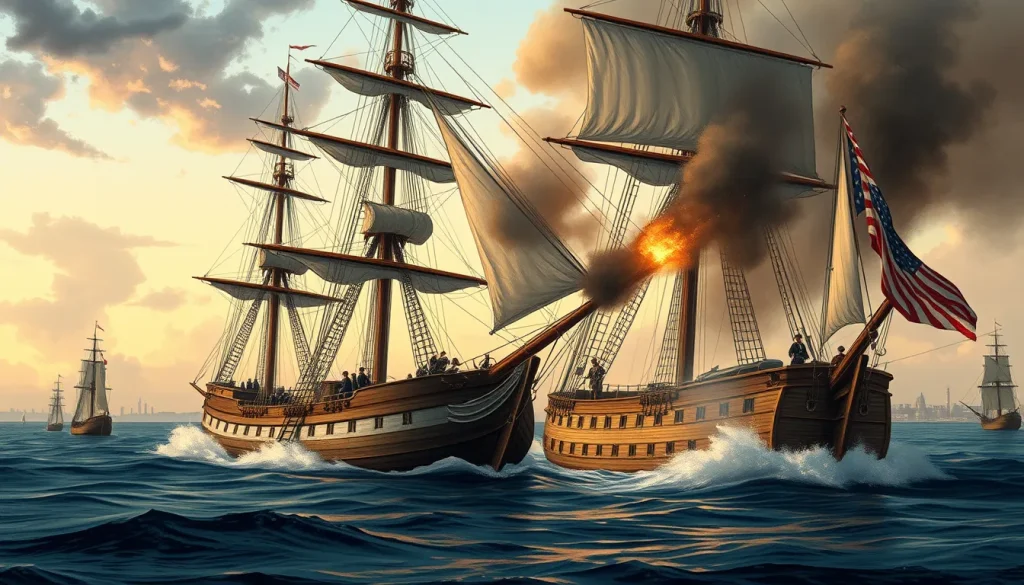
This article examines the single-ship duel between HMS Shannon and USS Chesapeake on 1 June 1813, fought off Boston Harbor in Massachusetts Bay during the War of 1812. The engagement lasted only minutes, but it became one of the war’s most studied naval actions because it reversed a run of American frigate victories and exposed the tactical importance of crew training, gunnery discipline, and command cohesion. It also shaped how Americans and Britons remembered naval honor, defeat, and blame for the rest of the war.
Historical Context
By 1813 the War of 1812 had settled into a maritime conflict shaped by Britain’s blockade of the American coast, American commerce raiding, and a series of celebrated single-ship frigate victories by the United States Navy. Ships such as USS Constitution and USS United States had defeated British frigates in 1812, embarrassing the Royal Navy and raising American expectations of naval success. Boston was a major port under British blockade, and its harbor became a focal point for both trade and naval movement.
The Chesapeake carried a difficult reputation. In 1807, during the Leopard affair, the British frigate HMS Leopard fired on the unprepared Chesapeake, which surrendered after minimal resistance and allowed the British to seize accused deserters. The episode damaged the ship’s name and led to the court-martial of Capt. James Barron. In May 1813, Capt. James Lawrence took command of the Chesapeake after his successful action in USS Hornet against HMS Peacock. Across the water, Capt. Philip Bowes Vere Broke had commanded HMS Shannon since 1806 and had trained his crew in a demanding, methodical gunnery routine. The two frigates were similar in size and broadside weight, but their crews and command climates were not.
What Happened
On 1 June 1813, the Chesapeake left Boston Harbor and stood out into Massachusetts Bay. The Shannon was waiting offshore. Broke had reportedly sent a challenge to Lawrence, but Lawrence never received it. Broke also detached another British frigate, HMS Tenedos, to make the Shannon appear isolated and draw the Americans out. Lawrence, seeking a ship-to-ship action, accepted the opportunity.
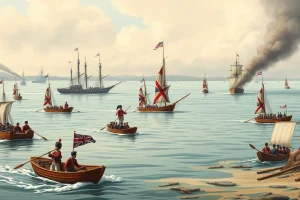
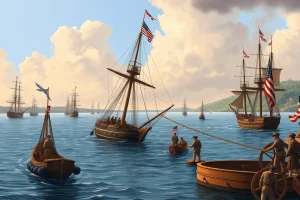
The ships closed in the late afternoon. Broke held his fire until close range, then the Shannon delivered concentrated broadsides aimed at the Chesapeake’s hull, gun crews, and command team. Lawrence and his first lieutenant, William Ludlow, were mortally wounded in the opening minutes. The Chesapeake’s rigging and maneuverability were badly damaged. Unable to avoid the British ship, the American frigate drifted stern-first against the Shannon. Broke personally led a boarding party, and after a short, bloody fight the British secured the Chesapeake. Lawrence, carried below, reportedly urged, "Don’t give up the ship." The Shannon took the prize toward Halifax, Nova Scotia, where Lawrence died of his wounds on 4 June 1813.
Why It Matters
The duel mattered immediately because it ended an American streak of frigate victories and restored British confidence in single-ship combat. It also became a case study in tactics: Broke’s crew had drilled repeatedly at aimed fire, while the Chesapeake had been hastily manned, with new recruits and unresolved tensions over pay. The American public, shocked by the defeat, searched for explanations. Some blamed individual officers or crew members, including Acting Lieutenant William Cox, Midshipman James W. Forest, and a Black bugler named William Brown. Later historians have generally treated those scapegoats as unfair; the defeat is better explained by the Shannon’s superior preparation, gunnery, and cohesion, along with the rapid destruction of the Chesapeake’s leadership.
The action also produced a lasting phrase. Lawrence’s reported words, "Don’t give up the ship," became a symbol of American naval resolve and were later associated with the U.S. Navy. At the same time, the battle shaped British memory as a vindication of professional training and leadership. Historians continue to debate how much Lawrence’s decision to engage reflected pressure to act, how much the Chesapeake’s crew problems mattered, and how much the outcome depended on Broke’s tactical choices.
Prelude
Through May 1813, the Shannon operated off Boston as part of the British blockade. Broke had long prepared his crew for a close-range fight. According to accounts of his routine, the crew exercised at great guns, carronades, and small arms throughout the week, a regimen that emphasized rapid reloading and deliberate aiming. The Chesapeake, by contrast, had only recently received Lawrence as commander. Its crew included men whose enlistments or pay were in dispute, and Lawrence filled out the ship with less experienced recruits in order to sail.
Broke’s challenge to Lawrence was written but never delivered. The departure of HMS Tenedos removed a supporting British frigate from view, creating the appearance of a fair duel. Lawrence, who preferred fighting warships to chasing merchant vessels, took the Chesapeake out on 1 June. The stage was set for a contest that looked evenly matched on paper but was unequal in training and readiness.
Forces and Commanders
HMS Shannon was a Leda-class frigate of about 1,065 tons, armed with 28 eighteen-pounder long guns, 4 nine-pounders, 3 twelve-pounders, and 16 thirty-two-pounder carronades. Its broadside weight was roughly 541 pounds, and its complement was about 320 officers and men. Capt. Philip Bowes Vere Broke had commanded the ship since 1806 and was known for rigorous gunnery practice. He survived a serious head wound received during the boarding action.
USS Chesapeake was a 38-gun frigate of about 1,244 tons, armed with 29 eighteen-pounder long guns, 2 twelve-pounder long guns, 18 thirty-two-pounder carronades, and 1 twelve-pounder carronade. Its broadside weight was roughly 567 pounds, and it carried about 387 officers and men. Capt. James Lawrence had recently commanded USS Hornet and had defeated HMS Peacock. He was mortally wounded in the action. His first lieutenant, William Ludlow, was also mortally wounded, leaving the Chesapeake without its senior leadership at a critical moment.
Battlefield and Map Context
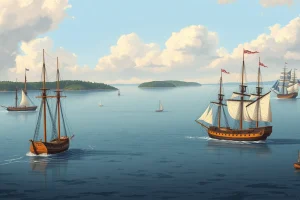
The action took place at sea off Boston Harbor, in Massachusetts Bay, Massachusetts. The Chesapeake cleared President Roads, the main channel out of Boston Harbor, shortly before 13:00. The Shannon stood farther offshore and maneuvered toward Cape Ann, roughly twelve nautical miles to the north-northeast, to avoid interference from American gunboats or shore batteries. The engagement began in the late afternoon, probably around 17:30 to 17:50, in open water. Because the fight occurred afloat, the battlefield has no fixed land coordinates; it is best mapped in relation to Boston Harbor, President Roads, Cape Ann, and the route to Halifax, where the prize was taken.
Battle Chronology
- Late morning to early afternoon, 1 June 1813: USS Chesapeake leaves Boston Harbor and enters Massachusetts Bay.
- Afternoon: HMS Shannon waits offshore, allowing the American ship to approach. Broke holds fire to draw the Chesapeake close.
- About 17:50: The ships open fire at very close range, by some accounts about 100 feet. The Shannon’s aimed broadsides strike the Chesapeake’s hull and gun crews.
- First minutes: Capt. Lawrence and Lt. Ludlow are mortally wounded. The Chesapeake’s rigging and steering are damaged, reducing its ability to maneuver.
- Shortly afterward: The Chesapeake falls against the Shannon, stern first. Broke leads boarders onto the American deck.
- Within about 11 to 15 minutes of the first shot: The British capture the Chesapeake. Broke is seriously wounded but survives.
- Following days: The Shannon sails for Halifax with the prize and prisoners. Lawrence dies on 4 June 1813.
Casualties and Losses
Casualty figures vary between contemporary returns and later tabulations. The most commonly cited British figures are about 24 killed and 59 wounded aboard HMS Shannon. For USS Chesapeake, commonly cited figures are about 56 killed and roughly 70 to 90 wounded. Some accounts describe the action as the war’s bloodiest single-ship naval engagement, with a large proportion of the American crew killed or wounded. Lawrence died of his wounds; Ludlow was mortally wounded; Broke survived a severe cutlass wound to the head. The Chesapeake itself was captured and later taken into the Royal Navy as HMS Chesapeake.
Result
The result was a decisive British tactical victory. The Shannon captured the Chesapeake after a brief but violent close-range action and brought the prize and survivors to Halifax. American prisoners were held at Melville Island Military Prison. In the United States, the defeat prompted public shock, newspaper debate, and disciplinary proceedings. Midshipman James W. Forest was reprimanded, William Brown received 100 lashes for failing to sound a bugle, and Acting Lieutenant William Cox was court-martialed for bringing Lawrence below deck and released from service. Modern assessments generally reject the idea that these individuals alone caused the defeat. Instead, the loss is attributed to the Shannon’s training, gunnery accuracy, and crew cohesion, combined with the rapid loss of the Chesapeake’s command and the ship’s inability to maneuver.
Strategic Consequences
For Britain, the victory restored prestige after earlier frigate losses and reinforced the value of Broke’s gunnery methods, which influenced Royal Navy training after the war. For the United States, the defeat checked the early naval narrative of invincibility and intensified debates about readiness, leadership, and the quality of crews. The Chesapeake was repaired and served in the Royal Navy until 1819, when it was sold; some of its timbers were later used in the Chesapeake Mill at Wickham, England. Lawrence’s reported dying words became part of American naval memory, while Broke’s victory became a celebrated example of professional preparation.
Primary Accounts
The most important contemporary accounts include Broke’s official after-action dispatch to the Admiralty, British naval reports, American newspaper coverage, ships’ logs, muster and casualty returns, and the records surrounding the American court-martial of Acting Lieutenant William Cox. These sources provide chronology, casualty figures, and command perspectives, but they are not neutral. Broke’s dispatch understandably emphasizes British skill and courage; American newspapers often sought heroes and scapegoats; and later reminiscences could be shaped by memory or national sentiment. The exact context of Lawrence’s reported words, "Don’t give up the ship," is also debated, since he was below deck and dying when the phrase was reportedly spoken.
Battlefield Today
The battle has no land battlefield. Its site lies in the waters off Boston Harbor and Massachusetts Bay, a working maritime landscape rather than a preserved park. Commemoration is distributed among several places: Lawrence was first buried in Halifax and later reinterred at Trinity Churchyard in Manhattan; British and American casualties were buried in Halifax-area grounds; and the Chesapeake Mill in Wickham, England, preserves timbers associated with the captured frigate. Museums and naval history organizations, including the U.S. Naval History and Heritage Command, the National Park Service, and Royal Museums Greenwich, hold related collections and interpretive materials.
Primary Sources
Researchers should begin with Capt. Philip Broke’s official dispatch and related Admiralty correspondence, which describe the British view of the engagement and the boarding. American sources include surviving logs and muster records of USS Chesapeake, contemporary Boston newspaper reports, and the court-martial record of Acting Lieutenant William Cox. These documents help reconstruct the sequence of events but must be read with care: casualty returns differ, eyewitnesses saw only parts of the action, and participants had reputations to defend. No complete, uncontested verbatim transcript of the battle exists. For archival consultation, readers should contact the U.S. Naval History and Heritage Command, the National Archives of the United Kingdom, and Canadian maritime archives in Halifax.
Further Reading
- Robert E. Cray Jr., "Explaining Defeat: The Loss of the USS Chesapeake," Naval History Magazine 21, no. 4 (August 2007).
- U.S. National Park Service, "Capture of USS Chesapeake."
- Naval Marine Archive, "HMS Shannon and USS Chesapeake – 1st June 1813."
- Society for Nautical Research, "The Action between the Shannon and the Chesapeake."
- Peter Padfield, Broke and the Shannon (London: Hodder and Stoughton, 1968).
- American Heritage, "The Great Sea Battle," December 1968.
References
- Robert E. Cray Jr., "Explaining Defeat: The Loss of the USS Chesapeake," Naval History Magazine 21, no. 4 (August 2007), https://www.usni.org/magazines/naval-history-magazine/2007/august/explaining-defeat-loss-uss-chesapeake.
- U.S. National Park Service, "Capture of USS Chesapeake," https://www.nps.gov/articles/000/capture-of-uss-chesapeake.htm.
- Naval Marine Archive, "Battle between the ‘Shannon’ and the ‘Chesapeake’ 1 June 1813," https://navalmarinearchive.com/research/pdf/shannon_chesapeake.pdf.
- Society for Nautical Research, "The Action between the Shannon and the Chesapeake," https://snr.org.uk/the-action-between-the-shannon-and-the-chesapeake/.
- American Heritage, "The Great Sea Battle," December 1968, https://www.americanheritage.com/great-sea-battle.
FAQ
Why did USS Chesapeake lose to HMS Shannon?
The most widely accepted explanation is that HMS Shannon had a highly trained crew, practiced aimed gunnery, and maintained cohesion, while USS Chesapeake had a newly assembled crew, pay and enlistment disputes, and lost its senior officers early in the action. Shannon’s first broadsides disabled Chesapeake and enabled a boarding capture.
How long did the Shannon-Chesapeake duel last?
The close-range fighting lasted only minutes. Most accounts place the capture within about 11 to 15 minutes of the first shots, although the exact timing varies slightly among sources.
What happened to USS Chesapeake after its capture?
The British took USS Chesapeake into the Royal Navy as HMS Chesapeake. It served until 1819 and was then sold; some of its timbers were later used in the Chesapeake Mill at Wickham, England.
Leave a Reply