
Short Answer
Benjamin Hawkins (August 15, 1754 – June 6, 1816) was the principal United States Indian agent for the Southeast and the federal government’s chief representative to the Creek Nation during the Creek War of 1813–1814. The Creek War formed part of the southern theater of the War of 1812, as U.S. forces, state militias, and allied Creeks fought the Red Stick faction of the Creek Confederacy. Hawkins’s role was diplomatic, administrative, and informational rather than military: he tried to prevent war, keep friendly Creeks aligned with the United States, report on Red Stick movements, and mediate the war’s settlement. His actions and records shaped both the conduct of the war and the subsequent loss of Creek lands.
Historical Context
By the late eighteenth century, the Creek Confederacy occupied a large region spanning parts of present-day Alabama, Georgia, and Florida. The new United States pressed treaty by treaty for land cessions and sought to draw the Creeks into its political and economic orbit. At the same time, Creek towns retained considerable autonomy, and divisions grew between those who accommodated U.S. demands and those who resisted further encroachment. The Federal Road, which crossed Creek territory to connect Georgia with Mississippi Territory, became a particular source of tension because it brought settlers, travelers, and military traffic through Indigenous lands.
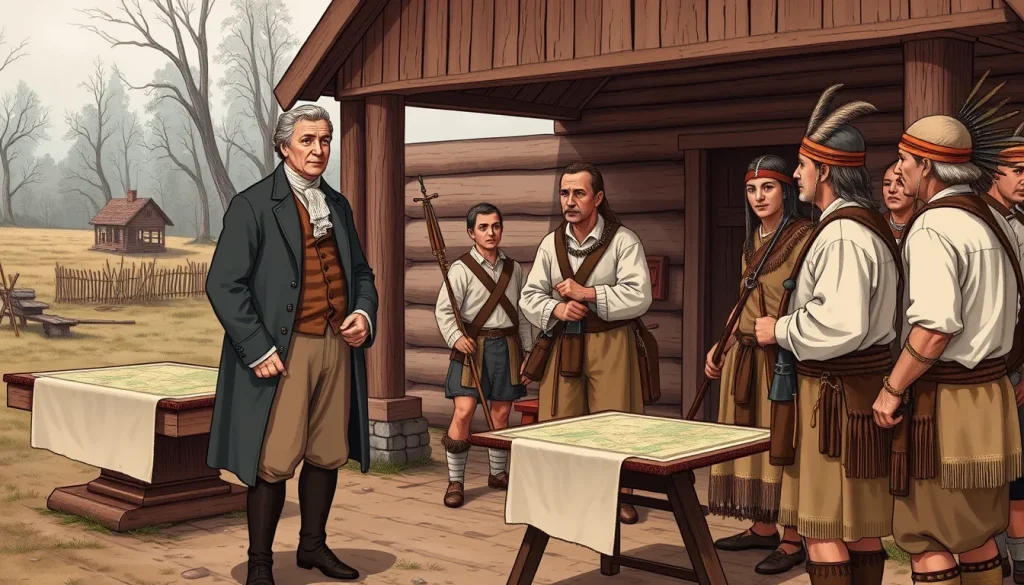
Benjamin Hawkins entered this world as a North Carolina planter, Revolutionary War veteran, and former U.S. senator. President George Washington appointed him in 1796 as federal superintendent or principal agent for Indian affairs south of the Ohio River, and President Thomas Jefferson continued him as principal agent to the Creeks after 1801. Hawkins established the Creek Agency near present-day Roberta, Georgia, in what became Crawford County. He learned the Muscogee language, lived among the Creeks, and gained enough standing to be called a Beloved Man by some Creeks. His program of civilization encouraged settled agriculture, livestock raising, and closer integration with the U.S. economy, which he believed was the only way Creek communities could survive American expansion.
The War of 1812 intensified these pressures. U.S. officials feared that British agents, Spanish authorities in Florida, or Shawnee leader Tecumseh might encourage Indigenous resistance in the South. Within the Creek Confederacy, the Red Stick faction, associated especially with the town of Tuckabatchee and the prophet Josiah Francis, rejected further land cessions and called for a return to traditional ways and armed resistance. Their opponents, often called friendly or pro-American Creeks, included leaders such as Big Warrior. Hawkins tried to strengthen the latter group while warning Washington of the former.
What Happened
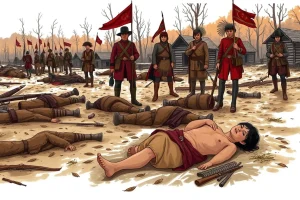
As tensions rose in 1813, Hawkins used his position to gather information, send messages to Creek leaders, and urge U.S. officials to prepare for possible war. He was not a field commander and did not lead troops in battle. Instead, he acted as the government’s chief channel of communication with the Creeks, reporting on Red Stick activity and attempting to keep neutral or friendly Creeks from joining the uprising. The Red Stick attack on Fort Mims on August 30, 1813, killed hundreds of settlers, militia, and allied Creeks and shocked the region into full-scale war.
During the campaigns that followed, Hawkins remained at or near the Creek Agency and provided intelligence and advice to U.S. military and territorial officials. He helped identify friendly Creek leaders and towns, encouraged cooperation with U.S. forces, and tried to limit the war’s spread among the Creeks. U.S. armies under Andrew Jackson, John Coffee, and others, supported by Cherokee, Choctaw, and friendly Creek warriors, defeated the Red Sticks in a series of engagements. The decisive battle came at Horseshoe Bend on March 27, 1814, on the Tallapoosa River in present-day Alabama.
After the fighting, Hawkins was present when Creek leaders and Major General Andrew Jackson concluded the Treaty of Fort Jackson on August 9, 1814. The treaty forced the Creeks to cede vast tracts of land in Alabama and Georgia, including territory belonging to friendly Creeks who had fought beside the United States. Hawkins believed the terms were unusually harsh and warned that they would weaken the very Creek leaders who had supported the U.S. cause. His objections had little effect. The treaty opened much of the Creek homeland to American settlement and marked a decisive shift in federal policy toward the Creeks.
Why It Matters
Hawkins’s role in the Creek War matters because it shows how U.S. Indian policy operated in practice during the War of 1812. He was neither a general nor a neutral observer. He was a federal agent whose diplomacy, intelligence, and relationships with Creek leaders helped the United States mobilize allies and justify its demands. At the same time, his failure to prevent war and his inability to soften the Treaty of Fort Jackson revealed the limits of his influence once military necessity and settler expansion took priority.
In the short term, Hawkins helped maintain a pro-American Creek faction and supplied information that assisted U.S. campaigns. In the longer term, the war and treaty shattered Creek power in the Southeast, opened Alabama and Georgia to rapid settlement, and contributed to Andrew Jackson’s national reputation. Historians disagree about how to judge Hawkins. Some emphasize his genuine interest in Creek welfare and his repeated efforts to moderate U.S. demands. Others stress that his civilization program and treaty negotiations were instruments of dispossession, however paternalistic his intentions. His extensive journals, letters, and reports remain essential sources for understanding the Creek War from a U.S. official’s perspective.
Early Life
Benjamin Hawkins was born on August 15, 1754, in Granville County, North Carolina, into a slaveholding planter family. He attended the College of New Jersey, later Princeton University, but did not graduate. During the American Revolution, he served on George Washington’s staff and acted as an interpreter of French. After the war, he held seats in the North Carolina legislature and the Continental Congress, and he served as a U.S. senator from North Carolina from 1789 to 1795.
Role Before the War
Hawkins was appointed federal Indian agent for the Southeast in 1796 and became principal agent to the Creeks. He established the Creek Agency near the Flint River in present-day Crawford County, Georgia, and lived among the Creeks for years. He learned Muscogee, negotiated land lines and treaties, and promoted the federal civilization program. He also married or lived with Lavinia Downs, a Creek woman, and had children with her. His long residence and linguistic ability gave him access to Creek political life that few U.S. officials possessed.
Role During the War
During the Creek War, Hawkins was the principal U.S. civil official among the Creeks. He did not command troops, but he was central to diplomacy and intelligence. He warned Washington of Red Stick militancy, tried to keep friendly Creeks loyal, and maintained communications between U.S. military commanders and Creek leaders. His agency served as a contact point for pro-American Creeks and as a source of information about the conflict. As the war radicalized both sides, however, Hawkins’s ability to shape events diminished.
Major Actions
- Reported Red Stick organizing and warned federal officials of the growing threat of war.
- Counseled Creek leaders such as Big Warrior and sought to separate friendly towns from the Red Stick movement.
- Provided intelligence and advice to U.S. forces operating in the southern theater of the War of 1812.
- Encouraged friendly Creeks to support U.S. campaigns and helped identify reliable Indigenous allies.
- Attended the Treaty of Fort Jackson in August 1814 and objected to its severe land cessions, though his objections were overruled.
Contemporary Accounts
Hawkins’s own letters, journals, and reports are the most detailed contemporary record of his role. They include correspondence with the War Department, descriptions of Creek politics, and explanations of his efforts to prevent war. U.S. military and territorial officials also wrote about Hawkins, often praising his knowledge but sometimes criticizing his caution or his sympathy for Creek concerns. Creek perspectives survive in oral traditions and in later accounts by Creek writers and leaders, but Red Stick voices are less fully represented in the written record because many documents came from their opponents. All these sources are shaped by wartime loyalties and by the assumptions of U.S. officials about Indigenous peoples.
Later Life
After the Treaty of Fort Jackson, Hawkins continued as U.S. agent to the Creeks, but his influence waned. He had opposed the treaty’s harshest terms and warned that they would undermine friendly Creek leaders. He remained at the Creek Agency, managed his plantation and mills, and continued to write about the Creeks and southeastern geography. He died at his home in Crawford County, Georgia, on June 6, 1816.
Historical Legacy
Hawkins is remembered in two main ways. One emphasizes his role as a long-serving agent who learned Creek language and customs, advocated for Creek welfare as he understood it, and left invaluable records of Creek life. The other emphasizes his participation in a federal system that steadily took Indigenous land and undermined Creek sovereignty. Both interpretations rest on the same evidence: Hawkins was a committed U.S. official who tried to manage Creek affairs for what he believed were mutual benefits, but whose policies and treaties contributed to the Creeks’ catastrophic losses in the Creek War and after.
Primary Sources
The most important primary sources for Hawkins’s role are his official correspondence and journals as U.S. Indian agent, published in Thomas Foster’s edition of his collected works. These documents show his reporting on Creek factions, his diplomatic efforts, and his views on the war and treaty. The Treaty of Fort Jackson itself, signed on August 9, 1814, is a central document for the war’s outcome and Hawkins’s presence at the negotiations. Andrew Jackson’s military correspondence and reports also mention Hawkins and the Creeks. Creek oral histories and later Creek accounts provide essential Indigenous perspectives, though they are not always contemporaneous and must be used carefully. Hawkins’s writings are limited by his official position, his paternalistic assumptions, and his dependence on Creek intermediaries for information.
Further Reading
- Thomas Foster, ed., The Collected Works of Benjamin Hawkins, 1796–1810 (Tuscaloosa: University of Alabama Press, 2003).
- Robbie Franklyn Ethridge, Creek Country: The Creek Indians and Their World (Chapel Hill: University of North Carolina Press, 2003).
- Florette Henri, The Southern Indians and Benjamin Hawkins, 1796–1816 (Norman: University of Oklahoma Press, 1986).
- Merrit B. Pound, Benjamin Hawkins, Indian Agent (Athens: University of Georgia Press, 1951).
- Gregory A. Waselkov, A Conquering Spirit: Fort Mims and the Redstick War of 1813–1814 (Tuscaloosa: University of Alabama Press, 2006).
- Frank Lawrence Owsley Jr., Struggle for the Gulf Borderlands: The Creek War and the Battle of New Orleans, 1812–1815 (Gainesville: University Presses of Florida, 1981).
- Encyclopedia of Alabama, Benjamin Hawkins, https://encyclopediaofalabama.org/article/benjamin-hawkins/.
References
- Wikipedia contributors, Benjamin Hawkins, Wikipedia, https://en.wikipedia.org/wiki/Benjamin_Hawkins.
- H. Thomas Foster II, Benjamin Hawkins, Encyclopedia of Alabama, https://encyclopediaofalabama.org/article/benjamin-hawkins/.
- Thomas Foster, ed., The Collected Works of Benjamin Hawkins, 1796–1810 (Tuscaloosa: University of Alabama Press, 2003).
- Robbie Franklyn Ethridge, Creek Country: The Creek Indians and Their World (Chapel Hill: University of North Carolina Press, 2003).
- Florette Henri, The Southern Indians and Benjamin Hawkins, 1796–1816 (Norman: University of Oklahoma Press, 1986).
- Merrit B. Pound, Benjamin Hawkins, Indian Agent (Athens: University of Georgia Press, 1951).
- Charles J. Kappler, ed., Indian Affairs: Laws and Treaties, vol. 2 (Washington: Government Printing Office, 1904), Treaty with the Creeks, 1814.
- Gregory A. Waselkov, A Conquering Spirit: Fort Mims and the Redstick War of 1813–1814 (Tuscaloosa: University of Alabama Press, 2006).
- Frank Lawrence Owsley Jr., Struggle for the Gulf Borderlands: The Creek War and the Battle of New Orleans, 1812–1815 (Gainesville: University Presses of Florida, 1981).
FAQ
What role did Benjamin Hawkins play in the Creek War?
Hawkins was the principal U.S. Indian agent to the Creeks. He tried to prevent war, maintain communication with Creek leaders, provide intelligence to U.S. officials, and keep friendly Creeks aligned with the United States. He was present at the Treaty of Fort Jackson in 1814.
Was Benjamin Hawkins a military commander in the Creek War?
No. Hawkins was a civilian Indian agent, not a field commander. He did not lead troops in battle, but he served as a diplomat, intelligence source, and liaison between the U.S. government and Creek leaders.
Why did Hawkins object to the Treaty of Fort Jackson?
Hawkins believed the treaty was unusually harsh because it took land from friendly Creeks who had fought alongside the United States. He warned that the terms would weaken pro-American Creek leaders, but his objections were largely ignored.
Leave a Reply