Short Answer
Artillery in the War of 1812 was a specialized technical arm that required skilled gunners, horses, and equipment. This article examines the recruitment and training of artillerymen on both the American and British sides, including regular soldiers, local units, and militia, and explains how these forces were raised, equipped, and prepared for combat.
Historical Context
At the outbreak of war in June 1812, the U.S. Regular Army numbered about 10,000 men, roughly half of whom were recent recruits. The artillery branch was small, with only a few companies of foot artillery and no field artillery organization. In contrast, the British Army in North America relied heavily on the Royal Artillery, which was administered separately by the Board of Ordnance and had a long tradition of professional service. Both sides also drew on provincial and militia forces, whose artillery units varied widely in quality and training.
What Happened
Recruitment for the U.S. Regular Army artillery was conducted at large, meaning recruiters sought men from any state rather than assigning them to specific state-raised regiments. The act of June 26, 1812 authorized a Regular Army of 36,700 men, including four artillery regiments. Initial enlistment terms required five years of service, but later recruits could choose to serve for the duration of the war. To encourage enlistment, Congress offered bounties of $31 and 160 acres of land, later increased to $124 and 320 acres—a sum that outpaced most unskilled laborer earnings. Despite these incentives, recruitment lagged, and the army did not become an effective fighting force until the war’s final year.
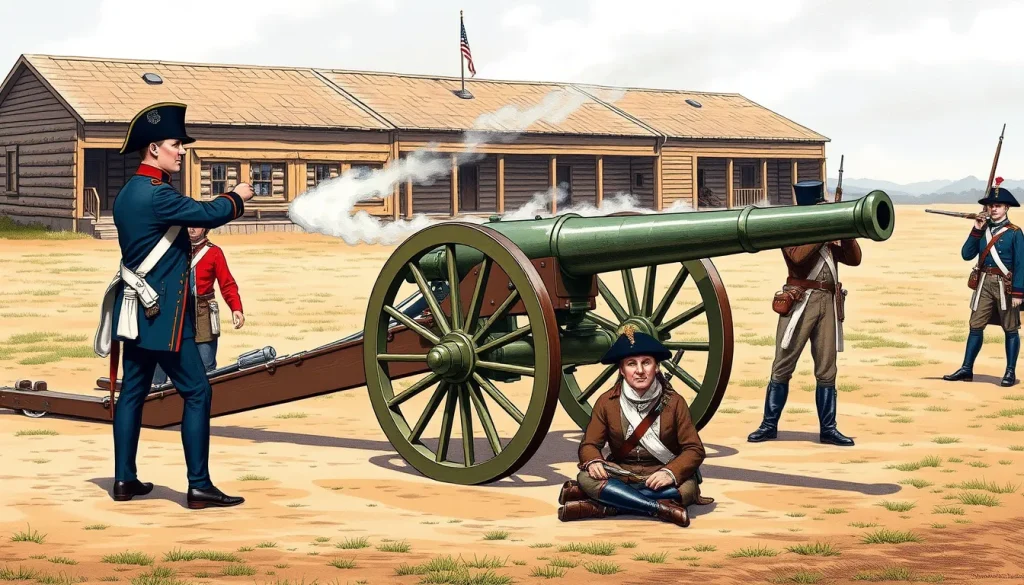
Training for American artillerymen was rudimentary. Recruits received basic drill from manuals such as those adapted from European practice, but there were few formal schools or experienced instructors. The Light Artillery Regiment, formed in 1812, was intended to serve exclusively as field artillery, but many regular batteries were still used in garrison or siege roles. The lack of training was compounded by poor pay and logistics; privates earned $5 per month (later raised to $8), and arrears often ran six to twelve months behind by 1814.

On the British side, the Royal Artillery provided the core of artillery support in Canada. Companies (sometimes called brigades) typically fielded six guns—four 6- or 9-pounder cannon and two howitzers—with about 145 officers and men, plus around 100 drivers and 200 horses. These companies were recruited in Britain and often had long-service veterans. However, no horse artillery was deployed to North America, and siege artillery was rarely used. The British also raised provincial units such as the Canadian Voltigeurs (though primarily infantry) and relied on embodied militia for local defence. Militia artillery companies existed in Upper and Lower Canada, but they were often poorly equipped and trained.
Indigenous allies were occasionally involved in artillery support, but their primary role was skirmishing and reconnaissance rather than operating guns. For example, at the siege of Fort Meigs in 1813, British artillery included regular gunners, but Indigenous warriors contributed to harassing fire. The Royal Marines, who served ashore in 1813–14, brought with them Congreve rocket detachments, a novel weapon with limited accuracy.
Why It Matters
The quality of artillery recruitment and training directly influenced key battles. At the Battle of Chippewa (July 5, 1814) and Lundy’s Lane (July 25, 1814), American regular gunners demonstrated that well-drilled crews could effectively maneuver field pieces in open ground. However, in the dense forests and with militia troops, artillery often had limited impact. For the British, the defence of Canada depended on a small force of regular gunners, supplemented by militia, and their effectiveness was crucial in repelling American invasions. The war revealed the need for systematic training and organization, leading to post-war reforms in the U.S. Army that established a more professional artillery branch.
Definition
Artillery in this context refers to soldiers who operated cannon, howitzers, and rocket launchers. They were distinct from infantry and cavalry and required knowledge of ballistics, gun drill, and maintenance. In the War of 1812, artillery units were classified as field (mobile), siege (heavy), or garrison (fixed) batteries.
Background
Before the war, the U.S. Army had only a handful of artillery companies stationed along the coast. There was no separate field artillery branch. The British, however, had a continental system inherited from the Napoleonic wars, with artillery organized into battalions and companies. In North America, the Royal Artillery had been present since the Seven Years’ War, and its officers were often graduates of the Royal Military Academy at Woolwich.
How It Worked
Recruitment for the American artillery relied on federal recruiters, often operating from recruiting posts in major cities. Enlistment was voluntary, with a bounty paid to encourage service. Training consisted of repetitive drill, often learned from manuals like those based on French Gribeauval system. Soldiers were expected to practice loading, aiming, and firing, but opportunities for live-fire practice were rare. British artillery recruitment was similarly voluntary, but with a longer tradition of professional training. Royal Artillery recruits were trained at Woolwich, and companies were kept at high readiness. In Canada, local militia artillerymen were often selected from skilled tradesmen and received periodic drill.
Competing Viewpoints
Historians debate the effectiveness of artillery in the war. Some argue that American artillery performed poorly due to inadequate training and equipment, while others note that at Chippewa and Lundy’s Lane, regular gunners proved decisive. Similarly, British observers often dismissed American militia artillery as ineffective, but they acknowledged the improvement of regular units by 1814. The role of technology—lighter guns and better carriages—was also significant, with the U.S. adopting modified Gribeauval designs, though the impact was limited by terrain and crew skill.
Role in the War of 1812
Artillery played a key role in several battles and sieges. At the siege of Fort Erie (1814), both sides used heavy artillery. In naval actions on the Great Lakes, artillery was mounted on ships, but this was a separate branch. On land, field artillery was most effective when used in open terrain and with trained crews. The American attack on York (April 1813) featured shore bombardment, while the British used rockets at the Battle of Bladensburg (August 1814) to panic American militia.
Consequences and Historical Interpretation
The war demonstrated that artillery was indispensable but required professional training. American post-war reforms included the establishment of a permanent artillery school and improved organization. The war also highlighted the limitations of militia artillery, leading to debates about the value of a standing army. For the British, the successful defence of Canada with regular artillery reinforced their reliance on professional forces. Historians like Donald E. Graves have emphasized that the effective use of field artillery in the Niagara campaign was a sign of things to come, shaping future American military doctrine.
Primary Sources
Key primary sources include discharge certificates from the National Archives (NARA M1856), which provide details on recruitment terms and service. The Canadian Encyclopedia’s article on arms and men references British unit records. Also useful are official reports and letters in the American State Papers, military affairs series. One notable source is the discharge certificate of John Warring, a soldier discharged for asthma, which illustrates the administrative process and bounty system.
Further Reading
- Hickey, Donald R. The War of 1812: A Forgotten Conflict. University of Illinois Press, 2012.
- Graves, Donald E. “Field Artillery of the War of 1812: Equipment, Organization, Tactics and Effectiveness.” Arms Collecting 30, no. 2 (1992): 39–48.
- Dastrup, Boyd L. “Field Artillery and the New Nation: 1784–1815.” In King of Battle: A Branch History of the U.S. Army’s Field Artillery, 35–81. U.S. Army Training and Doctrine Command, 1992.
- McKenney, Janice E. The Organizational History of Field Artillery 1775–2003. Center of Military History, 2007.
- Hitsman, J. Mackay. The Incredible War of 1812. University of Toronto Press, 1965.
References
- Deeben, John P., and Claire Prechtel-Kluskens. “Leaving the Army During Mr. Madison’s War.” Prologue 43, no. 3 (Fall 2011). National Archives. https://www.archives.gov/publications/prologue/2011/fall/discharge-certs.html.
- Grodzinski, John R. “Arms and the Men of the War of 1812.” The Canadian Encyclopedia, 2011, updated 2014. https://thecanadianencyclopedia.ca/en/article/arms-and-the-men-of-1812.
- National Archives. “War of 1812 Discharge Certificates.” Accessed 2023. https://www.archives.gov/research/military/war-of-1812/1812-discharge-certificates/discharge-certificates.html.
- Kerby, Robert L. “The Militia System and the State Militias in the War of 1812.” Indiana Magazine of History 73, no. 2 (1977). https://scholarworks.iu.edu/journals/index.php/imh/article/download/9999/13710/25955.
- “Field Artillery and the New Nation: 1784–1815.” Online Research Guide, Combined Arms Research Library. https://cgsc.contentdm.oclc.org/customizations/collection/p15766coll2/pages/New%20Nation/index.html.
FAQ
How many artillerymen served in the U.S. Army during the War of 1812?
Exact numbers are difficult to determine, but the Regular Army overall grew to about 35,000 men by 1814, with four artillery regiments authorized. Recruiting shortfalls meant the actual strength was lower.
What was the training like for American artillery recruits?
Training was largely limited to drill from manuals, with little live-fire practice. The lack of experienced instructors and equipment hindered effectiveness until the later years of the war.
Did British artillery units in Canada use rockets?
Yes, Congreve rockets were used by Royal Marine detachments from 1813, notably at the Battle of Bladensburg, but they were more notable for their noise than accuracy.
Leave a Reply