
Short Answer
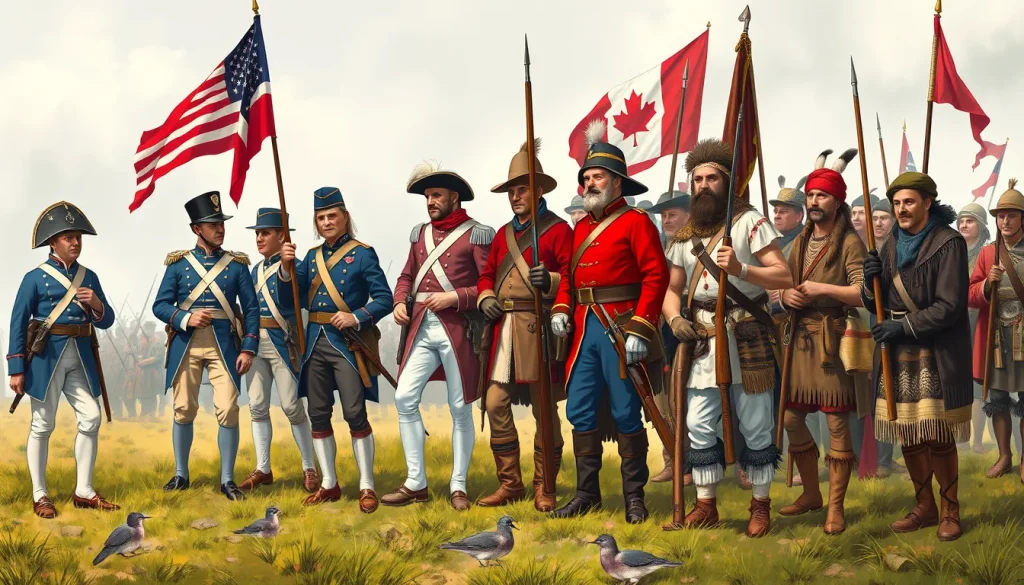
The War of 1812 (1812–1815) was a military conflict between the United States and Great Britain, with British North America (Canada) and many Indigenous nations allied with Britain. Some Indigenous nations also fought alongside the United States, and Spain had minor involvement in the South. This article explains the various participants and their roles.
Historical Context
The war emerged from long-standing tensions between the United States and Great Britain. Britain, engaged in the Napoleonic Wars with France, imposed trade restrictions that harmed American commerce and practiced impressment, seizing American sailors for the Royal Navy. Additionally, American settlers pushed westward into territories inhabited by Indigenous peoples, who received British support and resisted U.S. expansion. These factors led the United States to declare war on Britain on June 18, 1812, with the intention of invading Canada and asserting national honor.
What Happened
The war unfolded across several theaters: the Great Lakes and Canadian border, the Chesapeake Bay, the Atlantic coast, and the Gulf Coast. American invasions of Canada were repulsed in 1812, but the U.S. naval victories on Lake Erie (1813) and Lake Champlain (1814) were significant. In 1814, British forces burned Washington, D.C., but were stopped at Baltimore and Plattsburgh. In the Southeast, American troops and allied Indigenous nations defeated the Creek Red Sticks. The war ended with the Treaty of Ghent in December 1814, restoring the antebellum status quo, though the Battle of New Orleans was fought after the treaty was signed.
Why It Matters
The War of 1812 is often called the “Second War of Independence” in the United States, where it fostered a sense of national unity. In Canada, the successful defense against American invasions contributed to a distinct Canadian identity. For Indigenous peoples, however, the war was devastating: they lost important leaders and land, and their hopes of halting American westward expansion were crushed. The war also solidified U.S. control over the Northwest and Southeast regions.
Definition
The question “Which countries fought in the War of 1812?” refers to the sovereign states and allied groups that participated in the conflict. The primary belligerents were the United States and the United Kingdom of Great Britain and Ireland, but the war involved colonies, Indigenous nations, and other powers.
Background
Great Britain had colonies in North America, including Upper Canada (now Ontario), Lower Canada (now Quebec), and the Maritime provinces, which were collectively known as British North America. The British government relied on these colonial populations and recruited Indigenous allies to defend its interests. The United States sought to expand its territory and had alliances with some Indigenous nations, primarily in the Southeast.
How the Alliances Worked
Britain fielded regular British troops, but in North America it also depended on Canadian militia and Indigenous warriors. The British provided arms, supplies, and military leadership to Indigenous allies such as the Shawnee, Mohawk, and others under leaders like Tecumseh. The United States used its regular army, state militias, and allied Indigenous groups like the Choctaw and Cherokee. Spain, which controlled Florida, clashed with American forces over border territories but never formally declared war.
Competing Viewpoints
Historical interpretations of the belligerents vary. Americans often emphasize Britain’s maritime aggression and the defense of national sovereignty. Canadians view the war as a successful defense of their homeland against American invasion. Indigenous peoples argue that they fought for their own survival and land rights, not merely as auxiliaries for either empire. Modern historians recognize the war as a complex multi-sided conflict involving many actors.
Role of Each Participant
United States: The main antagonist, sought to end impressment and British trade restrictions, and aimed to expand into Canada and the West. U.S. forces included regulars and militias, with notable leaders like Andrew Jackson and William Henry Harrison.
Great Britain: The principal enemy, already at war with France, sought to protect its Canadian colonies and maintain naval supremacy. Britain deployed regulars, and the Royal Navy enforced a blockade of the U.S. coast.
British North America (Canada): As British colonies, Upper and Lower Canada provided the main defense against American invasions. Canadian militia alongside British regulars repelled multiple U.S. attacks, crucial in the war’s outcome.
Indigenous Nations: Many First Nations peoples allied with Britain, including the Shawnee, Ojibwe, Mohawk, and others, fighting to stop American encroachment. Some tribes, such as the Choctaw and Cherokee, sided with the United States. Indigenous participation was significant on both sides.
Spain: Though neutral officially, Spain clashed with American forces in West Florida and Louisiana, where Spain claimed territory. Spain’s involvement was limited and often confused with British activity.
Consequences and Historical Interpretation
The war ended with the Treaty of Ghent, which restored pre-war boundaries and did not address impressment or trade restrictions, yet both sides claimed victory. In the United States, the war inspired a new sense of nationalism and the “Era of Good Feelings.” In Canada, the defense against invasion became a founding myth. Indigenous nations lost power and territory, and their contributions were largely ignored for decades. Historians today view the war as a complex conflict where imperial competition, colonial ambitions, and Indigenous sovereignty intersected.
Primary Sources
Key primary sources include:
- U.S. Declaration of War (June 18, 1812): President James Madison’s message to Congress outlining grievances against Britain, including impressment and trade restrictions.
- Treaty of Ghent (December 24, 1814): The peace treaty ending the war, establishing the status quo ante bellum and a commission to settle boundary disputes.
- Brock’s Proclamation (July 1812): Issued by British Major-General Isaac Brock, seeking to rally Canadian militia and Indigenous allies against American invasion.
- Andrew Jackson’s letters and battle reports: Documenting campaigns against the Creek Nation and the defense of New Orleans.
- Indigenous petitions and speeches: Such as Tecumseh’s messages to British officers, illustrating Indigenous goals and alliances.
These sources offer firsthand perspectives but require careful reading due to bias and incomplete records.
Further Reading
- Hickey, Donald R. The War of 1812: A Forgotten Conflict. University of Illinois Press, 1989.
- Benn, Carl. The War of 1812. Osprey Publishing, 2002.
- Taylor, Alan. The Civil War of 1812: American Citizens, British Subjects, Irish Rebels, & Indian Allies. Alfred A. Knopf, 2010.
- Berton, Pierre. The Invasion of Canada, 1812–1813. McClelland & Stewart, 1980.
- Stagg, J.C.A. The War of 1812: Conflict for a Continent. Cambridge University Press, 2012.
References
- American Battlefield Trust. “10 Facts: The War of 1812.” https://www.battlefields.org/learn/articles/10-facts-war-1812 (accessed 2024).
- FamilySearch. “Who Fought in the War of 1812?” https://www.familysearch.org/en/blog/who-fought-in-the-war-of-1812 (accessed 2024).
- The Canadian Encyclopedia. “War of 1812.” https://www.thecanadianencyclopedia.ca/en/article/war-of-1812 (accessed 2024).
- Wikipedia. “War of 1812.” https://en.wikipedia.org/wiki/War_of_1812 (accessed 2024).
- New World Encyclopedia. “War of 1812.” https://www.newworldencyclopedia.org/entry/War_of_1812 (accessed 2024).
FAQ
Did Canada fight as an independent country?
No, Canada did not exist as a sovereign nation. British North America (Upper and Lower Canada) were British colonies whose militia fought alongside British regulars to defend the territory against American invasion.
Which Indigenous nations fought in the War of 1812?
Many Indigenous nations fought, with most siding with Britain (e.g., Shawnee, Ojibwe, Mohawk, and others), while some like the Choctaw and Cherokee allied with the United States. Their motivations centered on protecting their lands.
Why did the United States declare war on Britain?
The United States declared war in 1812 due to British impressment of sailors, trade restrictions during the Napoleonic Wars, and British support for Indigenous resistance against American expansion.
Leave a Reply