Short Answer
The Burning of York is the common name for the capture and partial destruction of York, the capital of Upper Canada and the predecessor of modern Toronto, by United States forces on 27 April 1813, during the War of 1812. This article concerns the Upper Canadian town on the north shore of Lake Ontario; the phrase does not refer to the city of York in England, and it is distinct from the British burning of Washington, D.C., in 1814. A joint army and naval expedition under Brigadier-General Zebulon Pike and Commodore Isaac Chauncey seized the town, destroyed the warship under construction in its naval yard, and set fire to the provincial Parliament and other public buildings. The episode is significant both as one of the clearer American successes of the 1813 campaign season and as an event British commanders later cited to justify the burning of Washington.
Historical Context
The United States declared war on Britain in June 1812 over maritime grievances, trade restrictions, and suspicions of British support for Indigenous resistance in the Old Northwest. The first year of fighting went badly for the United States on the Detroit and Niagara frontiers: British, Canadian, and Indigenous forces captured Detroit in August 1812 and repulsed the American attack at Queenston Heights in October, where Major-General Sir Isaac Brock, the British commander in Upper Canada, was killed. His successor in command and civil administration, Major-General Sir Roger Hale Sheaffe, held a large territory with few regular troops.
York, founded in 1793 as a provincial capital site, was by 1813 a small lakeside town of perhaps a thousand residents. It contained the legislature and government offices of Upper Canada, the harbour batteries and earthworks of Fort York, and a naval yard supporting the Provincial Marine on Lake Ontario. Its weight in the war was political and logistical rather than military: the garrison was small, the fortifications were incomplete, and the harbour was an important base for British lake operations.
Control of Lake Ontario shaped strategy for both sides, because the lake allowed relatively rapid movement of troops and supplies. Commodore Isaac Chauncey’s American squadron at Sackets Harbor could strike almost anywhere on the lake, while the British squadron at Kingston protected the supply line to the Niagara peninsula and the west. In the spring of 1813, American planners decided on a joint operation: a raid on York to destroy a warship under construction and capture naval and military stores, followed by an attack on Fort George at the mouth of the Niagara River. Sheaffe had concentrated most of his regulars at Kingston and on the Niagara frontier, leaving the capital thinly defended.

What Happened
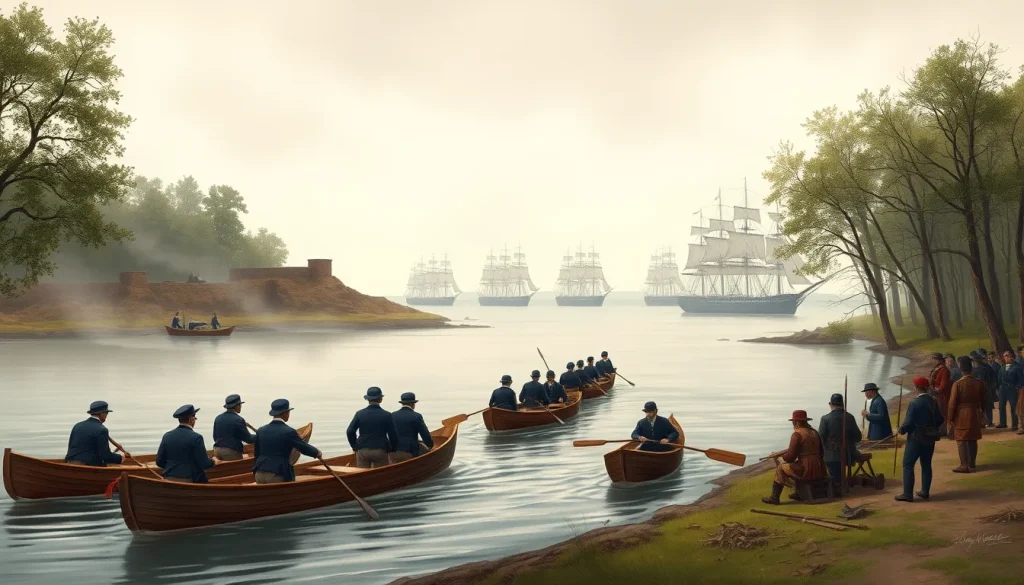
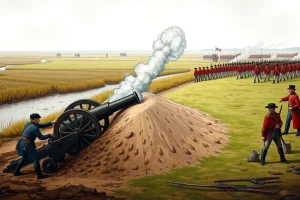
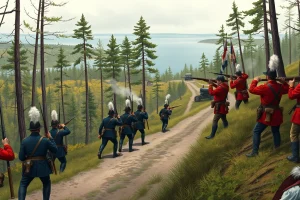
Chauncey’s squadron, carrying Pike’s landing force of roughly 1,700 regulars, appeared off York at dawn on 27 April 1813. The troops went ashore on the lakefront west of the fort, in the area of the present Exhibition Place and Fort York in Toronto, against opposition from British regulars, militia, and Ojibwe and Mississauga warriors. Naval gunfire supported the advance, and the small shore batteries were silenced. Pike pushed eastward toward the town while Sheaffe’s outnumbered defenders fought a delaying action in the woods west of the fort.
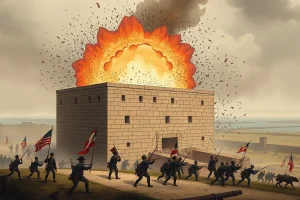
As the American advance closed on the fort, Sheaffe ordered his regulars to withdraw toward Kingston and directed that the warship under construction, a large vessel named Sir Isaac Brock, be burned along with naval and military stores. In the course of these events the fort’s stone magazine exploded. The blast killed and wounded large numbers of Americans, including Pike, who died of his injuries. Contemporary British accounts generally describe the explosion as an accident or the unintended result of the destruction order; some American accounts alleged deliberate sabotage. No conclusive evidence has settled the question.
Command of the American force on shore passed to a subordinate, and the town was occupied. Terms of surrender were negotiated on the Canadian side by the Anglican clergyman John Strachan and militia officers, who sought protection for persons and property. Over roughly six days, American troops plundered deserted houses, shops, and public buildings, and burned the provincial Parliament buildings, Government House, and other government structures, destroying the local printing press as well. American officers justified the destruction of public property as the seizure of assets supporting British forces, and some cited a reported scalp displayed in a government building as evidence of British collusion with Indigenous fighters. The Americans re-embarked in early May, having destroyed the ship and stores but capturing less than had been hoped.
Why It Matters
For the United States, the capture of a provincial capital was a needed political and morale victory in a year that had begun poorly, and it was celebrated in the press and in pro-war politics. For Britain and Upper Canada, it was an embarrassment that exposed how weakly the capital had been defended, and the loss of naval stores and the ship under construction hampered British lake operations, particularly in the effort to contest Lake Erie.
The burning of government buildings became the most durable consequence. British officers, including those who entered Washington in August 1814, pointed to the destruction at York, and later to the American burning of Newark (Niagara-on-the-Lake) in December 1813, as precedents justifying the burning of the White House, the Capitol, and other public buildings. Historians broadly accept that this retaliation sequence mattered to British decision-making, though they differ on how much weight to give it relative to military and strategic considerations. Canadian and British accounts have often emphasized the destruction of the capital as an unprovoked act of vandalism, while American accounts have stressed the destruction of public military property and the loss of life caused by the magazine explosion. Modern scholarship tends to treat the episode as part of an escalating cycle of reprisals rather than as a single originating crime.
Prelude
The raid grew out of American strategic planning for 1813 on Lake Ontario. Chauncey and the army commander at Sackets Harbor organized an expedition that would use naval superiority to move troops quickly against British posts. York was chosen partly because it was weakly garrisoned, partly because a large warship was under construction there, and partly because its capture promised stores needed for the Niagara campaign. The expedition sailed in late April and arrived off York on the morning of 27 April.
Forces and Commanders
The American land force of roughly 1,700 regulars was commanded by Brigadier-General Zebulon Pike, an army officer and explorer for whom Pikes Peak is named. The naval element, about sixteen vessels, was commanded by Commodore Isaac Chauncey. British and Canadian defenders numbered approximately 700 to 750, a mixed force that included detachments of the 8th (King’s) Regiment of Foot and the Royal Newfoundland Regiment, artillerymen, Upper Canadian militia, and Ojibwe and Mississauga warriors. Overall command rested with Major-General Sir Roger Hale Sheaffe, who also served as civil administrator of Upper Canada.
Battlefield and Map Context
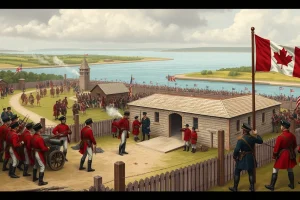
York stood on the north shore of Lake Ontario at the mouth of Garrison Creek, with the fort and harbour on the west side of the town and the Parliament and government buildings about two kilometres east along the shoreline. The American landing took place on the open lakefront west of the fort, near the sites of the modern Fort York National Historic Site and Exhibition Place. The attackers advanced eastward through woods and across open ground toward the fort and the town, supported by ships offshore. Because Toronto’s shoreline has since been extended by landfill, the 1813 landing beaches now lie well inland from the present lake edge.
Battle Chronology
At dawn on 27 April 1813 the American squadron anchored and began landing troops west of the fort. Skirmishing with British regulars, militia, and Indigenous warriors followed as the Americans moved inland, while naval guns suppressed the shore batteries. By mid-morning the defenders were withdrawing, and Sheaffe ordered the destruction of the ship under construction and the naval stores before retreating with his regulars toward Kingston. During this phase the fort magazine exploded, killing and wounding many Americans, including Pike, who died shortly afterward. The town’s remaining authorities negotiated a surrender, and American troops occupied York. The occupation lasted about six days, during which public buildings were burned and property was looted; the force then re-embarked and sailed for the Niagara frontier, where the attack on Fort George followed in late May.
Casualties and Losses
Casualty figures differ between sources and should be treated as approximations. American losses are commonly given as roughly 55 killed and about 265 wounded, with the magazine explosion accounting for most of them; some accounts report about 40 killed instantly by the blast and more than 200 wounded, many of whom died later. British and Canadian losses are variously reported at about 82 killed and 112 wounded, with some 274 to 290 taken prisoner. Material losses included the warship Sir Isaac Brock, naval and military stores, and public buildings and records. Pike’s death made him one of the highest-ranking American officers killed in the war.
Result
The action was a clear tactical success for the United States: the town was taken, the ship under construction and substantial stores were destroyed, and the British garrison withdrew. It was not, however, a permanent conquest. York was not garrisoned by the Americans, who re-embarked within about a week, and British authority was restored. Sheaffe’s decision to abandon the town, and his wider handling of the Niagara theatre, contributed to his removal from command later in 1813, when Major-General Francis de Rottenburg took over the Upper Canadian command.
Strategic Consequences
The destruction and the loss of stores disrupted British naval preparations on Lake Ontario and, indirectly, on Lake Erie, at a time when British lake forces were already stretched. For the United States, the raid demonstrated that Chauncey’s squadron could project army forces rapidly, although the American failure to hold ground meant the strategic gain was limited and temporary; Chauncey returned at the end of July 1813 to destroy additional stores and buildings at York without opposition. The political consequences were also significant on both sides: American newspapers made much of the victory, and British and Canadian commentators made much of the burning of the capital. The most frequently cited long-term consequence is the reprisal chain that culminated in the British burning of public buildings at Washington on 24 August 1814, which British commanders publicly connected to American conduct at York and Newark.
Primary Accounts
Contemporary accounts of the fighting come from several directions. Pike’s orders and correspondence, Chauncey’s despatches to the Secretary of the Navy, and Sheaffe’s reports to Governor General Sir George Prevost describe the operation from the commanders’ perspective, and all were written with an eye to reputation and to justifying decisions taken under pressure. Civilian testimony, such as the diary of the York resident Ely Playter, records the landing, the explosion, the occupation, and the plundering of the town in more everyday terms. The clergyman John Strachan’s letters describe the surrender negotiations and the destruction of public property. Later compilations, such as William James’s early nineteenth-century military history, preserved British interpretations and criticisms of Sheaffe’s conduct. These sources agree on the broad sequence of events but diverge sharply on the cause of the magazine explosion and on the extent and justification of the burning and looting.
Battlefield Today
Fort York National Historic Site in Toronto preserves the earthworks and several buildings of the 1813 fort, including structures dating from the war years, and interprets the battle and the occupation for visitors. Because of shoreline landfill, the landing site and the ground over which the fighting moved no longer correspond to the modern waterfront. The site of Upper Canada’s first Parliament buildings on Front Street East is recognized as an archaeological and commemorative location, and plaques and museum displays in Toronto address the burning of York and the later burning of Washington.
Primary Sources
Relevant contemporary documents include Major-General Sir Roger Hale Sheaffe’s official report to Governor General Sir George Prevost, written in the days after the retreat, which explains the destruction order and the withdrawal; Commodore Isaac Chauncey’s despatches to the Secretary of the Navy, William Jones, describing the landing, the explosion, and the withdrawal; Brigadier-General Zebulon Pike’s written orders and surviving correspondence from the expedition; and John Strachan’s letters describing the surrender and the destruction of government property. Civilian testimony includes the diary of Ely Playter, a York resident, which records the occupation from the perspective of the town’s inhabitants. American newspaper reporting of the raid provides evidence of how the victory was presented to the public, but it is shaped by wartime partisanship.
Each of these sources has limitations. Officers’ reports were written to justify decisions and to protect reputations, and American accounts frequently treated the magazine explosion as evidence of treachery while British accounts treated it as an accident. Civilian diaries reflect the experience of particular individuals and are uneven in coverage. No verified verbatim transcript of the principal despatches is reproduced here; readers should consult published documentary editions and the holdings of the Library and Archives Canada, the National Archives of the United Kingdom, and the United States National Archives for authoritative texts.
Further Reading
- Robert Malcomson, Capital in Flames: The American Attack on York, 1813 (Robin Brass Studio, 2008) — the standard modern study of the battle and occupation.
- Robert Malcomson, Lords of the Lake: The Naval War on Lake Ontario, 1812–1814 (Robin Brass Studio, 1998).
- Carl Benn, Historic Fort York, 1793–1993 (Natural Heritage/Natural History, 1993).
- Carl Benn, The Iroquois in the War of 1812 (University of Toronto Press, 1998).
- Donald R. Hickey, The War of 1812: A Forgotten Conflict (University of Illinois Press).
- Alan Taylor, The Civil War of 1812: American Citizens, British Subjects, Irish Rebels, and Indian Allies (Knopf, 2010).
- J. C. A. Stagg, The War of 1812: Conflict for a Continent (Cambridge University Press, 2012).
- Renée Lafferty, “The Battle of York,” The Canadian Encyclopedia.
- Fort York National Historic Site, City of Toronto Museums — site interpretation and collections relating to the 1813 attack.
References
- Renée Lafferty, “The Battle of York,” The Canadian Encyclopedia, https://www.thecanadianencyclopedia.ca/en/article/the-sacking-of-york
- “Raid on York,” The War of 1812, https://thewarof1812.org/battles/raid-on-york/
- Robert Malcomson, Capital in Flames: The American Attack on York, 1813 (Robin Brass Studio, 2008).
- Robert Malcomson, Lords of the Lake: The Naval War on Lake Ontario, 1812–1814 (Robin Brass Studio, 1998).
- Donald R. Hickey, The War of 1812: A Forgotten Conflict (University of Illinois Press).
- Alan Taylor, The Civil War of 1812 (Knopf, 2010).
- J. C. A. Stagg, The War of 1812: Conflict for a Continent (Cambridge University Press, 2012).
- Carl Benn, Historic Fort York, 1793–1993 (Natural Heritage/Natural History, 1993).
FAQ
Where was York, and what is the place called today?
York was the capital of the British colony of Upper Canada, on the north shore of Lake Ontario at the mouth of Garrison Creek. It is now the city of Toronto, Ontario, and the fort captured in April 1813 survives as Fort York National Historic Site.
Did the British deliberately blow up the magazine at York?
The cause remains unresolved. Major-General Sheaffe ordered the destruction of the ship under construction and of naval and military stores before retreating, and the fort magazine exploded during that phase of the fighting. Contemporary British accounts generally describe the explosion as accidental or unintended, while some American accounts alleged deliberate sabotage designed to kill attacking troops. No conclusive evidence has settled the question.
How is the burning of York connected to the burning of Washington in 1814?
British officers, including those who entered Washington in August 1814, cited the American destruction of government buildings at York in April 1813, and later the burning of Newark (Niagara-on-the-Lake) in December 1813, as justification for burning American public buildings. Historians generally treat the two events as links in a reprisal cycle, while disagreeing about how decisive that reasoning was compared with other military and political considerations.
Leave a Reply