Short Answer
The British capture of Detroit on 16 August 1812 was a decisive early War of 1812 victory in which Major General Isaac Brock, supported by Tecumseh and a mixed force of British regulars, Canadian militia, and Indigenous warriors, compelled Brigadier General William Hull to surrender the United States Army of the Northwest and the town and fort of Detroit. For British authorities in Upper Canada, the result was not merely a local success but a turning point in the western theatre: it ended the first American invasion, restored British control of the Michigan Territory, and transformed a defensive posture into an offensive one. This article examines why contemporaries in Britain, Upper Canada, and the Indigenous alliance viewed Detroit as a turning point, while noting how later historians have qualified that judgment.
Historical Context
When the United States declared war on Britain on 18 June 1812, Britain was deeply engaged in the Napoleonic Wars and could spare few regular troops for British North America. The defence of Upper Canada (now Ontario) depended on a small British garrison, local militia, the Provincial Marine, and alliances with Indigenous nations. From the British perspective, the Detroit frontier was one of the most vulnerable and strategically important sectors of the war. Detroit sat on the west bank of the Detroit River, opposite Fort Amherstburg (Malden) on the Canadian side. Control of Detroit and the river affected the fur trade, the Great Lakes supply routes, and the loyalty of Indigenous communities whose support was essential to British survival.
American strategy in the Northwest aimed to seize Detroit and invade Upper Canada, breaking British influence and opening the way to Montreal. Brigadier General William Hull, governor of the Michigan Territory, led the Army of the Northwest toward Detroit in July 1812. The British commander in Upper Canada, Major General Isaac Brock, was also the provisional civil administrator. He faced pressure to defend the province while maintaining political leadership. The British alliance with Tecumseh and other Indigenous leaders, including Roundhead and John Norton, gave them mobility, intelligence, and psychological advantage. Britain’s official strategy was largely defensive, but Brock believed that a bold counterstroke on the Detroit frontier could save Upper Canada.
What Happened
Hull arrived at Detroit with roughly 1,600 to 2,000 troops in early July 1812. On 12 July he crossed the Detroit River unopposed and occupied Sandwich (modern Windsor, Ontario). On 20 July he issued a proclamation urging Canadians to abandon British rule and embrace American liberty. Many Canadians did not rally to the American cause, and Hull’s supply line from Ohio became his central weakness.

British and Indigenous forces moved against that supply line. On 2 and 3 August, Tecumseh, Captain Muir, and Roundhead led a mixed force of Indigenous warriors and about 100 British regulars across the Detroit River near Brownstown. They attacked American supply convoys and gathered additional warriors. On 8 August, Hull sent Lieutenant Colonel James Miller with about 600 men to reopen the road; at the Battle of Maguaga, the Americans forced a British and Shawnee retreat but suffered casualties and failed to secure the route. The British captured mail that revealed Hull’s anxiety and his fear of Indigenous warfare. On 11 August, Hull withdrew his forces from Sandwich to Fort Detroit.
Brock acted quickly. After the Upper Canada legislature was prorogued, he traveled from York (Toronto) to the head of Lake Ontario and then to Port Dover, collecting volunteers. On 13 August he reached Fort Amherstburg with about 300 reinforcements. Against the advice of most of his officers, he decided to attack Detroit rather than wait. On 15 August he sent Hull a summons to surrender, warning that once fighting began the Indigenous warriors would be "beyond my control." Hull refused. British batteries at Sandwich opened fire on Fort Detroit, and American guns replied.
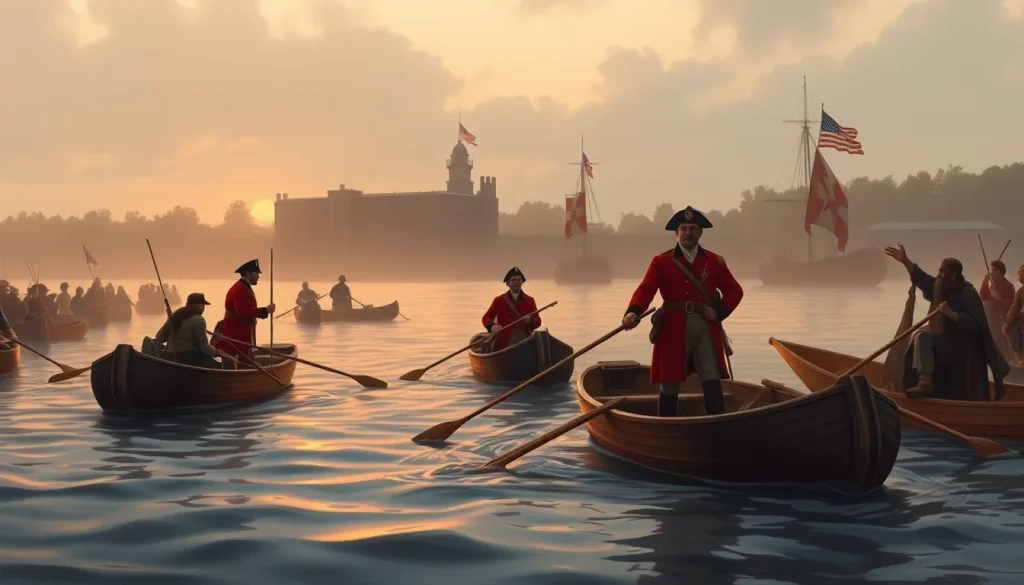
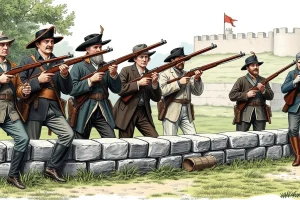
That night, some 530 Indigenous warriors crossed the Detroit River in canoes and landed below Detroit. At daylight on 16 August, Brock followed with British regulars, Royal Artillery, Canadian militia, and Grand River Iroquois led by John Norton, landing south of the fort under cover of the Provincial Marine ships Queen Charlotte and General Hunter. Brock advanced toward the fort while Tecumseh’s warriors moved through the forest. Hull, believing he faced overwhelming forces and fearing a massacre, surrendered around 10 a.m. The Americans gave up about 2,188 men, 39 guns, large quantities of stores, and the unfinished ship Adams. British and Indigenous losses were comparatively light. Hull was later court-martialed and sentenced to death, though the sentence was commuted.
Why It Matters
From the British perspective, the capture of Detroit mattered immediately because it ended the first American invasion of Upper Canada and removed a direct threat to the western province. It restored British control of the Michigan Territory and gave Britain and its Indigenous allies command of the Detroit River and the western Great Lakes approaches. The victory also provided a powerful morale boost to British regulars, Canadian militia, and Indigenous communities that had been uncertain about the war. Brock became a celebrated hero, and Tecumseh’s prestige among Indigenous nations increased.
In the longer term, Detroit was a turning point in the western campaign, but not a permanent conquest. British success at Detroit helped secure Upper Canada’s western flank for 1812 and allowed Brock to shift his attention to the Niagara frontier, where he was killed at Queenston Heights on 13 October 1812. American forces later recovered. In 1813, Oliver Hazard Perry’s victory on Lake Erie and William Henry Harrison’s invasion of Upper Canada led to the Battle of the Thames, where Tecumseh was killed and the British lost control of the Detroit frontier. Historians therefore debate whether Detroit was a true turning point or an early, dramatic success that did not determine the war’s final outcome. For British and Canadian memory, however, it remains a defining moment of the war, associated with Brock’s offensive spirit and the Indigenous alliance.
Definition
In this context, a "turning point" means a military and political shift that changes the initiative, morale, and strategic options of the participants. The British capture of Detroit did not end the War of 1812, but it reversed the first American offensive in the Northwest and gave Britain and its allies temporary control of a critical frontier. The British perspective treats that reversal as a turning point because it saved Upper Canada from early collapse and validated Brock’s aggressive defence.
Background
The British had several reasons to see Detroit as pivotal. Upper Canada was thinly populated and defended by only a few regular regiments. The loss of Detroit and Amherstburg would have isolated the western districts, encouraged American sympathizers, and weakened Indigenous support. Conversely, holding Detroit protected the fur trade, kept supply lines open, and demonstrated that Britain could defend its Indigenous allies. Brock also knew that American morale and leadership were fragile. Captured correspondence and reports from deserters convinced him that Hull was cautious and fearful. Britain’s official policy was defensive, but Brock interpreted his orders broadly enough to authorize a counterattack.
How It Worked
Brock’s success depended on speed, intelligence, deception, and coalition warfare. He moved reinforcements quickly from York to Amherstburg, arriving before Hull could consolidate. He used captured mail to assess American intentions. He coordinated with the Provincial Marine, whose ships covered the river crossing. He concentrated British regulars, Canadian militia, Royal Artillery, and Indigenous warriors into a combined force. Tecumseh’s warriors provided numbers, mobility, and psychological intimidation, crossing silently at night and appearing to threaten the fort from multiple directions. Brock’s surrender summons exploited Hull’s fear of Indigenous warfare. Finally, the British battery at Sandwich and the river crossing on 16 August created the impression of an overwhelming attack, prompting Hull to surrender without a full battle.
Competing Viewpoints
British and Canadian accounts have often emphasized Brock’s bold leadership and the loyalty of Canadian militia, presenting Detroit as proof that Upper Canada could be saved by aggressive action and Indigenous alliance. American accounts have tended to focus on Hull’s indecision, his fear of massacre, and his allegedly cowardly surrender, sometimes treating the defeat as a failure of American leadership rather than a British triumph. Indigenous perspectives, as far as they can be reconstructed from later testimony and British records, stress Tecumseh’s strategic role and the importance of the victory for Indigenous power in the region. Some historians argue that Detroit was a genuine turning point because it prevented an early American conquest of Upper Canada. Others contend that it was a temporary setback for the United States and that the real turning points came later, at Lake Erie and the Thames. The disagreement reflects different scales of analysis: local, regional, and war-wide.
Role in the War of 1812
The Detroit campaign was the first major land engagement in the Northwest. It shaped the war’s early political and military trajectory. For Britain, it justified the use of Indigenous allies and demonstrated that a small professional force, supported by militia and warriors, could defeat a larger American army. For the United States, it exposed the weaknesses of its militia system, supply arrangements, and command in the West. For Indigenous nations, the victory strengthened Tecumseh’s confederacy and delayed American expansion, though it also tied Indigenous objectives to British fortunes. The capture of Detroit set the stage for later campaigns: American efforts to retake Detroit, British and Indigenous attacks on Fort Meigs and Fort Stephenson, and the eventual American counteroffensive under Harrison.
Consequences and Historical Interpretation
The immediate consequences were clear: American forces in the Northwest were eliminated, Michigan was under British control, and Hull was disgraced. The British gained guns, stores, and the ship Adams, renamed Detroit. The victory also allowed Brock to return to the Niagara frontier, where he won another victory at Queenston Heights but was killed. In the longer term, Detroit did not permanently secure the Northwest for Britain. American naval power on Lake Erie and Harrison’s land campaign reversed the situation in 1813. Historians such as Donald Hickey and J.C.A. Stagg place Detroit within a broader story of American logistical failure and British-Canadian resilience, while Alan Taylor emphasizes the civil war dimensions of loyalty and allegiance. The British perspective on Detroit as a turning point is therefore best understood as a contemporary and regional judgment: it was a crucial early victory that changed the momentum in the West, even if it did not decide the war.
Primary Sources
Several contemporary documents illuminate the British perspective. Isaac Brock’s letters to Sir George Prevost, especially his correspondence in late July and August 1812, describe his plan to relieve Amherstburg and attack Detroit. They reveal his confidence, his reliance on captured intelligence, and his willingness to act against cautious advice. Brock’s surrender summons to Hull, dated 15 August 1812, is a key text; it warned that Indigenous warriors would be "beyond my control" once fighting began. The summons was a psychological weapon as much as a diplomatic message, and its threatening language should be read in that context. William Hull’s proclamation to Canadians, issued on 20 July 1812, shows American invasion rhetoric and the expectation that Canadians would defect. Hull’s official report and court-martial defense present his own justification: he claimed to face overwhelming numbers and sought to save his army and civilians from massacre. These accounts are valuable but self-serving. British military dispatches, Provincial Marine reports, and later memoirs by British participants add detail but must be checked against one another. There is no surviving written account by Tecumseh himself; his role is documented mainly through British and American observers, which limits direct access to Indigenous perspectives.
Further Reading
- The Canadian Encyclopedia, "Capture of Detroit, War of 1812," by James H. Marsh.
- Canada History, "Capture of Detroit."
- Donald R. Hickey, The War of 1812: A Forgotten Conflict (University of Illinois Press).
- J.C.A. Stagg, Mr. Madison’s War: Politics, Diplomacy, and Warfare in the Early American Republic, 1783–1830 (Princeton University Press).
- Alan Taylor, The Civil War of 1812: American Citizens, British Subjects, Irish Rebels, & Indian Allies (Knopf).
- Sandy Antal, A Wampum Denied: Procter’s War of 1812 (Carleton University Press).
- Parks Canada, Fort Malden National Historic Site, Amherstburg, Ontario.
- Library and Archives Canada, War of 1812 records and Brock papers.
References
- James H. Marsh, "Capture of Detroit, War of 1812," The Canadian Encyclopedia, https://www.thecanadianencyclopedia.ca/en/article/capture-of-detroit-war-of-1812.
- "Capture of Detroit," Canada History, https://canadahistory.ca/sections/voyager/Capture%20of%20Detroit.html.
- Donald R. Hickey, The War of 1812: A Forgotten Conflict (Urbana: University of Illinois Press, 1989; rev. ed. 2012).
- J.C.A. Stagg, Mr. Madison’s War: Politics, Diplomacy, and Warfare in the Early American Republic, 1783–1830 (Princeton: Princeton University Press, 1983).
- Alan Taylor, The Civil War of 1812: American Citizens, British Subjects, Irish Rebels, & Indian Allies (New York: Knopf, 2010).
- Sandy Antal, A Wampum Denied: Procter’s War of 1812 (Ottawa: Carleton University Press, 1997).
FAQ
Why did the British capture of Detroit matter?
It ended the first American invasion of Upper Canada, restored British control of the Michigan Territory, boosted British and Indigenous morale, and validated Major General Isaac Brock's aggressive defence.
Was Detroit a turning point in the War of 1812?
From the British perspective, it was a turning point in the western campaign because it reversed American momentum and secured the Detroit frontier for a time. However, the United States recovered in 1813, so historians debate whether it was decisive for the war as a whole.
Who was most responsible for the British victory?
The victory resulted from Brock's leadership, Tecumseh's Indigenous forces, and a mixed British, Canadian militia, and Indigenous contingent. American Brigadier General William Hull's indecision and fear of Indigenous warfare also contributed to the surrender.
What happened to William Hull after the surrender?
Hull was court-martialed for his conduct, sentenced to death, and then had his sentence commuted. He was dismissed from the army and spent his later years trying to defend his reputation.


Leave a Reply