
Short Answer
During the War of 1812, the British Army in Upper Canada could not live off the land. The province was thinly settled, its farms produced little surplus, and wartime demands quickly outstripped local resources. To keep regulars, militia, and Indigenous allies in the field, Britain relied on a fragile supply chain running from Quebec and Montreal up the St. Lawrence River to Kingston and then across the Great Lakes. Managed by the Commissariat and Ordnance departments, this system used bateaux, ox carts, local contracts, imported provisions, and improvisation. Its weaknesses shaped strategy and made logistics as decisive as firepower.
Historical Context
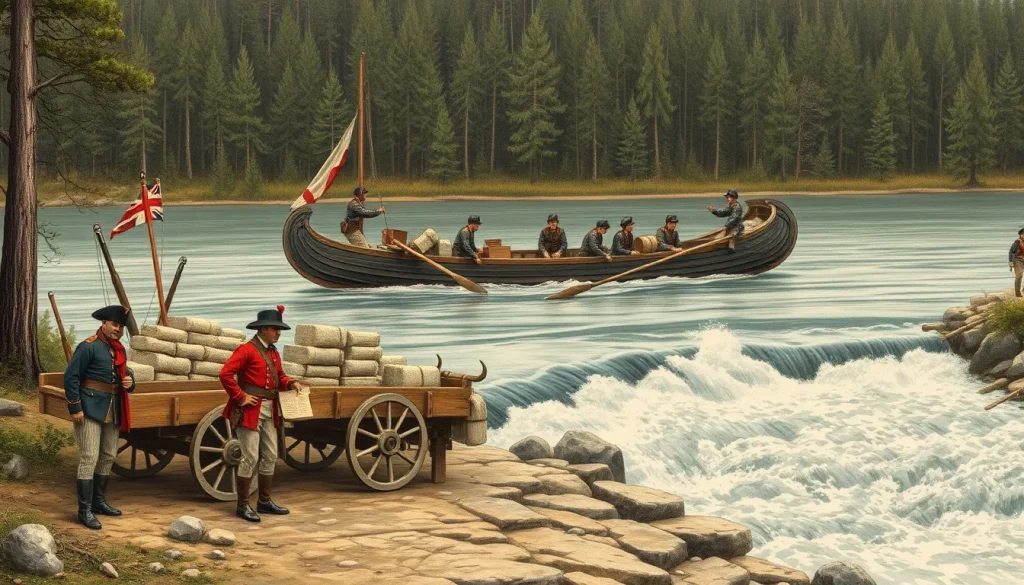
Upper Canada, established in 1791, was a small agricultural colony. Most settlers practiced subsistence farming. There were few large towns, few all-season roads, and no industrial base for arms, ammunition, or naval stores. When the War of 1812 began, Britain was already fighting Napoleonic France, so British North America was a secondary theatre with limited regular troops. Geography made supply central. The main line ran up the St. Lawrence from Quebec and Montreal to Kingston, then by water across Lake Ontario. The Lachine Rapids forced an eight-mile portage from Montreal to Lachine. Upstream, bateaux—flat-bottomed boats about forty feet long, carrying five tons with a crew of four and a tillerman—had to be rowed, poled, or towed against strong currents. Cargoes were carted around rapids. The trip from Lachine to Kingston, about 120 miles, took eleven to fourteen days upstream; downstream took three or four. Before the war, this system worked reasonably well. Wartime demand changed that.
What Happened
Once fighting began, the British Army in Upper Canada needed food, forage, fuel, clothing, camp equipment, ammunition, artillery, and engineering stores. The Commissariat handled provisions and transport; the Ordnance Department handled arms, ordnance, and military stores. In peacetime, the army bought fresh beef and flour from local farmers. London encouraged this after 1802 because fresh provisions were cheaper than salted ones shipped from Britain. Contractors such as Robert Hamilton proposed supplying Fort George with beef, and Kingston merchant Richard Cartwright believed Upper Canada could become a major supplier. Poor harvests after 1803 and then the war undermined those hopes.
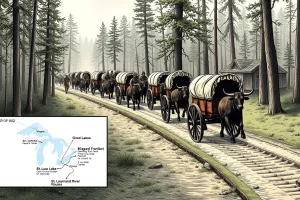
Upper Canada could not feed the forces stationed there. The militia was called out, reducing farm production and consuming supplies. The British imported salted Irish beef, flour, peas, and other provisions from Lower Canada, Britain, the Mediterranean, and the West Indies. Some goods were smuggled from the United States. The system also had to provision Indigenous allies, whose support was essential. All of this moved up the St. Lawrence. Cargoes were carted from Montreal to Lachine, then loaded into bateaux for Kingston. At the rapids, ox carts hauled goods overland while crews worked the lightened boats upstream with poles and tow ropes. From Kingston, supplies were transshipped onto lake vessels for distribution. Roads were few and often poor.
Rations varied. A general order issued at Kingston on 13 August 1813 set the field ration as 1½ pounds of flour or biscuit and either 10½ ounces of salt pork or 1 pound of fresh or salt beef. The same order complained that officers had altered rations without authority, causing “much inconvenience” for the Commissariat. Soldiers supplemented rations with garrison gardens and private purchases. Shortages were common. American offensives in 1813 disrupted communications. The 1813–1814 shipbuilding race on Lake Ontario added huge demands for naval stores and cannon. By 1814, the system was near breaking point. Lieutenant-General Sir Gordon Drummond doubted he could reinforce the Right Division because the Commissariat could not supply provisions. The British imposed martial law in Upper Canada when ordinary procurement failed, and used the corvée in Lower Canada for transport. The American campaign planned for 1815 aimed to cut the St. Lawrence, but the war ended first.
Why It Matters
Supply problems shaped strategy. British commanders could not plan distant operations without knowing whether food, ammunition, and reinforcements could arrive. The St. Lawrence line was vulnerable: a small American force might paralyze Upper Canada by cutting it. Logistics also affected civilians. Farmers faced demands for cattle, grain, and labor; merchants gained contracts but risked losses; militia service reduced production; martial law caused resentment. Indigenous allies depended on British provisions, so shortages could strain alliances.
Historians disagree about performance. Some emphasize the Commissariat’s improvisation and success in keeping the army in the field. Others stress structural weakness and the extent to which shortages limited operations. Most agree that logistics was central, not a footnote. After the war, Britain sought a safer interior route to Upper Canada, a quest that contributed to the Rideau Canal, completed in 1832.
Definition
In the British Army of 1812, supply meant food, forage, fuel, clothing, camp equipment, ammunition, artillery, engineering stores, and transport. The Commissariat Department handled provisions, forage, fuel, and much transport. The Ordnance Department handled arms, artillery, ammunition, and military stores. Quartermasters managed marches and camps. Together they formed the army’s civil administration.
Background
Before 1812, the army used existing local transport: bateaux on the St. Lawrence, ox carts and wagons at portages. This sufficed for peacetime garrisons. Britain also ran a global provisioning system during the Napoleonic Wars. War with the United States stretched that system across the Atlantic and up the St. Lawrence to a sparse frontier.
How It Worked
The route began at Quebec and Montreal. Goods moved eight miles overland to Lachine to avoid the Lachine Rapids, then by bateau up the St. Lawrence. At the upper rapids, cargoes were carted overland while boats were worked upstream. After the rapids, bateaux sailed or rowed sixty-seven miles to Kingston. The upstream journey took eleven to fourteen days. From Kingston, supplies went by lake vessel to posts such as Fort George and York. The system mixed military direction with civilian labor: contracts with farmers and merchants, hired bateaux crews, ox drivers, and local magistrates. In Lower Canada, the corvée supplied labor. When procurement failed, martial law compelled supplies in Upper Canada.
Competing Viewpoints
British commanders often blamed the Commissariat, but the department faced scarce local food, poor roads, vulnerable waterways, and competing demands from army, navy, and Indigenous allies. Some historians, following Glenn A. Steppler, argue the Commissariat achieved impressive results under difficult conditions. Others, such as Robert W. Passfield and Christopher D. Dishman, emphasize the system’s inadequacy and vulnerability. Colonists held mixed views: some welcomed contracts and high prices; others resented martial law, forced labor, and seizures. Indigenous nations expected provisions and gifts, and shortages could damage trust.
Role in the War of 1812
Logistics determined what the British could attempt. Protecting and using the St. Lawrence and Lake Ontario shaped deployments and fortifications. The Lake Ontario shipbuilding race consumed stores and skilled labor. American raids threatened the supply line. Shortages limited offensives and left garrisons hungry. The British kept an army in the field and supported Indigenous allies, but with difficulty. The war ended before the planned American campaign of 1815 could cut the St. Lawrence.
Consequences and Historical Interpretation
In the short term, the supply system enabled the defence of Upper Canada at high cost. It tied the province to imported provisions, encouraged smuggling, and exposed civilians to military demands. In the longer term, the war showed the St. Lawrence route was too vulnerable. Britain and later Canada sought an interior line of communication, contributing to the Rideau Canal. Historians now treat logistics as a major theme, helping explain why the northern war featured raids, sieges, and small armies rather than sustained conquest.
Primary Sources
Several contemporary documents illuminate supply. The most direct is a General Order from the Adjutant-General’s Office at Kingston, 13 August 1813, in Library and Archives Canada, RG 8 C 3502, Vol. 1171. It fixed the field ration as 1½ pounds of flour or biscuit and 10½ ounces of salt pork or 1 pound of fresh or salt beef. It also ordered officers not to alter rations without authority. As a prescriptive order, it shows the intended standard, not what soldiers always received.
Lieutenant-General Sir Gordon Drummond’s 1814 correspondence, quoted in Steppler, shows a commander’s anxiety: he doubted he could reinforce the Right Division because the Commissariat could not supply provisions. His letters reflect a commander’s perspective and may emphasize shortages to justify requests.
In 1801, Robert Hamilton proposed to the commissary at Fort George that local farmers deliver fresh beef weekly. In 1803, Richard Cartwright wrote to General Hunter that Upper Canada abounded in cattle and could increase beef production. Both were prewar, and both men had commercial interests. The British Army’s General Regulations and Orders, issued at Horse Guards on 12 August 1811, set official ration rules. They describe the system as intended, not as practiced on the frontier.
Further Reading
- Christopher D. Dishman, Warfare and Logistics along the US-Canadian Border during the War of 1812 (University Press of Kansas, 2021).
- Glenn A. Steppler, “‘A duty troublesome beyond measure’: Logistical Considerations in the Canadian War of 1812” (MA thesis, McGill University, 1974).
- Robert W. Passfield, “Ordnance Supply Problems in the Canadas: The Quest for an Improved Military Transport System, 1814–1828,” HSTC Bulletin (1981).
- Robert Henderson, “Diet and Food Preparation for the British Army during the War of 1812,” The War of 1812 Website.
- Library and Archives Canada, Record Group 8 C 3502, Vol. 1171, General Orders, Adjutant-General’s Office, Kingston, 13 August 1813.
- Adjutant-General’s Office, General Regulations and Orders for the Army (Horse Guards, 12 August 1811).
References
- Robert W. Passfield, “Ordnance Supply Problems in the Canadas: The Quest for an Improved Military Transport System, 1814–1828,” HSTC Bulletin 5, no. 1 (1981). https://doi.org/10.7202/800114ar
- Christopher D. Dishman, Warfare and Logistics along the US-Canadian Border during the War of 1812 (Lawrence: University Press of Kansas, 2021). https://kansaspress.ku.edu/9780700632701/
- “A General Order regarding the Distribution of Rations 1813,” The War of 1812 Magazine, Issue 16 (September 2011), citing Library and Archives Canada, RG 8 C 3502, Vol. 1171: 3, 4. https://www.napoleon-series.org/military-info/Warof1812/2011/Issue16/c_Rations1813.html
- Glenn A. Steppler, “‘A duty troublesome beyond measure’: Logistical Considerations in the Canadian War of 1812” (MA thesis, McGill University, 1974). https://doi.org/10.82308/21260
- Robert Henderson, “Diet and Food Preparation for the British Army during the War of 1812,” The War of 1812 Website. https://www.warof1812.ca/food.htm
FAQ
What was the main supply route for the British Army in Upper Canada?
The main route ran from Quebec and Montreal up the St. Lawrence River to Kingston, then across Lake Ontario and beyond. Bateaux carried goods upstream, with ox carts at the rapids.
What did British soldiers in Upper Canada eat?
Rations varied, but a standard field ration in 1813 was 1½ pounds of flour or biscuit and 10½ ounces of salt pork or 1 pound of fresh or salt beef. Soldiers supplemented this with gardens and private purchases.
Why was supplying Upper Canada so difficult?
Upper Canada had few people, little agricultural surplus, poor roads, and no industrial base. The St. Lawrence route was long, laborious, and vulnerable to American attack, while wartime demands from the army, navy, and Indigenous allies strained transport to its limits.

Leave a Reply