
Short Answer
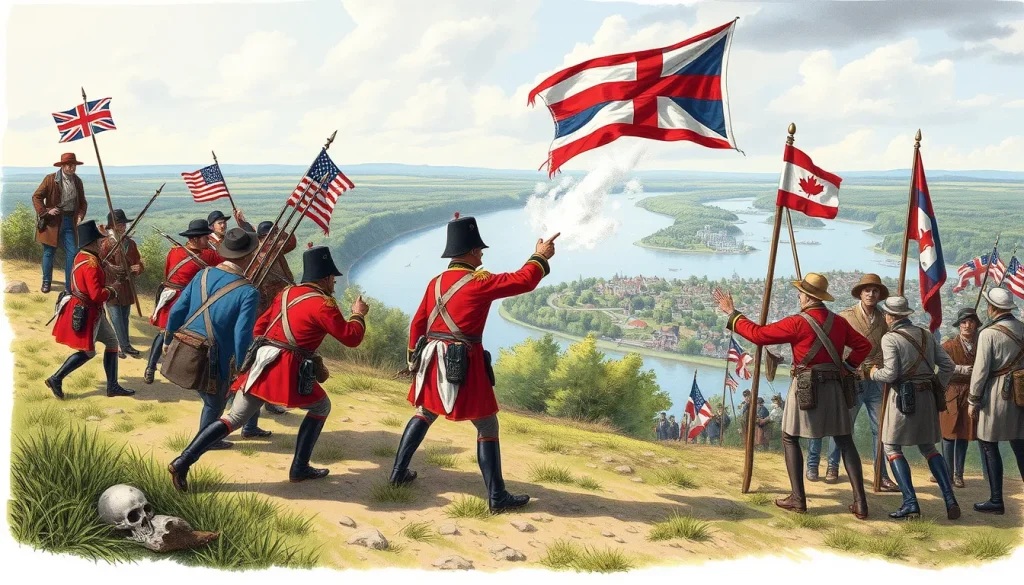
The United States did invade Canada in 1812, as part of the larger War of 1812 between the United States and Great Britain. The invasion consisted of three simultaneous thrusts aimed at the British colonies of Upper Canada (present-day Ontario) and Lower Canada (present-day Quebec). The American objective was to capture British territory in order to use it as a bargaining chip to force Britain to address maritime grievances such as impressment and trade restrictions. All three invasions failed, resulting in American defeats and retreat, but they shaped the course of the war and had significant consequences for Canada, Indigenous peoples, and the United States.
Historical Context
The roots of the invasion lay in the ongoing Napoleonic Wars in Europe, where Britain and France were locked in a bitter conflict. Britain’s Orders in Council restricted neutral trade with France, and the Royal Navy’s practice of impressment—the forcible recruitment of sailors, including many Americans—inflamed tensions. The United States, a neutral nation, sought to protect its maritime rights and national honor. President James Madison and a faction of Congress known as the War Hawks, primarily from the south and west, argued for war with Britain. Many Americans, including Thomas Jefferson, believed that the conquest of Canada would be, as he put it, “a mere matter of marching.” They expected the Canadian population, which had a significant proportion of American-born settlers, to welcome U.S. troops as liberators. The British, meanwhile, were heavily engaged in Europe and had only about 6,000 regular troops to defend all of Canada, relying also on local militia and Indigenous allies.
What Happened
The U.S. strategy in 1812 was a three-pronged invasion of Upper and Lower Canada. The first prong was launched from Detroit, Michigan Territory, under Major General William Hull. On July 12, 1812, Hull crossed the Detroit River into Upper Canada and issued a proclamation that promised Canadians “emancipation from tyranny and oppression.” He soon faced supply difficulties and harassment from British and Indigenous forces under Major General Isaac Brock and the Shawnee leader Tecumseh. After a crucial supply convoy was captured, Hull retreated to Fort Detroit. Brock pursued and, using a combination of threat and deception, convinced Hull to surrender Detroit on August 16, along with his entire army. This was a devastating American loss.
The second prong was an attack on the Niagara Peninsula. Under Major General Stephen Van Rensselaer, American troops attempted to cross the Niagara River and capture Queenston Heights on October 13, 1812. After initial success in seizing the heights, American forces were driven back by British troops and militia. The key event was the death of Brock, but the Americans were unable to hold their position. New York militia refused to cross into Canada, leaving the regulars isolated. Eventually, some 950 Americans were captured or killed, and the invasion failed.
The third prong was aimed at Montreal, the largest city in Canada. Major General Henry Dearborn assembled a force of more than 6,000 men at Plattsburgh, New York, and advanced toward the border in November 1812. His troops, mostly militia, refused to cross into Canada, and after a brief skirmish near Lacolle Mills, the entire force retreated to winter quarters without achieving any objective. Thus, by the end of 1812, all three American invasions had failed.
Why It Matters
The failed invasions of 1812 had immediate and long-term consequences. In the short term, they secured British control over Canada and bolstered British and Canadian morale. The victories at Detroit and Queenston Heights became celebrated events, particularly the death of Brock, who became a heroic figure in Canadian history. For the United States, the defeats exposed the army’s unpreparedness, poor leadership, and the limits of relying on untrained militia. The failures also had a lasting impact on Indigenous peoples. Many First Nations allied with the British, and Tecumseh’s confederacy fought to resist American expansion. Their contributions were crucial to the British victories, but after the war, the Treaty of Ghent restored the status quo, and the British abandoned many of their Indigenous allies, leading to devastating consequences for these communities. In the longer view, the invasion attempts contributed to a Canadian sense of identity, as the defense of the provinces was seen as a shared effort. Historians have interpreted the 1812 invasions as a classic example of American overconfidence and the challenges of campaigning in the wilderness, while also recognizing that the British and Canadian defense was well orchestrated.
Definition
The term “invasion” in this context refers to the deliberate military entry of U.S. armed forces into the British North American provinces of Upper and Lower Canada, with the intent to conquer and hold territory. The 1812 invasions were part of a broader U.S. strategy to bring pressure on Britain to stop violations of American neutrality on the high seas.
Background
The idea of invading Canada had been discussed in the United States for years before 1812, partly as a way to annex land and partly as a lever against Britain. During the American Revolutionary War, an earlier attempt had failed. In the early 1800s, as tensions with Britain increased, the notion resurfaced. Americans, buoyed by population growth and a false belief that Canadians would rally to them, viewed the conquest as almost inevitable. The British, aware of the threat, had fortified key points but were stretched thin due to the Napoleonic War.
How It Worked
The American plan in 1812 was based on a coordinated, three-axis advance. The western force under Hull was to secure Upper Canada west of the Niagara River, including Fort Malden. The central force under Van Rensselaer was to cross the Niagara River and seize the strategic high ground at Queenston. The eastern force under Dearborn was to advance along the Richelieu River toward Montreal. All three forces were composed largely of short-term militia, who were exempt from serving outside U.S. territory, and regular army units. The invasions were poorly planned, with inadequate supply lines, limited naval support on the Great Lakes, and overestimation of Canadian support.
Competing Viewpoints
Historians have debated whether the invasions were a genuine annexationist attempt or purely a defensive bargaining tactic. Some argue that American leaders, particularly the War Hawks, sought to incorporate Canada permanently into the United States, as evidenced by calls to make it a “zone of freedom.” Others, like Donald Hickey, maintain that the primary purpose was to seize territory that could be traded for concessions on maritime rights. At the time, British and Canadian observers saw the invasion as an act of aggression, while American leaders framed it as a liberation intended to free Canadians from British rule.
Role in the War of 1812
The invasions shaped the early course of the war. The humiliating surrender at Detroit was a major blow to American morale and gave the British control of the Michigan Territory. The defeat at Queenston Heights, though a British tactical victory, cost them the life of their most capable general. The failure of the Montreal expedition ended any hope of a quick American victory. These events forced the U.S. military to reorganize and led to a shift toward gaining command of the Great Lakes, which would eventually enable successful campaigns in 1813.
Consequences and Historical Interpretation
The immediate consequence of the failed invasions was that Canada remained in British hands. In the longer term, the defense of Canada in 1812 contributed to a nascent Canadian nationalism, with the war later remembered as a key moment in nation-building. For Indigenous peoples, the war brought mixed results: victories in 1812 were followed by losses and a decline in their status after the peace. Historians have used the 1812 invasions to illustrate themes of American overreach, the importance of leadership and logistics in warfare, and the complex interplay of imperial rivalries and local dynamics. The fact that the United States repeatedly attempted to invade Canada and failed is seen as a defining feature of the War of 1812 in North America.
Primary Sources
Several contemporary documents illuminate the 1812 invasions. William Hull’s proclamation to the people of Canada, issued on July 12, 1812, outlined the American rationale and promised protection. Isaac Brock’s dispatches to his superiors describe his defense strategy and the victory at Detroit. Tecumseh’s role is documented in British military records and later Indigenous oral traditions. American court-martial proceedings against Hull after his surrender provide a critical perspective on the failures. Each source must be understood in its own context: Hull’s proclamation was a propaganda piece, Brock’s letters reflect a commander’s perspective, and the court-martial records are legal documents with their own biases.
Further Reading
- Donald R. Hickey, The War of 1812: A Forgotten Conflict (University of Illinois Press, 1989)
- Pierre Berton, The Invasion of Canada, 1812-1813 (McClelland and Stewart, 1980)
- J. Mackay Hitsman, The Incredible War of 1812 (University of Toronto Press, 1965)
- Alan Taylor, The Civil War of 1812 (Knopf, 2010)
- Canadian Encyclopedia, War of 1812 (online article)
References
- Britannica, “War of 1812 – US-Britain, Causes, Outcome” https://www.britannica.com/event/War-of-1812/War
- USS Constitution Museum, “War of 1812 Overview (1812-1815)” https://ussconstitutionmuseum.org/major-events/war-of-1812-overview/
- The Canadian Encyclopedia, “War of 1812” https://thecanadianencyclopedia.ca/en/article/war-of-1812
- History.com, “How U.S. Forces Failed to Conquer Canada in War of 1812” https://www.history.com/articles/how-u-s-forces-failed-to-conquer-canada-200-years-ago
- American Battlefield Trust, “10 Facts: The War of 1812” https://www.battlefields.org/learn/articles/10-facts-war-1812
FAQ
Did the United States successfully invade any part of Canada in 1812?
No. All three American invasion attempts in 1812 failed. The forces under Hull surrendered at Detroit, the attack on Queenston Heights was repulsed, and the Montreal expedition never crossed the border.
Why did the United States want to invade Canada in 1812?
The United States viewed Canada as a vulnerable target that could be seized to force Britain to stop impressing American sailors and interfering with American trade. Some leaders also wanted to annex Canadian territory permanently.
What was the result of the 1812 invasions for the War of 1812?
The failures strengthened British control over Canada and dealt a serious blow to American morale. They also led to a shift in American strategy toward gaining naval supremacy on the Great Lakes and to a military reorganization that would produce later victories and defeats.

Leave a Reply