
Short Answer
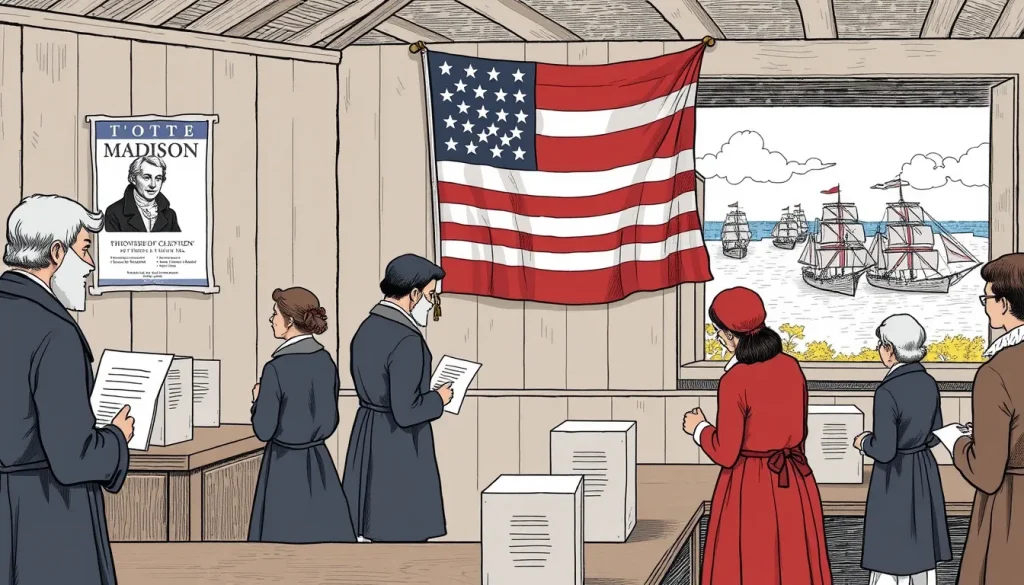
James Madison’s reelection in 1812 was the first presidential election held while the United States was engaged in a declared war. The contest occurred just months after Congress declared war on Great Britain on June 18, 1812, and it tested public confidence in the administration and the conflict itself. Madison, the Democratic-Republican incumbent, defeated a fusion candidate supported by anti-war Republicans and Federalists, thereby securing a second term and continued direction of the war effort.
Historical Context
Madison entered his first term in 1809 facing persistent violations of American neutrality by Great Britain and France, especially the impressment of American sailors and seizures of cargo. Economic coercion through the Embargo Act and its successor, the Non-Intercourse Act, had failed to force concessions. Meanwhile, British support for Indigenous resistance in the Northwest Territory increased tensions along the frontier. By 1812, war had become a likely outcome, and the decision to declare war on June 18 was made while the presidential campaign was already underway.
The political landscape was dominated by the Democratic-Republican Party, but it was internally divided over the wisdom of war. The Federalist Party, strongest in New England and tied to mercantile interests, largely opposed the conflict. The war also intensified sectional resentments, particularly against the “Virginia Dynasty” that had produced four of the first five presidents. These divisions shaped the election campaign and the strategy of Madison’s opponents.
What Happened
Madison was renominated by a Democratic-Republican congressional caucus on May 18, 1812, with near unanimity, though about fifty Republican congressmen abstained. The war declaration followed on June 18, making the election a referendum on the conflict. In the summer and fall, a loose coalition of anti-war Democratic-Republicans and Federalists coalesced around DeWitt Clinton of New York, then mayor of New York City and lieutenant governor of the state. Clinton’s candidacy was an attempt to unify disparate opposition: Federalists who disliked Madison’s policies, Republicans who thought the war was poorly prepared, and those who resented Virginia’s dominance.
The campaign included controversy over the purchase of the “Henry documents,” a set of letters that Madison bought for $50,000 in 1812. The papers, written by a British spy named John Henry, suggested British intrigue in New England but did not implicate Federalist leaders in treason. Critics accused Madison of misusing public funds for political advantage. Despite this, Madison’s campaign emphasized the nation’s honor and the necessity of the war.
The election took place in November, with results varying by state. Madison won 128 electoral votes to Clinton’s 89, carrying a majority of states. The popular vote was narrower: Madison received approximately 52.3 percent to Clinton’s 45.4 percent. The Federalists did not field a separate ticket, having thrown their support to Clinton.
Why It Matters
The 1812 election demonstrated that a republic could conduct a free and contested election during wartime, a principle that would be tested again in later conflicts. Madison’s victory allowed the War of 1812 to continue without a change in leadership, and it contributed to the decline of the Federalist Party, which never regained national power after its alignment with the anti-war coalition. Historians view the election as a milestone in the development of wartime democratic politics and as an indication of the war’s initially fragile public support.
Definition
James Madison’s reelection during wartime refers to the United States presidential election of 1812, held while the nation was fighting the War of 1812 against Great Britain. The election pitted the incumbent, James Madison, against DeWitt Clinton, a fusion candidate backed by anti-war Democratic-Republicans and Federalists. It was the first presidential election in American history to occur during a declared war.
Background
The election occurred against the backdrop of escalating Anglo-American tensions that had roots in the French Revolutionary and Napoleonic Wars. British naval supremacy, embodied in Orders in Council and the practice of impressment, angered Americans and violated neutral trade rights. Economic sanctions had failed, and the rise of a British-inspired Native confederacy under Tecumseh further aggravated frontier relations. Within the United States, the Democratic-Republican Party was fractured between “war hawks” and more cautious voices, while the Federalist Party remained influential in New England, where trade interests aligned with Britain.
How It Worked
The election took place through the existing Electoral College system, in which state legislatures or popular votes selected electors. The Democratic-Republican Party nominated Madison at a congressional caucus, a practice used in that era. The opposition, lacking a coherent party mechanism, formed a fusion movement around DeWitt Clinton, appealing both to Federalists and to disaffected Republicans. Campaign tactics included public speeches, newspaper editorials, and the use of the Henry documents to discredit Federalists. The voting was staggered across states, with some using popular ballots and others appointed electors.
Competing Viewpoints
Supporters of Madison argued that continuity in the presidency was necessary to successfully prosecute the war and that changing leaders would appear weak to Britain. They painted the war as a defense of national sovereignty and republican principles. Opponents, including Clinton’s backers, contended that Madison’s administration was incompetent, that the war was ill-conceived and costly, and that a new leader might negotiate a better peace. Federalists, while often disagreeing with Clinton on domestic policy, hoped to punish Madison for the war and for the embargo’s damage to trade. Some anti-war Republicans genuinely sought peace, while others were more concerned with regional pride and the Virginia dynasty.
Role in the War of 1812
The election directly influenced war policy. Madison’s victory ensured that the administration’s strategy—focused on invading British-held Canada and negotiating from strength—would continue. A defeat might have led to a negotiated peace or a change in military leadership. The election also emboldened Federalists in the Northeast, who continued to oppose the war and even threatened secession at the Hartford Convention in 1814. At the same time, the narrowness of the popular vote revealed that the war was not universally popular, a fact that shaped Madison’s later diplomatic moves.
Consequences and Historical Interpretation
Historians view the 1812 election as a crucial test for democratic governance under stress. Many emphasize that Madison’s victory, despite early military disasters such as the fall of Detroit and failed invasions of Canada, demonstrated the resilience of constitutional processes. Some scholars argue that the election marked the beginning of the end for the Federalist Party, as its association with opposition to a popular war hurt its credibility. Others highlight the regional divisions that the election exposed, particularly the isolation of New England and the growing importance of the South and West. The election also set a precedent for later wartime elections, including those during the Civil War and World War II, where incumbents typically won on appeals for continuity.
Primary Sources
Key primary sources include Madison’s war message to Congress, delivered June 1, 1812, which outlined grievances against Britain. His personal correspondence, such as the letter to Jefferson on October 14, 1812, reveals his assessment of the campaign. The Henry documents, though controversial, are a primary source on British espionage and the political maneuvering of the period. Election returns and contemporary newspaper accounts provide data on the voting results. These sources carry inevitable biases—Madison’s letters are partisan, and newspapers were often party mouthpieces—but they remain vital for understanding the election’s dynamics.
Further Reading
- Zinman, Donald A. America’s First Wartime Election: James Madison, DeWitt Clinton, and the War of 1812. University Press of Kansas, 2022.
- Miller Center essay, “James Madison: Campaigns and Elections.” University of Virginia.
- American Battlefield Trust, “The Election of 1812.”
References
- Miller Center, “James Madison: Campaigns and Elections.” https://millercenter.org/president/madison/campaigns-and-elections
- Constituting America, “James Madison Defeats DeWitt Clinton: The Wartime Election of 1812.” https://constitutingamerica.org/james-madison-defeats-dewitt-clinton-the-wartime-election-of-1812-guest-essayist-sam-agami/
- Zinman, Donald A. America’s First Wartime Election. University Press of Kansas, via Project MUSE. https://muse.jhu.edu/book/131411
- American Battlefield Trust, “The Election of 1812.” https://www.battlefields.org/learn/articles/election-1812
FAQ
Why was the 1812 election important?
It was the first presidential election held during a declared war, setting a precedent that American democracy could function in wartime. Madison's victory allowed the War of 1812 to continue under his leadership.
Who was DeWitt Clinton?
DeWitt Clinton was the mayor of New York City and lieutenant governor of New York who ran against Madison in 1812. He was backed by a coalition of anti-war Democratic-Republicans and Federalists.
How did Madison win despite early war setbacks?
Madison's party organization and the lack of a cohesive opposition helped him secure victories in states outside the Northeast. He also benefited from the war as a symbol of national defense.


Leave a Reply