
Short Answer
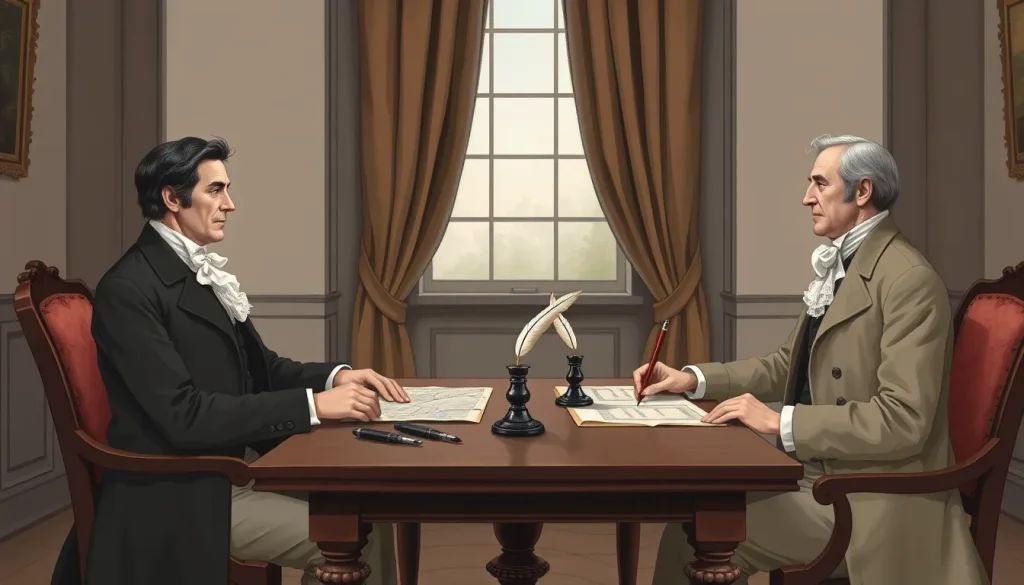
The early attempts to end the War of 1812 comprise the diplomatic initiatives and peace overtures made between the American declaration of war in June 1812 and the formal opening of negotiations at Ghent in August 1814. These efforts, initiated by the United States, Great Britain, and Russia, sought to terminate the conflict before military operations produced a decisive result. Although none of these early attempts succeeded, they shaped the diplomatic pathway to the eventual peace settlement.
Historical Context
The United States declared war on Great Britain on June 18, 1812, after more than a decade of maritime disputes and frontier grievances. The principal American complaints concerned British impressment of American sailors, enforcement of the Orders in Council restricting neutral trade, and British support for Indigenous peoples resisting American westward expansion in the Northwest Territory. The Madison administration and its Republican allies in Congress expected that Britain, already engaged in a life-or-death struggle with Napoleonic France, would make rapid concessions once confronted with a second war.
Remarkably, within six days of the American declaration, the British government—already mindful of the transatlantic crisis—repealed the Orders in Council on June 23, 1812. When the news of both events reached Washington and London, it created a fluid diplomatic situation in which both governments had reason to consider an early peace. The repeal, however, had arrived too late to prevent the war declaration, and the practice of impressment remained the fundamental point of contention. Russia, a British ally against Napoleon and a major trading partner of the United States, also had a strong interest in ending the war because it diverted British resources from the European conflict.
What Happened
President James Madison, in his own words, had scarcely drawn the sword out of the scabbard before he sought terms for returning it. On June 26, 1812, Secretary of State James Monroe sent instructions to Jonathan Russell, the American chargé d’affaires in London, authorizing him to propose an armistice. The American conditions were explicit: Great Britain must repeal the Orders in Council without substituting illegal blockades, discontinue impressment from American vessels, and restore sailors previously impressed. As an inducement, Monroe suggested that the United States would pass a reciprocal law prohibiting the employment of British seamen in American service.
Russell communicated these terms to Lord Castlereagh, the British foreign secretary, on August 24, 1812. Castlereagh replied on August 29 that the Prince Regent could not accept the American proposal, observing that the United States had issued its demands in ignorance of the Order in Council of June 23, which had already been revoked. More fundamentally, Castlereagh declared that no British administration could consent to renounce the right of impressment, explaining that “the great sensibility and jealousy of the people of England” on the subject made such a concession politically impossible. He further noted that Russell’s suggestion of an informal understanding offered no greater security to Britain than a formal treaty.
Despite this rejection, both governments left the door open to negotiation. In September 1812, the British government authorized Admiral Sir John Borlase Warren, commander of the North American station, to arrange a cessation of hostilities with American authorities. General Sir George Prevost, governor of British North America, had already concluded a local armistice with American General Henry Dearborn in August 1812, though President Madison declined to ratify it because it did not address impressment. When the British government learned of the American refusal, it issued orders for general reprisals on October 13, 1812—but expressly preserved Warren’s authority to negotiate a truce.
The next significant opening came from Russia. As Napoleon’s armies marched on Moscow in the autumn of 1812, Tsar Alexander I—anxious to concentrate British military efforts against the French—offered to mediate the Anglo-American dispute. The Russian offer reached Washington in March 1813, and Madison accepted it eagerly, despite knowing that Britain had not yet agreed to the scheme. He named a three-member commission consisting of Albert Gallatin, James Bayard, and John Quincy Adams, then the American minister in St. Petersburg, to enter into negotiations under Russian auspices.
Gallatin and Bayard sailed for Europe in May 1813. Adams, already in St. Petersburg, had been approached earlier by Chancellor Count Romanzoff, who had floated the idea of a Russian role. Castlereagh, however, declined the tsar’s proposal for mediation. He suspected that Russian intervention would complicate rather than facilitate a settlement, and he believed the question of impressment was a matter better settled directly between the two belligerents. Yet he did not wish to appear to reject a peace overture outright. In November 1813, therefore, Castlereagh wrote to the American government proposing direct, bilateral negotiations without third-party intervention. This proposal reached Washington through Admiral Warren and was eventually accepted. The American commissioners, remaining in Europe, received instructions to proceed to Ghent, Belgium, where formal talks opened in August 1814.
Why It Matters
The early attempts to end the war mattered both for what they attempted and for what they left unresolved. At the time, they demonstrated that neither belligerent had entered the war seeking unconditional victory. The American government, despite its aggressive posture on impressment, was willing to trade a formal renunciation of British impressment for a reciprocal American law excluding British seamen from American ships. The British government, while refusing to surrender the principle of impressment, authorized its commanders to seek local armistices and later proposed direct talks.
The failure of these attempts set important precedents. The British refusal to accept Russian mediation shaped the structure of the eventual peace process, leading directly to bilateral negotiations at Ghent. The appointment of Gallatin, Bayard, and Adams to the commission of 1813 created a diplomatic team that, with additions and changes, would negotiate the final treaty. Moreover, because both sides were willing to discuss terms intermittently from the war’s earliest months, the diplomatic channel remained open even as the conflict intensified in 1814.
Historians disagree about how close these early attempts came to succeeding. Some emphasize that British refusal to yield on impressment made peace impossible in 1812; others argue that the repeal of the Orders in Council might have permitted a settlement had the two governments been able to exchange communications more quickly. The Russian role has likewise been debated: some scholars interpret Alexander’s offer as a genuine act of peacemaking, while others regard it as an artful measure to free British forces against Napoleon. These interpretive divisions continue to shape scholarly assessment of the war’s diplomatic history.
Definition
The “early attempts to end the War of 1812” is a historical category denoting the diplomatic initiatives and peace proposals advanced between June 1812 and the opening of formal negotiations at Ghent in August 1814. It includes the American armistice proposal of June–August 1812, the British authorizations of local cease-fires, the Russian mediation offer of 1813, and the subsequent Anglo-American exchanges that led to direct talks.
Background
The background to these attempts lay in the peculiar circumstances of the war’s origin. The United States entered the conflict divided and unprepared, with hopes of territorial gains against British North America and expectations that Britain would yield to American maritime pressure. Britain, for its part, regarded the American war as a sideshow to the massive conflict against Napoleon and wished to keep its forces concentrated in Europe. Both governments thus had powerful reasons to limit the war’s scope and duration.
How It Worked
The early attempts proceeded through traditional diplomatic channels. The American chargé d’affaires in London communicated with the British foreign secretary. The American minister in St. Petersburg received overtures from the Russian government. The British government issued instructions to its admiral on the American station and its governors in British North America. In each instance, the effort rested on the assumption that a formal treaty or armistice could be negotiated before the fighting escalated beyond control.
Competing Viewpoints
The competing positions can be summarized briefly. The Americans insisted that impressment was a non-negotiable issue touching national sovereignty and the rights of American citizens. The British treated impressment as a matter of naval necessity and national honor, essential to manning the fleet against Napoleon. The Russians, especially Tsar Alexander and Chancellor Romanzoff, saw an opportunity to advance Russian interests by ending the American war. Historians have added their own interpretive layer, debating whether any of these positions were truly negotiable or whether deeper political obstacles made peace impossible before 1814.
Role in the War of 1812
The early attempts played a crucial role in the war’s trajectory. They failed in their immediate objective but succeeded in establishing a pattern of diplomatic contact between the belligerents. The existence of these channels meant that neither side had to improvise when military fatigue set in later. The commission appointed in response to the Russian offer was the direct antecedent of the delegation that negotiated the Treaty of Ghent.
Consequences and Historical Interpretation
The ultimate consequence of these early attempts is best understood through their failure. The inability of either side to reconcile over impressment meant that the war continued for two more years, with consequences including American military defeats and victories, the burning of Washington, and a final peace that said nothing about impressment. Historians interpret the early attempts as evidence that the war’s aims were limited, that both sides entered the conflict with mixed expectations, and that diplomacy remained a persistent, if often quiet, counterpart to arms.
Primary Sources
The most important primary sources for the early attempts to end the war are the diplomatic correspondence between Secretary of State James Monroe and Jonathan Russell from June through September 1812, and the resulting exchanges between Russell and Lord Castlereagh. Monroe’s instructions to Russell of June 26, 1812, set out the American terms in detail. Russell’s communication to Castlereagh of August 24, 1812, and Castlereagh’s reply of August 29, 1812, constitute the core record of the first attempt. Henry Adams’s History of the United States of America during the Second Administration of James Madison (vol. VII, 1891) quotes extensively from this correspondence, preserving portions of the documentary record.
For the Russian mediation offer, the dispatches from John Quincy Adams in St. Petersburg to the State Department, and the letters exchanged between Chancellor Romanzoff and the American minister, are essential. Adams’s personal diary also provides a vivid eyewitness perspective on the European diplomatic scene in 1813.
Secondary sources that reproduce or analyze these documents include the National Park Service article “Republicans hope to win concessions with minimal bloodshed” (2016) and David Thompson’s 19th-century History of the Late War between Great Britain and the United States (chapter 19), which offers a contemporary Canadian narrative of the same events. All these sources carry the biases of their authors: American official correspondence emphasized American grievances; British replies stressed the consistency and honor of the Crown; Thompson wrote from a loyalist perspective; and Henry Adams brought a critical, retrospective eye to all parties. Readers should weigh these perspectives accordingly.
Further Reading
- Henry Adams, History of the United States of America during the Second Administration of James Madison, 3 vols. (1890–1891).
- Francis F. Beirne, The War of 1812 (New York: E. P. Dutton & Co., 1949), esp. ch. 28.
- Donald R. Hickey, The War of 1812: A Forgotten Conflict (Urbana: University of Illinois Press, 1989).
- David Thompson, History of the Late War between Great Britain and the United States (1843), ch. 19, available online at warof1812-bicentennial.info.
- United States National Park Service, “Republicans hope to win concessions with minimal bloodshed” (2016), available at nps.gov/articles/winning-the-peace.htm.
References
- United States National Park Service, “Republicans hope to win concessions with minimal bloodshed,” https://nps.gov/articles/winning-the-peace.htm.
- David Thompson, History of the Late War between Great Britain and the United States, ch. 19, http://www.warof1812-bicentennial.info/books/historyofthelatewar/hlw-chapter19.php.
- Henry Adams, History of the United States of America during the Second Administration of James Madison, vol. VII (New York: Charles Scribner’s Sons, 1891), esp. chs. 1–2, 14.
- Francis F. Beirne, The War of 1812 (New York: E. P. Dutton & Co., 1949), ch. 28.
FAQ
Why did the first American peace overture fail?
The British government rejected the American armistice proposal of August 1812 because it demanded the discontinuation of impressment, which the British regarded as essential to naval strength and would not renounce. Lord Castlereagh also noted that the American terms had been drawn up before Britain had repealed the Orders in Council.
What role did Russia play in ending the War of 1812?
Tsar Alexander I offered to mediate between the United States and Britain in 1813, partly because he wanted Britain to focus its military resources against Napoleon and partly to restore Russo-American trade. Although Britain declined the Russian offer, it prompted Castlereagh to propose direct negotiations, which ultimately led to the talks at Ghent.
Did the early attempts achieve anything?
Although none of the early attempts ended the war, they established a working diplomatic channel between the belligerents, created the American commission that later negotiated the Treaty of Ghent, and demonstrated that both sides were receptive to a negotiated peace.


Leave a Reply