Short Answer
The British Commissariat in Canada was the department of the British Army responsible for procuring and distributing food, forage, fuel, transportation, and related stores for British and provincial forces during the War of 1812 (1812–1815). Operating in Upper and Lower Canada and the Maritime colonies, it had to feed regular soldiers, militia, and Indigenous allies while moving men and matériel across the St. Lawrence River and Great Lakes. Its performance was uneven but consequential: logistics shaped British strategy, limited offensive operations, and helped preserve British North America against American invasion.
Historical Context
The War of 1812 began when the United States declared war on Great Britain on 18 June 1812. British North America was a patchwork of colonies with a small population, perhaps half a million people, compared with the United States’ roughly six million. Britain was also engaged in the Napoleonic Wars, so only a limited number of regular troops could be spared for Canada. The main theatre ran along the St. Lawrence River and the Great Lakes, from Quebec and Montreal to Kingston, York, Niagara, Amherstburg, and Michilimackinac. Water transport was the cheapest and most practical means of moving heavy stores, but the St. Lawrence corridor was also a border, making the line of communication vulnerable to American attack. Local agriculture, especially in Upper Canada, was precarious. Farms produced limited surpluses, and the mobilization of militia removed labourers from fields. British financial reserves in the provinces were soon exhausted, and authorities sometimes resorted to martial law or forced requisitions to obtain supplies and transport. Indigenous nations in the Great Lakes region were essential allies, and the Commissariat’s ability to provide provisions and annual gifts helped maintain those alliances.
What Happened
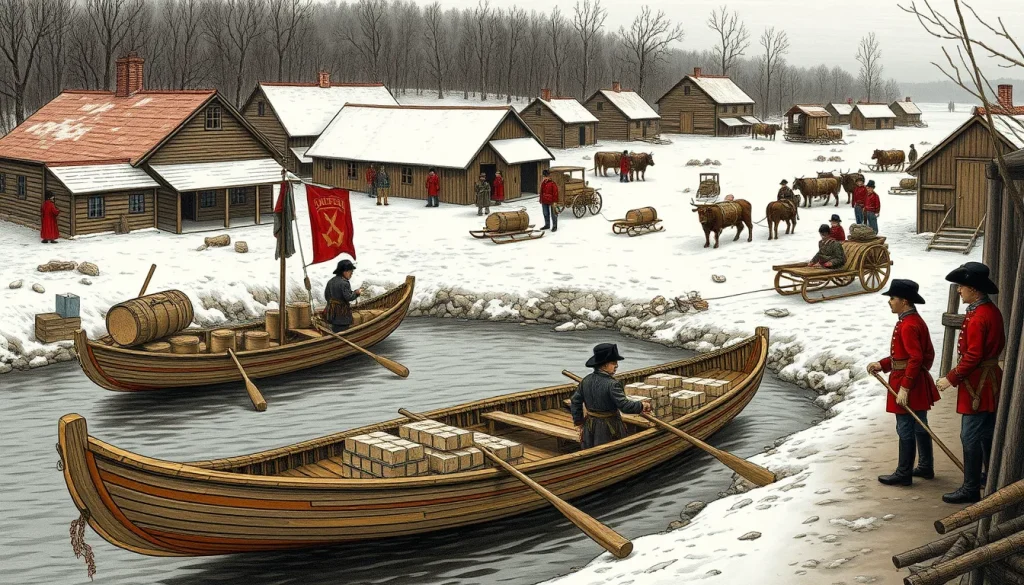
At the start of the war, the Commissariat Department had a small staff and relied on contracts with farmers, merchants, and local officials. It purchased meat, flour, biscuit, salt, rum, forage, fuel, and transport animals, and it arranged for imports from Britain, the Mediterranean, and the West Indies. In September 1812, the British Army raised the Corps of Canadian Voyageurs, largely organized by the North West Company and commanded by William McGillivray, to move supplies between Montreal and the western posts. The corps was disbanded in March 1813, and its duties were taken over by the Canadian branch of the British Commissariat Department as the Provincial Commissariat Voyageurs, which served until March 1815. Supplies travelled by bateaux, flat-bottomed boats of shallow draft that had developed in French Canada, from Montreal toward Kingston. Beyond Prescott, cargo was transferred to lake vessels. In winter, sleighs used the road along the north bank of the St. Lawrence. The route included five rapids between Montreal and Kingston, sometimes requiring cargo to be unloaded and carried overland. In August 1813, a general order from Kingston standardized the field ration to 1 ½ pounds of flour or biscuit and either 10 ½ ounces of salt pork or 1 pound of fresh or salt beef. The order also tried to stop general officers from altering rations without authority. During 1813 and 1814, American offensives disrupted the supply line, and British forces on the Niagara peninsula and at other posts sometimes went short. The war ended in 1815, and the Provincial Commissariat Voyageurs were disbanded that March.
Why It Matters
Logistics governed British strategy in Canada. The Commissariat could not sustain large offensive operations far from water, so British commanders often fought on the defensive or mounted limited raids. The supply system also affected the war’s outcome indirectly: it kept British regulars, militia, and Indigenous allies in the field, helped retain key posts such as Fort Mackinac, and made it possible to contest the Great Lakes. At the same time, shortages, inflation, smuggling from the United States, and coercive measures such as martial law exposed the fragility of the system. Historians disagree about how to weigh these achievements and failures. Some emphasize the Commissariat’s impressive ability to improvise under severe constraints; others stress that the department was never adequately staffed and that Canadian resources were fundamentally insufficient. The topic matters because it shifts attention from battles alone to the administrative and civilian networks that made military operations possible.
Definition
The British Commissariat in Canada was the field branch of the British Army’s civil supply administration, under the authority of HM Treasury. Its core duties were to procure, store, issue, and account for food, forage, fuel, transport, and certain items of shelter for troops. It was not a fighting formation, but it was essential to every campaign. A Commissary General supervised the department, assisted by deputy commissaries, clerks, storekeepers, and transport workers. In North America, the department also supplied provincial forces and, in practice, provided provisions and gifts to Indigenous allies.
Background
The Commissariat had existed in British North America before 1812, but the war forced a rapid expansion. The British Army’s supply system was designed for a global war against Napoleonic France, and Canada was a distant and difficult theatre. The country’s road network was poor, and the Great Lakes and St. Lawrence River were the main arteries of trade and military movement. Bateaux, developed in French Canada in the seventeenth century, were flat-bottomed, double-ended, and shallow-draft, making them suitable for rapids and lakeshores. They could carry about two to three tons of goods. During the War of 1812, the British organized and used these boats on a large scale, but they remained uncomfortable, slow, and vulnerable to weather and enemy attack.
How It Worked
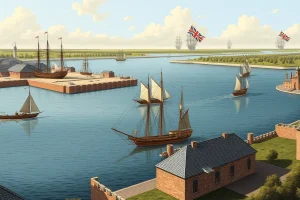
The Commissariat worked through a mixture of contracts, purchases, imports, and requisitions. It contracted with farmers and merchants in Lower and Upper Canada for beef, pork, flour, grain, hay, and oats. It also bought supplies smuggled from the United States, where local trade often continued despite the war. Overseas imports arrived by sea at Quebec or Montreal, usually between April and early October before the lower St. Lawrence froze. From Montreal, bateaux carried stores upriver to Kingston; beyond Prescott, lake vessels took over. In winter, sleighs moved goods along the north bank road. The department maintained magazines and depots at Quebec, Montreal, Kingston, York, Fort George, Amherstburg, and other posts. Rations were issued according to regulations, though actual amounts varied with distance from depots and the efficiency of transport. The Provincial Commissariat Voyageurs, about 400 men, wore civilian voyageur dress rather than uniforms and used their own frontier skills, though they were issued Brown Bess muskets, axes, and knives. The department also had to coordinate with the Royal Navy and Provincial Marine, which competed for the same food, forage, and transport.
Competing Viewpoints
Historians interpret the Commissariat’s performance in different ways. Glenn A. Steppler’s 1974 study argues that Canadian agricultural production and transport were never sufficient for the forces Britain employed, that the Commissariat’s staff was always too small, and that logistical problems limited offensive operations. Yet Steppler also concludes that the department’s logistical achievements were impressive given the obstacles. Other scholars emphasize adaptation and local contribution, pointing to the voyageurs, militia, merchants, and Indigenous suppliers who kept the system running. A 2024 review by Donald E. Graves notes that logistics remains under-discussed in many military histories of the northern border, even though British problems were severe. Some Canadian historians stress the role of Canadian and Indigenous labour; some British and American accounts focus more on shortages and administrative confusion. The debate is not over whether logistics mattered, but over whether it was mainly a story of successful improvisation or of chronic scarcity.
Role in the War of 1812
The Commissariat shaped the war’s major campaigns. In 1812, British control of the upper lakes depended on water transport and provisions for Indigenous allies, helping secure Michilimackinac and Detroit. In 1813, American attacks along the St. Lawrence and Niagara disrupted supply lines and left troops short. In 1814, Lieutenant-General Sir Gordon Drummond’s army on the Niagara peninsula faced serious shortages, and the Commissariat could not always forward reinforcements or provisions. The naval race on Lake Ontario also strained the department, because shipbuilding and naval crews consumed food, forage, and transport that the army needed. Throughout the war, the St. Lawrence corridor was both the main supply route and a front line, so convoys were vulnerable to raid and interdiction. The Commissariat’s work enabled British and Canadian forces to hold key posts and maintain alliances, but it also constrained how far and how fast they could move.
Consequences and Historical Interpretation
The immediate consequence of the Commissariat’s efforts was that British forces in Canada remained supplied well enough to avoid collapse, despite shortages and repeated crises. The war ended with the Treaty of Ghent in 1814 and ratification in 1815, restoring the prewar borders. The supply system did not win the war by itself, but it prevented defeat in a theatre where geography and scarcity were powerful enemies. Longer-term, the war exposed the need for better military transport and provisioning in British North America. It also left a historical memory of the bateaux and voyageurs, whose skills were essential to the British war effort. Historians increasingly treat the Commissariat not as a dull administrative footnote but as a central part of strategy. Steppler’s early study and later work by scholars such as Robert Malcomson and Christopher Dishman show that the ability to feed, move, and equip an army was as important as tactics or leadership. The subject also illuminates the roles of civilians, including farmers, merchants, teamsters, and Indigenous suppliers, who made the war possible.
Primary Sources
The most useful contemporary sources for the British Commissariat are official orders, regulations, and departmental records.
- General Orders, Adjutant-General’s Office, Kingston, 13 August 1813. Held in Library and Archives Canada, RG8 C 3502, vol. 1171: 3, 4, and reproduced in The War of 1812 Magazine, Issue 16. It fixes the field ration and orders that no changes be made without authority. It contributes precise detail on official allowances but does not prove what soldiers actually received.
- General Regulations and Orders for the Army, Horse Guards, 12 August 1811. This British army regulation sets out provisioning rules. It shows the framework the Commissariat was expected to follow, but it is not specific to Canada and may not reflect local practice.
- Commissariat records in Library and Archives Canada, RG8 (British Military and Naval Records). These records include correspondence, accounts, returns, and contracts from British North America. They are essential for reconstructing actual supply operations, though they are incomplete and were created for administrative and financial accountability.
Further Reading
- Steppler, Glenn A. "A duty troublesome beyond measure: logistical considerations in the Canadian War of 1812." PhD diss., McGill University, 1974. DOI: https://doi.org/10.82308/21260.
- Malcomson, Robert. "Nothing more uncomfortable than our flat-bottomed boats: Batteaux in the British Service during the War of 1812." The Northern Mariner/Le marin du nord 13, no. 4 (2003): 17–28. https://cnrs-scrn.org/northern_mariner/vol13/tnm_13_4_17-28.pdf.
- Dishman, Christopher. Warfare and Logistics Along the US-Canadian Border during the War of 1812. Reviewed by Donald E. Graves in Pennsylvania History: A Journal of Mid-Atlantic Studies 91, no. 1 (2024). DOI: https://doi.org/10.5325/pennhistory.91.1.0082.
- Library and Archives Canada, RG8, British Military and Naval Records.
- The War of 1812 Magazine, Issue 16 (September 2011), documents section. https://www.napoleon-series.org/military-info/Warof1812/2011/Issue16/c_Rations1813.html.
References
- Steppler, Glenn A. "A duty troublesome beyond measure: logistical considerations in the Canadian War of 1812." PhD diss., McGill University, 1974. https://doi.org/10.82308/21260.
- Graves, Donald E. Review of Warfare and Logistics Along the US-Canadian Border during the War of 1812, by Christopher Dishman. Pennsylvania History: A Journal of Mid-Atlantic Studies 91, no. 1 (2024). https://doi.org/10.5325/pennhistory.91.1.0082.
- Malcomson, Robert. "Nothing more uncomfortable than our flat-bottomed boats: Batteaux in the British Service during the War of 1812." The Northern Mariner/Le marin du nord 13, no. 4 (2003): 17–28. https://cnrs-scrn.org/northern_mariner/vol13/tnm_13_4_17-28.pdf.
- Adjutant-General’s Office, Kingston. General Orders, 13 August 1813. Library and Archives Canada, RG8 C 3502, vol. 1171: 3, 4. Reproduced in The War of 1812 Magazine, Issue 16 (September 2011). https://www.napoleon-series.org/military-info/Warof1812/2011/Issue16/c_Rations1813.html.
- Adjutant-General’s Office. General Regulations and Orders for the Army. Horse Guards, 12 August 1811.
FAQ
What did the British Commissariat supply in Canada during the War of 1812?
It procured and distributed food, forage, fuel, transport, and some shelter for British regulars, provincial forces, militia, and Indigenous allies. It also arranged contracts, imports, storage, and ration issuance.
How were British supplies moved from Montreal to Upper Canada?
Supplies moved mainly by bateaux from Montreal toward Kingston, then by lake vessels beyond Prescott. In winter, sleighs used the road along the north bank of the St. Lawrence, though the route was vulnerable to American attack.
Was the British Commissariat effective during the War of 1812?
Historians describe a mixed record. It kept British and allied forces in the field and helped retain key posts, but it suffered from inadequate staff, limited Canadian agriculture, transport bottlenecks, and occasional reliance on martial law and smuggling.
Leave a Reply