Short Answer
Tecumseh’s Confederacy was an intertribal Indigenous alliance in the Old Northwest, led by Shawnee chief Tecumseh and his brother Tenskwatawa, that sought to halt United States expansion onto Indigenous lands. During the War of 1812 it entered a military and diplomatic partnership with Britain in Upper Canada and along the Detroit frontier. The alliance gave British forces essential warriors, scouts, and knowledge of the country, while Tecumseh sought British support for Indigenous land rights and a recognized Indigenous territory. Its high point came with the surrender of Detroit in 1812, and its collapse followed Tecumseh’s death at the Battle of the Thames in 1813.
Historical Context
In this article, Tecumseh’s Confederacy means the intertribal movement centered on Prophetstown and Tecumseh’s leadership after about 1808, and the British alliance means its partnership with British military and Indian Department officials in Upper Canada and the Detroit corridor during the War of 1812. The roots lay in the Ohio Valley land conflicts that followed the American Revolution. The 1783 Treaty of Paris ceded British claims to territory south of the Great Lakes without consulting the Indigenous nations who lived there. The United States then negotiated treaties with individual nations at Fort Stanwix, Fort McIntosh, Fort Finney, and Greenville, acquiring large areas of Ohio and Indiana. Many Indigenous leaders argued that land was held in common and that no single nation could sell it without broader consent.
Armed resistance in the 1780s and 1790s, associated with leaders such as Little Turtle and Blue Jacket, ended in defeat at the Battle of Fallen Timbers in 1794 and the Treaty of Greenville in 1795. Tecumseh fought in that conflict and rejected the resulting land cessions. By the early 1800s his brother Tenskwatawa, known as the Prophet, was preaching a revitalization movement that rejected alcohol, factional land sales, and dependence on American goods. In 1808 they established Prophetstown near the confluence of the Wabash and Tippecanoe rivers in what is now Indiana. The settlement became a gathering place for Shawnees, Miami, Potawatomi, Ottawa, Ojibwa, Wyandot, Kickapoo, Winnebago, Sauk, Fox, Delaware, and other peoples.
American territorial governor William Henry Harrison pressed treaty negotiations that further divided Indigenous communities. The 1809 Treaty of Fort Wayne, which Harrison negotiated with several leaders, transferred large tracts in Indiana. Tecumseh denounced such agreements and traveled widely to build a confederacy that could negotiate as a united Indigenous bloc. Meanwhile, British officials in Upper Canada had their own reasons to cultivate Indigenous alliances. The province was sparsely settled, and British regulars were fully engaged with Napoleonic France. The British Indian Department distributed gifts, arms, and provisions and maintained posts such as Fort Malden at Amherstburg, opposite Detroit. When the United States declared war on Britain in June 1812, the northwestern frontier became a meeting point of British strategy and Indigenous resistance.
What Happened
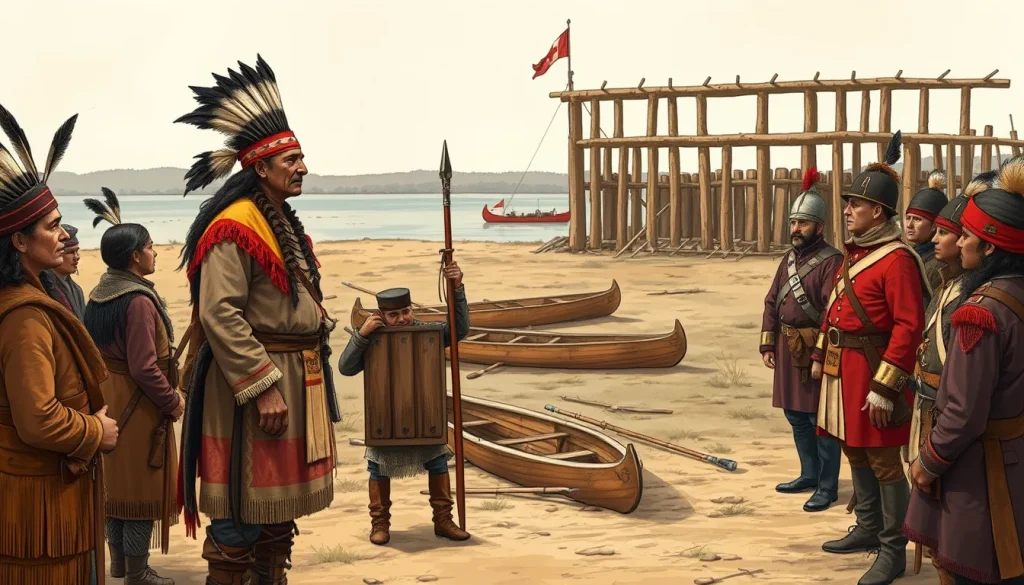
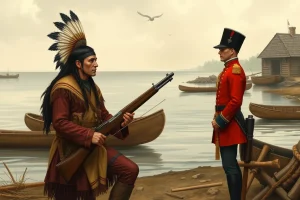
In November 1811, while Tecumseh was recruiting in the South, Harrison marched on Prophetstown. The Battle of Tippecanoe scattered Tenskwatawa’s followers and destroyed the settlement. Harrison claimed a major victory, but the attack also pushed Tecumseh and many of his followers toward a closer partnership with Britain. When war came in 1812, Tecumseh took his warriors to Fort Malden, where he worked with Major-General Isaac Brock, the British commander in Upper Canada. Their cooperation produced early British-Indigenous successes. In July 1812 a British and Indigenous force captured Fort Mackinac, securing the upper Great Lakes. In August, Brock and Tecumseh crossed from Amherstburg to Detroit and compelled American Brigadier-General William Hull to surrender the fort and town without a major battle. Tecumseh’s warriors, arranged to look more numerous than they were, helped convince Hull that resistance was hopeless.
In January 1813, British and Indigenous forces defeated an American column under Brigadier-General James Winchester at the Battle of Frenchtown, also called the River Raisin. After the American surrender, some Indigenous warriors killed wounded prisoners, an event that became a rallying cry for American troops. Later in 1813, Tecumseh and British Colonel Henry Procter besieged Fort Meigs in Ohio. The siege failed, and a second British-Indigenous attack against Fort Stephenson also failed. In September 1813, Oliver Hazard Perry’s American naval victory on Lake Erie cut British supply lines and forced Procter to abandon Detroit and Amherstburg. Tecumseh reluctantly retreated with the British into Upper Canada. On October 5, 1813, Harrison’s army caught Procter’s force near Moraviantown on the Thames River. In the Battle of the Thames, the British line broke, and Tecumseh was killed. His confederacy never recovered as a unified military force.
Why It Matters
The alliance changed the course of the northwestern war. In 1812 it helped Britain and its Indigenous allies offset American numbers and win Detroit and Mackinac. It also made the Detroit frontier a zone of intense and often brutal warfare, with civilian and prisoner killings that shaped American memory. The collapse of the alliance after Lake Erie and the Thames allowed the United States to reassert control over Michigan, Ohio, Indiana, and Illinois. For Indigenous nations, the result was catastrophic. The Treaty of Ghent in 1814 included a provision for restoring Indigenous rights and possessions as they had been in 1811, but the United States did not implement it in a way that protected Indigenous sovereignty. Postwar settlement and land cessions accelerated dispossession, setting precedents for the Indian Removal policies of the 1830s.
Historians disagree about how to describe the alliance. Some emphasize British dependence on Indigenous allies and the genuine military partnership that saved Upper Canada in 1812. Others stress the unequal nature of the relationship: Britain sought to defend Canada, while Tecumseh sought a recognized Indigenous nation or confederacy. The alliance therefore was both practical and fragile. It also matters in memory. In Canada, Tecumseh is often remembered as a loyal ally who died fighting alongside British forces. In the United States, he is frequently portrayed as a noble but doomed opponent. For many Indigenous communities, the confederacy represents an attempt at unity and sovereignty rather than merely an auxiliary of a European empire.
Definition
Tecumseh’s Confederacy was not a single state with a capital, bureaucracy, and permanent army. It was a loose but purposeful coalition of Indigenous nations and bands, bound by shared opposition to American land expansion and by the leadership of Tecumseh and, earlier, Tenskwatawa. The British alliance was a wartime partnership between that coalition and British military and Indian Department officials in Upper Canada. The partnership operated through councils, gift giving, military coordination, and shared campaigns rather than a formal treaty of alliance in the modern diplomatic sense.
Background
The confederacy grew from decades of Ohio Valley warfare, treaty making, and displacement. The Shawnees, Miamis, Delawares, Wyandots, and other nations had repeatedly lost land to American settlement and state and territorial militias. The Prophetstown movement offered spiritual renewal and political unity. British officials in Canada had long maintained connections with Great Lakes and Ohio Valley nations, partly to secure the fur trade and partly to protect Upper Canada. Those connections continued after the Jay Treaty of 1794, even as Britain evacuated its western posts in 1796. By 1812, British Indian Department agents such as Matthew Elliott and Robert Dickson were important intermediaries, distributing goods and recruiting warriors.
How It Worked
The alliance worked through mutual need. Tecumseh’s warriors provided reconnaissance, raids, and combat power. They knew the rivers, trails, and settlements of the Old Northwest far better than British officers. British authorities provided arms, ammunition, clothing, food, and bases such as Fort Malden and Fort St. Joseph. Councils at Amherstburg and elsewhere allowed British and Indigenous leaders to plan operations. The system was decentralized. Tecumseh could persuade and coordinate, but he could not command every warrior or nation as a modern general commands soldiers. British officers likewise had to negotiate with Indigenous leaders rather than issue orders. Supply shortages, competing war aims, and different views of risk repeatedly strained the partnership.
Competing Viewpoints
One interpretation presents the British-Indigenous alliance as a genuine military partnership that exploited American weaknesses and defended Upper Canada. In this view, Brock’s respect for Tecumseh and the joint capture of Detroit show a working coalition. A second interpretation emphasizes British self-interest. Britain needed Indigenous manpower because it could spare few regulars from Europe, but British leaders were not committed to an independent Indigenous state. When Lake Erie was lost, Procter retreated to save his regulars, leaving Tecumseh to fight or retreat as he chose. Historians also debate the Battle of Tippecanoe. Some see Harrison’s attack as the decisive provocation that drove Tecumseh into the British alliance; others argue Tecumseh was already seeking British support and that the confederacy had deeper roots.
Role in the War of 1812
In the northwestern theater, the confederacy and its British allies shaped the campaigns of 1812 and 1813. They captured Mackinac and Detroit, defeated Winchester at the River Raisin, and threatened American positions in Ohio and Indiana. Tecumseh’s presence gave British operations a reach they otherwise lacked. After Perry’s victory on Lake Erie, however, Britain could no longer supply or reinforce its posts around Detroit. Procter’s retreat and the Battle of the Thames ended the alliance’s offensive capacity. Tecumseh’s death on October 5, 1813, removed the most effective Indigenous leader in the region and shattered the confederacy as a coordinated force.
Consequences and Historical Interpretation
The immediate consequence was American reconquest of the Old Northwest and the collapse of Indigenous military resistance in that region. The longer consequence was land loss. Although the Treaty of Ghent promised restoration of Indigenous rights, the United States after 1815 negotiated or imposed new cessions and removed many nations westward. Britain, no longer at war, reduced its Indigenous diplomacy in the region. Historians continue to assess whether the British alliance was a missed opportunity for Indigenous sovereignty or a doomed dependence on an empire that would abandon its allies when convenient. Tecumseh’s Confederacy remains a central example of Indigenous diplomatic and military agency in the War of 1812.
Primary Sources
Several contemporary sources illuminate the alliance, though each has limits.
- Isaac Brock’s dispatches to Governor-General George Prevost in August 1812 describe the capture of Detroit and the cooperation of Indigenous warriors. They are valuable but present a British commander’s perspective and justify his decisions.
- William Henry Harrison’s reports and letters from 1813 describe the Thames campaign and Tecumseh’s death. They reflect an American military and political viewpoint and sometimes identify Tecumseh’s body with uncertainty.
- Henry Procter’s reports and later court-martial testimony defend his retreat after Lake Erie. They are essential but self-exculpatory.
- British Indian Department correspondence by Matthew Elliott, Robert Dickson, and others records councils, gifts, and intelligence. It reveals British organization but usually not Indigenous voices in their own words.
- The Treaty of Ghent, signed in December 1814, includes Article IX on restoring Indigenous rights. It shows diplomatic language, not how the provision was enforced.
- Indigenous oral traditions and later recollections, including Shawnee accounts, preserve Tecumseh’s leadership and the confederacy’s aims. They are vital but were transmitted and shaped over time.
Further Reading
- John Sugden, Tecumseh: A Life.
- John Sugden, Tecumseh’s Last Stand.
- Colin G. Calloway, The Shawnees and the War for America.
- Donald R. Hickey, The War of 1812: A Forgotten Conflict.
- Alan Taylor, The Civil War of 1812.
- Sandy Antal, A Wampum Denied: Procter’s War of 1812.
- Richard White, The Middle Ground.
- David S. Heidler and Jeanne T. Heidler, Courting victory: British, Native and American alliances, U.S. National Park Service.
- James H. Marsh and Tabitha de Bruin, Tecumseh, The Canadian Encyclopedia.
References
- Heidler, David S., and Jeanne T. Heidler. Courting victory: British, Native and American alliances. U.S. National Park Service. https://www.nps.gov/articles/courting-victory.htm
- Marsh, James H., and Tabitha de Bruin. Tecumseh. The Canadian Encyclopedia. https://thecanadianencyclopedia.ca/en/article/tecumseh
- Sugden, John. Tecumseh: A Life. New York: Henry Holt, 1997.
- Calloway, Colin G. The Shawnees and the War for America. New York: Viking, 2007.
- Hickey, Donald R. The War of 1812: A Forgotten Conflict. Urbana: University of Illinois Press, 2012.
- Taylor, Alan. The Civil War of 1812. New York: Knopf, 2010.
- Antal, Sandy. A Wampum Denied: Procter’s War of 1812. Montreal: McGill-Queen’s University Press, 1997.
- White, Richard. The Middle Ground. Cambridge: Cambridge University Press, 1991.
FAQ
What was Tecumseh's Confederacy?
It was an intertribal Indigenous coalition led by Shawnee chief Tecumseh and his brother Tenskwatawa, formed to resist American land expansion in the Old Northwest. It allied with Britain during the War of 1812 and included warriors from many nations, including Shawnee, Miami, Potawatomi, Ottawa, Ojibwa, Wyandot, and Kickapoo.
Why did Tecumseh ally with Britain?
Tecumseh sought British support to protect Indigenous lands and to counter American expansion after U.S. forces attacked Prophetstown at the Battle of Tippecanoe in 1811. Britain, already at war with the United States after June 1812, needed Indigenous manpower and knowledge to defend Upper Canada.
What happened to the confederacy after Tecumseh's death?
Tecumseh was killed at the Battle of the Thames on October 5, 1813. His confederacy lost its most effective leader and never recovered as a unified military force. The United States reasserted control over the Old Northwest, and Indigenous nations faced accelerating land loss after the war.

Leave a Reply