Short Answer
Tecumseh (c. 1768 – 5 October 1813), the Shawnee war leader and principal organizer of an intertribal confederacy in the Old Northwest, allied with Great Britain after the United States declared war in June 1812 and became the most formidable Indigenous commander on the Detroit frontier. Between the summer of 1812 and the autumn of 1813 he helped to break the first American invasion of Upper Canada, contributed to the surrender of Fort Detroit, fought at Fort Meigs, and was killed at the Battle of the Thames near Moraviantown. His death removed the central figure of organized Indigenous resistance in the Northwest and marked the effective collapse of the confederacy’s goal of a recognized Indigenous territory between the United States and British North America.
This article treats Tecumseh as a historical person and concentrates on his activity in the War of 1812. It does not attempt a full biography of his earlier career or a general history of the war; where the record is uncertain, the uncertainty is stated.
Historical Context
The war on the Detroit frontier grew out of a generation of conflict over land north of the Ohio River. Although Britain ceded its claims to the region in the Treaty of Paris of 1783, the United States moved quickly to survey and settle it. Shawnee, Miami, Delaware, Wyandot, Potawatomi, Odawa, Ojibwe, Kickapoo, Sauk, and other nations contested the validity of the cessions the United States had obtained, above all the Treaty of Fort Stanwix (1768), in which the Haudenosaunee sold land they claimed by conquest, and the treaties of Fort Finney (1786) and Greenville (1795), which transferred much of Ohio out of Indigenous hands.
Indigenous leaders had attempted since the 1780s to build a common front. The Mohawk leader Joseph Brant and others advanced the doctrine that land was held in common and that no single nation could sell it without the consent of the others. Armed resistance produced two severe defeats of the United States Army — the rout of Josiah Harmar’s force in 1790 and the destruction of Arthur St. Clair’s army on the Wabash on 4 November 1791 — but Major General Anthony Wayne’s victory at Fallen Timbers in 1794 broke that earlier confederacy.
British officials at Fort Malden, at Amherstburg in Upper Canada, monitored and supplied the nations of the Old Northwest through the Indian Department, partly to protect the fur trade and partly to maintain a buffer against American expansion. In 1808 Tecumseh and his brother Tenskwatawa, the Prophet, established a village on the Wabash River at its confluence with the Tippecanoe — commonly called Prophetstown — as a centre of religious revival and political unity. On 7 November 1811, while Tecumseh was travelling in the South, a force under William Henry Harrison destroyed the village at the Battle of Tippecanoe. When the United States declared war on Britain on 18 June 1812, Upper Canada was held by a small number of regulars, an unreliable militia, and the Indigenous nations whose partnership Britain now needed far more than before.
What Happened
American strategy in the west centred on Detroit. On 12 July 1812 Brigadier General William Hull crossed the Detroit River from Ohio into Upper Canada and occupied the town of Sandwich. Tecumseh, who had brought his warriors to Amherstburg, joined Major General Isaac Brock. In early August his men ambushed an American supply detachment near Brownstown, killing roughly twenty soldiers and capturing dispatches, and on 9 August they fought again at Maguaga. These actions disrupted Hull’s communications and helped isolate his army.
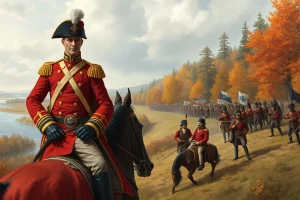
The decisive moment came on 16 August 1812. Brock demanded Hull’s surrender, and Tecumseh’s warriors — several hundred strong, marching and manoeuvring within sight of the fort — contributed to the impression of overwhelming force. Hull surrendered Fort Detroit and an army commonly estimated at about 2,200 men. The Detroit frontier, and with it the western flank of Upper Canada, was cleared of American troops in a single stroke, and Brock’s partnership with Tecumseh became one of the most remarked-upon alliances of the war.
In January 1813 American forces advanced again towards the River Raisin; the battles of 18 and 22 January ended in American defeat, and the killing of wounded prisoners afterwards by some Indigenous warriors became a staple of American propaganda. In the spring, a combined British and Indigenous force under Brigadier General Henry Procter and Tecumseh besieged Fort Meigs on the Maumee River from 28 April to 9 May 1813, shattering an American relief column on 5 May. Tecumseh is widely credited with intervening to stop the killing of prisoners taken in that action, an episode his contemporaries cited as evidence of his authority over allied warriors.
A second attempt on Fort Meigs in July 1813 failed. On 10 September 1813 Oliver Hazard Perry’s squadron destroyed the British fleet on Lake Erie, severing the supply line to Amherstburg and Detroit. Procter began a retreat up the Thames River; Tecumseh, who regarded the abandonment of the Detroit frontier as a betrayal of his people’s interests, followed with his warriors. On 5 October 1813 Harrison’s army of roughly 3,500 struck the retreating force near Moraviantown. The British regulars broke quickly and surrendered; Tecumseh’s men, posted in a swamp, resisted longer. Tecumseh was killed in the fighting. His body was not identified with certainty, and his followers dispersed.
Why It Matters
In the short term, Tecumseh’s alliance with Britain was decisive in the defence of Upper Canada in 1812 and 1813, and his warriors supplied the numbers, scouting, and knowledge of terrain that British regulars could not. Conversely, the collapse of the confederacy after his death opened the Old Northwest to American consolidation, though some nations continued to resist for decades.
In the longer term, the Treaty of Ghent of 24 December 1814 ended the war without any provision for Britain’s Indigenous allies, and Britain dropped its demand for an Indigenous buffer territory. American treaty-making and, later, forced removal followed in the regions where Tecumseh had recruited. Historians generally agree that the war’s outcome was far more damaging for Indigenous nations than for either empire, but they differ on how much of that outcome should be attributed to his death rather than to the balance of power on the frontier.
Interpretations of Tecumseh himself have shifted. Nineteenth-century Canadian accounts cast him as the saviour of Upper Canada and a loyal British ally; American accounts often treated him as an auxiliary of British policy or as a frontier adversary. From the 1980s, scholars such as John Sugden, R. David Edmunds, Gregory Evans Dowd, and Colin Calloway have re-centred the story on Indigenous objectives, arguing that Tecumseh fought for his own peoples’ land and sovereignty rather than for Britain. Points that remain disputed or poorly documented include the precise command arrangements with British officers, the identity of the person who shot him, and the degree to which he envisioned a formal independent Indigenous nation rather than a defensive confederacy.
Early Life
Tecumseh was probably born about 1768 on the Scioto River in south-central Ohio, at or near Chillicothe or Kispoko, into the Kispoko division of the Shawnee. His name is generally understood to refer to a shooting star or celestial panther, associated with his clan’s spiritual patrons. His father, Puckeshinwa, a Shawnee chief, was killed on 10 October 1774 at the Battle of Point Pleasant. Between 1774 and 1782 Shawnee towns were repeatedly occupied or destroyed by invading armies, and in 1786 Kentucky militia destroyed several villages, including Tecumseh’s. The family moved to the Maumee River, where intertribal resistance to American settlement was organized.
Tecumseh trained as a warrior under his elder brother Cheeseekau, who was killed in an attack on a fortified post near Nashville around 1792. He first distinguished himself in an attack on a flatboat on the Ohio River in 1788 and acquired a reputation for boldness, endurance, and personal discipline.
Role Before the War
Tecumseh fought through the campaigns of the early 1790s and was present at Fallen Timbers in 1794, where he distinguished himself in an attack on an American gun crew. He did not accept the Treaty of Greenville of 1795, though he was then only a minor chief. In 1798 he led a band of roughly 250 people, including some forty to fifty warriors, to the west fork of the White River in what is now Indiana.
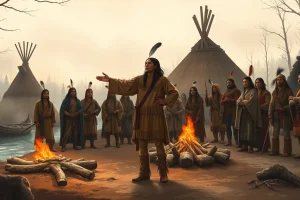
After his brother Lalawethika’s transformation into Tenskwatawa, the Prophet, in 1805, Tecumseh adopted traditional dress and threw himself into rebuilding intertribal resistance. The brothers established Prophetstown in 1808. Tecumseh travelled widely among the nations of the Northwest and, in 1810 and 1811, into the South to meet Creek, Chickasaw, and Choctaw leaders. His central argument was that Indigenous land was held in common and that no individual or nation could cede it without collective consent — an idea with roots in earlier pan-Indigenous diplomacy rather than an invention of his own. He met Harrison at Vincennes in 1810 in a tense confrontation over lands ceded by the Treaty of Fort Wayne. While he was absent in the South, Prophetstown was destroyed at Tippecanoe on 7 November 1811, a blow that narrowed his options and pushed the confederacy towards an open alliance with Britain.
Role During the War
After the American declaration of war, Tecumseh brought his warriors to the British post at Amherstburg. His value to the British was immediate: Upper Canada lacked regular troops, and the confederacy supplied scouts, skirmishers, and knowledge of the country that regular units could not replace. In return, Tecumseh sought British recognition of Indigenous territorial claims in any peace settlement. Some accounts, including that of the U.S. National Park Service, describe Brock placing Tecumseh in command of the Indigenous forces on the Detroit frontier; the surviving British correspondence confirms his extraordinary influence without documenting a formal commission in detail.
Tecumseh’s authority rested on personal prestige, oratory, and success in the field rather than on a bureaucratic rank, and it depended on the willingness of warriors from many nations to follow him. Relations with Procter, Brock’s successor, deteriorated as British priorities shifted eastward and supplies ran short. When Procter decided to abandon the Detroit frontier after the loss of Lake Erie, Tecumseh’s objections were both strategic and personal: retreat meant surrendering the lands his confederacy had taken up arms to defend.
Major Actions
His principal engagements in the war were the ambush near Brownstown and the action at Maguaga in August 1812; the capitulation of Fort Detroit on 16 August 1812; the River Raisin campaign of January 1813; the siege of Fort Meigs and the defeat of the American relief column on 5 May 1813; the second siege of Fort Meigs in July 1813; and the Battle of the Thames on 5 October 1813, where he was killed. In several of these actions he combined conventional manoeuvre with the dispersed, cover-based tactics of Indigenous warfare, and he repeatedly intervened to protect prisoners — conduct that even hostile American officers noted.
Contemporary Accounts
The fullest contemporary descriptions come from British and American officers. Brock’s correspondence praised Tecumseh in unusually strong terms, reported as a more sagacious or more gallant warrior does not, I believe, exist. Harrison, writing in 1811, described Tecumseh’s influence over widely separated nations as marking him out as one of those uncommon geniuses which occasionally appear to overturn the existing order. The future novelist John Richardson, then a teenage volunteer in the British ranks, later recalled the force of Tecumseh’s presence among the soldiers at Amherstburg. Procter’s and Harrison’s official reports supply the operational record of 1813.
These accounts are valuable but partial. Every one of them was written by a non-Indigenous officer or official, most of them describing Tecumseh to superiors or readers with their own reputations to protect. No letters, speeches, or other writings composed by Tecumseh himself are known to survive; the speeches attributed to him in later publications derive from second-hand transcription or reminiscence and cannot be treated as verbatim.
Later Life
This heading cannot be filled in the usual way, because Tecumseh’s life ended during the war: he was killed at the Battle of the Thames on 5 October 1813, at about forty-five years of age, in the territory he had come north to defend. What can be described is the aftermath for those who followed him. His confederacy fragmented; Tenskwatawa survived until 1836 and eventually settled in what is now Kansas, while other communities dispersed to British-held territory or to American reserves. No authoritative account records the fate of his immediate family.
Historical Legacy
In Canada, Tecumseh was commemorated early as a defender of Upper Canada, and a monument stands near Thamesville, Ontario, close to the battlefield. In the United States, his death was politicized almost immediately: Richard Mentor Johnson, a Kentucky officer, built a political career partly on his claim to have killed Tecumseh and was elected vice president in 1836, while Harrison’s association with Tippecanoe shaped his public image and his 1840 presidential campaign.
For many Indigenous nations, Tecumseh is remembered less as an ally of Britain than as a leader who sought a secure and independent Indigenous homeland and who insisted that land could not be sold by any single nation. Modern scholarship generally treats him as a skilled diplomat and field commander whose coalition was the most serious Indigenous attempt to check American expansion east of the Mississippi, and whose death, together with the Treaty of Ghent’s silence on Indigenous interests, left the nations of the Old Northwest without British protection.
Primary Sources
- Isaac Brock’s despatches and proclamations (1812). Brock’s letters to Governor General George Prevost and his proclamation to the inhabitants of Upper Canada document the British reliance on Indigenous allies and his assessment of Tecumseh. They are official documents written to justify decisions and secure resources, and they reflect a British perspective.
- William Henry Harrison’s correspondence (1811–1813). Harrison’s letters to the War Department, including his 1811 estimate of Tecumseh’s influence, describe the American view of the confederacy. They are the reports of an adversary and a territorial official with political ambitions.
- Henry Procter’s reports and court-martial proceedings (1813–1815). Procter’s account of the retreat up the Thames and his later court martial illuminate British-Indigenous tensions. The proceedings are adversarial and shaped by Procter’s need to defend his conduct.
- John Richardson, War of 1812 (1840) and related memoirs. Richardson served as a young British volunteer and wrote decades later. Vivid and frequently quoted, his recollections are retrospective and literary rather than contemporaneous.
- Treaty of Ghent, 24 December 1814. The treaty ended the war without any article addressing the Indigenous nations allied to Britain, a silence with direct consequences for Tecumseh’s followers. No transcript of a speech or letter by Tecumseh is known to survive; readers seeking the nearest contemporary record should consult British and American official correspondence in Library and Archives Canada and the U.S. National Archives.
Further Reading
- John Sugden, Tecumseh: A Life (Henry Holt, 1998) — the standard scholarly biography.
- R. David Edmunds, Tecumseh and the Quest for Indian Leadership (Little, Brown, 1984).
- Gregory Evans Dowd, A Spirited Resistance: The North American Indian Struggle for Unity, 1745–1815 (Johns Hopkins University Press, 1992).
- Colin G. Calloway, The Shawnees and the War for America (Viking, 2007).
- Alan Taylor, The Civil War of 1812 (Knopf, 2010).
- Donald R. Hickey, The War of 1812: A Forgotten Conflict (University of Illinois Press).
- National Park Service, War of 1812 subject pages, including “Indigenous Peoples.”
- Library and Archives Canada, War of 1812 records and the Dictionary of Canadian Biography entry on Tecumseh.
References
- National Park Service, “Indigenous Peoples,” War of 1812, https://nps.gov/subjects/warof1812/indigenous-peoples.htm
- The Canadian Encyclopedia, “Tecumseh and the War of 1812,” https://thecanadianencyclopedia.ca/en/article/tecumseh-the-savior-of-upper-canada-feature
- James H. Marsh and Tabitha de Bruin, “Tecumseh,” The Canadian Encyclopedia, https://thecanadianencyclopedia.ca/en/article/tecumseh
- Molly Stephey and James Ring Adams, “Tecumseh’s War: The Road to 1812,” NMAI Magazine 13, no. 1 (Spring 2012), https://www.americanindianmagazine.org/story/tecumsehs-war-road-1812
- Supreme Court of Ohio, “Tecumseh (c. 1768 – Oct. 5, 1813),” https://www.supremecourt.ohio.gov/courts/judicial-system/supreme-court-of-ohio/mjc/interest/native-american-lobby/tecumseh/
- John Sugden, Tecumseh: A Life (New York: Henry Holt, 1998).
- Gregory Evans Dowd, A Spirited Resistance: The North American Indian Struggle for Unity, 1745–1815 (Baltimore: Johns Hopkins University Press, 1992).
- Alan Taylor, The Civil War of 1812 (New York: Knopf, 2010).
FAQ
Why did Tecumseh side with the British in the War of 1812?
Tecumseh's confederacy had been fighting American expansion north of the Ohio River for years, and Britain was the only power in the region able and willing to supply arms, provisions, and military support. At Amherstburg he secured British backing in return for military assistance, while pressing for recognition of Indigenous territorial claims in any peace settlement. His objective was an Indigenous homeland, not the defence of the British Empire.
How did Tecumseh die?
He was killed on 5 October 1813 at the Battle of the Thames near Moraviantown in Upper Canada, while his warriors resisted Harrison's much larger American army after the British regulars had broken and surrendered. His body was not identified with certainty. Several men later claimed to have shot him, most prominently the Kentucky officer Richard Mentor Johnson, but no claim is verifiable from contemporary evidence.
What happened to Tecumseh's confederacy after his death?
It fragmented. With no leader of comparable standing and with British support withdrawn from the Detroit frontier, the coalition did not recover. The Treaty of Ghent of 24 December 1814 made no provision for Britain's Indigenous allies, and Britain abandoned its demand for an Indigenous buffer territory. In the following decades, American treaty-making and forced removal reshaped the nations of the Old Northwest and the South.

Leave a Reply