Short Answer
During the War of 1812, the British conducted several amphibious raids on American-controlled shores of Lake Ontario, the most significant being the attacks on Sackets Harbor on 29 May 1813 and Oswego on 6 May 1814. These operations reflected the critical importance of controlling Lake Ontario, as both sides sought to build and protect naval squadrons that would command the lake and supply routes. By combining Royal Navy warships with small army landing forces, the British aimed to destroy American naval stores, delay ship construction, and support land operations along the Niagara frontier.
Historical Context
Lake Ontario served as the central artery for military movement and logistics in the Upper Canada theatre. Control of the lake allowed a side to move troops and supplies rapidly and to strike at enemy bases. At the outbreak of war, the British had a small naval force, the Provincial Marine, but it was primarily a transport service. The Americans, recognizing the need for a warship squadron, established a major naval yard at Sackets Harbor, New York, where Commodore Isaac Chauncey began building a fleet. In response, the British dispatched Commodore Sir James Lucas Yeo with experienced Royal Navy officers and men in early 1813 to take command of the Lake Ontario squadron, based at Kingston at the eastern end of the lake.
By May 1813, Chauncey’s squadron had become strong enough to support American land operations on the Niagara Peninsula, leaving Sackets Harbor vulnerable. The British, under Lieutenant General Sir George Prevost, sought to exploit this temporary advantage by launching a raid on the American naval base. The attack aimed to relieve pressure on British forces in the Niagara region and to destroy the ship under construction at the harbor. By 1814, the strategic situation had shifted, and the British again used their naval supremacy to strike at the American supply line at Oswego, a key transit point for heavy ordnance destined for Sackets Harbor.
What Happened
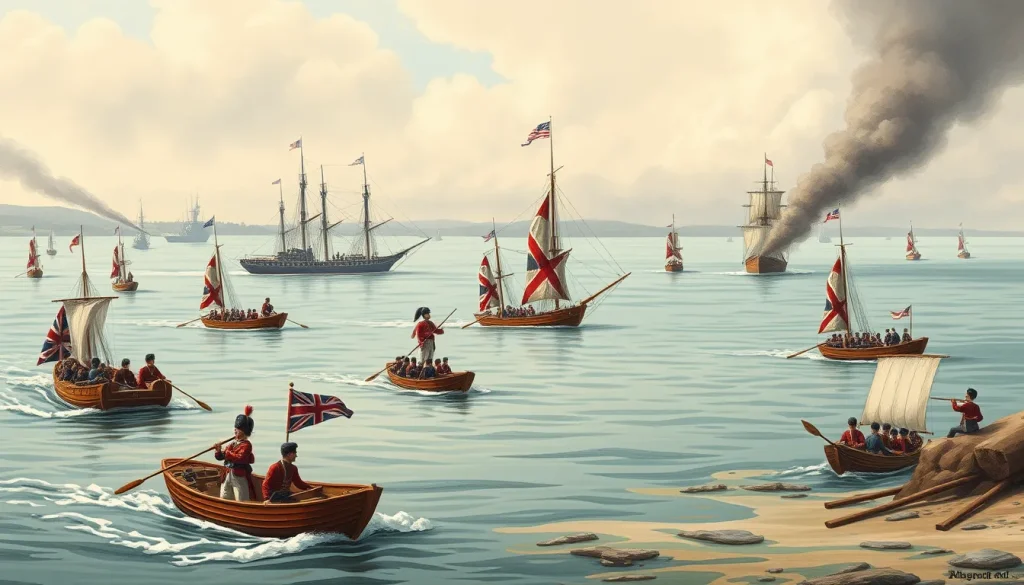
The raid on Sackets Harbor in 1813 was launched from Kingston on 27 May. A force of about 800 troops, drawn from the light companies of eight regiments and including 40 Indigenous warriors, was embarked on Yeo’s five warships and 33 bateaux. Colonel Edward Baynes commanded the landing force, while Yeo led the flotilla. Prevost accompanied for political and strategic oversight. The Americans, warned by the sighting of the British force, prepared defenses centered on an abatis and artillery batteries. On the morning of 29 May, the British landed east of the harbor, but the initial militia resistance collapsed. The regulars, however, formed strong defenses, and Baynes’s assault stalled. With casualties mounting and the threat of Chauncey’s squadron returning, Prevost ordered a withdrawal. The British lost 47 killed, 195 wounded, and 16 missing; American losses were about 21 killed, 85 wounded, and 154 missing. During the battle, American panicked soldiers set fire to their own storehouses, but the damage was limited.
In May 1814, the British attempted another raid, this time on Fort Ontario and the village of Oswego. The landing force, over 900 strong, was commanded by Lieutenant Colonel Victor Fischer of the Regiment de Watteville, with naval command by Yeo. The British squadron, including the frigates Prince Regent and Princess Charlotte, bombarded the fort while troops landed. Despite the soaking of ammunition, the British advanced with bayonets and captured the fort after the American defenders retreated. The raid was a tactical success, but the delay in the landing had allowed the Americans to move most of the valuable guns and stores inland, reducing the strategic impact.
Why It Matters
These raids demonstrated the difficulty of amphibious operations in the confined, storm-prone waters of Lake Ontario. They also underscored the importance of naval supremacy; the failure at Sackets Harbor preserved Chauncey’s shipbuilding capability and allowed the Americans to continue their naval program. The attack on Oswego, while successful, failed to change the balance of naval power because the vital ordnance escaped capture. Historians argue that the raids, despite mixed results, forced the Americans to divert troops to defend their bases, and they contributed to the strategic stalemate on the lake. The raids also illustrated the cooperation between the British army and navy, which was a key factor in maintaining control of Upper Canada.
Definition
Amphibious raids are military operations launched from the sea by naval forces to land troops on a hostile shore for a limited objective, typically to seize, destroy, or disrupt a target, followed by withdrawal. In the War of 1812, such raids were conducted by the British on Lake Ontario to strike at American naval infrastructure and supply lines.
Background
The British and American naval squadrons on Lake Ontario were engaged in an arms race. The British operated from Kingston, while the Americans from Sackets Harbor. By 1813, Yeo had formed a disciplined squadron, but both sides were wary of risking their ships in a decisive battle. Raids offered a way to project power without committing the whole fleet, and the British used them to gain local advantage and delay American construction.
How It Worked
British amphibious raids on Lake Ontario followed a general pattern. A landing force, composed of regular soldiers, marines, and sometimes sailors, was embarked on Yeo’s warships and transports. The squadron would sail from Kingston, often at night, to avoid detection. Upon arriving off the target, the ships would provide naval gunfire support, bombarding enemy shore batteries and positions. Troops would then land in boats, often under enemy fire, and attempt to achieve their objective quickly. The raid was designed to be swift, with the force re-embarking after completion. Command was split: the naval officer (Yeo) controlled the fleet and fire support, while an army officer (such as Baynes or Fischer) commanded the landing force. Coordination was essential but often challenged by weather and enemy resistance.
Competing Viewpoints
Historians have debated the effectiveness of these raids. Some argue that the raid on Sackets Harbor was a wasted opportunity; had Baynes pressed the assault, he might have destroyed the American shipyard. Others contend that Prevost’s decision to withdraw was prudent, given the risk of losing the landing force to Chauncey’s returning squadron. The Oswego raid is similarly debated: some emphasize the capture of the fort and village, while others point out that the failure to seize the heavy guns meant the raid did little to alter the naval balance.
Role in the War of 1812
The raids were part of a broader British strategy to protect Upper Canada. By striking at American naval bases, the British hoped to slow American shipbuilding and preserve their own command of the lake. The raids also served as diversions, shifting American forces away from the Niagara frontier. They were successful in this regard; after Sackets Harbor, Chauncey kept his squadron near his base, leaving American army operations unsupported, which contributed to the British victory at Stoney Creek.
Consequences and Historical Interpretation
The immediate consequences of the raids were mixed: Sackets Harbor was a tactical repulse, while Oswego was a tactical victory. Strategically, they helped the British maintain a stalemate on Lake Ontario, preventing the Americans from gaining a decisive naval advantage. In the longer term, the raids demonstrated the viability of joint operations and set precedents for later amphibious warfare. Historians view these operations as emblematic of the challenges of fighting on the Great Lakes, where weather, logistics, and the small scale of forces shaped the course of the war.
Primary Sources
Contemporary accounts include the ship’s log of HMS Wolfe, Yeo’s flagship, which provides daily observations of the raids. Lieutenant Joseph Mermet of the Regiment de Watteville wrote a detailed letter describing the Oswego attack, preserved in the Viger Papers at Library and Archives Canada. American commander Jacob Brown’s reports to his superiors document the defense of Sackets Harbor. These sources offer contrasting perspectives, though each carries biases of rank, nationality, and memory.
Further Reading
- Robert James Williamson, “The First Encounter: Fighting for Naval Supremacy on Lake Ontario, 7–10 August 1813,” Canadian Military History 11, no. 3 (2002).
- John R. Grodzinski, “Battle of Sackets Harbor,” The Canadian Encyclopedia, 2011.
- Donald E. Graves, Field of Glory: The Battle of Crysler’s Farm, 1813 (Toronto: Robin Brass Studio, 1999).
- J. Mackay Hitsman, The Incredible War of 1812 (Toronto: University of Toronto Press, 1965).
- Library and Archives Canada, Manuscript Group 24, L8, Viger Papers, Saberdache Bleu, vol. 4.
References
- Grodzinski, John R. “Battle of Sackets Harbor.” The Canadian Encyclopedia, last edited December 15, 2013. https://thecanadianencyclopedia.ca/en/article/raid-on-sackets-harbor.
- Williamson, Robert James. “The First Encounter: Fighting for Naval Supremacy on Lake Ontario, 7–10 August 1813.” Canadian Military History 11, no. 3 (2002). http://scholars.wlu.ca/cmh/vol11/iss3/3.
- “Battle of Sackets Harbor – War of 1812.” thewarof1812.org. Accessed 2024. https://thewarof1812.org/battles/battle-of-sackets-harbor/.
- “Napoleon Series: War of 1812 Issue 3.” The Napoleon Series, June 2006. https://www.napoleon-series.org/military-info/Warof1812/2006/Issue3/c_oswego.html.
- “Battle of Fort Oswego (1814).” Wikipedia. https://en.wikipedia.org/wiki/Raid_on_Fort_Oswego.
FAQ
What was the purpose of the British amphibious raids on Lake Ontario?
The raids aimed to destroy American naval stores, delay ship construction, and relieve pressure on British land forces by attacking American bases and supply lines on Lake Ontario.
Why did the British raid Sackets Harbor in 1813?
Sackets Harbor was the primary American naval base on Lake Ontario. The British sought to destroy the yard and the ship under construction, which contributed to naval superiority, while the American squadron was away supporting the Niagara campaign.
What were the results of the raid on Oswego in 1814?
The British captured Fort Ontario and the village of Oswego, but most of the heavy guns and supplies had been removed inland, limiting the strategic benefit. The raid was a tactical success but did not decisively alter naval balance.

Leave a Reply