
Short Answer
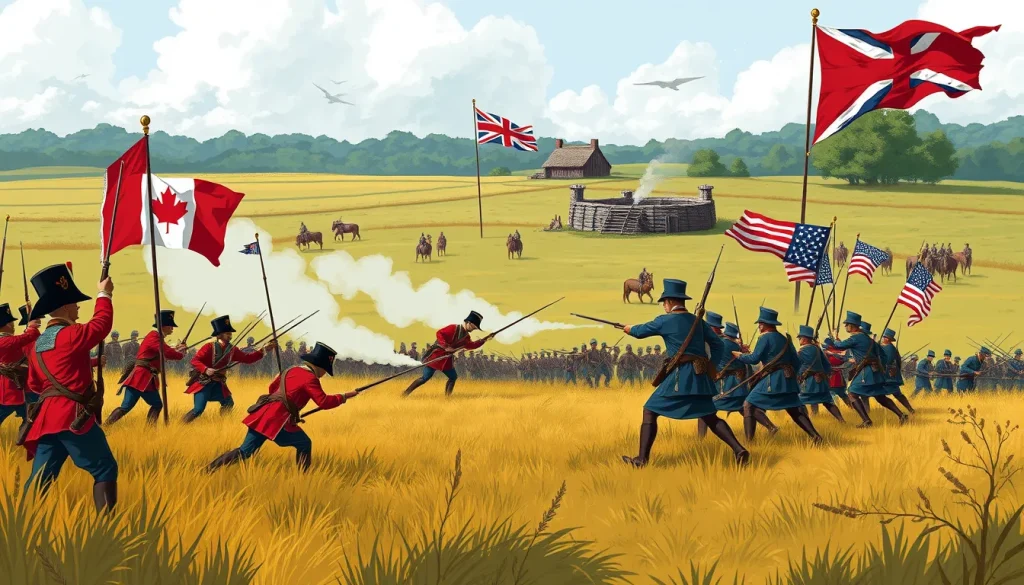
The War of 1812 (1812–1815) pitted the United States against Great Britain and its North American colonies. At the time, the territory that today comprises Canada was divided into separate British colonies—most prominently Upper Canada (now Ontario) and Lower Canada (now Quebec), along with the Maritime provinces. There was no independent nation called Canada, yet the term “Canada” was commonly used to refer to these British possessions. American leaders aimed to conquer these lands, and the war’s outcome profoundly influenced the development of a future Canadian nation.
Historical Context
The roots of the War of 1812 lay in the global conflict between Britain and Napoleonic France, which led to British restrictions on American trade and the impressment of American sailors. Additionally, American expansionists, known as War Hawks, saw an opportunity to annex British North America. They believed, as Thomas Jefferson reportedly said, that capturing Canada would be “mere a matter of marching.” The colonies themselves were composed of a mix of Loyalists who had fled the American Revolution, French-speaking “Canadiens” in Lower Canada, and recent American immigrants in Upper Canada. British authorities maintained control through military garrisons and the colonial militia, while a network of Indigenous allies, led by figures like Tecumseh, formed crucial partnerships.
What Happened
The United States declared war on June 18, 1812, and immediately launched invasions of Upper and Lower Canada. American forces were repelled at Queenston Heights (October 1812), where British commander Isaac Brock was killed, and at Châteauguay (October 1813) and Crysler’s Farm (November 1813) in Lower Canada. In 1813, American troops briefly captured and burned York (present-day Toronto), but later withdrew. The war saw significant fighting on the Great Lakes and along the Niagara frontier, as well as British counterattacks, including the burning of Washington, D.C., in 1814. By the end of 1814, neither side had gained decisive territorial advantage, and diplomatic negotiations at Ghent produced the Treaty of Ghent (December 24, 1814), which restored pre-war boundaries and essentially maintained the colonial status quo. The final battle, at New Orleans, occurred after the treaty was signed but before news reached America.
Why It Matters
The war’s immediate effect was the preservation of British North America as a separate entity, not incorporated into the United States. It also gave rise to a narrative of Canadian militia and Indigenous warriors, alongside British regulars, successfully defending their homeland—a narrative that became central to English-Canadian identity in the nineteenth century. However, the war was disastrous for Indigenous nations; they lost warriors, their homeland in the American interior, and any hope of halting American expansion. The Treaty of Ghent’s Article IX, which promised to restore Indigenous lands, was largely ignored. Later historians have emphasized the role of British regulars as the decisive military force, while also acknowledging the contributions of the Canadian militia and Indigenous allies. The war marked a step toward responsible government and, decades later, Confederation in 1867, as the colonies moved from separate entities to a unified Canada.
Definition
In the context of the War of 1812, “Canada” was not a sovereign state but a geographic and administrative term. It referred specifically to the Province of Upper Canada and the Province of Lower Canada, created by the Constitutional Act of 1791, and sometimes to all British North American colonies, including Nova Scotia, New Brunswick, and Prince Edward Island. The residents were British subjects, and their governments were subject to the British Crown. The term “Canadian” at that time generally meant a French-speaking settler in Lower Canada, though English-speaking settlers also used it. The modern sense of Canada as a country did not exist.
Background
Following the American Revolution, thousands of Loyalists migrated north, leading to the division of the old Province of Quebec into Upper Canada (largely English-speaking and British in character) and Lower Canada (majority French-speaking and Catholic). These colonies were governed by appointed governors and legislative councils, with elected assemblies subject to colonial oversight. The American republic, meanwhile, harbored dreams of incorporating its northern neighbor. The 1812 declaration of war explicitly cited impressment and trade restrictions, but expansionist sentiment was strong, particularly among southern and western War Hawks.
How It Worked
During the war, British military commanders coordinated regular army units, colonial fencible regiments, and locally raised militia. The governments of Upper and Lower Canada operated under British martial law and civil administration, with governors like George Prevost and Isaac Brock overseeing defense. The colonies had no independent foreign policy, and their military efforts were directed by the British War Office. For most colonists, life continued under British law, and the war was an imperial conflict in which they were belligerents on the British side.
Competing Viewpoints
Americans often regarded Canada as a vulnerable, potentially willing addition to the United States. Some believed the colonists were unhappy under British rule and would welcome American troops as liberators. This proved largely untrue; the population in Upper Canada, especially, included many recent American immigrants who were neutral or sympathetic, but the British and Loyalist elite maintained control. British and Canadian contemporaries viewed the colonies as loyal parts of the British Empire, defending themselves against an unprovoked invasion. Modern scholars emphasize the diversity of loyalties, noting that some colonists remained neutral, some supported the American cause, and many were coerced into militia service.
Role in the War of 1812
The invasions of Canada were a central strategic aim for the United States. American planners targeted Upper and Lower Canada because they were lightly defended and seen as a means to pressure Britain. The British and their colonial allies fought to retain the colonies. The war’s progress hinged on the control of the Great Lakes, where naval battles like Lake Erie (1813) gave the Americans temporary superiority but not decisive conquest. In 1814, as the Napoleonic conflict ended, Britain sent reinforcements and launched counter-offensives, but the Treaty of Ghent essentially restored pre-war boundaries, preserving British North America.
Consequences and Historical Interpretation
The war reinforced the colonial status quo but also sowed seeds of unity among the British North American colonies. The shared experience of repelling invasions contributed to a sense of distinct identity, particularly in Upper Canada, where the militia’s role was celebrated. The postwar period saw increased immigration, economic development, and political reforms that gradually moved toward responsible government. Historians now debate whether the war was a “British victory,” an American strategic failure, or a mutual stalemate. In Canada, the war has been commemorated as a founding event, although the role of Indigenous peoples is increasingly recognized. Ultimately, the Canada that emerged from the War of 1812 was not an independent nation but a set of colonies that would later unite into the Dominion of Canada in 1867.
Primary Sources
Key primary sources include the American declaration of war (June 18, 1812), which listed British maritime grievances; British orders-in-council that restricted trade; and the Treaty of Ghent (1814) itself. Correspondence from leaders such as Isaac Brock and George Prevost illuminates colonial perspectives. The journals of militia officers and civilians, such as those of John Strachan in York, provide local views. The Dictionary of Canadian Biography’s War of 1812 feature offers reliable transcriptions and biographical context. Each source carries biases: American documents emphasize national honor and grievances; British and Canadian accounts stress loyalty and courage; Indigenous perspectives are often filtered through European observers.
Further Reading
- Pierre Berton, The Invasion of Canada, 1812–1813 (Toronto: McClelland and Stewart, 1980).
- Pierre Berton, Flames Across the Border, 1813–1814 (Toronto: McClelland and Stewart, 1981).
- Alan Taylor, The Civil War of 1812: American Citizens, British Subjects, Irish Rebels, & Indian Allies (New York: Alfred A. Knopf, 2010).
- Donald E. Graves, Field of Glory: The Battle of Crysler’s Farm, 1813 (Toronto: Robin Brass Studio, 1999).
- J. Mackay Hitsman, The Incredible War of 1812: A Military History (Toronto: University of Toronto Press, 1965).
References
- The Canadian Encyclopedia, “War of 1812,” by James H. Marsh, Pierre Berton, and Tabitha de Bruin, https://thecanadianencyclopedia.ca/en/article/war-of-1812.
- Government of Canada, “What do you know about the fight for Canada?” (2012), https://publications.gc.ca/collections/collection_2012/pc-ch/CH4-157-2012-eng.pdf.
- Dictionary of Canadian Biography, “The War of 1812,” https://www.biographi.ca/en/special_1812.html.
- Matthew Yglesias, “The Trump-Trudeau argument about steel tariffs and the War of 1812, explained,” Vox, June 7, 2018, https://www.vox.com/2018/6/7/17434998/trump-trudeau-white-house-burn-1812.
- Canada’s History, “The Treaty of Ghent,” November 15, 2019, https://www.canadashistory.ca/explore/military-war/the-treaty-of-ghent.
FAQ
Was Canada a country during the War of 1812?
No. Canada was not a sovereign nation; it consisted of separate British colonies, notably Upper and Lower Canada, governed by the British Crown.
When did Canada become an independent country?
Canada gradually gained self-governance through Confederation in 1867, but it was not fully independent until the Statute of Westminster in 1931 and the Constitution Act of 1982.
Who defended Canada during the War of 1812?
British regulars, Canadian militia, and Indigenous allies (including Tecumseh's confederacy) fought together to repel American invasions.

Leave a Reply