
Short Answer
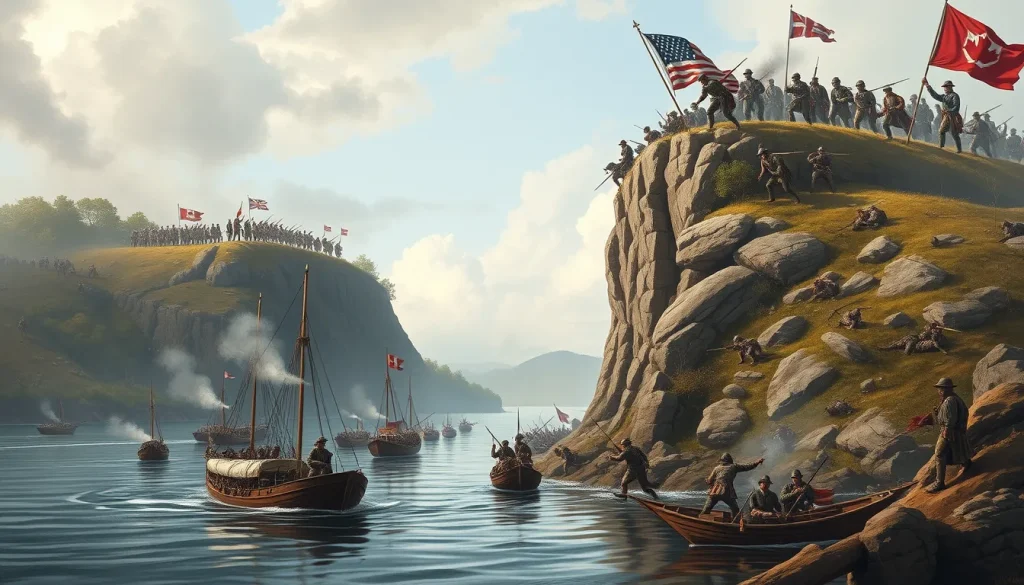
The Niagara Campaign of 1812 comprised the first sustained military operations on the Niagara River frontier during the opening months of the War of 1812. The campaign centered on a U.S. attempt to invade Upper Canada, culminating in the Battle of Queenston Heights on 13 October 1812, where British, Canadian, and Indigenous forces repelled the American attack but lost their commander, Major General Isaac Brock. The campaign exposed fundamental flaws in American military organization and set the pattern for three years of bloody but inconclusive frontier warfare.
Historical Context
The War of 1812 arose from a cluster of grievances: British impressment of American sailors, seizure of neutral trade, and perceived encouragement of Indigenous resistance to American expansion. A vocal group of congressional ‘War Hawks’ advocated for the conquest of Canada as the surest means to compel British concessions. The Niagara River, connecting Lakes Erie and Ontario, formed a narrow, defensible border between New York State and Upper Canada. Both sides maintained forts—Fort Niagara on the American shore and Fort George on the Canadian side—making the frontier a strategic corridor for any invasion of Upper Canada.
American planners assumed Canada would fall quickly, convinced by its small population and the distance from Britain. However, the British regulars, Canadian militia, and Indigenous allies were prepared to defend their territory. The American army in 1812 was small, poorly trained, and riddled with leadership deficiencies, while the state militia system proved ill-suited for offensive operations beyond U.S. borders. These factors directly shaped the course of the Niagara campaign.
What Happened
After the U.S. declaration of war in June 1812, American forces assembled along the Niagara frontier under Major General Stephen Van Rensselaer, a political appointee with limited military experience. British and Canadian forces, commanded by Major General Isaac Brock, fortified positions along the Niagara River. In the early hours of 13 October, American regulars and militia crossed the river and seized the heights above Queenston. Brock, rushing to the scene, was killed during a counterattack. The British rallied under Major General Roger Hale Sheaffe, who led a mixed force of British regulars, Canadian militia, and Mohawk warriors. The Americans, unable to secure reinforcements because the New York militia refused to cross the international border, were driven from the heights and forced to surrender. The battle ended in a decisive British victory, but the loss of Brock was a severe blow to British and Canadian morale. The campaign subsequently settled into a stalemate, with both sides reinforcing their positions, but no further major action occurred on the Niagara front in 1812.
Why It Matters
The Niagara Campaign of 1812 had immediate and long-term significance. It dashed American hopes of a quick conquest of Canada and revealed the structural weaknesses of the American military system, particularly the inability to use militia for offensive operations. For the British and Canadians, it became a celebrated defensive victory and a symbol of unity among British regulars, Canadian militia, and Indigenous allies. The campaign also established a pattern of escalation—raids and counter-raids—that would define the Niagara frontier for the rest of the war. Historians argue that the campaign’s failure helped prompt American military reforms, leading to the more professional army that fought effectively in 1814. It also intensified the cycle of reprisals, such as the burning of Newark and the later destruction of Buffalo, that marked the wider war.
Prelude
The Niagara campaign of 1812 began with the U.S. declaration of war on 18 June. American forces under Van Rensselaer concentrated at Lewiston, New York, near the mouth of the Niagara River. The British were aware of the threat and Brock actively prepared defenses, moving troops along the river and relying on the loyalty of Upper Canadian settlers and warriors from the Six Nations and other Indigenous peoples. The American plan aimed to seize the heights overlooking Queenston to gain control of the river crossing and then advance toward Fort George. Brock, anticipating an attack, kept his forces ready and even considered preemptive strikes.
Forces and Commanders
American forces numbered around 6,000 men, mostly militia, with a core of regulars under Lieutenant Colonel John Chrystie and Colonel Winfield Scott. Stephen Van Rensselaer commanded the army despite lacking formal military training. The British and Canadian force was smaller, about 1,500 regulars and militia, but professionally led. Sir Isaac Brock was an aggressive and popular commander, supported by Major General Sheaffe and local militia officers. Indigenous allies, including Mohawk warriors led by John Norton, played a crucial supporting role in the defense.
Battlefield and Map Context
The battlefield centered on Queenston, a small village on the Canadian bank of the Niagara River, dominated by the Niagara Escarpment, a steep ridge rising about 300 feet. Fort Niagara on the American bank provided artillery support for the crossing, while British batteries at Fort George and Vrooman’s Point covered the river. The heights above Queenston offered a commanding view of the surrounding countryside, making it a key tactical position. The river at that point was about 1,200 feet wide, crossable in boats under fire.
Battle Chronology
The American attack began shortly after 3 a.m. on 13 October, with boats ferrying troops across the river. A small British picket was overwhelmed. The first wave, led by Lieutenant Colonel Chrystie, encountered heavy fire from British guns, and some boats were forced back. However, a separate landing under Captain John E. Wool succeeded in scaling the heights via a fisherman’s path. Wool’s men captured the redan battery on the heights, driving off the gunners. Brock, arriving from Fort George, launched a counterattack with two small companies of militia, but was killed during the assault. Sheaffe, who had been recalled from Fort George, gathered reinforcements from the west and led a long flanking march to the heights. By mid-afternoon, Sheaffe’s force, augmented by Indigenous warriors, attacked the Americans from above. The American militia on the New York shore refused to cross, leaving the attackers isolated. After heavy fighting, the American force was surrounded and surrendered.
Casualties and Losses
The British suffered approximately 14 killed, 77 wounded, and 22 captured, including Major General Isaac Brock. American casualties were far heavier: about 100 killed, 200 wounded, and over 800 prisoners, including many militia who had not been engaged. The disparity reflected both the intensity of the fight and the collapse of the American command structure after the militia refused to reinforce.
Result
The Battle of Queenston Heights was a clear British victory. The American invasion attempt was repelled, and the U.S. forces retreated to Fort Niagara. Despite the loss of their charismatic leader, the British and Canadian forces held the frontier. The result solidified British control over the Niagara Peninsula for the remainder of 1812 and demoralized the American war effort.
Strategic Consequences
The failure of the Niagara campaign had profound strategic consequences. It ended any realistic American hope of capturing Canada in 1812 and forced the United States to adopt a defensive posture for the winter. For Britain, the victory strengthened its hold on Upper Canada and underscored the value of Indigenous alliances and Canadian militia. The death of Brock, however, deprived the British of their ablest commander in the theater, a loss felt in later campaigns. The campaign also demonstrated that militia could not be relied upon for invasions, spurring the U.S. government to rely more heavily on regular troops in subsequent years.
Primary Accounts
Several contemporary accounts exist, including the official reports of General Van Rensselaer and Major General Sheaffe, letters from Brock to his superiors, and memoirs of participants such as Colonel Winfield Scott. These sources provide detailed narratives but reflect the biases of their authors. Van Rensselaer sought to deflect blame onto the militia, while Sheaffe’s report was criticized for understating his own role. The Mohawk perspective is preserved in oral traditions and later writings by John Norton.
Battlefield Today
The Queenston Heights battlefield is now a National Historic Site in Canada, commemorated with Brock’s Monument, a tall column erected in the 1850s. The surrounding area has preserved many original features, including the escarpment and the river crossing points. Visitors can explore the grounds and interpretive panels. The site is managed by Parks Canada and remains a prominent landmark of the War of 1812.
Primary Sources
Key primary sources for the Niagara Campaign of 1812 include:
- Van Rensselaer’s official report (October 1812) – provides the American perspective but attempts to justify his own conduct and blame the militia.
- Sheaffe’s dispatch to the British Governor General, dated 14 October 1812 – details the British side, but has been criticized for inaccuracies.
- Isaac Brock’s correspondence – his surviving letters, though he died in the battle, illuminate British planning and the strategic situation.
- Memoirs of Winfield Scott – Scott’s later account offers a critical view of American leadership and the militia system.
- John Norton’s journal – provides insight into the role and perspective of the Mohawk warriors.
These documents are held at archives such as the Library and Archives Canada, the U.S. National Archives, and various historical societies. Researchers should be aware of each author’s personal and national biases.
Further Reading
- Babcock, Louis L. The War of 1812 on the Niagara Frontier. Buffalo Historical Society, 1927.
- Berton, Pierre. The Invasion of Canada, 1812–1813. McClelland & Stewart, 1980.
- Graves, Donald E. The Battle of Queenston Heights. Friends of Fort George, 2012.
- Hickey, Donald R. The War of 1812: A Forgotten Conflict. University of Illinois Press, 1989.
- Whitfield, Carol M. The Battle of Queenston Heights. National Historic Sites Service, 1974.
References
- “The Niagara Campaign – War of 1812.” The War of 1812 Website. https://thewarof1812.org/campaigns/the-niagara-campaign/
- “War of 1812 Campaigns.” U.S. Army Center of Military History. https://history.army.mil/Research/Reference-Topics/Army-Campaigns/Brief-Summaries/War-of-1812-Campaigns/
- “Niagara campaign.” Wikipedia. https://en.wikipedia.org/wiki/Niagara_campaign (for 1814 context, used for clarity).
- Rauch, Steven J. The Campaign of 1812. Center of Military History, U.S. Army, 2013.
- “Niagara Campaigns.” Encyclopedia.com. https://www.encyclopedia.com/history/dictionaries-thesauruses-pictures-and-press-releases/niagara-campaigns
FAQ
What was the Niagara Campaign of 1812?
It was the opening American attempt to invade Upper Canada across the Niagara River, culminating in the Battle of Queenston Heights on October 13, 1812, which ended in a British victory.
Why did the American invasion at Queenston fail?
The American force was defeated because the New York militia refused to cross the border to reinforce the attacking troops, leaving them isolated and outnumbered after the British rallied and counterattacked.
How did the Niagara Campaign of 1812 affect the War of 1812?
The failure ended American hopes of quick conquest, boosted British and Canadian morale, and forced the United States to rethink its military strategy, leading to reforms that later improved its regular army.
Leave a Reply