
Short Answer
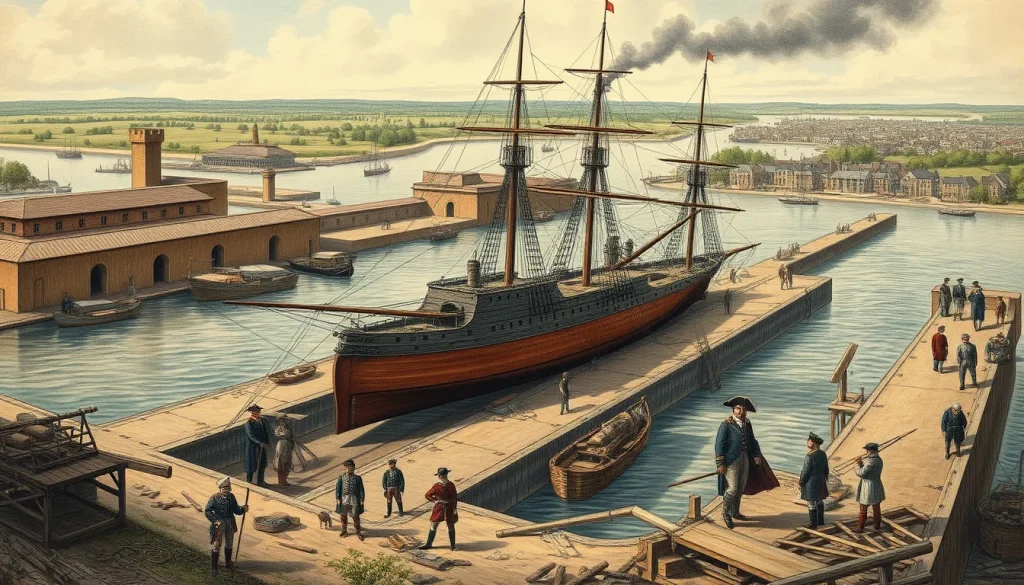
Shipbuilding at Kingston during the War of 1812 refers to the construction of warships at the British naval dockyard on Point Frederick, in present-day Kingston, Ontario. This shipyard, one of the most important on Lake Ontario, built the vessels that enabled the Royal Navy and Provincial Marine to challenge American naval superiority on the lake. The shipbuilding race between Kingston and Sackets Harbor directly shaped the outcome of the war on the Upper Canada frontier.
Historical Context
Lake Ontario was a critical inland waterway during the War of 1812. Both the United States and Great Britain recognized that control of the lake would allow forces to move troops and supplies and to strike at enemy territory. Kingston, situated at the head of the St. Lawrence River and the eastern end of Lake Ontario, was a natural naval base. The British had maintained a small naval establishment there since 1789, and by the outbreak of war it was the main dockyard for the Provincial Marine on the lake. The Americans established a competing naval base at Sackets Harbor, New York, in 1809, and the two sides engaged in an escalating shipbuilding contest throughout the war. The Kingston shipyard was uniquely positioned to build large vessels because of its deep harbor, nearby supply of timber, and the existing infrastructure of the dockyard.
What Happened
At the start of the war, the Provincial Marine operated a small squadron on Lake Ontario, but it was outmatched by the newly created American squadron under Commodore Isaac Chauncey. The British realized they needed more and larger warships. In early 1813, Commodore Sir James Lucas Yeo arrived to command the Royal Navy on the lake, bringing skilled shipwrights and a determination to build a fleet that could match the Americans. The Kingston yard was expanded, and a series of vessels were laid down. The shipyard built the 22-gun corvette HMS Wolfe (later renamed HMS Montagu) launched in 1813, and the 58-gun frigate HMS Prince Regent and the 42-gun HMS Princess Charlotte, both launched in 1814. Also in 1814, the shipyard constructed the largest warship ever built on the Great Lakes, the HMS St. Lawrence, a first-rate ship of the line carrying 112 guns. These vessels allowed the British to gain temporary control of Lake Ontario in 1814, though the naval war remained a contest of attrition.
The shipyard employed hundreds of workers, including shipwrights, joiners, blacksmiths, and labourers, many recruited from Britain and Quebec. They worked long hours, often under difficult conditions, to rush the ships into service. Timber was felled locally and floated to the yard. The naval dockyard included a rope walk, sail loft, and repair facilities. The ships were built on slipways and launched into the harbor. Despite challenges such as shortages of skilled labor and competition for supplies, the Kingston yard proved remarkably productive.
Why It Matters
The shipbuilding at Kingston had a direct impact on the course of the war. By building larger and more powerful ships, the British were able to counter the American naval threat and protect Upper Canada from invasion from the lake. The presence of the powerful HMS St. Lawrence effectively deterred an American attack on Kingston in 1814, which was a vital supply route. Moreover, the shipyard contributed to the industrial development of Kingston, which would later become a permanent military settlement. The shipbuilding race also influenced the peace negotiations, as both sides sought to maintain their naval strength. However, after the war, the shipbuilding program was discontinued, and many of the vessels were later scrapped or sold. The importance of Kingston as a naval shipyard continued into the mid-nineteenth century, but its zenith was during the War of 1812.
Historical Map Context
Kingston is located on the northeastern shore of Lake Ontario, at the point where the lake narrows into the St. Lawrence River. The naval dockyard was situated on Point Frederick, a small peninsula that encloses the harbor to the southeast of the town. The point was strategically placed to command the entrance to the harbor and the river below. The shipyard itself consisted of a series of slipways, mast houses, and workshops along the waterfront. The town of Kingston grew on the opposite side of the harbor, and the dockyard was connected to the mainland by a narrow isthmus. This geography made the shipyard easy to defend against land attack while allowing easy access to the deep water of the harbor.
Modern Location
The site of the Kingston naval shipyard is now occupied by the Royal Military College of Canada, which was established in 1876 on Point Frederick. The old dockyard structures have largely disappeared, but the foundation of some buildings and the Martello Tower are still visible. The harbor area remains a naval and civilian port. The location is in Kingston, Ontario, within the limits of the Canadian Forces Base. Visitors can see historical markers and the remains of the shipyard and fortifications.
Events at the Site
Key events include the construction and launch of HMS Wolfe in 1813, the massive expansion of the yard under Commodore Yeo, the launching of HMS Prince Regent and Princess Charlotte in 1814, and the launching of HMS St. Lawrence in September 1814. The shipyard also served as a base for the fleet, with ships being fitted out and repaired. In 1812, the yard was attacked by American forces in the Battle of the Thousand Islands, a minor skirmish, but the shipyard itself was never captured. After the war, the yard was reduced, and the last warships were removed in the 1830s.
Associated People
Important figures associated with shipbuilding at Kingston include Commodore Sir James Lucas Yeo, who commanded the Royal Navy squadron on the lake and oversaw the shipbuilding program; his subordinate commanders such as William Mulcaster and Alexander Dobbs; and the master shipwrights and naval officers who directed construction. The yard also employed many skilled craftsmen, including William Bell, a shipwright who kept a diary of his work. The shipyard was also visited by Lieutenant-General Sir George Prevost, Governor General of Canada, who supported the expansion.
Surviving Monuments and Site
The site is now part of the Royal Military College, which maintains the historic buildings of the dockyard, including the Mackenzie Building, which was constructed in 1877, and the Fort Frederick Martello Tower, built in 1846 to protect the harbor. There is also the Naval Memorial at Point Frederick commemorating the sailors and shipwrights. The site is a National Historic Site of Canada, recognized for its role in the defense of Canada. Visitors can explore the RMC grounds and view the remains of the old shipyard and the historic cannons.
Primary Sources
Primary sources for shipbuilding at Kingston include the correspondence of Commodore Yeo to the Admiralty, preserved in the National Archives of the United Kingdom (records of the Admiralty, ADM series). These letters detail the progress of construction and the challenges of recruiting skilled labor. Another important source is the diary of William Bell, a shipwright who worked at the dockyard, which provides ground-level details about daily work. Midshipman’s logs and ships’ muster books also survive in naval records. The Colonial Office correspondence in Canadian archives contains reports from provincial officials. These sources must be interpreted with caution, as they may emphasize successes and underplay problems, but they remain essential for understanding the operation of the shipyard.
Further Reading
- Hickey, Donald R. The War of 1812: A Forgotten Conflict. University of Illinois Press, 1989.
- Malcomson, Robert. Lords of the Lake: The Naval War on Lake Ontario, 1796-1815. Naval Institute Press, 1998.
- Benn, Carl. The War of 1812. Osprey Publishing, 2002.
- Turner, Wesley B. British Generals in the War of 1812: High Command in the Canadas. McGill-Queen’s University Press, 1999.
References
- Hickey, Donald R. The War of 1812: A Forgotten Conflict. University of Illinois Press, 1989.
- Malcomson, Robert. Lords of the Lake: The Naval War on Lake Ontario, 1796-1815. Naval Institute Press, 1998.
- Benn, Carl. The War of 1812. Osprey Publishing, 2002.
- Turner, Wesley B. British Generals in the War of 1812: High Command in the Canadas. McGill-Queen’s University Press, 1999.
- Bell, William. Diary of William Bell, manuscript. Queen’s University Archives, Kingston.
- Admiralty records, ADM 1/2732, The National Archives, Kew, UK.
FAQ
What was the largest ship built at Kingston during the War of 1812?
The HMS St. Lawrence, a first-rate ship of the line with 112 guns, launched in September 1814.
Why was Kingston important for shipbuilding?
Its deep harbor, accessible location, and existing dockyard made it the main British naval base on Lake Ontario, and the shipyard built the warships that controlled the lake.
What happened to the shipyard after the war?
The yard was gradually decommissioned; the site later became the Royal Military College of Canada.


Leave a Reply