

Short Answer
The War of 1812 was a conflict fought primarily between the United States and Great Britain from June 1812 until February 1815. It grew out of disputes over maritime rights, British restrictions on American trade, the impressment of sailors, U.S. expansion into Indigenous lands, British relationships with Native nations, and the wider struggle between Britain and Napoleonic France.
The fighting stretched across an enormous area—from the Great Lakes and Canadian borderlands to the Chesapeake Bay, Atlantic Ocean, Gulf Coast, and Indigenous homelands of the Old Northwest and Southeast. American forces invaded British North America several times. British troops captured and burned public buildings in Washington. Naval battles occurred on the Atlantic and inland lakes. Indigenous nations fought to defend their own political and territorial interests. Free and enslaved African Americans served on both sides or used the war as an opportunity to pursue freedom.
The Treaty of Ghent was signed on December 24, 1814, restoring peace largely on the basis of the territorial situation that had existed before the war. The treaty entered into force after ratifications were exchanged in Washington on February 17, 1815. Because news crossed the Atlantic slowly, the famous Battle of New Orleans was fought on January 8, 1815, after the treaty had been signed but before it had taken effect.
Although the military conflict ended without the United States or Britain obtaining most of the objectives that had driven the war, its consequences were substantial. The war influenced American nationalism, Canadian historical memory, Anglo-American relations, Indigenous sovereignty and land loss, westward expansion, military institutions, maritime policy, and the political careers of figures such as Andrew Jackson and William Henry Harrison.
The immediate disputes centered heavily on British interference with American maritime trade and the Royal Navy’s practice of impressment. Western expansion and conflict between the United States and Indigenous nations—some of which maintained alliances or relationships with Britain—added another dimension. The war was also inseparable from the Napoleonic Wars then consuming Europe.
The United States initially expected that attacks on British North America might succeed quickly, but early invasions encountered serious setbacks. American naval victories provided morale and strategic advantages, while fighting on the Great Lakes eventually helped the United States regain Detroit and weaken the British-Indigenous coalition in the Northwest.
After Napoleon’s first defeat in Europe freed British troops for service in North America, Britain increased pressure on the United States during 1814. British forces defeated Americans at Bladensburg and entered Washington, burning the Capitol and other public buildings. Yet subsequent British offensives against Baltimore and through the Lake Champlain corridor failed.
Peace negotiations produced the Treaty of Ghent in December 1814. The treaty essentially ended the Anglo-American conflict without a major territorial transfer and did not resolve impressment—the issue had become less urgent with the end of the Napoleonic struggle.
The Library of Congress describes the conflict as ending inconclusively after three years of fighting, while Britain’s National Army Museum characterizes the military result as a stalemate. These descriptions are useful because the consequences differed considerably depending on which participant or community is being examined.
Why Did the War of 1812 Begin?
There was no single cause.
The war emerged from overlapping maritime, economic, diplomatic, territorial, political, and Indigenous conflicts that developed during the first decade of the nineteenth century.
Britain, France, and American Neutral Trade
Understanding the War of 1812 requires understanding the Napoleonic Wars.
Britain and Napoleonic France were engaged in a struggle that affected much of Europe and global commerce. Britain dominated the seas, while Napoleon attempted to restrict British trade with continental Europe.
Both sides interfered with neutral commerce.
The United States, which depended heavily on overseas trade, found itself caught between the two powers. Britain issued Orders in Council restricting commerce with territories controlled by or aligned with France. Napoleon responded with his own commercial restrictions.
From the British perspective, such measures were instruments in an existential European war. From the American perspective, interference with neutral shipping represented an attack on national sovereignty and commercial rights.
The National Park Service describes the War of 1812 as a direct outgrowth of the Napoleonic Wars rather than an isolated North American conflict.
Impressment
The most famous maritime grievance involved impressment.
The Royal Navy needed enormous numbers of sailors to sustain Britain’s global naval war. British warships stopped merchant vessels and removed sailors believed to be British subjects or deserters.
The central problem was citizenship.
Britain did not fully accept that a British-born subject could simply abandon obligations to the Crown by becoming a naturalized American. Americans, by contrast, regarded naturalized citizens as Americans entitled to protection.
In practice, American sailors could be caught in the system.
The National Park Service estimates that around 6,000 Americans between 1803 and 1812 were swept into British impressment practices, although historical totals vary depending on definitions and records.
The issue became a potent symbol of violated sovereignty.
The Chesapeake–Leopard Affair
Tensions became particularly severe after the Chesapeake–Leopard Affair in 1807.
The British warship HMS Leopard attacked the American frigate USS Chesapeake after its commander refused to allow a search for alleged Royal Navy deserters. British sailors boarded the damaged American vessel and removed four men.
The incident caused outrage in the United States and nearly produced war five years before the actual declaration.
Western Expansion and Indigenous Resistance
Maritime disputes were only part of the story.
The United States was expanding westward into territories inhabited by Indigenous nations. Land acquisition and settlement produced growing resistance.
Shawnee leader Tecumseh and his brother Tenskwatawa, known as the Prophet, attempted to build a broad Indigenous movement capable of resisting further American expansion.
British officials in Canada maintained relationships with Native nations and, in some cases, supplied them. Many Americans interpreted this as British encouragement of attacks on frontier settlements.
The historical situation was more complicated. Indigenous nations had their own objectives and were defending their own homelands rather than simply acting as proxies for Britain. NPS scholarship emphasizes that Indigenous conflicts had deep roots in disputes over land and self-determination that predated the formal Anglo-American war.
This distinction is essential.
For many Indigenous peoples, the War of 1812 was one phase of a much longer struggle over territory, sovereignty, and survival.
The War Hawks
A younger generation of American political leaders pushed strongly for war.
Often called the War Hawks, they included prominent figures such as Henry Clay of Kentucky and John C. Calhoun of South Carolina.
Their motivations were not identical. Maritime honor, national sovereignty, frontier security, and expansion all mattered.
Some Americans also believed that conquering British Canada would remove British influence from the continent and might be militarily achievable.
President James Madison did not formally declare annexation of Canada to be the cause of war, but an invasion of British North America quickly became central to American military strategy. The Library of Congress notes that the United States entered the conflict with ambitious plans to conquer Canada, a goal it did not achieve.
The Declaration of War
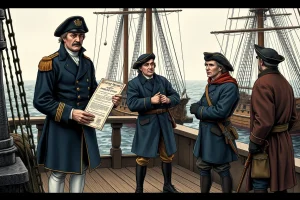
On June 1, 1812, President James Madison sent Congress a message outlining American grievances against Britain.
The vote demonstrated that the decision was controversial.
The House of Representatives approved the declaration 79 to 49 on June 4. The Senate approved it 19 to 13 on June 17. Madison signed the declaration on June 18.
The United States was now at war with the world’s leading naval power.
Yet neither country was fully prepared for the conflict that followed.
Britain’s primary military attention remained focused on Napoleon in Europe. The United States possessed a small regular army and a comparatively small navy, depended heavily on state militias, and lacked the administrative and logistical capacity needed for an easy conquest of Canada.
Those weaknesses became apparent almost immediately.
1812: Invasion, Defeat, and Naval Surprise
American strategy initially centered on invasions of British North America.
Many Americans believed Canada might be vulnerable. Instead, the first campaigns exposed serious problems in U.S. command, logistics, coordination, training, and militia reliability.
The Fall of Detroit
General William Hull advanced from Detroit into Upper Canada but soon retreated.
British Major General Isaac Brock and Shawnee leader Tecumseh formed a powerful partnership. British regulars, Canadian forces, and Indigenous warriors placed Hull under growing pressure.
On August 16, 1812, Hull surrendered Detroit and roughly 2,500 troops.
The capitulation was a stunning American disaster and a major early success for the British-Indigenous coalition.
Detroit demonstrated how important Indigenous military participation could be. Brock’s comparatively limited forces were considerably strengthened by Indigenous allies, while American fear of Native attack influenced Hull’s calculations.
Queenston Heights
A second major American invasion crossed the Niagara River in October 1812.
At the Battle of Queenston Heights, American troops initially gained ground but failed to secure a lasting breakthrough. British and allied forces ultimately defeated the invasion.
Isaac Brock was killed during the fighting.
His death transformed him into one of the most enduring figures in Canadian memory of the war.
By the end of the first campaign season, the expectation of an easy American conquest of Canada had proved unrealistic.
A Different Story at Sea
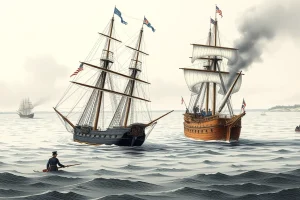
The United States performed better in a series of highly publicized ship-to-ship engagements.
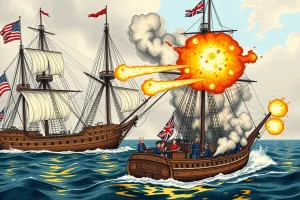
On August 19, 1812, USS Constitution defeated HMS Guerriere. During the engagement, British cannon fire appeared to rebound from the American frigate’s heavy hull, helping give Constitution the enduring nickname “Old Ironsides.”
The frigate later defeated HMS Java on December 29. USS United States captured HMS Macedonian in October.
These victories did not overturn Britain’s overwhelming strategic naval superiority, but they were psychologically important.
A young American navy had shown that individual U.S. warships could defeat Royal Navy opponents under favorable conditions.
Britain increasingly responded through blockade rather than relying on isolated frigate duels.
1813: The War Turns on the Great Lakes
The second year brought continued fighting along the Canadian frontier and Great Lakes.
The geography of the region made control of waterways essential. Roads were poor, overland movement was difficult, and armies depended heavily on lakes and rivers for supplies.
Frenchtown and “Remember the Raisin”
Early in 1813 American troops suffered another major setback at Frenchtown on the River Raisin in Michigan Territory.
American forces were defeated by British and Indigenous troops. The deaths of prisoners and wounded men after the battle contributed to the American slogan “Remember the Raisin,” which became a rallying cry during later campaigns.
The Battle of Lake Erie
The strategic situation changed dramatically on September 10, 1813.
An American squadron under Oliver Hazard Perry defeated the British squadron on Lake Erie.
Control of the lake allowed the United States to move troops and supplies through the Northwest and threatened the British position around Detroit. Perry reported the victory with the famous message beginning, “We have met the enemy…”
The British position became increasingly difficult to maintain.
The Battle of the Thames
British forces and their Indigenous allies withdrew eastward.
General William Henry Harrison pursued them.
On October 5, 1813, American troops defeated the British-Indigenous force at the Battle of the Thames in Upper Canada.
Tecumseh was killed.
His death had consequences far beyond the battlefield. His attempt to construct a broad Indigenous confederacy capable of resisting U.S. expansion suffered a devastating blow.
The defeat also weakened the British-Indigenous alliance in the Northwest and allowed the United States to regain Detroit.
The Creek War and the Southern Conflict
At roughly the same time, a related but distinct conflict was reshaping the Southeast.
The Creek War of 1813–1814 emerged from divisions within Creek society as well as pressure from U.S. expansion.
The faction commonly called the Red Sticks sought to defend traditional political and cultural practices and resist expanding American influence. Other Creeks opposed them and fought alongside U.S. forces.
It is therefore misleading to describe the Creek War simply as Americans fighting “the Creek.” Creek people fought on multiple sides.
NPS historians emphasize that the Indigenous wars occurring alongside the War of 1812 had origins in longstanding struggles over land and self-determination and cannot be understood solely as extensions of Anglo-American hostilities.
Horseshoe Bend
On March 27, 1814, Andrew Jackson led a force composed of U.S. regulars, Tennessee militia, and Indigenous allies against Red Stick warriors at Horseshoe Bend on the Tallapoosa River.
More than 800 Red Stick warriors died, and their military resistance in the Creek War was effectively broken.
The subsequent Treaty of Fort Jackson forced the Creek Nation to cede approximately 23 million acres to the United States—including land belonging to Creeks who had fought alongside Jackson.
The Creek War illustrates why Indigenous history cannot be reduced to Britain versus the United States.
For Native peoples, alliances could be temporary, internal divisions mattered, and even cooperation with the eventual victor did not necessarily protect their lands.
1814: Britain Takes the Offensive
The strategic environment changed fundamentally in 1814.
Napoleon’s defeat and first abdication allowed Britain to transfer experienced troops from Europe to North America.
For the United States, the war suddenly became more dangerous.
Rather than concentrating mainly on defending Canada, Britain could undertake major offensive operations.
Three theaters became especially important: the Niagara frontier, the Chesapeake, and Lake Champlain.
The Niagara Campaign
American military performance improved in 1814.
At Chippawa and Lundy’s Lane, American regular troops demonstrated that they could fight experienced British forces effectively.
Lundy’s Lane became one of the hardest-fought battles of the war, but neither side achieved the decisive conquest of the Niagara frontier that might have transformed the conflict.
By this point, both countries had discovered how difficult it was to convert local battlefield victories into strategic domination across the borderlands.
The Chesapeake Campaign and the Burning of Washington
Britain had been raiding the Chesapeake region since 1813.
In August 1814, a larger British force landed in Maryland and advanced toward Washington.
American troops attempted to stop it at Bladensburg on August 24.
They were defeated.
British troops entered Washington that evening and burned major public buildings, including the Capitol and the President’s House. The Washington Navy Yard had also been burned as American personnel sought to prevent valuable material from falling into British hands.
The capture of the U.S. capital was one of the most humiliating events of the war for the United States.
But it did not decide the conflict.
The British next turned toward a commercially and militarily important target: Baltimore.
Baltimore and Fort McHenry
Baltimore was a major port and center of American privateering.
Unlike Washington, the city had prepared substantial defenses.
British troops landed at North Point while Royal Navy ships moved toward Fort McHenry, which guarded the water approach to Baltimore.
Beginning on September 13, British ships bombarded the fort.
The fort held.
By the morning of September 14, the British naval assault had failed, while strong American defenses on land made a successful capture of Baltimore increasingly unlikely.
Among those observing the bombardment was Francis Scott Key.
Seeing the large American flag still flying over Fort McHenry inspired him to write the words that eventually became “The Star-Spangled Banner.”
Baltimore provided the United States with an important defensive success only weeks after the destruction of Washington.
Lake Champlain and Plattsburgh
An even more strategically important British offensive moved south from Canada toward Plattsburgh, New York.
Governor General Sir George Prevost commanded a large army of experienced troops, while British naval forces attempted to gain control of Lake Champlain.
Control of the lake was critical to maintaining the invasion’s supply line.
On September 11, 1814, an American naval squadron commanded by Thomas Macdonough defeated the British fleet at the Battle of Lake Champlain.
Without control of the lake, Prevost withdrew his army northward.
The result mattered beyond the battlefield.
Peace negotiations were already underway at Ghent. The failure of the British invasion reduced Britain’s ability to demand territorial concessions based on a dominant military position in the northern theater.
The Naval War
The War of 1812 was fundamentally a maritime conflict.
Indeed, the dispute that pushed the United States toward war centered heavily on maritime rights.
The United States could not hope to match the Royal Navy ship for ship. Britain possessed an enormous global fleet supported by the resources of an empire.
American strategy therefore included several different approaches: naval frigate cruises, smaller warships, privateering, commerce raiding, and intense naval competition on the Great Lakes.
Early victories by Constitution, United States, and other vessels generated tremendous publicity.
But Britain’s blockade increasingly restricted American commerce and naval movement.
On inland waters, however, fleet actions could directly determine the fate of armies.
American victories on Lake Erie in 1813 and Lake Champlain in 1814 were strategically important precisely because they controlled the supply routes upon which land campaigns depended.
The war thus demonstrated that naval power meant more than spectacular frigate duels. Control of transportation, commerce, blockades, and inland waterways could shape entire campaigns.
Indigenous Peoples and the War of 1812
Any history of the War of 1812 that treats Indigenous peoples as secondary participants misses one of the conflict’s most important dimensions.
Native nations had their own governments, interests, rivalries, alliances, and strategic objectives.
They were not simply “British allies” or “American allies.”
For many Indigenous communities, the central issue was land.
American settlement was moving into Native homelands. Tecumseh attempted to organize resistance on a continental scale, arguing that land belonged collectively to Native peoples and could not legitimately be surrendered piecemeal by individual groups.
When the war began, his forces allied with Britain because British support offered a possible means of restraining U.S. expansion.
Indigenous warriors made major contributions to early British successes, particularly around Detroit and in the defense of Upper Canada.
But the alliance had limits.
Britain’s primary goal was preserving British North America, not creating the independent Indigenous political territory Tecumseh hoped to secure.
Tecumseh’s death at the Thames in 1813 severely damaged organized resistance in the Northwest.
In the Southeast, the defeat of the Red Sticks at Horseshoe Bend opened millions of acres to U.S. control.
The peace settlement at Ghent contained provisions concerning Indigenous nations, including Article IX, under which both governments agreed to end hostilities with Indigenous nations and restore rights and possessions held in 1811, provided those nations also ceased hostilities.
In practice, the postwar period did not restore the Indigenous geopolitical position that had existed before the conflict.
American settlement and territorial expansion continued.
For many Native communities, therefore, the consequences of the War of 1812 extended far beyond 1815.
African Americans and the War
Free and enslaved African Americans participated in the conflict in different ways and for different reasons.
Free Black sailors served aboard American naval vessels and privateers. African Americans also participated in coastal defenses and military operations.
The National Park Service estimates that African Americans may have represented as much as 20 percent of some American privateer crews and up to roughly 10 percent of crews aboard U.S. Navy vessels.
For enslaved people, British operations offered another possibility: escape.
As British forces operated in the Chesapeake, enslaved people fled plantations and reached British ships.
In April 1814, Vice Admiral Alexander Cochrane issued a proclamation offering people who left the United States the opportunity to enter British service or be transported as free settlers to British territories.
Some freedom seekers joined the British Colonial Marines; others ultimately established new lives in British-controlled territories.
African Americans also fought in American forces, including at New Orleans. The city’s defenders included free men of color as well as enslaved laborers and other groups drawn into the defensive effort.
The war therefore could mean military service, economic disruption, continued enslavement, or an opportunity to escape bondage—depending on an individual’s circumstances.
Opposition to the War
Americans themselves were deeply divided over the conflict.
Opposition was particularly strong among Federalists and in parts of New England, where merchants had suffered from earlier U.S. embargo policies and feared further destruction of Atlantic commerce.
As the war continued, opposition culminated in the Hartford Convention of 1814–1815, where New England Federalists discussed constitutional grievances and proposed amendments.
The timing was disastrous for their political reputation.
News of the peace settlement and the American victory at New Orleans soon created a wave of national celebration, while the Federalists appeared associated with wartime opposition.
Their decline had begun before the convention, but the postwar political environment further weakened them.
Peace Negotiations at Ghent
By 1814, both governments had reasons to negotiate.
The United States had endured invasion, blockade, financial difficulties, and military setbacks.
Britain had spent more than two decades fighting revolutionary and Napoleonic France and had little desire for an indefinite war in North America.
Negotiations began in Ghent, Belgium, in August 1814.
The American delegation included John Quincy Adams, Henry Clay, Albert Gallatin, James A. Bayard, and Jonathan Russell.
After months of negotiation, American and British representatives signed the Treaty of Ghent on December 24, 1814.
The settlement did not award Canada to the United States.
It did not force Britain to concede the maritime principles over which the United States had gone to war.
It largely provided for restoration of conquered territory and commissions to resolve boundary questions.
Most importantly, it ended the war between the two countries.
The British ratified the treaty on December 31, 1814. The U.S. Senate unanimously advised and consented to ratification on February 16, 1815. President Madison ratified it on February 17, and ratifications were exchanged the same day, bringing the agreement into force.
The Battle of New Orleans
The Treaty of Ghent had been signed, but armies in North America did not yet know that peace had been agreed.
British forces targeted New Orleans, whose position near the mouth of the Mississippi made the city economically and strategically important.
Andrew Jackson assembled a diverse defensive force.
On January 8, 1815, British troops launched their main assault against American positions at Chalmette.
The attack failed disastrously.
British casualties exceeded 2,000 killed, wounded, or captured according to U.S. Naval History and Heritage Command’s chronology, while the American defensive position remained intact.
New Orleans became one of the most celebrated American victories in the country’s early history and dramatically increased Jackson’s national reputation.
But the familiar statement that the battle was fought “after the war had ended” requires qualification.
The treaty had been signed, but it had not yet entered into force. The treaty required ratification and exchange before hostilities formally ended.
New Orleans was therefore fought after the peace agreement had been negotiated but before the War of 1812 officially ended on February 17, 1815.
War of 1812 Timeline
| Date | Event |
|---|---|
| June 22, 1807 | Chesapeake–Leopard Affair intensifies Anglo-American tensions |
| November 1811 | Battle of Tippecanoe deepens conflict in the Northwest |
| June 1, 1812 | Madison sends war message to Congress |
| June 18, 1812 | United States declares war on Great Britain |
| August 16, 1812 | Detroit surrenders to Brock and the British-Indigenous coalition |
| August 19, 1812 | USS Constitution defeats HMS Guerriere |
| October 1812 | American invasion fails at Queenston Heights |
| January 1813 | American defeat at Frenchtown/River Raisin |
| April 1813 | American forces capture York |
| September 10, 1813 | American victory at Lake Erie |
| October 5, 1813 | Battle of the Thames; Tecumseh is killed |
| March 27, 1814 | Battle of Horseshoe Bend |
| August 24, 1814 | Battle of Bladensburg and burning of Washington |
| September 11, 1814 | American victory at Lake Champlain/Plattsburgh |
| September 12–14, 1814 | Battle of Baltimore and defense of Fort McHenry |
| December 24, 1814 | Treaty of Ghent signed |
| January 8, 1815 | Battle of New Orleans |
| February 16, 1815 | U.S. Senate approves Treaty of Ghent |
| February 17, 1815 | Ratifications exchanged; treaty enters into force |
| June 30, 1815 | A final distant naval encounter occurs when USS Peacock, unaware peace had been concluded, attacks East India Company brig Nautilus |
The last episode demonstrates how slowly news traveled in an age before electronic communication. Naval operations could continue thousands of miles away long after diplomats had settled the conflict.
Who Won the War of 1812?
There is no single answer that captures every dimension of the war.
At the Anglo-American state level, the peace settlement is commonly described as a stalemate or inconclusive. Borders were not fundamentally redrawn, the United States did not conquer Canada, Britain did not dismantle the United States, and the Treaty of Ghent restored much of the prewar territorial situation.
American public memory nonetheless emphasized successful resistance to Britain, especially after Lake Erie, Baltimore, Lake Champlain, and New Orleans.
In what became Canada, memory emphasized the successful defense of British North America against repeated American invasions. Canadian government historical resources continue to present the war through multiple American, British, Canadian, and Indigenous perspectives rather than as a simple single-sided narrative.
Britain preserved Canada and eventually restored peace with the United States, while its larger strategic focus remained Europe and Napoleon.
Indigenous outcomes were substantially different. The death of Tecumseh, destruction of his confederacy, defeat of the Red Sticks, territorial cessions, and declining British support weakened Indigenous resistance to U.S. expansion.
For that reason, asking only which nation “won” can obscure some of the war’s most consequential results.
What Did the War Actually Change?
The Treaty of Ghent restored peace more effectively than it resolved the original political questions.
Impressment was not abolished by the treaty.
Instead, the issue largely faded because the end of the Napoleonic Wars sharply reduced Britain’s need to impress sailors on the massive wartime scale that had generated the dispute. The U.S. Senate Historical Office notes that the treaty itself accomplished none of the principal original American war objectives, including ending impressment.
Yet the broader relationship between Britain and the United States changed.
Neither country wanted another costly Anglo-American war.
Postwar agreements eventually reduced military competition on the Great Lakes and helped turn the U.S.–British North American boundary into an increasingly peaceful international border.
Effects on the United States
The American experience of the war combined military humiliation with powerful postwar nationalism.
Detroit had surrendered.
American invasions of Canada had repeatedly failed.
Washington had been occupied and public buildings burned.
At the same time, Americans remembered Constitution, Lake Erie, Fort McHenry, Lake Champlain, and New Orleans.
Those victories became more politically influential in public memory than many of the earlier defeats.
The war also elevated military figures into national prominence. Andrew Jackson’s reputation after Horseshoe Bend and New Orleans helped propel his later political career. William Henry Harrison’s role in the Northwest similarly contributed to his national standing.
The conflict also exposed weaknesses in American finance, logistics, fortifications, military organization, and transportation—problems that influenced postwar policy.
Effects on Canada
The war occupies a distinctive place in Canadian historical memory because American invasions of British North America failed.
The defense relied on British regulars, local militia, Indigenous allies, and other forces.
Figures such as Isaac Brock, Laura Secord, Charles de Salaberry, and Indigenous leaders became connected with later narratives of Canadian identity and resistance.
But the modern nation of Canada did not yet exist in 1812.
The territories involved included British colonies such as Upper and Lower Canada, and projecting later Canadian national identity directly backward onto all participants can oversimplify the historical situation.
Recognizing that distinction allows the war’s importance in Canadian memory to be discussed without treating nineteenth-century British North America as identical to modern Canada.
Effects on Indigenous Nations
For Indigenous nations, the consequences were profound.
Before the war, British presence in North America provided at least some strategic counterweight to American expansion.
The war weakened that possibility.
Tecumseh died. His coalition fractured. The Red Sticks were defeated. Enormous areas of Indigenous land passed into U.S. control.
Britain’s postwar priorities increasingly favored stable relations with the United States.
The result was a major shift in the balance of power across the continent.
The National Park Service describes the conflict for Native peoples as part of a much longer struggle to protect homelands, political independence, and autonomy—a struggle that continued long after the formal peace between Britain and the United States.
The War of 1812 and Historical Memory
The War of 1812 is sometimes called America’s “forgotten war.”
That description is only partly useful.
Many individual pieces of the conflict remain famous even when their connection to the war is less widely understood.
“Old Ironsides” comes from the war.
“The Star-Spangled Banner” comes from the defense of Baltimore.
Andrew Jackson’s national fame was transformed by New Orleans.
Tecumseh became one of the most widely remembered Indigenous leaders in North American history.
The burning of Washington remains one of the most extraordinary moments in the history of the U.S. capital.
Canada preserves numerous battlefields, monuments, historic sites, archival collections, and commemorations connected with the conflict.
The problem is therefore not that nothing is remembered.
It is that individual episodes are often remembered separately from the larger conflict that connected them.
Common Misconceptions About the War of 1812
“The war was only about impressment.”
Impressment was one of the most important grievances, but maritime trade restrictions, western expansion, frontier warfare, national sovereignty, and Indigenous-British relations also mattered.
“The United States declared war to conquer Canada.”
The American government officially emphasized maritime and sovereignty grievances. Nevertheless, conquering British North America quickly became an important military objective, and expansionist expectations were present among some supporters of the war.
“Canada defeated the United States.”
Modern Canada did not yet exist as an independent country. British regulars, colonial forces, militia units, Indigenous allies, and others successfully resisted U.S. invasions of British North America.
“The United States clearly defeated Britain.”
American forces won important battles, especially late in the conflict, but the United States did not conquer Canada and the peace treaty did not compel Britain to concede the original maritime issues. Official and institutional histories commonly characterize the overall Anglo-American military settlement as inconclusive or a stalemate.
“New Orleans was fought after the war was already over.”
The Treaty of Ghent had been signed, but it had not yet entered into force. The battle occurred January 8, 1815; ratifications were exchanged February 17.
“Indigenous peoples simply fought for Britain.”
Different Native nations and communities followed different strategies. Some allied with Britain, some with the United States, some attempted neutrality, and Indigenous groups sometimes fought one another. Their objectives centered strongly on their own sovereignty, communities, and lands rather than British imperial goals alone.
Why the War of 1812 Matters
The War of 1812 did not transform the map of North America as dramatically as the American Revolution or Mexican-American War.
Its importance lies elsewhere.
It represented the young United States’ attempt to defend sovereignty in an international system dominated by European empires.
It helped define the military and political development of British North America.
It was a critical turning point in Indigenous resistance to U.S. expansion.
It created opportunities for some enslaved people to seek freedom while leaving slavery itself intact and expanding alongside the United States.
It demonstrated the strategic importance of naval power, inland waterways, transportation, logistics, and fortified cities.
It produced symbols and stories that became embedded in American and Canadian national memory.
Perhaps most importantly, the conflict demonstrates why wars cannot always be reduced to a winner and loser.
The same peace settlement could be remembered as vindication in one country, successful defense in another, a manageable secondary conflict by an empire focused on Europe, and a geopolitical disaster by Indigenous communities losing the strategic support needed to resist expanding settlement.
That is why the War of 1812 is best understood not as a single national story, but as an interconnected North American and Atlantic history.
Researching the War of 1812
The surviving documentary record of the war is extensive.
The Library of Congress provides digitized newspapers, maps, broadsides, congressional publications, government documents, the James Madison Papers, Andrew Jackson Papers, and other collections useful for reconstructing the conflict.
The U.S. National Archives preserves compiled military service records, pension and bounty-land applications, discharge certificates, naval and Marine Corps records, and records concerning impressed sailors. These collections are particularly useful for military and genealogical research.
Canadian government collections provide muster rolls, pay lists, claims, certificates, medal registers, maps, paintings, publications, historic sites, and resources concerning Indigenous participation.
Together, these sources make it possible to study the War of 1812 not merely through later narratives but through the surviving documents of the people who experienced it.
Conclusion
The War of 1812 began as an Anglo-American struggle over maritime rights, sovereignty, trade, expansion, and security, but it became much more than a war between two governments.
It was a naval war and a frontier war.
It was a struggle over Canada and the Great Lakes.
It intersected with Indigenous wars over land and sovereignty.
It created opportunities for enslaved people to seek freedom.
It brought British soldiers into Washington and American armies into Upper Canada.
It produced victories that became legends and defeats that national memories sometimes minimized.
The Treaty of Ghent restored peace between the United States and Britain without producing a decisive territorial settlement. But the consequences of the war were not evenly distributed.
The United States emerged with a stronger sense of national confidence and greater freedom to expand westward. British North America remained outside U.S. control and developed its own powerful memory of successful defense. Britain moved toward a more stable relationship with its former colonies. Indigenous nations faced a much more difficult strategic position as American expansion accelerated.
Understanding the War of 1812 therefore requires looking beyond the question of who won.
It requires examining why the war began, how different peoples experienced it, what changed after the fighting stopped, and how later generations chose to remember it.
That broader view transforms the War of 1812 from an easily overlooked conflict into one of the defining turning points in the nineteenth-century history of North America.
FAQ
Why did the United States declare war on Great Britain in 1812?
The Madison administration cited British maritime measures during the Napoleonic Wars — the Orders in Council restricting neutral trade and the Royal Navy's impressment of sailors from American ships — along with concerns over British relations with Indigenous nations in the Old Northwest. Congress declared war on June 18, 1812, by the narrowest recorded vote for a declared war in U.S. history.
Who won the War of 1812?
Militarily, historians generally describe it as a draw: the Treaty of Ghent restored prewar boundaries. The United States failed to conquer Canada or win treaty language on maritime rights, leading historians such as Brian Arthur and Jon Latimer to call it an effective British success; American memory instead emphasizes successful defense and the Battle of New Orleans.
What did the Treaty of Ghent decide?
Signed December 24, 1814, and ratified by the U.S. Senate in February 1815, it restored the status quo ante bellum, returning captured territory to prewar holders. It left maritime issues to be resolved by the European peace, which had already ended impressment and the trade restrictions.
Why is it called the "second war of independence"?
The phrase is an American nationalist framing that emerged after 1815, reflecting the view that the United States had defended its sovereignty against Britain. Historians treat it cautiously, noting the war's mixed outcomes and its very different meanings in British, Canadian, and Indigenous memory.

Leave a Reply