Short Answer
In June 1812 the British government suspended the Orders in Council, the Privy Council decrees that had regulated neutral trade with Napoleonic Europe since 1807. The decision followed more than a year of industrial distress, mass petitioning and parliamentary attack inside Britain, and it came within days of the American declaration of war. The repeal is central to the history of the War of 1812 because it removed one of the two principal American grievances — the other being impressment — but it arrived too late to prevent the conflict.
Historical Context
After the Battle of Trafalgar (21 October 1805) ended any realistic prospect of a French invasion of Britain, the Anglo-French struggle widened into economic warfare. The United States, as the largest neutral carrier, was caught between the British blockade of France and Napoleon’s attempt to close the continent to British goods. American policymakers replied with the Embargo Act of December 1807, the Non-Intercourse Act of March 1809 and Macon’s Bill No. 2 of May 1810, which reopened trade with both belligerents but promised to reimpose non-intercourse on whichever power failed to revoke its decrees. Napoleon’s Cadore letter of August 1810 appeared to revoke the Berlin and Milan decrees; President James Madison accordingly revived non-intercourse against Britain in November 1810, while Britain kept the Orders in force and continued to seize American ships and impress American seamen. By 1812 commercial restriction and impressment had carried the two countries to the edge of war.
What Happened
By 1811 the British economy was in deep depression. The loss of the American market and the disruption of continental trade threw textile workers out of employment, and machine-breaking disturbances spread through Nottinghamshire, Yorkshire and Lancashire. Between the winter of 1811 and the spring of 1812, merchants and manufacturers in Manchester, Liverpool, Birmingham, Sheffield, Leeds, Glasgow and Bristol petitioned Parliament, arguing that the Orders injured Britain more than France and that the licence system administering them enriched a favoured few.
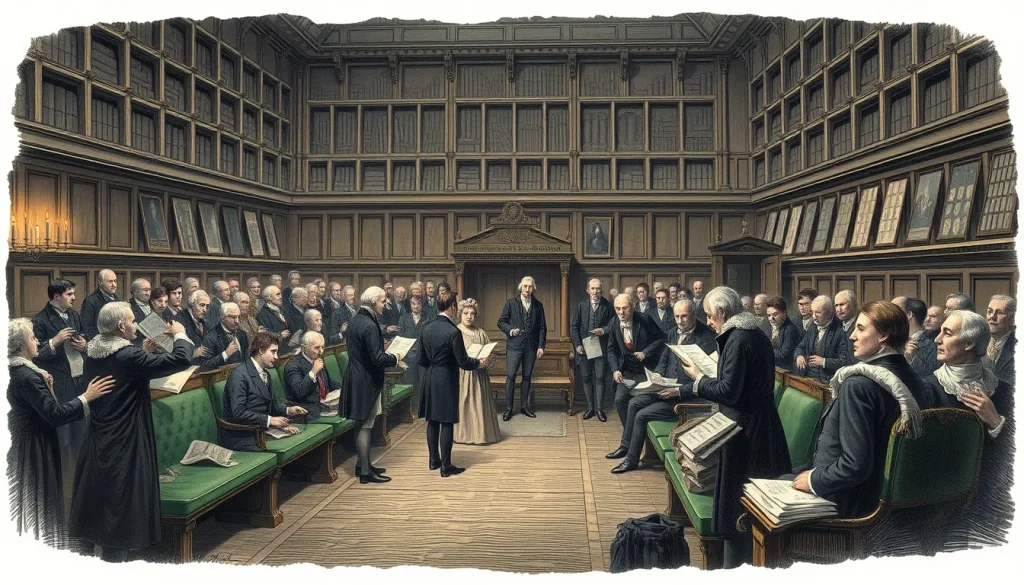
On 3 March 1812 Henry Brougham moved in the House of Commons for an inquiry into the state of trade under the Orders in Council and the licence trade. The House went into committee, examined merchants and manufacturers, and reported later that spring. The government resisted immediate repeal, but the evidence placed the ministry on the defensive and gave the opposition a detailed case.

Spencer Perceval, the prime minister and a firm defender of the Orders, was assassinated in the lobby of the House of Commons on 11 May 1812. A new ministry under Lord Liverpool took office in June. On 16 June 1812 Lord Castlereagh, the Foreign Secretary, told the Commons that the Orders would be suspended; on 23 June 1812 an Order in Council revoked them while reserving the right to restore them if France did not abandon its own decrees. The United States had declared war on 18 June 1812, and news of that declaration reached London on 29 July 1812, after the British concession had already been issued.
Why It Matters
The repeal removed the commercial grievance from the American case almost at the moment the war began. Madison’s war message of 1 June 1812 and the declaration of war of 18 June 1812 had listed the Orders among the leading causes; the British concession meant that the United States was in part fighting over a policy Britain had already surrendered. Impressment, and British support for Indigenous resistance on the northwestern frontier, remained unaddressed. Reopening trade with the United States also served the British war effort, which depended on exports, credit and naval stores.
Historians differ over which pressure mattered most. Some emphasise domestic distress and the petitioning campaign, treating the repeal as a response to organised economic interest and parliamentary pressure. Others stress strategic calculation — the wish to avoid a second war while Britain was fully engaged against Napoleon, and to keep exports flowing to Russia and other remaining markets. Still others argue that the concession was late, conditional and grudging, designed as much to embarrass Napoleon and divide him from the United States as to conciliate America.
Definition
The Orders in Council of 1807 were a set of Privy Council decrees, issued under the royal prerogative, that imposed a British counter-blockade on Napoleonic Europe. Repeal in 1812 refers to the revocation of those decrees: announced in Parliament on 16 June 1812 and formalised by an Order in Council of 23 June 1812. The revocation was conditional, since Britain reserved the right to restore the Orders if France did not revoke the Berlin and Milan decrees.
Background
The British Order in Council of 16 May 1806 declared the coast from Brest to the Elbe under blockade. Napoleon answered with the Berlin Decree of 21 November 1806, which barred French, allied and neutral trade with Britain. Britain retaliated with the Order in Council of 7 January 1807 and, more sweepingly, with the orders of 11 November 1807. Napoleon’s Milan Decree of 17 December 1807 completed the exchange by declaring that neutral ships which submitted to British search or paid British duties could be seized. The result was a mutually reinforcing system in which each power claimed to be retaliating against the other, while neutral shipping bore the cost.
How It Worked
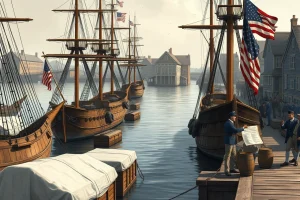
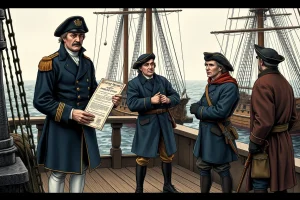
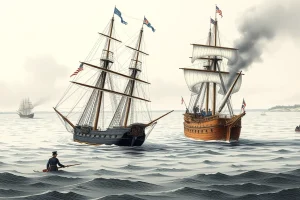
Under the British orders, neutral vessels trading with the continent had to call first at a British port, pay duties and obtain a licence before proceeding. The Royal Navy enforced the blockade by stopping, searching and seizing ships that failed to comply. Because the system could not be applied uniformly, the Board of Trade issued licences exempting particular voyages or merchants. This licence trade became a central complaint: critics argued that it created monopolies, favoured well-connected firms and turned a measure of national retaliation into a source of private profit. In the Atlantic, enforcement of the orders and the Royal Navy’s practice of impressing seamen from American vessels together produced the confrontations that drove Anglo-American relations toward war.
Domestic and Economic Pressures
The most immediate pressures on the British government were economic and domestic. The American embargo and non-intercourse measures cut off a major market for British manufactures, and official trade returns showed a steep decline in exports to the United States. The textile districts of Lancashire, Yorkshire and the Midlands suffered severe unemployment and wage reductions, while bad harvests and high food prices deepened the distress. The Luddite machine-breaking of 1811–1812, concentrated in the hosiery and woollen trades, alarmed the government even where it was not directly caused by the Orders.
Organised petitioning turned this distress into a political problem. Manufacturing towns and merchant communities sent petitions to Parliament describing bankruptcies and unemployed workers, and the inquiry opened by Brougham’s motion gave those complaints a public forum. The licence trade supplied a second line of attack, since it appeared to reward a privileged minority while the general body of merchants suffered. The death of Perceval in May 1812 removed the most committed defender of the system and allowed the Liverpool ministry to treat concession as a practical necessity rather than a surrender of principle.
Competing Viewpoints
Historians have offered several explanations, usually in combination. One line, often associated with accounts stressing British public opinion and economic interest, treats the repeal as a response to the depression of 1811–1812 and the petitioning of manufacturing districts. Another emphasises strategy: with Napoleon still dominant in Europe and war with the United States imminent, the government sought to remove a grievance that threatened to open a second front and disrupt trade with Russia and other markets. A third stresses diplomacy, arguing that the Cadore letter had allowed Napoleon to pose as the champion of neutral rights, and that repeal was intended to restore Britain’s standing and detach the United States from France. A fourth, more sceptical reading holds that the concession was late and reversible, and that its timing — after the American declaration of war — shows how far policy had been driven by events rather than by a change of conviction.
Role in the War of 1812
The Orders in Council were among the principal grievances named in the American declaration of war, alongside impressment, the seizure of ships and British support for Indigenous nations resisting American expansion. Their repeal in June 1812 therefore sits at the hinge of the conflict’s origins: Britain gave up the commercial restriction at almost the same moment the United States declared war, and each government learned of the other’s action only later. Because impressment was not conceded, the repeal did not by itself end the dispute, and the war continued. Reopened trade with the United States, however, supplied Britain with food and raw materials and helped finance the war in Europe.
Consequences and Historical Interpretation
The repeal did not end the war, but it removed the issue that had been most easily negotiable and left impressment, maritime rights and the frontier as the unresolved questions. It also demonstrated that British commercial policy was responsive to domestic economic interests and to parliamentary pressure, even in wartime. Historians continue to debate the counterfactual: whether an earlier and unconditional repeal, communicated before Congress voted, could have prevented the war, or whether impressment and the western frontier would have produced a conflict in any case. The episode is generally treated as evidence that the Orders had become a net liability for Britain, and that the government recognised the fact only after the American market had already been lost.
Primary Sources
The most important contemporary records fall into three groups: the British parliamentary record, the official texts of the decrees and orders, and American statements of grievance.
- Hansard’s Parliamentary Debates, 3 March 1812. The report of Henry Brougham’s motion on the Orders in Council and the licence trade records the arguments used in the Commons, including detailed claims about the state of trade and the operation of licences. Early nineteenth-century Hansard was compiled from newspaper reports and is not a verbatim record, so speeches should be treated as close paraphrase rather than exact quotation.
- The Orders in Council of 1807 and the Order in Council of 23 June 1812. The texts were published in the London Gazette and reprinted in official collections. They define the legal terms of the blockade and of its revocation, and show the conditional language attached to the repeal.
- Napoleon’s Berlin Decree (21 November 1806) and Milan Decree (17 December 1807). These state the French side of the commercial war and are essential for assessing Britain’s claim that the Orders were retaliatory.
- Petitions of merchants and manufacturers to the House of Commons, 1811–1812. Printed in the Journals of the House of Commons and in parliamentary papers, these document the specific economic complaints behind the petitioning campaign.
- James Madison’s war message to Congress, 1 June 1812. The message and the resulting declaration list the American grievances, including the Orders in Council, and show how the commercial issue was presented to Congress.
- British diplomatic and Board of Trade correspondence, 1812. Held in the National Archives (UK), this material illuminates the government’s reasoning and the conditions attached to the repeal. Like all official records it reflects the views of officeholders and should be read alongside petition and merchant evidence.
Further Reading
- Bradford Perkins, Prologue to War: England and the United States, 1805–1812 (Berkeley: University of California Press, 1961).
- J. C. A. Stagg, Mr. Madison’s War: Politics, Diplomacy and Warfare in the Early American Republic, 1783–1830 (Princeton: Princeton University Press, 1983).
- Donald R. Hickey, The War of 1812: A Forgotten Conflict (Urbana: University of Illinois Press, revised edition 2012).
- Paul W. Schroeder, The Transformation of European Politics, 1763–1848 (Oxford: Oxford University Press, 1994).
- Hansard’s Parliamentary Debates, first series, volume 21 (1812).
- The National Archives (UK), Board of Trade and Foreign Office papers relating to trade and blockade, 1811–1812.
References
- Hansard, ‘Mr. Brougham’s Motion Relating to the Orders in Council and the Licence Trade’, HC Deb, 3 March 1812, vol. 21, cc. 1092–1163. https://api.parliament.uk/historic-hansard/commons/1812/mar/03/mr-broughams-motion-relating-to-the
- ‘Orders in Council (1807)’, Wikipedia. https://en.wikipedia.org/wiki/Orders_in_Council_(1807)
- Bradford Perkins, Prologue to War: England and the United States, 1805–1812 (Berkeley: University of California Press, 1961).
- J. C. A. Stagg, Mr. Madison’s War (Princeton: Princeton University Press, 1983).
- Donald R. Hickey, The War of 1812: A Forgotten Conflict (Urbana: University of Illinois Press, revised edition 2012).
FAQ
Why did Britain repeal the Orders in Council in 1812?
The Liverpool ministry revoked the Orders on 23 June 1812 chiefly because of severe economic depression in Britain's manufacturing districts, a sustained petitioning campaign by merchants and manufacturers, parliamentary inquiry prompted by Henry Brougham's motion of 3 March 1812, the death of the Orders' firm defender Spencer Perceval in May 1812, and the wish to remove a likely cause of war with the United States while Britain remained engaged against Napoleon.
Did the repeal of the Orders in Council prevent the War of 1812?
No. The American declaration of war passed on 18 June 1812, before news of the British concession could cross the Atlantic; the news reached London on 29 July 1812. The repeal also left impressment and British support for Indigenous resistance unaddressed, so the war continued even after the commercial grievance had been given up.
What was the licence trade?
Because the Orders in Council could not be enforced uniformly, the British Board of Trade issued licences exempting particular voyages or merchants from the blockade. Critics argued that the system created monopolies and enriched a favoured few, and the licence trade became one of the main targets of parliamentary attack in 1812.
Leave a Reply