Short Answer
During the War of 1812 (1812–1815), American naval gunners in several single-ship frigate actions defeated Royal Navy opponents more decisively than prewar expectations suggested. This article treats ‘American naval gunners’ as the gun crews of the United States Navy in ship-to-ship actions, especially frigate duels, rather than all American seafarers or privateers. The question of why they outperformed is best answered as a convergence of material advantage, crew size, training, tactics, and command—not as proof of inherent national superiority. The most famous examples occurred in 1812, when USS Constitution, United States, and again Constitution defeated HMS Guerriere, Macedonian, and Java, shocking a British public accustomed to naval victory.
Historical Context
By 1812, the Royal Navy was the world’s largest and most experienced naval force. Britain had been at war with France since 1793, and its officers and crews had won numerous fleet and single-ship actions. The Royal Navy also enforced blockades, convoyed trade, and impressed seamen, practices that contributed to Anglo-American tensions. The United States Navy, by contrast, was small. Congress had authorized six frigates in 1794, and by 1812 the service could deploy only a handful of major ships. American naval officers such as Isaac Hull, Stephen Decatur, and William Bainbridge had seen service in the Quasi-War with France and the Barbary Wars, but many enlisted crewmen were new to combat.
American frigates were designed to be powerful for their rate. Joshua Humphreys and other designers used southern live oak, a dense hardwood resistant to rot and cannon shot, and built ships that were longer, beamier, and more heavily armed than standard British 38-gun frigates. Although rated as 44-gun ships, Constitution and its sisters often carried more than fifty guns, including long 24-pounders and 32-pounder carronades. A typical British 38-gun frigate carried long 18-pounders and lighter carronades. In smoothbore, muzzle-loading naval gunnery, heavier shot and larger crews could be decisive at close range. The war at sea therefore pitted a numerically superior and battle-hardened Royal Navy against a smaller American navy whose best frigates were individual overmatches for many British cruisers.
What Happened
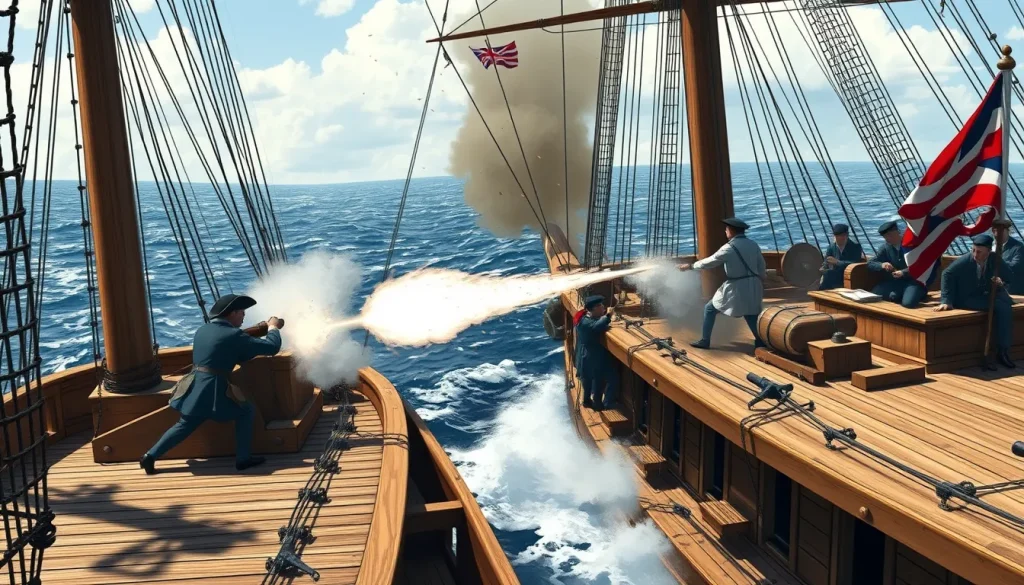
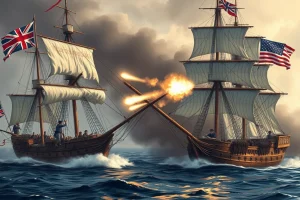
The first great frigate duel occurred on 19 August 1812, about 750 miles east of Boston, when USS Constitution under Captain Isaac Hull met HMS Guerriere under Captain Richard Dacres. Hull manoeuvred to close range and ordered his gunners to hold their fire until the ships were nearly alongside. The resulting broadsides damaged Guerriere’s hull and brought down her masts; she surrendered. According to a frequently repeated contemporary remark reported by the National Park Service, a crew member compared the Constitution’s live oak side to iron after an 18-pounder shot failed to penetrate. On 25 October 1812, USS United States under Commodore Stephen Decatur defeated HMS Macedonian, and on 29 December 1812, Constitution under Commodore William Bainbridge defeated HMS Java. In early 1813, USS Hornet defeated HMS Peacock. These victories gave Americans a sense that their frigates and gunners could beat the Royal Navy in single combat.

The pattern was not universal. On 1 June 1813, HMS Shannon under Captain Philip Broke defeated USS Chesapeake under Captain James Lawrence in about fifteen minutes off Boston. Broke’s crew had trained intensively in gunnery, and their accurate fire killed or wounded many of Chesapeake’s officers and crew before boarding. Later, on 28 March 1814, HMS Phoebe and HMS Cherub captured USS Essex off Valparaiso. The Royal Navy remained dominant overall, and the British blockade tightened. The American gunnery advantage, therefore, was real in certain early frigate actions but not a blanket rule across the war.
Why It Matters
These engagements mattered immediately for morale. American victories provided good news in a war otherwise marked by failed invasions and defeats on land. In Britain, the loss of frigates to a new naval power caused public indignation and led the Admiralty to caution against single-ship encounters with American 44-gun frigates. In the longer term, the victories became central to U.S. naval memory, especially the reputation of Constitution as ‘Old Ironsides.’ Yet they did not break the British blockade or change the war’s strategic balance. Historians continue to debate whether the results reflected superior American gunnery, superior American ships, British overconfidence, or a combination of factors. The debate matters because it tests how much battlefield outcomes can be attributed to skill rather than material conditions.
Definition
In this context, ‘outperform’ means that American gun crews, in particular engagements, delivered more destructive broadsides at decisive range, dismasted opponents, and forced surrender more often than British crews did in comparable frigate duels. It does not mean that every American gunner was better trained or that the United States Navy as a whole outgunned the Royal Navy.
Background
Royal Navy gunnery was not amateur. British crews drilled in loading, sponging, ramming, and firing, and British officers were expected to maintain discipline under fire. The Royal Navy’s long war with France produced experienced seamen, but it also stretched manpower. Press gangs filled crews with men of varied skill, and blockade duty could wear down ships and men. American frigates, meanwhile, were built as prestige and commerce-protection vessels. Their officers had something to prove and often trained crews intensively once at sea, using live-fire practice when powder and shot allowed.
How It Worked
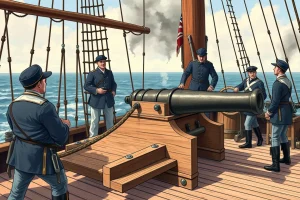
Several factors combined to give American gunners an edge in the early frigate victories. First was broadside weight. The American 44-gun frigates carried long 24-pounder cannon, while most British 38-gun frigates carried long 18-pounders. The heavier American shot could damage masts, rigging, and hulls more severely. Second was crew size. American 44s carried roughly 400 to 500 men, compared with around 280 to 340 on many British 38s. More men per gun meant faster reloading and more sustained fire, and more Marines and riflemen could sweep enemy decks. Third was training. Captains such as Hull, Decatur, and Bainbridge exercised their crews at the great guns and emphasized holding fire until close range, where accuracy and impact were greatest. Fourth was ship construction. Live oak frames gave American frigates a toughness that British 18-pounder shot often could not defeat, raising American morale and lowering British confidence. Fifth was British constraint. The Royal Navy had global commitments, and not every British frigate captain had an elite, well-drilled crew. Some British ships fired at longer range or were worn from blockade service. None of these factors alone explains every victory, but together they account for much of the early American success.
Competing Viewpoints
Historians disagree about emphasis. Theodore Roosevelt, in The Naval War of 1812, argued that American gunnery and training were superior, and his interpretation influenced later American accounts. British and some later historians have contended that the American 44-gun frigates were simply larger and more heavily armed than the British 38-gun frigates they fought, making the contests unequal. Other scholars stress crew quality, leadership, and contingency. A balanced view notes that American gunners performed extremely well in 1812 and early 1813, but that British gunnery remained formidable. HMS Shannon’s destruction of USS Chesapeake in 1813 shows that British crews could also achieve devastating accuracy and rate of fire. The debate is therefore less about national character than about material, institutional, and tactical variables.
Role in the War of 1812
The frigate victories boosted American recruiting and public morale and forced the Royal Navy to respect American heavy frigates. They also encouraged American commerce raiding and single-ship challenges. However, Britain’s numerical superiority, blockade, and control of the Atlantic sea lanes remained intact. The victories did not prevent the burning of Washington in 1814 or change the terms of the Treaty of Ghent in 1814. They mattered most as psychological and symbolic successes within a wider war that the United States could not win at sea by frigate duels alone.
Consequences and Historical Interpretation
In the immediate aftermath, American newspapers celebrated the victories, and the Constitution became a national symbol. British commentators expressed shock and demanded explanations. Over time, historians have used the engagements to examine professionalism, naval technology, and the limits of morale. The most defensible conclusion is that American naval gunners outperformed British gunners in specific frigate actions because they combined heavier guns, larger crews, rigorous close-range training, and tough ships against British opponents who were sometimes overconfident, worn, or less intensively trained for single-ship combat. The advantage was conditional, not absolute, and it faded as the Royal Navy adapted and the war’s broader strategic realities reasserted themselves.
Primary Sources
Contemporary sources for these engagements include Captain Isaac Hull’s letter to Secretary of the Navy Paul Hamilton, dated 28 August 1812, which describes the Constitution-Guerriere action and Hull’s decision to hold fire. The Constitution’s logbook records times, manoeuvres, and the progress of the battle. Captain Richard Dacres’s report gives the British perspective and differs on some timing details, a discrepancy that may reflect different chronometers or log-keeping. The memoir of Moses Smith, a gunner aboard Constitution, offers a later recollection of crew experience, but it was written years afterward and carries the biases of memory and patriotic reflection. British newspaper coverage, including the London Times, shows the shock caused by American victories, though such accounts were editorial and often indignant. Reports from HMS Shannon and USS Chesapeake provide a necessary counterexample, showing that British gunnery could be lethally effective. Each source must be read with attention to self-justification, incomplete observation, and the fog of battle.
Further Reading
- Margherita M. Desy, ‘America’s Frigate Triumphs,’ Naval History Magazine 26, no. 3 (June 2012).
- National Park Service, ‘Summer 1812: The USS Constitution shatters the aura of British naval superiority.’
- Theodore Roosevelt, The Naval War of 1812 (1882).
- William S. Dudley, ed., The Naval War of 1812: A Documentary History, 3 vols. (Naval Historical Center, 1985–2002).
- Andrew Lambert, The Challenge: Britain Against America in the Naval War of 1812 (2012).
- Donald R. Hickey, The War of 1812: A Forgotten Conflict (rev. ed., 2012).
- Ian W. Toll, Six Frigates: The Epic History of the Founding of the U.S. Navy (2006).
- USS Constitution Museum, online collections and articles on War of 1812 naval gunnery.
References
- Desy, Margherita M. ‘America’s Frigate Triumphs.’ Naval History Magazine 26, no. 3 (June 2012). https://www.usni.org/magazines/naval-history-magazine/2012/may/americas-frigate-triumphs
- National Park Service. ‘Summer 1812: The USS Constitution shatters the aura of British naval superiority.’ https://www.nps.gov/articles/old-ironsides.htm
- Roosevelt, Theodore. The Naval War of 1812. New York: G.P. Putnam’s Sons, 1882.
- Dudley, William S., ed. The Naval War of 1812: A Documentary History. 3 vols. Washington, DC: Naval Historical Center, 1985–2002.
- Lambert, Andrew. The Challenge: Britain Against America in the Naval War of 1812. London: Faber and Faber, 2012.
- Hickey, Donald R. The War of 1812: A Forgotten Conflict. Rev. ed. Urbana: University of Illinois Press, 2012.
- Toll, Ian W. Six Frigates: The Epic History of the Founding of the U.S. Navy. New York: W.W. Norton, 2006.
FAQ
Did American naval gunners really outperform the British in the War of 1812?
In several early frigate duels, especially in 1812, American gunners achieved more decisive results than British crews. However, the advantage was not universal. British gunnery remained highly effective, as HMS Shannon's victory over USS Chesapeake in 1813 demonstrated. Historians generally explain the American successes as a combination of heavier armament, larger crews, close-range training, and tough ship construction.
Why did USS Constitution defeat HMS Guerriere?
Constitution carried heavier long 24-pounder guns and more crew than Guerriere, and Captain Isaac Hull trained his gunners to hold fire until close range. The resulting broadsides damaged Guerriere's hull and brought down her masts. Constitution's live oak hull also resisted British 18-pounder shot, which boosted American morale and helped force Guerriere's surrender.
If American gunners were better, why did HMS Shannon defeat USS Chesapeake?
HMS Shannon under Captain Philip Broke had an exceptionally well-drilled crew that practiced live-fire gunnery. In a short, close action off Boston on 1 June 1813, Shannon's accurate fire disabled Chesapeake and killed or wounded many of her officers and crew. The battle shows that British gunnery could be superior when a crew was intensively trained and well led, so the American advantage was conditional rather than absolute.
Leave a Reply