Short Answer
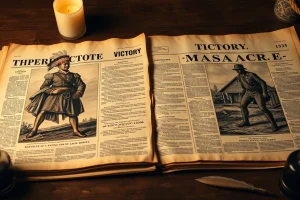
Broadsides and public notices were a ubiquitous and effective means of communication during the War of 1812. These large printed sheets, posted in taverns, town squares, and other public places, carried proclamations, military appeals, and news of political decisions. They played a critical role in shaping public opinion and disseminating official information on both sides of the conflict, and they survive today as indispensable primary sources for understanding the war.
Historical Context
The War of 1812 (1812–1815) pitted the United States against Great Britain over maritime rights, impressment, and territorial expansion. In an era before mass media and instantaneous communication, governments and military commanders relied on printed broadsides to reach the public quickly. Broadsides were cheap to produce, often printed on a single sheet of paper, and could be distributed door-to-door or posted in public gathering spots. They were used for official government pronouncements, such as declarations of war and royal orders, as well as for recruiting appeals and political commentary. The rapid spread of printed news was essential for mobilizing citizen-soldiers, explaining policy, and rallying public support.
What Happened
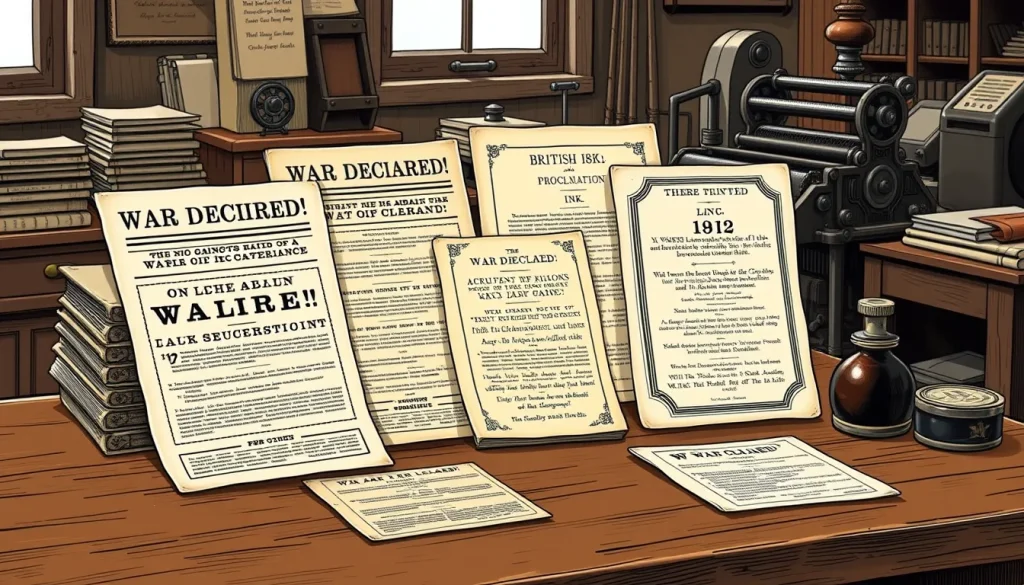
During the War of 1812, broadsides were published by both American and British authorities. The United States declared war on June 18, 1812, and a broadside titled “WAR DECLARED!!” was printed in Hartford, Connecticut, on June 22, 1812, by the Connecticut Mirror. It listed the congressional vote totals and announced the authorization of naval forces and letters of marque and reprisal. Meanwhile, the British government, acting through the Prince Regent, issued a proclamation on June 23, 1812, repealing the Orders in Council that had restricted American trade. This broadside was printed in London by Andrew Strahan. In July 1814, the Prince Regent issued another proclamation for recalling and prohibiting British subjects from serving in the American armed forces; this was also issued as a broadside. American military leaders also used broadsides: Brigadier General Alexander Smyth issued a recruiting broadside addressed “To the Men of the state of New York” in 1812, urging volunteers to join an invasion of Canada. These examples illustrate the range of official and military public notices printed during the war.
Why It Matters
Broadsides and public notices are crucial primary sources for understanding the War of 1812. They capture the contemporary language, arguments, and tone of official communication. They reveal how both governments sought to frame the conflict and influence public opinion. For historians, these documents offer insight into the political and social climate of the period, the methods of recruiting, and the dissemination of news. They also show the importance of print media in the early 19th century. The study of these broadsides helps illuminate the contested viewpoints of the war, including opposition in New England and the challenges of military leadership.
Definition
Broadsides are large sheets of paper printed on one side, typically used for public announcements, proclamations, or advertisements. Public notices are similar printed announcements intended to inform the public about official decrees, events, or calls to action. In the context of the War of 1812, broadsides included declarations of war, government proclamations, military recruiting appeals, and even political commentary.
Background
Printing technology in the early 19th century made broadsides cheap and easy to produce. With movable type and manual presses, printers could produce hundreds of copies in a short time. They were often distributed through postal routes, posted on walls, or handed out on the street. Their large type and bold headlines were designed to attract attention. Governments used them for official notices, while individuals and groups used them to express opinions or rally support. During the War of 1812, tensions between the United States and Britain led to a flood of war-related broadsides.
How It Worked
A typical broadside was issued by a government body, a military commander, or a printer. It began with a large headline, such as “WAR DECLARED!!” or “A Proclamation,” followed by the text of the announcement. The text could be a legal proclamation, a call for recruits, or a news item. The broadside would be printed by a local printer and then distributed. For example, the “WAR DECLARED!!” broadside was printed at the “MIRROR-OFFICE,” likely the Connecticut Mirror’s print shop. The British proclamations were printed by royal printers George Eyre and Andrew Strahan in London. Distribution often involved posting in public places, such as town halls, markets, and taverns, as well as distribution to local officials and military units.
Competing Viewpoints
Historians and contemporaries held different views on the reliability and purpose of broadsides. Some saw them as essential tools for informing the public; others viewed them as propaganda. In the United States, many New Englanders were opposed to the war, and broadsides could be used to voice dissent, such as those connected to the Hartford Convention. British proclamations emphasized the loyalty of subjects and the severity of treason. The Alexander Smyth broadside was criticized for its boastful and ultimately empty promises, illustrating the risk of overstatement. Modern historians must evaluate the bias, audience, and intent of each broadside.
Role in the War of 1812
Broadsides played a central role in communicating the outbreak of war, the justification for wartime measures, and calls for military service. The US government’s declaration of war was spread through broadsides like the “WAR DECLARED!!” sheet. The British government’s repeal of the Orders in Council was announced in a broadside, though it came too late to prevent the war. Military commanders used broadsides to stimulate enlistment, as did Alexander Smyth. The 1814 proclamation against British subjects serving in the American military was also an official broadside. Without print media, the speed of communication would have been even slower, and public awareness of events would have been limited.
Consequences and Historical Interpretation
The use of broadsides during the War of 1812 influenced public perception and memory of the conflict. They created a record of how the war was announced and justified. Historians today use broadsides to study public opinion, rhetoric, and the dissemination of government policy. The presence of opposition voices, such as those in New England, shows the contested nature of the war. The survival of these broadsides in archives and museums like the Massachusetts Historical Society and the USS Constitution Museum provides a tangible link to the era. They remind us of a time when printed paper was the primary mass medium.
Primary Sources
The following are notable broadsides from the War of 1812 preserved in institutional collections:
- “WAR DECLARED!!” (June 22, 1812), printed at the Mirror-Office (Connecticut Mirror), Hartford. It announces the US declaration of war and lists congressional votes. Held by the USS Constitution Museum (via Digital Commonwealth).
- “At the Court at Carlton House, The Twenty-third Day of June 1812” – British broadside repealing the Orders in Council, printed by Andrew Strahan in London. Held by the USS Constitution Museum.
- “A Proclamation, For recalling and prohibiting His Majesty’s natural-born Subjects from serving in the Sea or Land Forces of the United States of America” (July 23, 1814), printed by George Eyre and Andrew Strahan, London. Held by the USS Constitution Museum.
- Alexander Smyth’s broadside “To the Men of the state of New York” (1812), held by Brock University Archives (Brock University Digital Repository).
These documents are valuable for understanding the official and unofficial communication strategies of the belligerents, but each has biases and limitations—they were designed to persuade or inform, and their survival may be selective.
Further Reading
- Massachusetts Historical Society, “The War of 1812: Items from the Collections of the Massachusetts Historical Society,” https://www.masshist.org/features/war-of-1812-selections
- USS Constitution Museum, “Broadsides Collection,” https://ussconstitutionmuseum.org/
- Digital Commonwealth, “WAR DECLARED!!” https://dp.la/item/c25282c074f43a8efc926396a3ec93dc
- Brock University Digital Repository, “Broadside by Alexander Smyth, 1812,” http://hdl.handle.net/10464/17205
References
- Massachusetts Historical Society, “The War of 1812: Items from the Collections of the Massachusetts Historical Society,” https://www.masshist.org/features/war-of-1812-selections
- USS Constitution Museum, “At the Court at Carlton House,” https://ussconstitutionmuseum.org/collection-items/at-the-court-at-carlton-house-the-twenty-third-day-of-june-1812-present-his-royal-highness-the-prince-regent-in-council/
- USS Constitution Museum, “A Proclamation, For recalling and prohibiting His Majesty’s natural-born Subjects from serving in the Sea or Land Forces of the United States of America,” https://ussconstitutionmuseum.org/collection-items/a-proclamation-for-recalling-and-prohibiting-his-majestys-natural-born-subjects-from-serving-in-the-sea-or-land-forces-of-the-united-states-of-america/
- Digital Commonwealth, “WAR DECLARED!!,” https://dp.la/item/c25282c074f43a8efc926396a3ec93dc
- Brock University Digital Repository, “Broadside by Alexander Smyth, 1812,” http://hdl.handle.net/10464/17205
FAQ
Why were broadsides important during the War of 1812?
Broadsides were a primary means of disseminating official news, proclamations, and military calls to action to the public, making them vital for communication and propaganda.
What did the "WAR DECLARED!!" broadside announce?
It announced the United States' declaration of war against Great Britain on June 18, 1812, including congressional vote totals and the authorization of naval forces and letters of marque.
Where can War of 1812 broadsides be found today?
They are held in institutions such as the USS Constitution Museum, the Massachusetts Historical Society, and Brock University Library, many of which have made digital copies available online.
Leave a Reply