
Short Answer
Introduction: Two Wars, One Week
In the third week of June 1812, two fateful acts of war unfolded a continent and an ocean apart. On June 18, President James Madison signed a declaration of war against Great Britain—the closest war vote in American history. On June 24, Napoleon Bonaparte’s Grande Armée crossed the Niemen River into Russia, launching the most catastrophic invasion Europe had ever seen.
The timing was no coincidence, and the connection was no accident. The War of 1812 cannot be understood apart from the titanic struggle between Britain and Napoleonic France that had consumed the Atlantic world for two decades. The grievances that pushed America to war—impressment, blockades, strangled trade—were byproducts of that European death match. The strategies Britain used in Canada and the Chesapeake were shaped by the demands of fighting Napoleon. The war’s climax in 1814 was made possible by Napoleon’s abdication, which freed thousands of Wellington’s veterans for service in North America. And the peace at Ghent was signed the way it was—silently dropping every issue America had declared war over—precisely because Napoleon’s defeat had made those issues vanish.
To Americans, it was a “second war of independence.” To Britons, it was an infuriating sideshow at the moment of their nation’s existential fight. To Canadians, it was their founding defense. But to historians, the War of 1812 is best understood as the American theater of the age of Napoleon—a war that Europe’s conflict started, shaped, and finally ended.
This article untangles that double helix: how the Napoleonic Wars caused the American war, how the two struggles twisted around each other for three years, and how the settlement of one settled the other.
A World War’s American Front
From 1793 to 1815, with only one brief interruption (the Peace of Amiens, 1802–1803), Britain and France were at war—a generation-long contest over the future of Europe and, many believed, of civilization. Britain’s weapon was the sea: the Royal Navy, supreme after Trafalgar (1805), blockaded French ports and strangled French commerce. Napoleon’s weapon was the continent: unable to invade Britain or challenge the Navy, he built the Continental System, closing Europe’s ports to British goods and forbidding neutrals from trading with his enemy.
Caught in the middle was the world’s largest neutral carrier: the United States. American merchants grew rich re-exporting Caribbean sugar and coffee to a Europe at war—and grew furious as both empires seized American ships for trading with the other. By the war’s eve, France and Britain had each confiscated hundreds of American vessels. The United States was, in effect, being punished by both sides of a war it desperately wanted no part of.
That is the essential framework: the War of 1812 was fought within the gravitational field of a much larger war. Every major decision in Washington, London, and—for that matter—Paris was conditioned by the struggle with Napoleon.
The Road to War Ran Through Europe
Blockade Against Blockade: The Strangulation of Neutral Trade
The economic warfare escalated in steps:
- 1805 — The Essex decision. British courts ruled that American re-exports of French colonial goods were illegal unless duties were paid and the trade “broken.” The Royal Navy began seizing American merchantmen in earnest.
- 1806 — The Berlin Decree. Napoleon declared Britain under blockade and barred neutral trade with it.
- 1807 — The Orders in Council. Britain answered: neutrals wishing to trade with Europe must first pass through British ports and pay British duties. France answered with the Milan Decree: any ship submitting to British rules was liable to seizure.
An American captain was thus trapped in a perfect catch-22: obey Britain and France would seize your ship; obey France and Britain would. The commerce of a neutral republic had become a prize of war for both empires.
Impressment: The Royal Navy’s Manpower Hunger
Fighting Napoleon required a vast fleet, and the fleet required sailors—deserters from which routinely fled to better-paying American merchant ships. Britain’s answer was impressment: stopping American vessels at sea and hauling off sailors alleged (often on the flimsiest grounds) to be British subjects. By most estimates, between 6,000 and 10,000 American sailors were impressed into the Royal Navy across the two French wars—some of whom died under a flag not their own, in a war not their own.
The issue exploded in the Chesapeake–Leopard affair (June 22, 1807), when a British warship fired on the unprepared U.S. frigate Chesapeake, killed or wounded twenty-one Americans, and seized four sailors. Americans were incandescent; war was only averted by diplomacy. But the episode fixed “Free Trade and Sailors’ Rights” as the era’s rallying cry—and, tellingly, Britain refused to renounce impressment as a principle, because the war against Napoleon made it convinced the practice was indispensable.
Economic Coercion and Napoleon’s Deception
The United States tried to fight back with its one great weapon: its market. Jefferson’s Embargo Act (1807) halted virtually all American exports—a spectacular self-inflicted wound that wrecked New England’s ports without bending either empire. Successor measures (the Non-Intercourse Act of 1809; Macon’s Bill No. 2 of 1810) promised to lift trade barriers against whichever belligerent ended its own restrictions first.
Here Napoleon played his sharpest trick. In 1810, his foreign minister’s Cadore letter hinted that France would revoke its decrees against American shipping—while Napoleon simultaneously continued seizing and selling American cargoes in French ports. Madison, accepting the letter at face value, renewed non-intercourse against Britain alone in early 1811. Britain, watching French customs houses continue to confiscate American goods, dismissed Madison’s move as proof that the President was Napoleon’s dupe. The trap was sprung: the two Atlantic powers now regarded each other as hopelessly compromised, and drift toward war accelerated. Events on the western frontier—the clash with Tecumseh’s confederacy at Tippecanoe (November 1811) and the conviction that British Canada stood behind Indigenous resistance—threw the western “War Hawks” onto the scales.
The Repeal That Came Too Late
In the spring of 1812, the political ground in London shifted catastrophically. Prime Minister Spencer Perceval was assassinated in the House of Commons on May 11, 1812—the only British prime minister ever murdered. Amid an economic slump and a roaring petition campaign from industrial cities, the new ministry under Lord Liverpool relented: the Orders in Council were suspended in mid-June and formally revoked on June 23, 1812.
It was five days after the American declaration of war.
Because news crossed the Atlantic only by sailing ship, Americans voted for war not knowing their central trade grievance had been surrendered—and London revoked the Orders not knowing it was now at war. Historians have never ceased to ask whether faster communication could have prevented the conflict. Perhaps; impressment remained unresolved, western grievances ran deep, and the War Hawks wanted Canada. But the episode stands as one of history’s cruelest illustrations of how wars begin in the gaps between capitals.
Fighting France First: Napoleon Shapes the American War, 1812–1813
A Defensive Empire
Britain entered the American war with its hands full: hundreds of thousands of men fighting in Spain and Portugal, a fleet blockading Europe, and a treasury stretched to its limit. North America received what London could spare—which, in 1812, was almost nothing: perhaps five thousand regulars to hold Canada against an invasion by a nation of seven and a half million. Governor-General Sir George Prevost was instructed, in essence, to defend, endure, and wait until Napoleon was beaten.
That Britain expected to hold Canada with militia and a skeleton garrison tells you everything about its priorities. France came first; America was a distraction to be managed.
The Ironies of a War Within a War
The entanglement produced ironies almost too rich for fiction:
- American farmers fed Wellington’s army. While the Royal Navy blockaded American ports, British-licensed American merchants shipped huge quantities of grain to Spain and Portugal—provisioning the very British army then fighting Napoleon. Madison’s war measure was, in part, Britain’s commissariat.
- Britain blockaded selectively. For its first year the blockade pointedly exempted New England—both to keep British manufacturers supplied through smuggling and to nurture the region’s anti-war Federalists. The strategy of division worked: “Mr. Madison’s War” was deeply unpopular from Maine to Connecticut.
- Napoleon reaped the benefit without lifting a finger. The United States was never France’s ally—there was no treaty, no coordination, and France’s own seizures of American ships rivaled Britain’s. But every British regiment sent to Quebec was a regiment not in the Peninsula. Federalists charged that Madison had made America the Corsican’s pawn; the more precise truth is that the U.S. had become Napoleon’s accidental co-belligerent.
- A British bank had already financed America’s expansion. In 1803, Napoleon—his American empire ruined by the Haitian Revolution and war with Britain resuming—sold Louisiana to fund his campaigns, with Barings of London underwriting the bonds. The territory Britain’s own bankers helped America acquire included New Orleans, where the war’s last great battle would be fought.
Shock at Sea
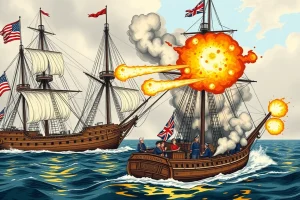
The early naval war delivered the one thing London had least expected from Nelson’s heirs: humiliation. In a span of months, USS Constitution destroyed HMS Guerriere and HMS Java, and USS United States captured HMS Macedonian—single-ship victories that stunned a British public unaccustomed to losing anything at sea since Trafalgar. The Times of London lamented the losses more bitterly than any continental reverse. British pride was partly salvaged when HMS Shannon took USS Chesapeake off Boston in June 1813—but not before Captain James Lawrence’s dying command, “Don’t give up the ship,” entered the American naval lexicon. Meanwhile, some five hundred American privateers savaged British merchant shipping, driving insurance rates in Bristol and the Irish Sea to heights unseen in years.
None of this threatened Britain’s command of the ocean. But it rankled—enough that, when peace talks came in 1814, British negotiators arrived nursing a genuine desire to punish the upstarts.
The Tsar Tries Mediation
The first attempt to end the war came, fittingly, from a European power. In March 1813, Tsar Alexander I—fighting Napoleon at his own gates and alarmed to see his ally Britain bleeding in America—offered to mediate. Madison accepted instantly, dispatching Treasury Secretary Albert Gallatin and Senator James Bayard across the Atlantic before London had even answered. Britain, unwilling to let a third party referee maritime rights, declined the mediation but eventually agreed to direct negotiations—and the venue drifted from Gothenburg, Sweden, to the Flemish city of Ghent, where talks finally opened in August 1814.
By then, the whole chessboard had changed. In Russia, Napoleon’s Grande Armée had died in the snow. At Leipzig in October 1813, Europe’s combined powers broke his empire. In April 1814, he abdicated. And that single event transformed the American war overnight.
1814–1815: Napoleon’s Fall Floods America with Veterans
“Wellington’s Invincibles” Cross the Atlantic
With France beaten, Britain could finally attend to the nuisance across the ocean. Through the summer of 1814, **roughly 14,000–16,000 seasoned troops—many of them veterans of Wellington’s Peninsula campaigns—**crossed to North America. The blockade was extended to New England’s harbors. The war Britain had managed on a shoestring now became, briefly, a real war, fought on four fronts:
- Niagara (July 1814): The battles of Chippewa and Lundy’s Lane—Lundy’s Lane the bloodiest battle ever fought on Canadian soil—saw American regulars under Winfield Scott prove they could stand toe-to-toe with Peninsula veterans, at frightful cost.
- The Chesapeake (August–September): A force under Major General Robert Ross, a Peninsula veteran, routed American militia at Bladensburg and burned Washington’s public buildings—the psychological centerpiece of Britain’s punitive campaign. Three weeks later the same force was repulsed at Baltimore, where Ross fell at North Point and Fort McHenry survived the bombardment that produced “The Star-Spangled Banner.”
- Lake Champlain (September 11, 1814): The decisive stroke miscarried. Prevost marched south with veterans toward Plattsburgh, but when Captain Thomas Macdonough’s squadron destroyed the British flotilla on the lake, Prevost withdrew—his army intact, his invasion over, and his career ruined.
- The Gulf (December 1814–January 1815): A final expedition under **Sir Edward Pakenham—Wellington’s brother-in-law and one of his most distinguished division commanders—**sailed against New Orleans.
Every one of these offensives, and the men who led them, were direct dividends of Napoleon’s defeat.
Vienna Overshadows Ghent
But if Napoleon’s fall armed Britain in America, it also exhausted Britain everywhere else. At the Congress of Vienna, which assembled in the autumn of 1814 to carve up Napoleon’s empire, Britain’s foreign secretary Lord Castlereagh faced disputes with Russia that twice brought the great powers to the edge of a fresh European war. A prolonged American conflict—costly, unpopular, and fought over issues that no longer existed—was a luxury the British public, groaning under wartime taxes, would not fund forever.
The news from America then undercut the hardliners: Baltimore repulsed, Plattsburgh abandoned, and no conquest in hand. The cabinet sought the opinion of the one man whose word could not be challenged. The Duke of Wellington, asked whether Britain should demand territorial concessions, answered with cold soldier’s logic: you have no right to demand territory from a treaty of peace when you have failed to conquer any. The letter ended the hardline position.
On Christmas Eve 1814, the commissioners—John Quincy Adams, Henry Clay, Albert Gallatin, James Bayard, and Jonathan Russell for the United States—signed the Treaty of Ghent. It restored the status quo ante bellum: boundaries as before, captures returned, grievances referred to future commissions. It said not one word about impressment, blockades, neutral rights, or the Orders in Council—the causes over which America had declared war.
The silence was not oversight. It was the point. Napoleon’s defeat had dissolved those causes: with no French war to fight, Britain no longer needed to strangle neutral commerce or scour the seas for sailors. America’s objectives were achieved without being written down—secured not by American arms but by the battlefields of Europe, a resolution as galling to American pride as it was welcome to American merchants.
New Orleans and the Hundred Days: The Peace That Arrived Just in Time
Because news still traveled at the speed of sail, the war’s most lopsided battle came after its end. On January 8, 1815, Andrew Jackson’s polyglot army annihilated Pakenham’s Peninsula veterans before New Orleans, killing the general and some two thousand of his men—the same redcoats who had marched with Wellington from Portugal to France, brought down by cotton-bale ramparts and Tennessee riflemen in a war already officially over. The victory made Jackson a national hero and let Americans convince themselves that Ghent was a triumph rather than a draw.
Peace news reached New York on February 11, 1815, and the Senate ratified the treaty days later—as, almost simultaneously, the disgruntled Federalist delegates of the Hartford Convention arrived in Washington with their list of grievances, stepping off their carriages into a city celebrating both peace and Jackson’s victory. The Federalist Party never recovered.
Then, on March 1, Napoleon escaped Elba and landed in France. The Hundred Days had begun—and for a few dizzy weeks Britain faced the nightmare of fighting a renewed European war with an American war still unresolved. Ghent had closed that door just in time. At Waterloo on June 18, 1815, Britain fought Napoleon once only, and finished him.
The Peace They Made Together: How the End of One War Settled the Other
Impressment Dies with Napoleon
The Treaty of Ghent never mentioned impressment, and Britain never formally renounced it. It simply stopped the practice—because the end of the French wars ended the Royal Navy’s insatiable hunger for men. An issue that had bedeviled Anglo-American relations for two decades disappeared with the war that created it. The lesson was not lost on American statesmen: the republic’s maritime rights had been hostage to Europe’s wars, and only Europe’s peace secured them.
From Enemies to Neighbors
The postwar settlement between the two former belligerents was swift and, by the standards of history, astonishingly durable:
- Rush–Bagot Agreement (1817): The two nations stripped their Great Lakes navies to a handful of vessels—naval disarmament that gradually extended, by custom and later agreements, into the demilitarization of the entire U.S.–Canadian border, the seed of what would be proudly called the world’s longest undefended frontier.
- Convention of 1818: The 49th parallel was fixed from the Lake of the Woods to the Rockies; Oregon was placed under joint occupation; New England fishing rights were patched back together.
- The Monroe Doctrine (1823): When Napoleon’s old enemies in the Holy Alliance contemplated restoring Spain’s revolted American colonies, Britain—now committed to Atlantic peace and profiting from trade with the new republics—proposed a joint Anglo-American declaration against European recolonization. Monroe and John Quincy Adams issued their own instead, but it floated on the reality of post-Napoleonic British sea power. The strange new alignment of the 1820s was inconceivable without the double settlement of 1814–15.
The Economic Reckoning
Peace in Europe also detonated an economic shock. British manufacturers, their continental blockade over, dumped mountains of cheap goods on the American market, crushing the infant industries the blockade had inadvertently nurtured. The response—the Tariff of 1816, the Second Bank of the United States (1816), Henry Clay’s “American System”—was the policy architecture of a nation that had learned, in the crucible of economic warfare between Britain and Napoleon, that independence required protected industry and sound finance. Wartime customs revenue had collapsed (exports fell from roughly $45 million in 1811 to under $7 million by 1814, and the national debt nearly tripled); the Republican Party of Jefferson emerged from the war governing like Federalists.
The War’s Forgotten Losers—and Canada’s Founding Story
If the double peace made winners of Anglo-American reconciliation, it made one set of peoples its permanent victims. At Ghent, Britain had opened the talks demanding an Indigenous buffer state in the Northwest Territory—the solemn promise made to Tecumseh’s confederacy and Britain’s other Native allies, whose warriors had saved Canada in 1812–13. By autumn the demand was quietly dropped. Tecumseh himself lay dead at the Thames (October 1813), his confederacy broken. Abandoned at the peace table, Indigenous nations faced the American republic alone; the era of removal that followed across the Old Northwest and South was, in a real sense, the War of 1812’s true ending.
Canada, by contrast, forged from the war its founding myth—the militia and regulars of a thinly settled colony (with crucial Indigenous allies) repelling invasion—while Britain settled disbanded Peninsula veterans on Canadian land grants, creating military colonies like Perth, Ontario, expressly as a hedge against future American war. Two national identities, American self-congratulation and Canadian defiance, were both minted from what London had regarded as a tiresome distraction from France.
Historians’ Debates: Sideshow, Stab in the Back, or Second Independence?
Interpretations of the war’s relationship to the Napoleonic conflict have always been arguments about whose war it really was:
- The sideshow view (common in British historiography): the American war was a minor, exasperating colonial flare-up within a world war—Britain fought it with Wellington’s leftovers between Talavera and Waterloo, and the Duke’s intervention, not General Jackson’s, truly wrote the peace.
- The stab-in-the-back view—which was British popular opinion in 1812: America chose the precise moment of Britain’s existential struggle to attack, hoping to strip Canada while the lion was otherwise engaged. Historians such as Troy Bickham (The Weight of Vengeance) have shown how deeply this sense of betrayal shaped Britain’s punitive mood in 1814.
- The sovereignty view (the American nationalist tradition): maritime rights, impressment, and national honor made war unavoidable, Napoleon or no; the timing was provoked by British policy, not calculated around France.
- The expansionist view (associated with historian Julius Pratt and the “western school”): the war was substantially about land—Canada, Florida, and neutralizing British-backed Indigenous power—causes that had little to do with Napoleon at all.
- The Republican-party view (J.C.A. Stagg’s Mr. Madison’s War): Madison went to war to save his party and the republican experiment from seeming impotent before its own people.
Modern scholarship generally converges on the frame this article has used: whatever America’s internal motives, the war’s causes, course, climax, and settlement were each, at every stage, conditioned by the struggle against Napoleon. The two conflicts were less parallel wars than a single intertwined crisis of the Atlantic world.
Timeline: Two Wars, One Timeline
| Date | In Europe | In North America |
|---|---|---|
| 1803 | Anglo-French war resumes; Napoleon sells Louisiana (Barings finances the bonds) | U.S. doubles in size |
| 1805–07 | Trafalgar; Berlin & Milan Decrees; Essex ruling; Orders in Council | Neutral shipping squeezed; Chesapeake–Leopard (1807); Embargo Act |
| 1810–11 | Napoleon issues the deceptive Cadore letter; seizes U.S. ships | Non-intercourse against Britain restored; Tippecanoe |
| June 1812 | Perceval assassinated (May); Orders revoked June 23; Napoleon invades Russia June 24 | U.S. declares war June 18 |
| 1813 | Napoleon’s army destroyed in Russia and at Leipzig; Tsar offers mediation | U.S. naval victories stun Britain; Shannon–Chesapeake; Tecumseh killed at the Thames |
| April 1814 | Napoleon abdicates | Peninsula veterans flood Canada; blockade tightens |
| Aug–Sept 1814 | Congress of Vienna convenes; Anglo-Russian crisis | Washington burned; Baltimore holds; Plattsburgh turns back the invasion |
| Dec 24, 1814 | Castlereagh juggling Vienna | Treaty of Ghent signed |
| Jan–Feb 1815 | Napoleon on Elba, plotting | New Orleans (Jan 8); treaty ratified (Feb); Hartford Convention collapses |
| June 1815 | Napoleon returns; Waterloo (June 18) | Peace holds; Anglo-American reconciliation begins |
| 1817–18 | Post-Napoleonic peace consolidates | Rush–Bagot (1817); Convention of 1818 fixes 49th parallel |
Key Figures at a Glance
- Napoleon Bonaparte — His Continental System strangled neutral trade, his deceptions misled Madison, his sale of Louisiana expanded America, and his fall decided the war’s final shape.
- James Madison — The president who gambled a war while the world’s greatest empire was distracted, and won the gamble by one vote in the Senate.
- Duke of Wellington — Fought Napoleon in Spain, declined the American command, and wrote the memo that killed Britain’s demands at Ghent.
- Lord Castlereagh — Britain’s foreign secretary, balancing the Congress of Vienna and the Ghent talks simultaneously.
- John Quincy Adams & Albert Gallatin — The American commissioners whose patience at Ghent converted survival into settlement.
- Robert Ross & Edward Pakenham — Peninsula veterans whose fates (Ross killed at Baltimore; Pakenham before Jackson’s ramparts) embodied the transfer of Wellington’s war to America’s shores.
- Tecumseh — The confederacy leader whose alliance with Britain was valued in Canada’s crisis and abandoned at its peace.
- Tsar Alexander I — The European monarch who tried first to end an American war, because every ally mattered against Napoleon.
Frequently Asked Questions
Was the War of 1812 part of the Napoleonic Wars? Not formally—America and France were never allies—but effectively, yes. The war’s causes (impressment, blockades, trade restrictions) were created by the Anglo-French struggle; its course was dictated by Britain’s commitments against Napoleon; its climax came only after Napoleon’s abdication freed British armies; and its settlement was possible only because his defeat had erased the war’s causes.
Did Napoleon want the United States to go to war with Britain? He profited from it without coordinating it. His 1810 “revocation” of anti-neutral decrees was deliberately misleading—it baited Madison into confronting Britain while France continued seizing American ships. Every British soldier sent to Canada was a soldier not facing France.
If Britain repealed the Orders in Council before hearing of the declaration of war, why did the war still happen? Transatlantic news took weeks by sail. Congress declared war June 18, 1812, unaware the Orders were suspended that same week; London revoked them unaware war had been declared. Whether the repeal would have prevented the war had communications been faster remains one of history’s great counterfactuals—impressment and western grievances persisted, and the declaration passed by a single Senate vote.
How did Napoleon’s defeat change the war in 1814? It transformed it. Some 14,000–16,000 British veterans crossed the Atlantic; the blockade was extended to New England; offensives were launched on four fronts—the Niagara, Lake Champlain, the Chesapeake, and the Gulf. Washington was burned by Peninsula veterans; Plattsburgh was turned back by them narrowly; New Orleans was assaulted by them under Wellington’s brother-in-law.
Why doesn’t the Treaty of Ghent mention impressment or neutral rights? Because Napoleon’s defeat made those questions moot. With the French wars over, Britain had no need to impress sailors or blockade neutral trade. America got its objectives in practice—European peace delivered what American arms had not—and both governments preferred a clean treaty of status quo ante bellum.
Was the United States allied with Napoleon? No. There was no treaty, no coordination, and France preyed on American shipping almost as eagerly as Britain did. Federalists branded Madison a tool of the “Corsican ogre,” but the United States was at most Napoleon’s accidental co-belligerent, fighting a common enemy for entirely separate reasons.
How did the two wars’ endings shape U.S.–British relations? Profoundly and, ultimately, peacefully. Within three years the two nations had agreed to disarm on the Great Lakes (Rush–Bagot, 1817) and fixed the 49th-parallel boundary to the Rockies (Convention of 1818). The post-Napoleonic order—British sea power underwriting Atlantic peace—allowed the Monroe Doctrine and a century of Anglo-American rapprochement.
Who actually won the War of 1812? Depends who you ask—and it was the Napoleonic context that made the question slippery. Canada proved it could survive; the United States proved it could endure and emerged confident; Britain lost nothing it cared to keep; and the war’s unequivocal losers were the Indigenous nations abandoned at Ghent and the Federalist Party destroyed at home.
Conclusion
Strip the Napoleonic Wars away, and the War of 1812 becomes nearly unintelligible. There is no impressment without the Royal Navy’s struggle against France. There are no Orders in Council without the Continental System. There is no declaration of war without the calculation—made in both Washington and London—of where the world’s greatest empire’s attention lay. There is no burning of Washington, no veterans at New Orleans, without Napoleon’s abdication; and there is no peace at Ghent, silent on every American grievance, without his defeat.
That is why the war has always been remembered differently on opposite sides of the ocean: as a founding chapter in America and Canada, and as a footnote in a Britain that was rather preoccupied between Trafalgar and Waterloo. Both memories are true to what each nation lived. But the full story belongs to a single Atlantic crisis, in which a young republic tried to assert itself on a stage dominated by an emperor and an empire—and discovered that its second war of independence would be ignited, fought, and resolved largely by the death throes of the first great modern world war.
The final irony is the durable one. The two wars ended within months of each other, and the peace that settled Europe settled North America too—not through conquest, but through exhaustion, pragmatism, and the quiet disappearance of everything they had been fighting over. The longest peaceful border in the world, and a century of Anglo-American rapprochement, were born at Ghent and Vienna alike.
Further Reading
- Troy Bickham, The Weight of Vengeance: The United States, the British Empire, and the War of 1812
- J.C.A. Stagg, Mr. Madison’s War: Politics, Diplomacy, and Warfare in the Early American Republic
- Donald R. Hickey, The War of 1812: A Forgotten Conflict
- Alan Taylor, The Civil War of 1812: American Citizens, British Subjects, Irish Rebels, & Indian Allies
- Jon Latimer, 1812: War with America
- Andrew Lambert, The Challenge: Britain Against America in the Naval War of 1812
- Bradford Perkins, Prologue to War: England and the United States, 1805–1812 and Castlereagh and Adams
- Fred L. Engelman, The Peace of Christmas Eve
- Charles J. Esdaile, Napoleon’s Wars: An International History
- Adam Zamoyski, Rites of Peace: The Fall of Napoleon and the Congress of Vienna

Leave a Reply