
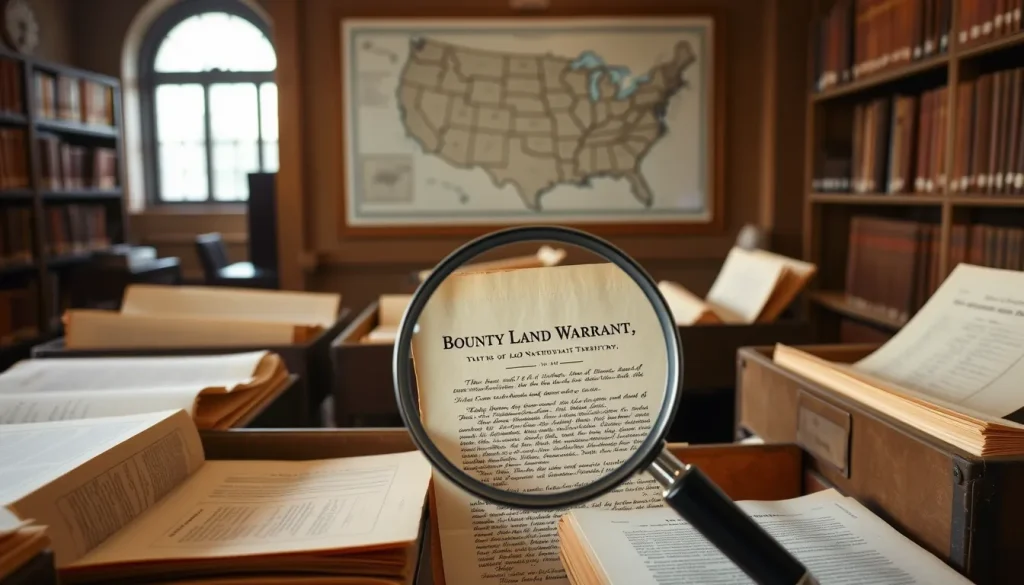
Short Answer
War of 1812 Bounty Land Warrants were federal certificates that entitled veterans of the War of 1812 to claim public land as partial compensation for military service. Issued under a series of acts of Congress from 1811 to 1855, they helped recruit troops and reward service. For genealogists, the associated application files and warrant records are rich sources of personal and service information, often documenting veterans’ units, ranks, residences, and family members.
Historical Context
The American tradition of granting land bounties for military service dates to colonial times and the Revolutionary War. By the early 1800s, the federal government owned vast public lands in the Northwest and Southwest territories. Congress used land warrants to encourage enlistment in the regular army and volunteer forces during the War of 1812. The first War of 1812 bounty acts were passed in December 1811 and January and May 1812, offering 160 acres to noncommissioned officers and soldiers who served for five years. A later act of December 1814 doubled the acreage for soldiers enlisting after that date, creating the ‘double bounty warrant.’ To fulfill these promises, Congress reserved 2 million acres each in the territories of Michigan, Illinois, and Louisiana (present-day Arkansas). The land was not initially transferable, and veterans were required to locate their claim within these specified districts. Over time, Congress expanded eligibility and eased restrictions, culminating in the 1855 act that granted warrants to most remaining veterans and their heirs.
What Happened
Eligible veterans (or their heirs) applied to the War Department for a bounty land warrant. The application file typically contained the veteran’s name, age, unit, and period of service; widows or heirs provided additional proof of relationship. After approval, the General Land Office issued a warrant—a certificate that could be used to select a specific tract of surveyed public land. The veteran or assignee then received a patent (title) from the government. Because warrants were non-transferable until 1852, the original veteran (or heir) usually located the land, but many sold their rights after 1852. The records generated—application files, warrant stubs, and surrender warrants—were maintained by the War Department, the Pension Office, and the General Land Office. Today these records are held primarily in Record Group 15 (Veterans Administration) and Record Group 49 (Bureau of Land Management) at the National Archives. Microfilm publication M848 reproduces 105 volumes of warrants and indexes, while M313 indexes pension applications that often include bounty land information.
Why It Matters
Bounty land records are among the most valuable genealogical resources for War of 1812 veterans. They provide proof of military service, unit and rank, place of residence, and sometimes details about the veteran’s family. For widows, they document marriage dates and maiden names, information often unavailable elsewhere. These records also illustrate the federal government’s policy of using public land to reward soldiers and encourage settlement. For modern genealogists, accessing these records can confirm a veteran’s service, lead to compiled military service records and pensions, and reveal where a veteran settled after the war. The records are widely used in constructing family histories and understanding the westward expansion that followed the war.
Definition
A bounty land warrant is a legal document that gave the holder the right to a specified amount of public land, typically 160 or 320 acres, in exchange for military service. Unlike a pension (monetary payment), a warrant was a certificate that could be applied toward the purchase of land from the federal government. The warrant itself listed the veteran’s name, rank, unit, and date of issue, but often contained little personal data; the accompanying application file is usually the genealogical goldmine.
Background
Congress authorized the first U.S. military bounty lands in 1776 to encourage enlistment during the American Revolution. The practice continued with the War of 1812, the Mexican War, and various Indian wars. The War of 1812 warrants were specific to the acts of 1811, 1812, and 1814, but veterans could also claim under later acts of 1842, 1850, 1852, and 1855. These later acts extended eligibility to men who served shorter terms, including many militia members. The records from all these acts are often interfiled, making it essential for researchers to search for all possible warrant applications.
How It Worked
The process began when a veteran (or his widow or heir) submitted an application to the War Department, providing evidence of service and identity. After verification, the Pension Office issued a bounty land warrant, which was sent to a local General Land Office. The veteran (or assignee) selected a tract of land and received a patent. The warrant was then surrendered to the GLO, and the transaction was recorded in the abstract of locations. This process created several distinct document types: the application file (including testimony and supporting documents), the warrant itself, the surrender warrant (showing the location), and the patent. For genealogists, the application files are the most informative. They are arranged alphabetically by veteran’s surname and are in the custody of the National Archives. The surrendered warrants are filed with the General Land Office and can be located via the BLM’s General Land Office Records database. Microfilm M848 provides digitized copies of the warrants themselves, with indexes on roll 1.
Competing Viewpoints
Historians have debated the effectiveness and fairness of the bounty land system. Some argue that the warrants were an efficient way to recruit troops and distribute public land, encouraging settlement of the frontier. Others note that many veterans never received their land because of restrictive regulations, the long delay of some acts, or the inability of soldiers to travel to remote districts. Critics also point out that speculators often took advantage of veterans after 1852, when warrants became transferable, leading to abuses. For genealogists, these debates highlight the variability of records—some veterans have extensive paperwork, while others have almost none—and the importance of checking all possible sources.
Role in the War of 1812
The promise of bounty land was a key inducement for recruits, especially in the regular army and early volunteer units. The acts of 1811 and 1812 helped fill the ranks after the declaration of war, and the doubled bounty of 1814 was an incentive for enlistment as the war continued. While not all soldiers received warrants at the time, the later congressional acts (especially 1850 and 1855) extended benefits to thousands of veterans who had served only briefly or in state militia. These warrants thus had a lifelong impact on many veterans and their families, often resulting in patents for land in Ohio, Indiana, Illinois, Michigan, Missouri, Arkansas, and other public-land states.
Consequences and Historical Interpretation
The bounty land system contributed to the rapid settlement of the trans-Appalachian West in the decades after 1815. Many veterans, or their widows, used the warrants to acquire farms and establish communities. The records are a tangible link between military service and westward expansion. For genealogists, the records are a primary source that can lead to other military and land records, enriching family histories. However, the system also reflected the limitations of early federal administration: processing delays, lost files, and fraud. Modern interpretations emphasize both the generous intent and the practical difficulties that veterans faced, which is why not every eligible veteran received a warrant and why some who did never patented the land.
Primary Sources
The National Archives holds three main record groups of value: Record Group 15 (Veterans Administration) contains bounty land warrant application files and index M313; Record Group 49 (Bureau of Land Management) contains the surrendered warrants, patents, and the microfilm M848 (War of 1812 Military Bounty Land Warrants, 1815–1858); and Record Group 94 (Adjutant General) has compiled service records. The application files often include witness statements and family data. The warrants themselves show the warrant number, veteran’s name, rank, unit, and date issued. The surrendered warrant files include the patent location. Each source has biases and limitations: application files were generated to prove eligibility, so they may contain errors or omissions; warrant registers do not reveal whether the veteran actually settled on the land. Nonetheless, these records are indispensable for genealogical research.
Further Reading
- Butler, Stuart L. Genealogical Records of the War of 1812. National Archives, Prologue, 1991. https://www.archives.gov/publications/prologue/1991/winter/war-of-1812.html
- Kluskens, Claire. War of 1812 Military Service, Bounty Land, and Pension Records: A Step-by-Step Guide to Basic Federal Sources. NARA, 2020. https://twelvekey.com/wp-content/uploads/2020/05/war_of_1812_basic_guide_2020_05_19.pdf
- National Archives and Records Administration. Bounty-Land Warrants for Military Service, 1775–1855. NARA Reference Information Paper. https://www.archives.gov/research/military/bounty-land-1775-1855.pdf
- National Archives and Records Service. War of 1812 Military Bounty Land Warrants, 1815–1858. Microfilm publication M848. https://www.archives.gov/files/research/military/army/dc/m848.pdf
References
- National Archives and Records Administration. Bounty-Land Warrants for Military Service, 1775–1855. https://www.archives.gov/research/military/bounty-land-1775-1855.pdf
- Butler, Stuart L. Genealogical Records of the War of 1812. National Archives, Prologue, 1991. https://www.archives.gov/publications/prologue/1991/winter/war-of-1812.html
- National Archives and Records Service. War of 1812 Military Bounty Land Warrants, 1815–1858. Microfilm publication M848, 1971. https://archive.org/details/warof1812militar12unit
- Kluskens, Claire. War of 1812 Military Service, Bounty Land, and Pension Records: A Step-by-Step Guide to Basic Federal Sources. NARA, 2020. https://twelvekey.com/wp-content/uploads/2020/05/war_of_1812_basic_guide_2020_05_19.pdf
FAQ
How do I find a War of 1812 bounty land warrant for my ancestor?
Start by searching the Bureau of Land Management's General Land Office Records (glorecords.blm.gov) for patents with 'MW' accession numbers. Then order the surrendered warrant file from NARA using NATF Form 84, or locate the application file using M313 or the alphabetical arrangement. You can also search the index on M848 or consult the War of 1812 Pension Index (M313) for cross-references.
What information is in a bounty land warrant application file?
Typical files include the veteran's name, age, place of residence, military unit and rank, period of service, and sometimes discharge paperwork. Widow's applications include marriage date, place, and the widow's maiden name.
Were bounty land warrants transferable?
Initially, warrants were not transferable and had to be used by the veteran or his heirs. The 1842 act allowed them to be used on any public land, but transferability did not become legal until 1852. After that, many veterans sold their warrants, which is why some records show assignees rather than the veteran's name.



Leave a Reply