
Short Answer
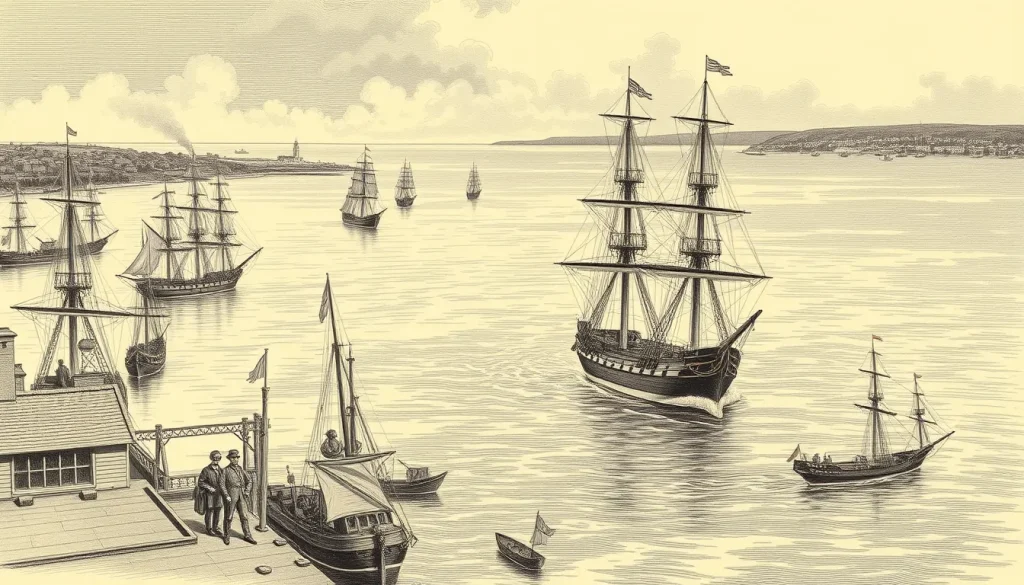
The Royal Navy’s blockade of the American coast during the War of 1812 (1812–1815) was a systematic maritime campaign that progressively cut off the United States from overseas markets and internal coastal trade. Implemented in stages beginning with the Chesapeake and Delaware Bays in December 1812, the blockade expanded to the entire Atlantic and Gulf coasts by 1814. It devastated American exports, reduced government customs revenue, and proved a decisive factor in the war’s outcome, highlighting the economic vulnerability of the young republic.
Historical Context
When the United States declared war on Britain on June 18, 1812, the nation’s economy was already struggling under the effects of Jefferson’s Embargo (1807–1809) and subsequent non-importation acts. American shipping and trade had flourished during the Napoleonic Wars as a neutral carrier, but both Britain and France had interfered with that commerce. The Royal Navy, then the world’s dominant naval power, was heavily engaged in Europe but still able to deploy significant forces to North America. The U.S. Navy was small—around a dozen ocean-going warships—while American merchant shipping was extensive and vital to the economy. The British strategy aimed to exploit domestic divisions, particularly New England’s opposition to the war, by initially exempting that region from the blockade. This calculated policy sought to weaken the American war effort by strangling commerce and revenue while encouraging Federalist calls for peace. At the same time, the British relied on the blockade to prevent American privateers from sortieing and to protect British trade and supply lines to Canada and the West Indies.
What Happened
The blockade was not imposed all at once. In December 1812, Admiral Sir John Borlase Warren declared a blockade of the Chesapeake and Delaware Bays, the two largest commercial waterways on the American east coast. New England was deliberately excluded to foster anti-war sentiment and to maintain a supply of foodstuffs to British forces in the Iberian Peninsula. Over the next year, the blockade expanded. In March 1813, it was extended to include New York, Charleston, Savannah, and other southern ports. By November 1813, the entire coast south of Narragansett Bay was under blockade. After Vice Admiral Alexander Cochrane replaced Warren in early 1814, and following Napoleon’s abdication in April 1814, the blockade was extended to New England in May 1814, completing the encirclement.
The blockade was enforced by British warships operating out of Halifax, Bermuda, and other bases. At its peak, more than 130 British vessels were stationed off the American coast. American warships and privateers were increasingly confined to port. Coastal trade—the movement of goods between American ports—was nearly eliminated, as was most foreign trade. The value of American exports plunged from approximately $61 million in 1811 to about $7 million in 1814, a decline of roughly 89 percent. Imports fell from $53 million to $13 million over the same period. Federal customs revenue, the government’s main income source, dropped from $13 million to $6 million, causing the Treasury to rely on loans and paper money, which led to inflation and a near-insolvency by late 1814. The blockade also disrupted the U.S. Navy’s ability to operate; after mid-1813, most U.S. warships remained blockaded in port, and the few that escaped were captured or forced into neutral harbors.
Why It Matters
The blockade was the most consequential British naval operation of the war. It directly undermined American war finances, exacerbated regional tensions, and contributed to the Federalist resurgence and the Hartford Convention. The economic hardship it caused was felt throughout the country, leading to widespread demands for peace. Historians such as Andrew Lambert argue that the blockade, rather than the more celebrated frigate duels or land battles, was the central factor in Britain’s ability to impose a favorable peace. The blockade also had longer-term effects: it accelerated the shift of resources from shipping and commerce to manufacturing, and it influenced post-war debates over protective tariffs, as embodied in the Tariff of 1816. Although the blockade ended with the Treaty of Ghent in December 1814, its economic consequences lingered, and the lessons about naval power and economic interdependence shaped American strategic thinking.
Definition
A blockade is the interception by a navy of maritime commerce to and from an enemy’s ports, with the goal of cutting off trade, supplies, and military resources. In the War of 1812, the Royal Navy’s blockade of the United States was an exercise of sea power designed to cripple the American economy and force the government to sue for peace. Unlike a “paper” or legal blockade, the British blockade was effectively enforced because the Royal Navy had overwhelming strength in North American waters after Napoleon’s defeat.
Background
The blockade emerged from Britain’s broader naval strategy during the Napoleonic Wars, which included economic warfare against France and its allies. The United States, as a neutral carrier, had profited from the conflict, but both Britain and France imposed restrictions on neutral trade. Britain’s Orders in Council and France’s Milan and Berlin Decrees led to the seizure of American ships and the impressment of American sailors. These grievances were immediate causes of the war. The British blockade of the American coast was not a response to a single incident but a deliberate campaign that began after the U.S. declaration of war. Admiral Warren, commander of the North America and West Indies Station, initiated the blockade in late 1812, and it was expanded as the war progressed and as British resources became available.
How It Worked
The blockade operated through a cordon of Royal Navy warships stationed off major American ports. Ships were assigned to specific areas, watching for merchant vessels attempting to enter or leave. They also intercepted neutral ships trading with the United States. The blockade was not always airtight; some small vessels, privateers, and blockade runners managed to slip through, particularly in the early stages. However, the presence of British warships and the risks of capture made insurance rates soar and caused most American merchants to keep their ships in port. The blockade also included coastal raids and amphibious operations, such as the 1813 and 1814 Chesapeake Bay campaigns, which aimed to destroy military supplies and further disrupt commerce. The British issued official proclamations naming the blockaded ports, which had legal implications under international law, but the actual enforcement was the key factor.
Competing Viewpoints
Historians have debated the blockade’s economic and strategic impact. Traditional American narratives emphasize the heroic frigate victories and downplay the blockade, while British historians often argue that the blockade was the war’s decisive element. Andrew Lambert, in The Challenge, contends that the blockade was the single most important British contribution to the war, strangling American commerce and finances. Donald Hickey, a leading American scholar, acknowledges the blockade’s severe economic impact but argues that U.S. military defeats on land and on the lakes were equally important in bringing peace. Some economic historians, like Douglas Irwin and Joseph Davis, question whether the trade disruptions from the blockade and embargo actually accelerated American industrialization; they suggest that the effects were temporary and that long-term industrial growth trends remained unchanged. These competing interpretations reflect broader debates about the relative importance of sea power versus land operations and the economic resilience of the United States.
Role in the War of 1812
The blockade played a central role in the war’s outcome. It undermined the U.S. government’s ability to finance the war, disrupted the movement of military supplies and troops along the coast, and prevented the U.S. Navy from challenging British control of the sea. It also exacerbated sectional tensions by initially exempting New England, which allowed that region to profit from trade with the enemy and fed anti-war sentiment. When the blockade was extended to New England in 1814, the economic hardship became nationwide. The blockade also enabled British amphibious operations, such as the burning of Washington in August 1814, and protected British supply lines to Canada. By the end of 1814, the American economy was in ruins, and the federal government was virtually bankrupt, making peace negotiations at Ghent more urgent.
Consequences and Historical Interpretation
In the short term, the blockade caused an estimated economic loss of hundreds of millions of dollars, destroyed the American merchant marine, and forced many shipbuilders and sailors into unemployment. It also contributed to the growth of domestic manufacturing, as imports of British goods were cut off, although recent scholarship suggests the impact on industrial growth was limited. Customs revenue never fully recovered, and the federal government’s fiscal troubles persisted into the post-war period. The blockade also had diplomatic consequences: the Treaty of Ghent, signed December 24, 1814, did not address impressment or blockade, but the end of the Napoleonic Wars made those issues moot. Historians generally agree that the blockade was a decisive factor in the war, but they differ on its relative weight compared to other factors such as the failure of American campaigns in Canada and the British military successes. The blockade’s legacy is seen in the American emphasis on a strong navy in subsequent decades and in the enduring memory of economic suffering caused by a naval blockade.
Primary Sources
Relevant primary sources include the official blockade proclamations issued by Admiral Warren and Vice Admiral Cochrane, which were published in American and British newspapers. The correspondence of Albert Gallatin, Secretary of the Treasury, and of Secretary of the Navy William Jones, reveal the financial and operational pressures caused by the blockade. American customs records and the annual reports of the Treasury document the dramatic decline in imports and exports. British naval dispatches from the North American station, held at the National Archives of the UK, provide the blockading squadrons’ operational details. The letters of First Lady Dolley Madison, cited in Brian Arthur’s dissertation, reflect the administration’s anxiety over finances. Each source has limitations: official proclamations are legalistic, Treasury reports may understate evasion, and personal correspondence is subjective. Together, they illustrate the blockade’s impact from both sides.
Further Reading
- Arthur, Brian. How Britain Won the War of 1812: The Royal Navy’s Blockades of the United States, 1812–1815. Woodbridge: Boydell Press, 2011.
- Hickey, Donald R. The War of 1812: A Forgotten Conflict. Urbana: University of Illinois Press, 1989.
- Lambert, Andrew. The Challenge: Britain Against America in the Naval War of 1812. London: Faber & Faber, 2012.
- Mahan, Alfred Thayer. Sea Power in Its Relations to the War of 1812. 2 vols. Boston: Little, Brown, 1905.
- Irwin, Douglas A., and Joseph H. Davis. “Trade Disruptions and America’s Early Industrialization.” NBER Working Paper No. 9944, 2003.
References
- Arthur, Brian. “The Royal Navy and Economic Warfare in North America, 1812–1815.” PhD diss., University of Greenwich, 2009. doi:10.1016/j.jaad.2009.11.691.
- “The British Blockade of the American Coast – War of 1812.” Accessed 2025. Link.
- Hickey, Donald R. “How Britain Won the War of 1812: The Royal Navy’s Blockades of the United States, 1812–1815.” Review. The Napoleon Series (2012). PDF.
- Grodzinski, John R. “Atlantic Campaign of the War of 1812.” The Canadian Encyclopedia, 2011. Link.
- Irwin, Douglas A., and Joseph H. Davis. “Trade Disruptions and America’s Early Industrialization.” NBER Working Paper No. 9944, 2003. doi:10.3386/w9944.
FAQ
Why did the British initially exempt New England from the blockade?
The British sought to exploit anti-war sentiment in Federalist New England, allowing its merchants to continue trading with Britain and British North America, which weakened American unity and provided supplies to British forces.
How did the blockade affect American finances?
The blockade cut customs revenue by roughly half from 1811 to 1814, forcing the U.S. government to rely on loans and treasury notes, leading to inflation and a near-bankruptcy by late 1814.
What was the blockade's role in the peace negotiations?
The economic devastation caused by the blockade increased American public pressure for peace and contributed to the U.S. decision to accept the Treaty of Ghent, even though the blockade and impressment issues were not explicitly resolved.
Leave a Reply