

Short Answer
The Battle of Fort Oswego (also known as the Battle of Oswego) was a British combined naval and military operation against the American-held Fort Ontario and the village of Oswego, New York, on 6 May 1814, during the War of 1812. Although the British captured the fort and the village, they failed to seize the heavy cannon destined for the American squadron at Sackets Harbor, thus diminishing the strategic value of their tactical victory. This engagement is commonly referred to as the Battle of Fort Oswego to distinguish it from the earlier 1756 Battle of Fort Oswego during the Seven Years’ War.
Historical Context
By early 1814, Lake Ontario had become a critical naval frontier in the War of 1812. Both the United States and Great Britain were building warships to contest control of the lake, which was essential for supplying and reinforcing their respective armies on the Niagara frontier and along the St. Lawrence River. The American naval squadron under Commodore Isaac Chauncey was based at Sackets Harbor, while the British squadron under Commodore Sir James Lucas Yeo operated from Kingston at the eastern end of the lake.
During the winter of 1813–1814, both sides raced to launch new frigates. The British completed their two frigates, HMS Prince Regent and HMS Princess Charlotte, in mid-April 1814, before the Americans completed their own. This gave Yeo a temporary numerical and qualitative advantage. Lieutenant General Sir Gordon Drummond, the Lieutenant Governor of Upper Canada, proposed using this window to attack the main American base at Sackets Harbor. However, the Governor General of Canada, Sir George Prevost, refused to reinforce Drummond for a direct assault on such a strongly defended position.
Instead, Drummond and Yeo turned their attention to Oswego, a smaller but vital link in the American supply chain. Oswego, located at the mouth of the Oswego River on the southeastern shore of Lake Ontario, was the staging point for ordnance, food, and other supplies moving from the Mohawk River and Oneida Lake to Sackets Harbor. Intelligence suggested that thirty or more heavy guns intended for Chauncey’s new frigates were waiting at Oswego. Capturing these guns would help maintain Yeo’s naval advantage by preventing the Americans from arming their more powerful superfrigates.
What Happened
On the evening of 3 May 1814, Yeo’s squadron left Kingston carrying a landing force of soldiers and marines. The force consisted of the 2nd Battalion of Royal Marines, a company of the Glengarry Light Infantry, a company of the Regiment de Watteville, and 200 sailors armed with boarding pikes, all under the overall command of Lieutenant Colonel Victor Fischer of the Regiment de Watteville. The squadron arrived off Oswego early on 5 May, but a southerly breeze prevented the ships from approaching close enough to support a landing, and a storm that evening forced the British to withdraw for the night.
The British returned on 6 May at about 11 a.m. The American garrison at Oswego was commanded by Major George Mitchell of the 3rd U.S. Regiment of Artillery. His force consisted of about 242 regular soldiers, 25 U.S. Navy sailors, and approximately 200 New York militia. Mitchell tried to deceive the British by erecting many tents to exaggerate his numbers. The fort itself was in poor repair, but the delayed landing had allowed the defenders to shift extra guns to face the lake, giving the fort about five pieces of artillery.
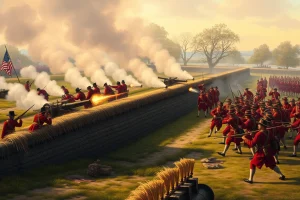
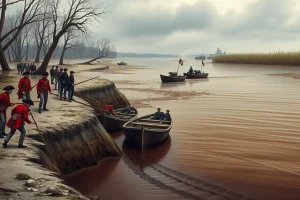
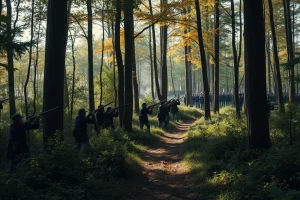
The British ships commenced a bombardment of the fort while smaller vessels swept the landing beaches with gunfire. At about 2 p.m., the landing began. Most troops landed in deep water, soaking their ammunition, but they fixed bayonets and advanced under heavy fire. While the Glengarry Light Infantry cleared the woods on the left and the sailors attacked the village, the main body of troops made a frontal assault on the fort. The American infantry stationed on the glacis fell back into the fort, and as the attackers reached the top of the glacis, the defenders abandoned the fort and fled. The British occupied Fort Ontario and the village, but discovered that the heavy guns they sought were not there—they had either been removed or were still en route.
Why It Matters
The capture of Oswego was a tactical victory for the British, but a strategic disappointment. The failure to secure the naval guns meant that the American squadron at Sackets Harbor would soon be able to arm its larger frigates. When Commodore Chauncey launched his ships later in 1814, he gained command of the lake and effectively blockaded Yeo’s squadron at Kingston. The battle also demonstrated the vulnerability of American supply lines on Lake Ontario and the importance of Oswego as a point of conflict.
Historically, the Battle of Fort Oswego is often overshadowed by larger engagements, but it remains an example of the difficulties both sides faced in maintaining naval dominance on the Great Lakes. It also illustrates the limited strategic impact of a purely tactical success when the primary objective fails.
Prelude
In the spring of 1814, British naval superiority on Lake Ontario was temporary and fragile. The capture of the heavy guns at Oswego was seen as a decisive move to extend that advantage. The British plan required swift and coordinated action, but the weather delayed the landing by a day, giving the American defenders time to prepare.
Forces and Commanders
British: Overall command of the expedition rested with Commodore Sir James Lucas Yeo, who directed the naval squadron. The landing force was under Lieutenant Colonel Victor Fischer, commanding officer of the Regiment de Watteville. Subordinate commanders included Lieutenant Colonel James Malcolm (2nd Battalion, Royal Marines), Captain Alexander MacMillan (Glengarry Light Infantry), and Captain William Mulcaster (Royal Navy, commanding the sailors). The squadron comprised eight warships, including the frigates HMS Prince Regent and HMS Princess Charlotte, along with several sloops and brigs.
American: The garrison at Fort Ontario and the village of Oswego was under Major George Mitchell of the 3rd U.S. Regiment of Artillery. His force included about 242 regulars, 25 U.S. Navy sailors, and around 200 New York militia. The naval presence was minimal, and the fort’s artillery was limited to five light cannon.
Battlefield and Map Context
Fort Ontario was located on a rise east of the Oswego River, overlooking Lake Ontario. The village of Oswego lay on the west bank of the river. The fort was a square stone and earth structure, but in 1814 it was in a state of disrepair, having been used as a shore battery site since the American Revolution. The surrounding terrain was wooded, with a beach landing area to the north. The British chose to land on the eastern side of the river, near the fort, to achieve a direct approach.
Battle Chronology
- 3 May: British squadron departs Kingston with landing force.
- 5 May: Arrival off Oswego; landing aborted due to wind and weather.
- 6 May, 11 a.m.: British squadron returns and begins bombardment.
- ~2 p.m.: Landing commences; troops wade ashore under small-arms fire.
- Afternoon: British assault captures the fort and village.
- Evening: British re-embark, taking prisoners and supplies, but failing to find the heavy guns.
Casualties and Losses
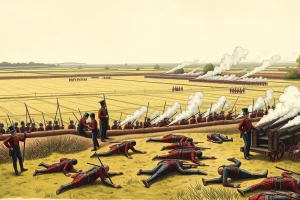
British casualties are reported at 17–18 killed and 63–69 wounded, with slight discrepancies between army and navy returns. Captain William Mulcaster was severely wounded, losing a leg. American losses are uncertain: Major Mitchell reported 6–21 killed, 38 wounded, and 25–60 captured. The wide variation reflects the chaos of the retreat and the loss of some records. Both sides suffered from wet conditions and fire from the fort.
Result
The British achieved a tactical victory, capturing Fort Ontario, the village, and a number of supplies. However, they failed to capture the heavy naval guns that were the main object of the expedition. As a result, the battle is often viewed as a Pyrrhic or hollow victory for the British.
Strategic Consequences
The immediate consequence was the withdrawal of the British squadron to Kingston. The failure to secure the guns allowed the American squadron under Commodore Chauncey to complete the arming of its new frigates, giving the United States command of Lake Ontario by mid-1814. This forced the British to adopt a defensive posture on the lake and reduced their ability to support operations along the Niagara frontier. The battle also highlighted the importance of Oswego as a supply depot, leading both sides to strengthen their positions in the region.
Primary Accounts
British accounts include the official dispatch from Commodore Yeo to the Admiralty, in which he described the landing and the seizure of the fort but lamented the absence of the guns. Lieutenant Colonel Fischer also submitted a report detailing the military operations. On the American side, Major Mitchell’s report to his superiors outlined the defense and the evacuation of the garrison. A notable personal account is that of a soldier of the 2nd Battalion, Royal Marines, who described the wet landing and the scramble up the glacis.
Battlefield Today
The site of Fort Ontario is now part of Fort Ontario State Historic Site, operated by the New York State Office of Parks, Recreation and Historic Preservation. The fort was rebuilt in the 1840s and used through World War II. Visitors can tour the grounds, see the restored fortifications, and view exhibits on the War of 1812 and the fort’s later history.
Primary Sources
The most important primary sources are the official military and naval reports. Commodore Yeo’s dispatch, dated after the action, provides the British perspective on the landing and the failure to find the guns. Lieutenant Colonel Fischer’s report details the troop movements and the assault. On the American side, Major Mitchell’s official report to the U.S. War Department describes the defense and the decision to abandon the fort. Additionally, several regimental histories and personal diaries from participants survive, though many are less detailed. A limitation of these sources is that both commanders had reasons to emphasize their own effectiveness and downplay failures; Yeo, for instance, may have minimized the strategic disappointment.
Further Reading
- The War of 1812: A Forgotten Conflict by Donald R. Hickey
- The Naval War of 1812 by Theodore Roosevelt
- Flames Across the Border: 1813–1814 by Pierre Berton
- Fort Ontario State Historic Site – official visitor information
References
- “Battle of Fort Oswego (1814).” Wikipedia. Accessed at https://en.wikipedia.org/wiki/Battle_of_Fort_Oswego_(1814)
- Hickey, Donald R. The War of 1812: A Forgotten Conflict. University of Illinois Press, 1989.
- Roosevelt, Theodore. The Naval War of 1812. G.P. Putnam’s Sons, 1882.
- Fort Ontario State Historic Site, New York State Parks. https://parks.ny.gov/historic-sites/fortontario/
FAQ
Why did the British attack Oswego in May 1814?
The British sought to capture heavy naval guns destined for the American squadron at Sackets Harbor, which would have preserved their temporary superiority on Lake Ontario.
Who commanded the British and American forces at the Battle of Fort Oswego?
The British expedition was under Commodore James Lucas Yeo, with the landing force led by Lieutenant Colonel Victor Fischer. The American garrison was commanded by Major George Mitchell.
What were the casualties at the Battle of Fort Oswego?
British casualties were about 17-18 killed and 63-69 wounded. American losses were between 6 and 21 killed, 38 wounded, and 25-60 captured.
Why was the Battle of Fort Oswego considered a strategic failure for the British?
The British failed to capture the heavy guns they sought, allowing the American squadron to later arm its most powerful ships and gain control of Lake Ontario.

Leave a Reply