Short Answer
The Battle of Horseshoe Bend, also known as the Battle of Tohopeka, was fought on March 27, 1814, on a bend of the Tallapoosa River in what is now east-central Alabama. It was the climactic engagement of the Creek War (1813–1814), which was intertwined with the War of 1812. The battle resulted in a decisive victory for U.S. forces under Major General Andrew Jackson, aided by Cherokee and Lower Creek allies, over the Red Stick faction of the Upper Creek nation. The outcome broke the military power of the Red Sticks, forced the cession of over 20 million acres of Creek land, and substantially advanced U.S. expansion into the Southeast.
Historical Context
The Creek Nation, a confederacy of towns in the southeastern United States, experienced deep internal divisions in the early 19th century. The Lower Creeks, who lived closer to European-American settlements, increasingly adopted elements of Euro-American agriculture, trade, and cultural practices. In contrast, many Upper Creeks, called Red Sticks because of their red ceremonial war clubs, rejected these changes and sought to preserve traditional ways. Violence erupted into a civil war among the Creeks in 1813, exacerbated by the influence of Tecumseh, the Shawnee leader who urged a pan-Indian resistance to American expansion. The Red Sticks received support from the Spanish in Florida and, indirectly, from the British.
The conflict drew in the United States after the Red Stick attack on Fort Mims on August 30, 1813, in which hundreds of white settlers and Lower Creek were killed. The event prompted American military campaigns, led primarily by Major General Andrew Jackson of the Tennessee Militia. Jackson’s forces, which included regular U.S. infantry, Tennessee and Georgia volunteers, and allied Cherokee and Lower Creek warriors, pursued the Red Sticks through the winter of 1813–1814. After several smaller engagements, the Red Sticks consolidated at a fortified position known as Tohopeka on Horseshoe Bend of the Tallapoosa River, where Jackson’s army confronted them in March 1814.
What Happened
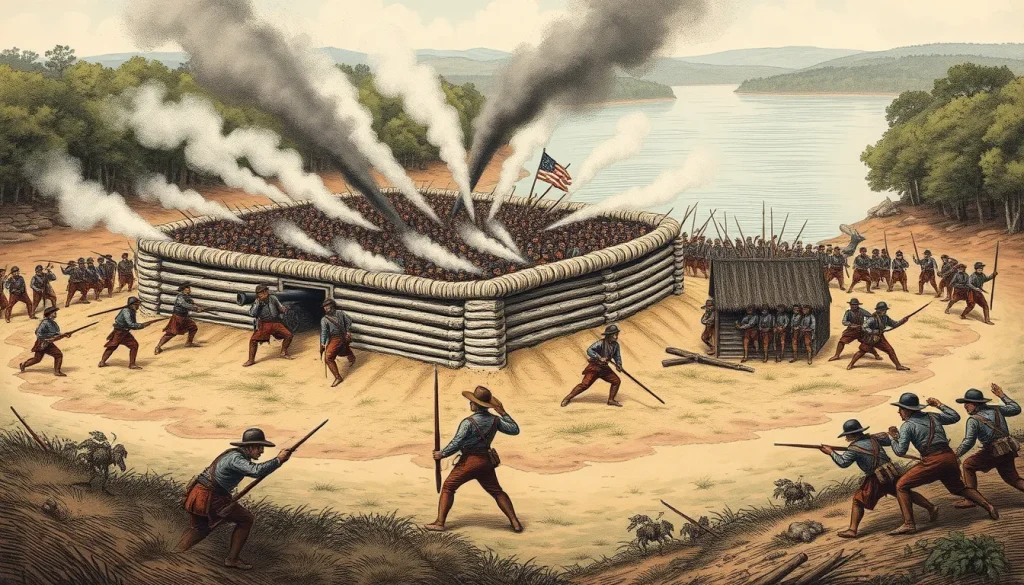
By March 26, 1814, Jackson’s force of about 3,300 men—comprising the 39th U.S. Infantry, Tennessee militia, and about 600 allied Cherokee and Lower Creek warriors—camped six miles north of the Red Stick stronghold at Horseshoe Bend. The Red Sticks, commanded by Chief Menawa, numbered roughly 1,000 warriors, along with approximately 350 women and children. They had fortified the peninsula formed by the bend with a substantial log-and-mud breastwork that spanned the narrow neck of land, making a frontal assault extremely dangerous. The Tallapoosa River, deep and high from spring rains, protected the other three sides.
On the morning of March 27, Jackson launched a two-pronged attack. He sent Brigadier General John Coffee with cavalry, allied Cherokee, and Lower Creek warriors to cross the river downstream and encircle the Red Sticks from behind. Coffee’s men positioned themselves on the opposite bank, and a small contingent of Cherokee swam across, seized the Red Sticks’ canoes, and ferried about 200 warriors across the river to attack the rear of the fortification. Meanwhile, Jackson initiated an artillery bombardment against the breastwork. The attack from the rear caused many Red Stick defenders to abandon the barricade to confront the Cherokee, creating an opening. Jackson then ordered the 39th U.S. Infantry, led by Colonel John Williams and including a young Sam Houston, to assault the barricade with bayonets. The frontal charge succeeded, and the U.S. forces and their allies poured into the Red Stick village.
The battle quickly turned into a rout. Many Red Stick warriors attempted to flee across the Tallapoosa River but were shot down in the water. Chief Menawa, wounded seven times, escaped by playing dead until nightfall and then floating away in a canoe. The Red Sticks suffered catastrophic losses—more than 800 warriors killed, while U.S. and allied losses were modest, with about 276 killed and wounded. The battle effectively ended Red Stick resistance.
Why It Matters
The Battle of Horseshoe Bend was the decisive military engagement of the Creek War. It destroyed the Red Stick fighting force and forced the remaining Creek leaders to sue for peace. The subsequent Treaty of Fort Jackson, signed in August 1814, imposed on the Creek Nation the cession of over 20 million acres of land—roughly half of present-day Alabama—to the United States, even though many of the ceding Creeks were U.S. allies. This vast land acquisition opened the region to American settlement and accelerated the push of white pioneers into the Southeast. The victory also elevated Andrew Jackson’s national reputation as an aggressive and effective military commander, contributing to his later presidency and his role in the forced removal of Native American peoples through policies such as the Indian Removal Act of 1830. For the Creek Nation and other southeastern tribes, Horseshoe Bend marked a turning point toward loss of sovereignty and territory, leading eventually to the Trail of Tears.
Prelude
The immediate prelude to the battle lay in the Red Sticks’ defiance and the American campaigns that followed the Fort Mims massacre. Jackson’s forces had engaged the Red Sticks at the battles of Talladega, Emuckfaw, and Enotachopco during the winter months, gradually driving them toward the fortified position at Horseshoe Bend. The Red Sticks, under Chief Menawa, chose the Horseshoe Bend site for its defensive advantages, constructing a formidable breastwork of logs and earth and gathering their noncombatants there. By late March, Jackson had consolidated his forces and moved decisively against the stronghold.
Forces and Commanders
United States and Allied Forces commanded by Major General Andrew Jackson included about 3,300 men: the 2,600-man Tennessee Militia, the 39th U.S. Infantry (regulars), and approximately 700 allied warriors from the Cherokee Nation and Lower Creek towns. Cherokee leaders such as Major Gideon Morgan and Colonel John Lowry played significant roles, and the Cherokee warrior Tuq-qua (“The Whale”) is noted for leading the canoe seizure. The Red Sticks, numbering around 1,000 warriors, were led by Chief Menawa (also known as Hoithlewaulee), a prominent Upper Creek leader. The Red Stick force included warriors from various Upper Creek towns, along with women and children who had sought refuge.
Battlefield and Map Context
The battlefield was a roughly 100-acre peninsula formed by a horseshoe-shaped bend of the Tallapoosa River in present-day east-central Alabama, near the town of Daviston. A high ridge ran down the center of the peninsula; the Red Stick village of Tohopeka lay along the ridge. The neck of the peninsula—the open end of the horseshoe—was fortified with a log-and-mud breastwork about 400 yards long, making a direct approach hazardous. The river, which flowed on three sides, was deep and strong, providing a natural defense. Jackson’s camp was six miles north, and he approached from that direction. The modern map shows the same topographical features, and the site is now preserved as Horseshoe Bend National Military Park.
Battle Chronology
March 26, 1814: Jackson’s army arrives within six miles of Horseshoe Bend and camps for the night. March 27, early morning: Jackson divides his forces, sending Coffee’s cavalry and allied warriors to cross the Tallapoosa downstream and surround the Red Sticks. About 10:30 a.m., Jackson begins artillery bombardment of the breastwork. Simultaneously, Coffee’s Cherokee contingent swims across the river, seizes canoes, and ferries about 200 warriors to the rear of the Red Stick position. The rear attack causes many defenders to abandon the breastwork. Jackson orders the 39th Infantry to assault the barricade; they breach it with a bayonet charge. Fighting devolves into a massacre; many Red Sticks are killed while trying to escape across the river. By late afternoon, the battle ends with the destruction of the Red Stick stronghold.
Casualties and Losses
Casualty figures are subject to variation among sources, but reliable estimates indicate that out of approximately 1,000 Red Stick warriors, over 800 were killed. U.S. and allied casualties were about 276 killed and wounded, including U.S. soldiers, militia, and Cherokee and Lower Creek allies. The Red Sticks also suffered the loss of noncombatants; some women and children were killed in the chaos of the assault. Andrew Jackson’s official report claimed 557 Indians dead, but later estimates have been higher. The American Battlefield Trust lists total casualties as 1,063 for the Red Sticks and 276 for the U.S. forces.
Result
The battle was a decisive American victory. The Red Stick military force was virtually annihilated, and organized resistance in the Creek War collapsed. Chief Menawa escaped but his power was broken. The battle led directly to the Treaty of Fort Jackson, signed on August 9, 1814, in which the Creek Nation—including both allies and opponents of the United States—was forced to cede large portions of their territory. The victory also strengthened Andrew Jackson’s reputation as a military leader and gave him political capital.
Strategic Consequences
The strategic consequences were profound. The U.S. gained control over a vast area of present-day Alabama, opening it to settlement. The Creek military threat to the U.S. frontier was eliminated, which indirectly aided the U.S. in the larger War of 1812 by freeing troops and resources. For the Creek Nation and other southeastern tribes, the loss of land and sovereignty accelerated their eventual removal. The Treaty of Fort Jackson, which punished both hostile and friendly Creeks alike, reflected the expansionist policy of the United States. Andrew Jackson’s victory at Horseshoe Bend became a cornerstone of his political career, and it is often seen as a prelude to the Indian Removal policies of the 1830s.
Primary Accounts
Several contemporary accounts document the battle. Andrew Jackson’s letters and official reports to the Secretary of War describe the engagement, the fortification, and his tactics. He famously remarked, “It is impossible to conceive a situation more eligible for defense than the one they had chosen and the skill which they manifested in their breastwork was really astonishing.” Accounts from Cherokee participants, such as those recorded in later Cherokee traditions, recount the daring canoe seizure and the role of Cherokee warriors. A letter from Jackson to his wife, Rachel, provides a personal view. However, these accounts are predominantly from the American side; no detailed Red Stick perspective exists, which reflects the near destruction of the Red Stick leadership. The National Park Service has collected these documents and their interpretive materials.
Battlefield Today
Horseshoe Bend National Military Park, established in 1956, preserves the battlefield and interprets the battle’s history. Located in east-central Alabama near Daviston, the park encompasses the peninsula and the river bend. Visitors can walk the battlefield, see reconstructed sections of the barricade, and view exhibits on the Creek War and the battle. The park also includes a visitor center with artifacts and interpretive programs. The site is a National Historic Landmark and is operated by the National Park Service.
Primary Sources
Key primary sources include Andrew Jackson’s correspondence and official reports, which are held at the Library of Congress and the Tennessee State Library and Archives. The journal of Major John Reid, a military aide, provides a firsthand account of the campaign. U.S. Army returns and muster records document the forces involved. On the Cherokee side, later accounts collected by ethnographers, such as those in the Draper Manuscripts, preserve memories of the Cherokee role. These sources offer valuable insight but must be evaluated for their perspectives: Jackson’s reports emphasize his command and the regular troops; Cherokee accounts highlight their contributions; and the voices of the Red Sticks are almost entirely absent. Researchers should also consult the official treaty text of the Treaty of Fort Jackson, which is available in the United States Statutes at Large.
Further Reading
- B. D. (Brian) C. (2017). The Creek War and the Battle of Horseshoe Bend. National Park Service. Link
- American Battlefield Trust. “Horseshoe Bend Battle Facts and Summary.” Link
- Bluhm, Raymond K. “Battle of Horseshoe Bend.” Encyclopedia Britannica. Link
- National Park Service. “Alabama: Horseshoe Bend National Military Park.” Link
- National Park Service. “The Battle of Horseshoe Bend: Collision of Cultures.” Link
References
- Britannica, “Battle of Horseshoe Bend,” https://www.britannica.com/topic/Battle-of-Horseshoe-Band
- National Park Service, “Spring 1814: The Battle of Horseshoe Bend,” https://www.nps.gov/articles/behind-the-sharp-knife.htm
- National Park Service, “Alabama: Horseshoe Bend National Military Park,” https://home.nps.gov/articles/horseshoebend.htm
- American Battlefield Trust, “Horseshoe Bend Battle Facts and Summary,” https://www.battlefields.org/learn/war-1812/battles/horseshoe-bend
- National Park Service, “The Battle of Horseshoe Bend: Collision of Cultures,” https://www.nps.gov/articles/000/the-battle-of-horseshoe-bend-collision-of-cultures-teaching-with-historic-places.htm
FAQ
What was the Battle of Horseshoe Bend?
The Battle of Horseshoe Bend (March 27, 1814) was a decisive U.S. victory over the Red Stick faction of the Creek Nation, led by Andrew Jackson, at a fortified peninsula on the Tallapoosa River in Alabama. It effectively ended the Creek War.
Why did the Battle of Horseshoe Bend happen?
The battle was the culmination of the Creek War, which began as a Creek civil war over assimilation and escalated after Red Stick attacks on American settlements, including the Fort Mims massacre. The U.S. responded with military campaigns led by Andrew Jackson.
What were the consequences of the Battle of Horseshoe Bend?
The battle resulted in the destruction of Red Stick military power and the Treaty of Fort Jackson, which forced the Creek Nation to cede over 20 million acres of land, opening the region to American settlement and accelerating Indian removal.


Leave a Reply