Short Answer
The Battle of Baltimore, fought September 12–14, 1814, was a combined British land and naval attack on Baltimore, Maryland, during the War of 1812. After capturing and burning Washington, D.C., British forces under Major General Robert Ross and Vice Admiral Alexander Cochrane sought to seize Baltimore, the third-largest American city and a center of privateering and shipbuilding. American defenders repelled the land advance at North Point and withstood a heavy bombardment of Fort McHenry, forcing the British to withdraw. The battle inspired Francis Scott Key to write the lyric poem later set to music as “The Star-Spangled Banner.”
Historical Context
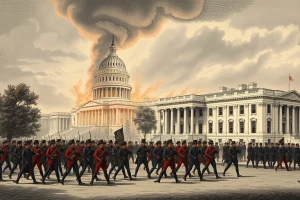
During the early years of the War of 1812, British strategy in North America was largely defensive, as the Royal Navy and army were needed against Napoleon in Europe. The abdication of Napoleon in April 1814 freed veteran British forces for active operations against the United States. In August 1814, a British expeditionary force entered the Chesapeake Bay, defeated American militia at Bladensburg, and occupied Washington, D.C., burning the Capitol and the White House. The ease of that raid encouraged British commanders to attempt the capture of Baltimore, a larger and strategically more important port.
Baltimore was central to American privateering and commerce. Baltimore-based privateers had seized more than five hundred British merchant ships during the war. The city also boasted important shipyards and a large population. Unlike Washington, Baltimore had prepared for invasion. Local militia under Major General Samuel Smith built extensive earthworks, and Fort McHenry guarded the harbor entrance. These preparations would prove significant.
What Happened
The British appeared off the Patapsco River on September 10, 1814. On September 12, troops landed near North Point, about fifteen kilometers southeast of Baltimore. Maryland militia under Brigadier General John Stricker engaged the British advance, inflicting casualties. During the fighting, British commander Major General Robert Ross was mortally wounded. Colonel Arthur Brooke assumed command of the land force and pressed forward, eventually reaching the American main line at Hampstead Hill. He found the defenses too strong to attack without naval support.
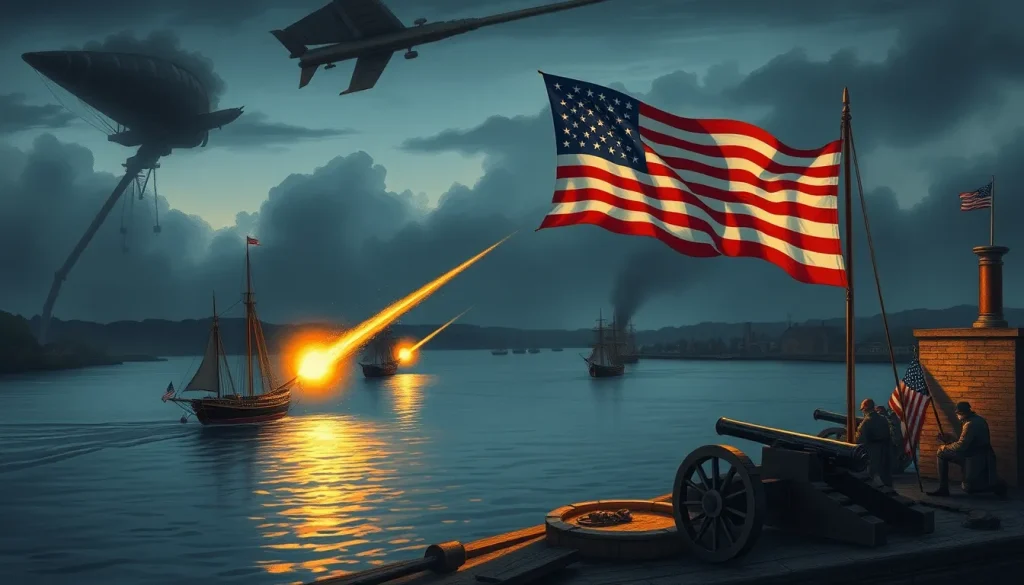
Meanwhile, on September 13, British warships began a heavy bombardment of Fort McHenry. Because the water was too shallow for heavy ships to approach, the attack was delivered by bomb vessels firing high-angled mortar shells and a rocket ship firing Congreve rockets. The fort, commanded by Major George Armistead, returned fire and remained resolute. A British attempt to land a boat party near Ferry Branch during the night was repelled by American batteries. On the morning of September 14, the bombardment stopped, and the garrison raised a large garrison flag. The failure to silence Fort McHenry, combined with the strength of the American land defenses, led Brooke to order a withdrawal. The British re-embarked by September 15.
Why It Matters
The Battle of Baltimore ended the British Chesapeake campaign of 1814. Baltimore remained in American hands, and the British turned their attention to other objectives, eventually moving toward New Orleans. The victory boosted American morale after the burning of Washington and strengthened American confidence in negotiations at Ghent. The iconic image of the flag over Fort McHenry, seen by Francis Scott Key, produced a poem that became the American national anthem. Historically, the battle is remembered as a critical defensive success, although its strategic impact is debated; some historians note that British withdrawal reflected the strength of American fortifications and the failure of the bombardment, while others emphasize that the war itself ended in a negotiated peace with no clear military victor.
Prelude
After Washington fell, British commanders chose Baltimore as their next objective. The city’s importance as a port and privateering base made it a high-value target, and a successful capture might have weakened American resolve. In anticipation, Baltimore’s defenses were organized by Major General Samuel Smith, a veteran of the Revolution and a member of Congress. Smith called out thousands of militia, constructed a fortified line on Hampstead Hill east of the city, and placed batteries along the Patapsco River. Fort McHenry, a star fort built in 1800, was repaired and garrisoned with about one thousand men. A boom and gun barges blocked the harbor entrance, and smaller defenses, including Fort Babcock, Fort Covington, and a redoubt at Ferry Point, protected the western approaches. The fleet arrived on September 10, and by September 12, the attack was under way.
Forces and Commanders
The American forces were led overall by Major General Samuel Smith. Brigadier General John Stricker commanded the Maryland 3rd Brigade, which fought the delaying action at North Point. Major George Armistead commanded Fort McHenry. American forces included regulars, militia, and volunteers; estimates of the number behind the fortified line at Hampstead Hill range around 10,000 or more, with about 1,000 defending Fort McHenry.
The British forces were under the overall command of Vice Admiral Sir Alexander Cochrane, with Rear Admiral George Cockburn commanding part of the fleet. Major General Robert Ross commanded the army contingent until his death on September 12; Colonel Arthur Brooke then took command. The landing force numbered between 3,800 and 4,500 soldiers and marines, depending on the source. The naval attack on Fort McHenry was carried out by bomb vessels including HMS Terror, Volcano, Meteor, Devastation, and Aetna, and the rocket ship HMS Erebus.
Battlefield and Map Context
The battlefield lay at the junction of the Patapsco River and Chesapeake Bay, near Baltimore, Maryland. British troops landed on North Point, a peninsula on the eastern side of the Patapsco, and advanced northwest toward Baltimore. The American line at Hampstead Hill, about two miles from the city, consisted of entrenchments and artillery batteries across the Philadelphia Road. Fort McHenry sat on a peninsula on the west side of the harbor entrance, commanding the water approach. Secondary batteries on Ferry Branch guarded the fort’s western flank. Today, Fort McHenry is preserved in the Locust Point neighborhood of Baltimore, while the North Point area is partly developed but retains historical markers and a small battlefield park.
Battle Chronology
- September 10: British fleet arrives at the Patapsco River.
- September 12, early morning: British troops begin landing at North Point.
- September 12, midday–afternoon: Skirmishing occurs; Ross is killed; Brooke leads the advance and attacks the American position at North Point; American forces withdraw.
- September 13, early morning: British bomb vessels and rocket ship begin bombarding Fort McHenry.
- September 13–14, night: A British boat assault toward Ferry Branch is repelled by American guns.
- September 14, dawn: The bombardment stops; the garrison raises the large flag; Brooke decides the American defenses are too strong and withdraws.
- September 15: British troops re-embark and depart the Patapsco.
Casualties and Losses
Casualty figures for the land battle at North Point vary by source. The British reported 38 dead, 251 wounded, and 50 missing; American Brigadier General John Stricker reported 24 dead, 139 wounded, and 50 captured. At Fort McHenry, the American garrison had 4 killed and 24 wounded, according to the American Battlefield Trust. British losses in the bombardment are not fully documented. Discrepancies in these figures reflect the confusion of battle and differing official reporting standards.
Result
The battle ended with a British withdrawal. British commanders found the American land fortifications too strong and the naval bombardment of Fort McHenry too weak to force a passage. Baltimore remained in American hands, and the British Chesapeake campaign concluded. The result is generally described as an American defensive victory.
Strategic Consequences
Strategically, the British failure at Baltimore ended their Chesapeake operations. They soon shifted their attention to the Gulf Coast, culminating in the Battle of New Orleans in January 1815, which was fought after the Treaty of Ghent had been signed but before news reached the combatants. In the peace negotiations at Ghent, the American defense of Baltimore helped restore American prestige and confidence. The battle also had a cultural impact far beyond the war: the sight of the American flag over Fort McHenry inspired Francis Scott Key, leading to the poem “The Star-Spangled Banner,” adopted as the U.S. national anthem decades later.
Primary Accounts
The most immediate primary source is Francis Scott Key’s manuscript of “Defence of Fort McHenry,” written after the bombardment while Key was detained on a British vessel during the attack. John Stuart Skinner, who was with Key on the truce ship, later recounted the event. Official reports from American commanders, including Armistead and Stricker, and British reports from Brooke and Cochrane, provide operational detail. Contemporary newspapers, such as the Salem Gazette, printed eyewitness accounts of the night actions. Each source carries its own bias: American reports tend to stress the success of the defense, British reports emphasize the strength of the American fortifications and the decision to withdraw as prudent.
Battlefield Today
Fort McHenry is now Fort McHenry National Monument and Historic Shrine, operated by the National Park Service, and remains the most visible site of the 1814 defense. The Star-Spangled Banner Flag House in Fells Point preserves the home where Mary Pickersgill sewed the large flag. The Battle Monument in downtown Baltimore was erected to honor those who died in the Battle of Baltimore and North Point; it is the first War of 1812 monument in the United States. The Star-Spangled Banner National Historic Trail links many related sites in Maryland and the Chesapeake. A portion of the North Point battlefield is preserved in a small park, and several neighborhood sites, including Riverside Park (the site of Fort Wood), are marked.
Primary Sources
Key primary sources for the Battle of Baltimore include:
- “Defence of Fort McHenry” manuscript by Francis Scott Key, September 1814. A poem written after the bombardment; later published as a broadside and eventually set to music.
- Official report of Major George Armistead, commanding Fort McHenry, to Samuel Smith, September 1814. Provides American defensive account.
- Official report of Brigadier General John Stricker on the Battle of North Point, September 1814.
- British reports from Colonel Arthur Brooke and Vice Admiral Alexander Cochrane, describing the withdrawal and reasons for it.
- Contemporary newspaper articles, including an eyewitness account reprinted from the Salem (Massachusetts) Gazette, September 27, 1814, detailing the night attack.
These sources must be read critically; none is a complete or neutral record, and casualty numbers and details sometimes conflict.
Further Reading
- Donald R. Hickey, The War of 1812: A Forgotten Conflict (1989).
- Walter R. Borneman, 1812: The War That Forged a Nation (2004).
- National Park Service, “Battle of Baltimore,” Fort McHenry National Monument and Historic Shrine, available online.
- American Battlefield Trust, “Fort McHenry Battle Facts and Summary,” available online.
References
- National Park Service, “Battle of Baltimore,” Fort McHenry National Monument and Historic Shrine, https://www.nps.gov/fomc/learn/historyculture/battle-of-baltimore.htm.
- National Park Service, “Baltimore and North Point,” Star-Spangled Banner National Historic Trail, https://www.nps.gov/stsp/learn/historyculture/baltimore-and-north-point.htm.
- American Battlefield Trust, “Fort McHenry Battle Facts and Summary,” https://www.battlefields.org/learn/war-1812/battles/fort-mchenry.
- John R. Grodzinski, “Battle of Baltimore,” The Canadian Encyclopedia, https://thecanadianencyclopedia.ca/index.php/en/article/battle-of-baltimore.
FAQ
Why did the British attack Baltimore?
Baltimore was the third-largest U.S. city, a major port, and home to privateers that had captured hundreds of British merchant ships. British commanders hoped that seizing it would weaken American morale and help end the war.
How did the Battle of Baltimore lead to the writing of “The Star-Spangled Banner”?
Francis Scott Key was aboard a British warship during the bombardment. At dawn on September 14, seeing the American flag still flying over Fort McHenry, he wrote the poem “Defence of Fort McHenry,” which was later set to music as “The Star-Spangled Banner.”
Was the Battle of Baltimore a turning point in the War of 1812?
Many historians view it as an American defensive victory that ended the British Chesapeake campaign and boosted American confidence. It did not end the war, but it influenced peace negotiations at Ghent and the later American national identity.



Leave a Reply