Short Answer
The year 1814 marked the critical turning point of the War of 1812, as the Napoleonic Wars in Europe ended and Britain transferred its military might to North America. The conflict that had been a stalemate on the Canadian border became a fight for the survival of the United States, with invasions from Canada, the Chesapeake Bay, and the Gulf Coast. This year determined the final outcome, shaped the Treaty of Ghent, and left a lasting imprint on American national identity.
Historical Context
Between 1812 and early 1813, both the United States and Great Britain struggled to advance their war aims. American invasions of Canada repeatedly failed, while British naval superiority disrupted American trade and coastal defenses. In Europe, however, the long-running Napoleonic Wars reached a turning point. Napoleon’s disastrous invasion of Russia in 1812 and the decisive defeat at Leipzig in October 1813 forced France onto the defensive. By April 1814, the Sixth Coalition had captured Paris and compelled Napoleon to abdicate. This development freed thousands of British regulars and naval resources for deployment against the United States. As one American Republican observed, ‘We should have to fight hereafter not for free trade and sailors rights, not for the conquest of the Canadas, but for our national existence.’ The global context thus transformed the nature of the war.
What Happened
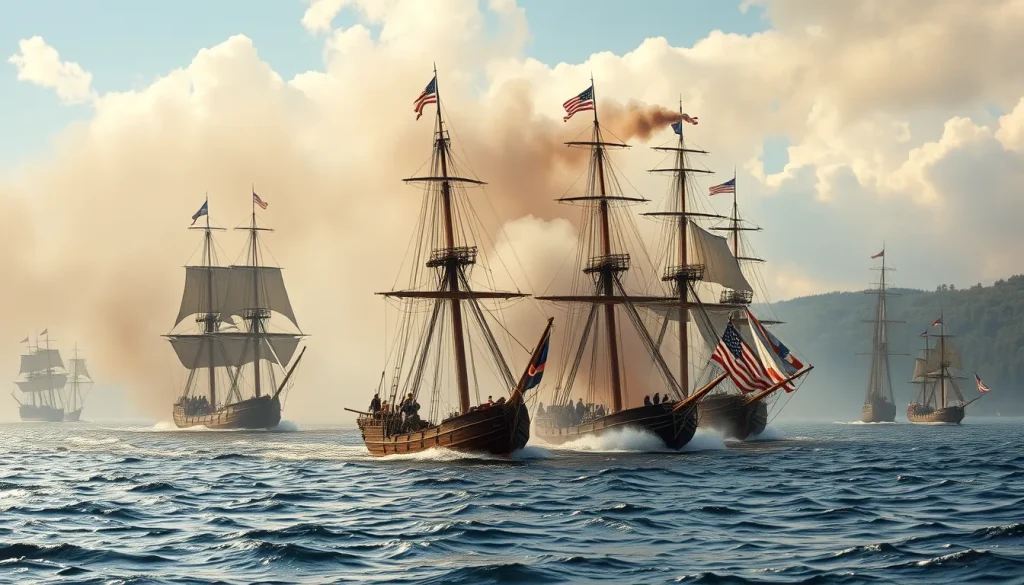
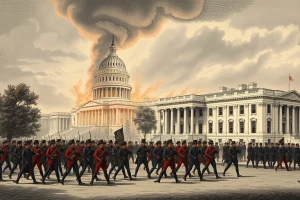
The 1814 campaign season saw Britain take the offensive on multiple fronts. In the north, Lieutenant Governor Sir George Prevost led about 10,000 British troops down the Lake Champlain corridor toward Plattsburgh, New York, intending to isolate New England. The accompanying naval squadron was defeated by Master Commandant Thomas Macdonough in the Battle of Lake Champlain on September 11, 1814. American victory forced Prevost to retreat to Canada. In the Chesapeake, a British force captured and burned Washington on August 24, 1814, but was repulsed at Baltimore in mid-September, where the successful defense of Fort McHenry inspired the American national anthem. On the Niagara frontier, American regulars under Jacob Brown and Winfield Scott fought bloody but inconclusive battles at Chippawa, Lundy’s Lane, and Fort Erie in July and August. Finally, a major British invasion of the Gulf Coast began in late 1814, culminating in the Battle of New Orleans on January 8, 1815, a resounding American victory under Andrew Jackson, though the peace treaty had already been signed.
Why It Matters
The events of 1814 determined the war’s outcome. American resistance at Plattsburgh and Baltimore blunted British territorial ambitions, while the failure of the northern invasions and the defeat at New Orleans removed any British leverage for conquest. The Treaty of Ghent, signed on December 24, 1814, restored pre-war boundaries and ended the fighting, with both sides agreeing to a status quo ante bellum. The war solidified American independence and fostered a sense of national unity, even as the Federalist Party’s opposition culminated in the Hartford Convention. For the British, the war proved a costly sideshow after the major European conflict, and 1814 convinced London that further conquests were not worth the expense.
Definition
Decisive, as applied to a year of a war, means that period in which the strategic outcome is effectively settled, even if formal peace is delayed. In the War of 1812, 1814 is decisive because it witnessed the peak of British military pressure, the defeat of that pressure on multiple fronts, and the commencement of peace negotiations that finalized the war’s terms.
Background
After two years of inconclusive conflict, the United States saw its initial war aims—conquest of Canada and an end to maritime impressment—fail. British policy, tied to the European war, was primarily defensive. The defeat of Napoleon changed this calculus, allowing Britain to reinforce its North American forces and adopt an aggressive strategy. Simultaneously, domestic American dissent, especially in Federalist New England, reached its height in 1814, threatening to undermine the republic.
How It Worked
British strategy in 1814 aimed to split the United States by seizing key points: Lake Champlain, the Chesapeake, and the Gulf Coast. The plan called for naval control of Lake Champlain to protect supply lines and open a route to Albany, and coastal raids to divert American troops from the northern front. In the Chesapeake, a combined fleet and army captured Washington, but the subsequent attack on Baltimore failed. The British also planned to use territorial conquests as bargaining chips in peace negotiations, but their defeats at Plattsburgh and Baltimore denied them gains. The Gulf Coast expedition, intended to secure the vital Mississippi Valley, was crushed at New Orleans in January 1815, though this battle occurred after the treaty was signed.
Competing Viewpoints
Historians differ on the weight of 1814. Some, like Donald Hickey, argue that the successful defenses at Plattsburgh and Baltimore were the turning point, forcing Britain to accept a negotiated peace without territorial gains. Others emphasize the importance of the Battle of New Orleans in shaping American public memory, even though it had no bearing on the treaty. J.C.A. Stagg points to the earlier American failures in 1812 and the defeat of Indian confederations as equally decisive. A third view holds that the war was ultimately decided by exhaustion and financial strain, making no single year truly decisive. These interpretations reflect competing judgments about military significance, diplomacy, and the war’s long-term impact.
Role in the War of 1812
1814 was the year in which the war’s outcome was essentially fixed. The British invasions demonstrated American military weakness but also its ability to rally and repel a veteran enemy. The American victories preserved U.S. sovereignty and prevented any British territorial gains. Moreover, the negotiations at Ghent, which had stalled in the spring, were accelerated by British setbacks in the campaigns of 1814. The peace treaty signed in December essentially restored the status quo, but it also ensured that American maritime grievances—such as impressment and trade restrictions—were not explicitly resolved, leaving them to be settled in the future.
Consequences and Historical Interpretation
The immediate consequence of 1814 was the end of hostilities, with the Treaty of Ghent ratified in February 1815. The American victories, especially New Orleans, created national heroes and fostered a sense of martial pride. Over the long term, the war accelerated the decline of Federalist influence, opened the westward expansion by breaking the power of Indian confederacies in the Northwest and South, and improved American diplomatic standing. Historians continue to debate whether the war was a American victory or a draw, but consensus holds that 1814 was the year when the republic’s survival was tested and affirmed.
Primary Sources
Key primary sources include Master Commandant Thomas Macdonough’s after-action report of the Battle of Lake Champlain, which described the naval engagement and the critical maneuvering of his flagship Saratoga. Major General Andrew Jackson’s correspondence and reports from the New Orleans campaign provide firsthand insight into the American defense. British records, including Sir George Prevost’s despatches to London, detail the planning and retreat from Plattsburgh. Additionally, American newspapers and private letters from 1814, such as the diary of civilian J.C. Hubbell, capture the public’s anxiety and relief. Each source must be read with attention to the author’s role and perspective; military reports often emphasize success or downplay failure.
Further Reading
- Hickey, Donald R. The War of 1812: A Forgotten Conflict. University of Illinois Press, 1989.
- Stagg, J.C.A. The War of 1812: Conflict for a Continent. Cambridge University Press, 2012.
- Heidler, David S., and Jeanne T. Heidler, eds. Encyclopedia of the War of 1812. ABC-CLIO, 1997.
- Malcomson, Robert. The Battle of Plattsburgh: A Naval and Military Victory. Tempus, 2000.
- National Park Service, War of 1812 articles: Things Fall Apart: The Road to ‘Victory’ and Turning the tide.
References
- Heidler, David, and Jeanne Heidler. “Things Fall Apart: The Road to ‘Victory’.” National Park Service, n.d. https://nps.gov/articles/things-fall-apart.htm.
- Hickey, Donald R. “Turning the tide: The British Empire strikes back.” National Park Service, n.d. https://www.nps.gov/articles/turning-the-tide.htm.
- “Autumn 1814: The British Navy suffers a decisive defeat at the Battle of Lake Champlain.” National Park Service, n.d. https://nps.gov/articles/battle-of-lake-champlain.htm.
- Stagg, J.C.A. “Interview: War of 1812 Historian.” HistoryNet, n.d. https://historynet.com/interview-with-war-of-1812-historian-j-c-a-stagg/.
- Britannica, “War of 1812 – US-Britain, Causes, Outcome.” Accessed 2026. https://www.britannica.com/event/War-of-1812/War.
FAQ
Why is 1814 considered the decisive year?
1814 was decisive because the defeat of Napoleon allowed Britain to launch large-scale invasions of the United States. The successful American defenses at Plattsburgh and Baltimore, along with the later victory at New Orleans, foiled British plans and secured a peace without territorial losses.
What were the main British campaigns in 1814?
The British launched three major campaigns: an invasion from Canada via Lake Champlain, an attack on the Chesapeake Bay that burned Washington and was repulsed at Baltimore, and a Gulf Coast invasion that culminated in the Battle of New Orleans.
Did the Battle of New Orleans affect the peace treaty?
No, the Battle of New Orleans was fought on January 8, 1815, after the Treaty of Ghent had been signed on December 24, 1814. The victory inflated American morale but did not change the treaty terms.



Leave a Reply