
Short Answer
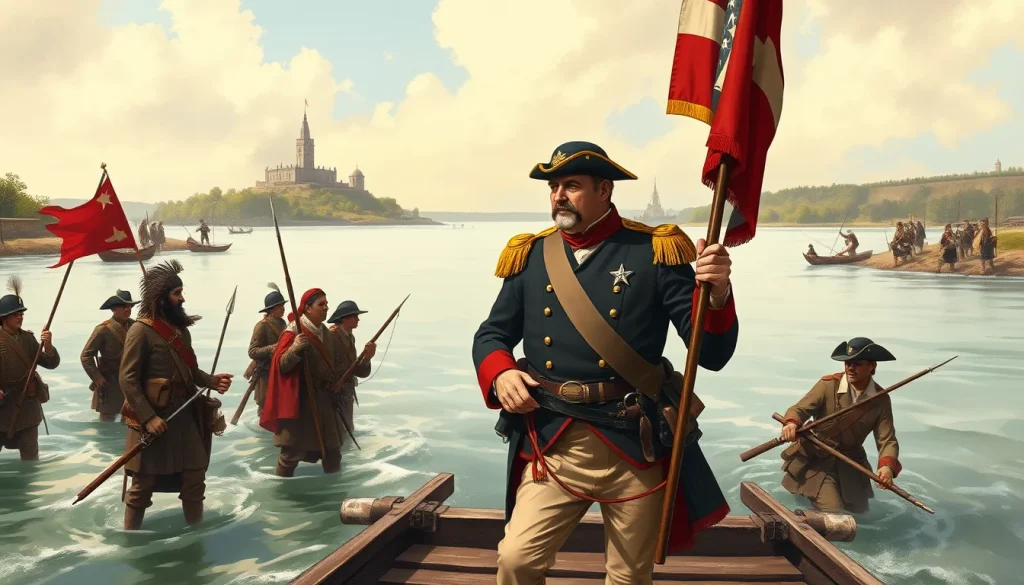
William Hull’s invasion of Upper Canada was the first major American offensive of the War of 1812. In July 1812, Brigadier General William Hull, governor of Michigan Territory, led a mixed force of regulars and militia across the Detroit River from Detroit into what is now Ontario, hoping to seize strategic positions and encourage Canadian disaffection. The campaign collapsed after a series of supply-line setbacks and Hull’s loss of nerve, culminating in his capitulation at Fort Detroit on 16 August 1812—a stunning British victory that gave the enemy control of the entire Michigan Territory and darkened American prospects in the war’s crucial opening months.
Historical Context
The War of 1812 began amid long-standing Anglo-American disputes over maritime impressment, trade restrictions, and suspected British support for Indigenous resistance on the western frontier. President James Madison and his administration, unable to strike at Britain directly on the ocean, decided that the conquest of Canada—the nearest British possession—might force Britain to make concessions. Many Americans expected the invasion would be easy, given Britain’s preoccupation with Napoleonic France and the belief that Canadian colonists were ripe for liberation.
In January 1812, Hull, a Revolutionary War veteran and the governor of Michigan Territory, traveled to Washington to lobby for command of an invasion from the west. He proposed using Fort Detroit as a base to attack the British at Fort Amherstburg (Malden) and then push eastward. The Madison administration endorsed the plan, and Hull, despite initial hesitation, accepted a commission as brigadier general. He arrived at Detroit on 5–7 July 1812 with about 2,200 men, including the 4th U.S. Infantry and Ohio militia. The army was poorly supplied and many militia refused to cross the river because they believed the invasion was unconstitutional. Hull crossed anyway, on 12 July, with roughly 1,600 men.
What Happened
Hull’s forces crossed the Detroit River unopposed and occupied the Canadian town of Sandwich (modern Windsor). On July 20, he issued a proclamation to the inhabitants, promising liberation from British tyranny and threatening that any white man found fighting beside Indigenous warriors would receive no quarter. The proclamation had mixed effects: some Canadian militia deserted their posts, but others were alienated by Hull’s threats to destroy property and his cooperation with American officers who lacked discipline.
Rather than advancing against weakly defended Fort Amherstburg, Hull hesitated. His supply line stretched from Detroit back to Ohio, and he feared attacks by Tecumseh’s warriors and British regulars. On 2–3 August, Tecumseh and Captain Adam Muir ambushed an American supply convoy at Brownstown Creek, capturing Hull’s personal papers that revealed his fears and troop numbers. On 8 August, a relief column under Lieutenant Colonel James Miller fought the Battle of Maguaga, forcing the British and First Nations to retreat, but with heavy American losses. On 11 August, Hull withdrew his forces from Sandwich back to Fort Detroit, and he even talked of returning to Ohio until his militia officers persuaded him to stay.
Meanwhile, British Major General Isaac Brock arrived at Fort Amherstburg on 13 August with reinforcements. Hoping to intimidate Hull, Brock and his Indigenous allies crossed the Detroit River on 15 August. Brock’s demand for surrender included a warning that the “numerous body of Indians who have attached themselves to my troops will be beyond control the moment the contest commences.” On 16 August, after a brief artillery exchange and seeing the Indigenous forces in his rear, Hull raised a white flag and surrendered Fort Detroit without a major fight. Approximately 2,188 American soldiers were taken prisoner, along with large quantities of supplies and the unfinished ship Adams, which the British renamed Detroit.
Why It Matters
The surrender was a humiliating disaster for the United States. It gave the British complete control of the Michigan Territory and the upper Great Lakes, forcing the Americans to abandon any immediate plans to invade Upper Canada from the west. The victory boosted British and Canadian morale, and it demonstrated the effectiveness of combined British and Indigenous operations. Hull was later court-martialed for cowardice and neglect of duty, condemned to death, but pardoned by President Madison due to his Revolutionary War record. Historians continue to debate whether Hull was a coward, incompetent, or mentally broken, but the invasion’s collapse shaped the course of the war in the Northwest Theater, where Americans did not regain the initiative until 1813.
Prelude
Before the crossing, Hull’s army faced significant challenges. His militia were reluctant to enter Canada, and many insisted the Constitution forbade it. Hull’s own confidence was shaken by reports of British and Indigenous strength. He also lacked accurate information about when war had been declared, and his intercepted correspondence later revealed his deep anxieties. The invasion was preceded by weeks of marching through the wilderness from Ohio to Detroit, a journey that exhausted his men and strained logistics.
Forces and Commanders
American: Brigadier General William Hull commanded an army of about 2,200 men, including the 4th U.S. Infantry, various Ohio militia regiments, and some Michigan volunteers. Key subordinates included Lieutenant Colonel James Miller, who fought at Maguaga, and Colonel Lewis Cass, later a famous politician, who was a militia officer.
British and Allied: The British forces in the region were initially small, under Colonel Henry Procter at Fort Amherstburg, but were reinforced on 13 August by Major General Isaac Brock. Brock had with him 300 regulars of the 41st Regiment, 30 artillerymen, about 400 militia, and roughly 530 Indigenous warriors under Tecumseh, Roundhead, and other leaders, including warriors from the Potawatomi, Wyandot, and Shawnee nations.
Battlefield and Map Context
The campaign centered on the Detroit River, which separates the modern states of Michigan and Ontario. Fort Detroit stood on the American bank, while the British had Fort Amherstburg (also called Fort Malden) about 20 miles south, at the mouth of the Detroit River on the Canadian side. The village of Sandwich (now Windsor) was directly across from Detroit. The terrain around the river was heavily wooded, with swampy areas that hindered movement. Control of the river and its land routes was vital for supply lines, and the British and First Nations used the river to raid American convoys.
Battle Chronology
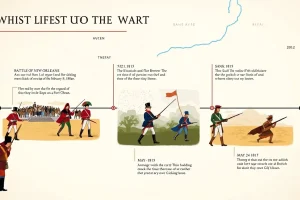
12 July 1812: Hull’s army crosses the Detroit River and occupies Sandwich.
20 July: Hull issues his proclamation to Canadian inhabitants.
2–3 August: Tecumseh and Muir ambush an American supply convoy at Brownstown Creek; Hull’s papers are captured.
8 August: American force under Miller fights the Battle of Maguaga; they drive off British and Indigenous forces but suffer many casualties.
11 August: Hull orders withdrawal of his forces from Sandwich back to Fort Detroit.
13 August: Brock arrives at Fort Amherstburg with reinforcements.
15 August: Brock’s forces cross the Detroit River; artillery exchanges open.
16 August: Hull surrenders Fort Detroit without a major engagement.
Casualties and Losses
Casualties in the campaign were relatively light by later standards. At Brownstown, about 15 Americans were killed or wounded; at Maguaga, the Americans lost at least 18 killed and 64 wounded, while the British and Indigenous forces suffered a similar number. The surrender at Detroit resulted in the capture of about 2,188 American soldiers, along with 39 cannons, muskets, ammunition, and the ship Adams. British and Indigenous losses were minimal, though exact figures are not reliably recorded.
Result
The result was a complete British victory. All American forces in the region surrendered, and the British secured the surrender of the entire Michigan Territory. The captured American soldiers were taken to Quebec as prisoners of war. Hull was later exchanged in 1814 and court-martialed, but his surrender was a decisive turning point in the early war.
Strategic Consequences
The surrender of Detroit gave the British command of the upper Great Lakes and the frontier from Ohio to Lake Michigan. It thwarted President Madison’s plan for a quick conquest of Upper Canada. The American government was forced to redirect resources to defensive efforts in the Northwest, and it took the victories of Oliver Hazard Perry at Lake Erie and William Henry Harrison at the Battle of the Thames in 1813 to regain the initiative. For the British, the victory secured the support of Indigenous allies and boosted morale in Upper Canada, where loyalty to the Crown strengthened.
Primary Accounts
Hull’s proclamation of 20 July 1812 survives as a primary document. In it he wrote, “I come to find enemies not to make them, I come to protect not to injure you.” The British demand for surrender is also documented in Brock’s letter to Hull, warning that Indigenous warriors would be “beyond control” once hostilities began. The terms of capitulation, signed on 16 August, are preserved. Many American soldiers’ letters and journals, including those of Captain Thomas Jessup who called Hull “a coward,” also provide contemporary criticism. First Nations oral traditions and British official reports add to the record, though they must be weighed for bias.
Battlefield Today
The site of Fort Detroit is now within the city of Detroit, Michigan, though the original fort no longer stands; a historical marker commemorates the surrender. On the Canadian side, Sandwich (now Windsor) retains some heritage buildings. Fort Malden National Historic Site in Amherstburg preserves the British fort and offers interpretation of the 1812 campaign. The Detroit River itself remains an international boundary, and historical markers along both shores note the events of 1812.
Primary Sources
The most relevant primary sources include Hull’s proclamation, his official reports to the Secretary of War, Brock’s letters and orders, and the terms of capitulation. The captured American mail, particularly Hull’s letters, provided the British with valuable intelligence and is often quoted in secondary accounts. Also important are the journals of soldiers such as Captain Thomas Jessup and Colonel Lewis Cass, which reveal the low morale and distrust of Hull. These sources are available at the Library of Congress, National Archives of Canada, and the Archives of Ontario. Because many are personal writings, they are subject to bias and must be read critically.
Further Reading
- Hitsman, J. Mackay. The Incredible War of 1812: A Military History. Toronto: University of Toronto Press, 1965.
- Benn, Carl. The War of 1812. Oxford: Osprey Publishing, 2002.
- Rauch, Steven J. The Campaign of 1812. Washington, DC: Center of Military History, United States Army, 2013.
- Taylor, Alan. The Civil War of 1812: American Citizens, British Subjects, Irish Rebels, & Indian Allies. New York: Alfred A. Knopf, 2010.
- NPS websites: “He is a coward” and “American Proclamation” (National Park Service).
- Canadian Encyclopedia articles on William Hull and Capture of Detroit.
References
- Ridler, Jason. “William Hull.” The Canadian Encyclopedia. Last edited December 14, 2013. https://thecanadianencyclopedia.ca/en/article/william-hull.
- Marsh, James H. “Capture of Detroit, War of 1812.” The Canadian Encyclopedia. Last edited March 4, 2015. https://thecanadianencyclopedia.ca/en/article/capture-of-detroit-war-of-1812.
- National Park Service. “I come to find enemies not to make them, I come to protect not to injure you.” Last updated May 24, 2016. https://www.nps.gov/articles/american-proclamation.htm.
- National Park Service. “He is a coward.” Last updated March 5, 2015. https://www.nps.gov/articles/surrender-of-detroit.htm.
- Rauch, Steven J. The Campaign of 1812. Center of Military History, United States Army, Washington, DC, 2013. https://history.army.mil/Portals/143/Images/Publications/Publication%20By%20Title%20Images/C%20Pdf/CMH_Pub_74-2.pdf.
FAQ
Why did Hull cross into Upper Canada?
Hull crossed the Detroit River on July 12, 1812, as part of a planned American invasion of Canada, aiming to capture British posts and encourage Canadian defection to the United States.
What was the main cause of Hull’s failure?
Historians point to Hull’s fear of Indigenous warriors, his compromised supply line, and his loss of confidence, which led to his decision to surrender Detroit despite having numerical superiority.
How did the surrender affect the war?
It gave the British control of Michigan and the upper Great Lakes, demoralized American forces, and helped solidify British–Indigenous alliances. The Americans did not recover until 1813.
Leave a Reply