
Short Answer
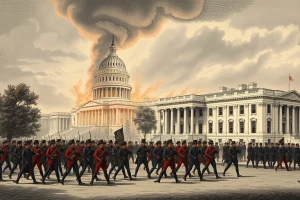
The British burning of the White House on August 24, 1814, remains one of the most dramatic events of the War of 1812. During a raid on Washington, D.C., British troops under Major General Robert Ross set fire to the President’s House, the Capitol, and other public buildings, marking the only time a foreign power captured and burned the American capital. The event was a retaliatory strike for American attacks on Canadian cities and profoundly affected American morale and the war’s course.
Historical Context
The War of 1812 was fought between the United States and Great Britain amid unresolved issues from the American Revolution, including British impressment of American sailors, trade restrictions, and British support for Indigenous nations resisting American expansion. The conflict began in June 1812, with most fighting along the Canadian border, where American forces attempted to invade British colonies. By early 1814, Napoleon’s defeat in Europe allowed Britain to commit more troops to North America, shifting the war’s focus to the American coast.
In 1813, American forces had burned the town of York (present-day Toronto), the capital of Upper Canada, which inflamed British opinion. British leaders planned retaliatory raids against American cities, including Washington, to punish the United States, demoralize its people, and potentially force it to the negotiating table. Washington was chosen not as a strategic military objective but as a political symbol, with its public buildings representing American governance.
What Happened
On August 19, 1814, a British force of about 4,500 troops under Major General Robert Ross landed at Benedict, Maryland, on the Patuxent River. Their objective was to capture Washington, D.C. Over the following days, they advanced toward the capital, meeting little resistance. On August 24, American forces, including militia and regulars, confronted the British at Bladensburg, Maryland, just northeast of Washington. Despite superior numbers and artillery, the American militia broke under the British attack, leading to a rout later called the “Bladensburg Races.” President James Madison, who had witnessed the battle, fled into Virginia.
That evening, British troops entered Washington. Rear Admiral George Cockburn, who accompanied the army, directed the destruction of public buildings. The British first burned the Capitol, which contained the Library of Congress, then marched on the President’s House. Finding it deserted, they ransacked it and set it on fire. They also burned the Treasury, War Office, and other government structures. The Washington Navy Yard was set ablaze by American forces to prevent its capture, adding to the conflagration.
Dolley Madison, the First Lady, had refused to leave until a portrait of George Washington was saved. She ordered the full-length painting by Gilbert Stuart to be removed from its frame and taken to safety. After the British left, a severe storm—possibly a tornado—swept through the city, extinguishing many fires and causing further damage. The British did not stay long; they withdrew the next day, heading for Baltimore.
Why It Matters
The burning of Washington was a significant humiliation for the United States, demonstrating the nation’s vulnerability and the inadequacy of its defenses. President Madison was forced to flee, and the government was temporarily disrupted. The destruction of public buildings, including the White House and Capitol, symbolized the fragility of the young republic. Yet the event also galvanized American resolve; the British attack on Baltimore shortly afterward was repulsed, and the war ended later that year with no clear victory. The White House and other buildings were rebuilt, and the event became a lasting memory in American history, serving as a reminder of both the nation’s resilience and its early struggles for respect on the international stage.
Definition
The burning of the White House, also known as the President’s Palace or Executive Mansion, was the deliberate destruction by fire of the official residence of the President of the United States on August 24, 1814, by British troops during the War of 1812. It was part of a broader burning of public buildings in Washington, D.C., after the British captured the city following the Battle of Bladensburg.
Background
The British decision to attack Washington grew from several factors. The principal immediate cause was the American burning of York (now Toronto) in 1813, which British commanders saw as wanton destruction of a provincial capital. Additionally, British forces were already raiding the Chesapeake Bay region in 1814, and the lack of American resistance encouraged an inland expedition. Admiral George Cockburn, in particular, advocated for striking at Washington to destroy American morale and public property. The British also hoped to divert American troops from the Canadian border and to negotiate peace from a position of strength.
How It Worked
After the defeat at Bladensburg, British troops marched into Washington. The destruction was organized and systematic, focusing on public buildings. The White House was set ablaze after soldiers looted furniture and personal effects. According to accounts, they piled furniture, curtains, and bedding in the center of rooms and used incendiary devices to ignite them. The flames consumed the interior, leaving only the stone exterior walls. The Capitol was similarly burned, destroying the Library of Congress and many early records. The British took care, however, to spare private residences, and they left the Patent Office intact after an appeal that its contents were private property. The burning was halted by a sudden thunderstorm, which extinguished many fires.
Competing Viewpoints
British commanders and soldiers justified the burning as retribution for American acts of destruction, particularly the burning of York and other Canadian villages. They argued that Washington’s public buildings were legitimate military targets, as they symbolized the American government and its war effort. American contemporaries and later historians condemned the burning as barbaric and unnecessary, noting that the British had destroyed a civilian capital rather than military installations. Some also criticized the American government for failing to defend the city adequately, while others blamed Secretary of War John Armstrong for his negligence. Modern scholarship views the burning as a tactical and psychological blow but one that ultimately strengthened American determination.
Role in the War of 1812
The burning of Washington took place in the third year of the war, when both sides were seeking a decisive advantage. The British raid was intended to weaken American resolve and force a settlement. Instead, it had the opposite effect: it rallied Americans, who were angered by the destruction of their capital. The British next attacked Baltimore, but the defense of Fort McHenry—which inspired Francis Scott Key to write “The Star-Spangled Banner”—ended in a British withdrawal. The war ground on until the Treaty of Ghent was signed on December 24, 1814, although formal ratification came later. The raid on Washington demonstrated the vulnerability of the United States but also its ability to recover and continue the conflict.
Consequences and Historical Interpretation
Immediately, the fire left the White House in ruins. President Madison and his wife never lived there again; they resided at the Octagon House until the end of his term. Rebuilding began under James Hoban, the original architect, and President James Monroe moved into the reconstructed mansion in 1817. The exterior walls, which had been painted white to hide fire damage, gave the structure its lasting nicknamed “White House.” Historians have interpreted the burning as a turning point in the war, highlighting American unpreparedness but also the resilience of the republic. It became a symbol of British aggression and a source of national unity. In British memory, the event is less prominent, often overshadowed by the later defeat at Baltimore and the Treaty of Ghent.
Primary Sources
Contemporary sources include Major General Robert Ross’s official report to Secretary of State for War and the Colonies Earl Bathurst, written after the burning, which details the destruction of public buildings. Dolley Madison’s letters to her sister, particularly those describing the evacuation and saving of the Washington portrait, provide an American perspective. British officer George Robert Gleig wrote accounts of the campaign, including the burning, from the soldier’s view. The National Park Service and the White House Historical Association preserve these documents and artifacts.
Further Reading
- Walter R. Borneman, 1812: The War That Forged a Nation (2004)
- Donald R. Hickey, The War of 1812: A Forgotten Conflict (1989)
- Anthony S. Pitch, The Burning of Washington: The British Invasion of 1814 (1998)
- White House Historical Association, “Days of Destruction: The President’s House” (online resource)
- National Park Service, “Burning the Capital” (online article)
References
- National Park Service, “Complete the destruction of the public buildings with the least possible delay,” https://www.nps.gov/articles/burning-the-capital.htm
- HISTORY.com Editors, “British troops set fire to the White House,” HISTORY, https://www.history.com/this-day-in-history/august-24/british-troops-set-fire-to-the-white-house
- American Battlefield Trust, “The Capture and Burning of Washington, D.C.,” https://www.battlefields.org/learn/articles/burning-washington-dc
- White House Historical Association, “Days of Destruction: The President’s House,” https://www.whitehousehistory.org/days-of-destruction-the-presidents-house
- Jesse Greenspan, “When the British Burned Washington, D.C.,” HISTORY, https://www.history.com/articles/the-british-burn-washington-d-c-200-years-ago
FAQ
Why did the British burn the White House?
The British burned the White House and other public buildings in Washington as retaliation for the American destruction of York (Toronto) in 1813, and to demoralize the U.S. government and population.
Did the British burn any private homes in Washington?
The British primarily targeted public buildings. They generally spared private residences, and they even left the Patent Office intact after its administrator argued it contained private property.
How did the White House survive the fire?
The White House was not completely destroyed. The stone exterior walls remained standing. It was rebuilt and first occupied by President James Monroe in 1817, who moved back into the restored mansion.


Leave a Reply