
Short Answer
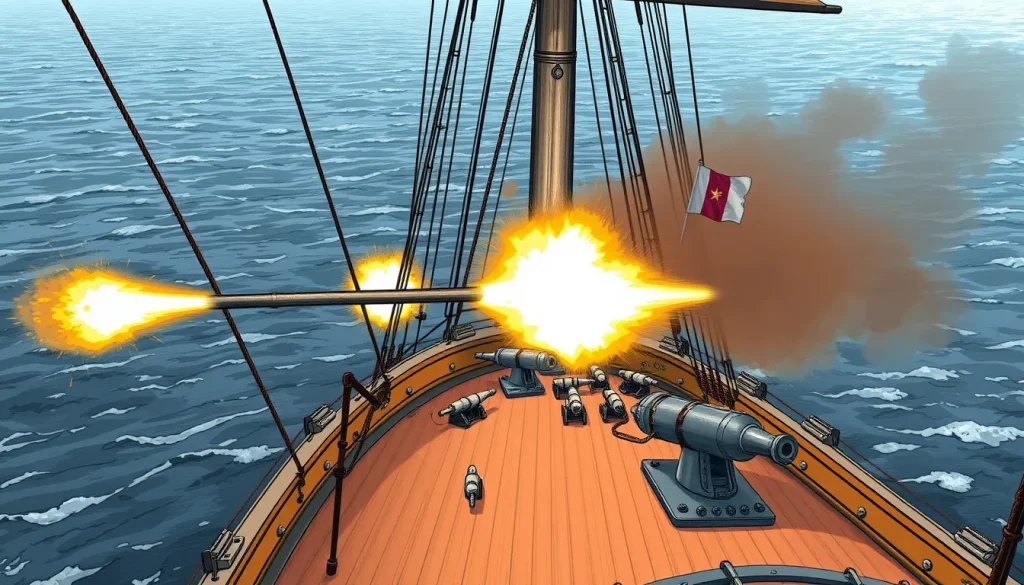
Naval guns during the War of 1812 (1812–1815) were the decisive weapons on the high seas and the Great Lakes, determining the outcome of frigate duels, fleet actions, and coastal bombardments. These cannon—primarily long guns and carronades—were mounted on warships of the United States Navy, the Royal Navy, and the provincial forces of British North America. The war tested the effectiveness of existing gun designs, highlighted tactical differences between the two navies, and influenced later naval ordnance development.
Historical Context
At the beginning of the war, the Royal Navy was the world’s dominant naval power, having triumphed at Trafalgar in 1805. Its ships carried a mix of long guns and carronades, with frigates typically armed with 18-pounder long guns on the main deck. The United States Navy, although small, possessed a force of heavy frigates such as the USS Constitution and the USS United States, which were armed with 24-pounder long guns—a significant firepower advantage over comparable British frigates. On the Great Lakes, both sides built squadrons of armed schooners, brigs, and sloops, often mounting guns that were lighter but essential for controlling inland waterways and supporting troop movements. The war also saw the widespread use of gunboats, particularly by the Americans, though these were generally less effective than ships of the line.
What Happened
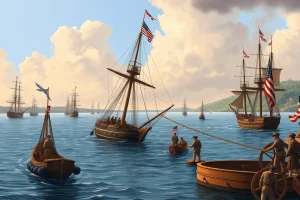
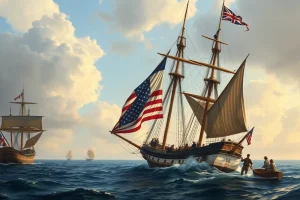
Naval guns were employed in several decisive engagements. In the Atlantic, American frigates won notable single-ship actions: the USS Constitution defeated HMS Guerrière (August 1812) and HMS Java (December 1812), while the USS United States captured HMS Macedonian (October 1812). In these battles, the heavier American long guns enabled them to outrange and outgun their opponents. On the Great Lakes, the Battle of Lake Erie (September 1813) saw Commodore Oliver Hazard Perry’s squadron, armed with carronades and long guns, defeat a British squadron under Commander Robert Barclay. At the Battle of Lake Champlain (September 1814), Commodore Thomas Macdonough used a combination of long guns and carronades to defeat a British squadron, though the British had a preponderance of long guns. The war also featured the famous duel between HMS Shannon and USS Chesapeake (June 1813), where the Shannon’s better gunnery and disciplined crew led to a British victory. In the Pacific, the USS Essex under Captain David Porter used its carronades effectively against British whalers, but was ultimately defeated by British frigates armed with long guns that outranged its carronades.
Why It Matters
Naval gun performance and design directly influenced the outcome of key battles and the strategic balance. American victories in frigate duels boosted national morale and demonstrated that the Royal Navy was not invincible, but they did not break British naval supremacy. On the Great Lakes, control of the waterways allowed both sides to move troops and supplies, and victories like Lake Erie secured American control of the upper lakes. The war also prompted assessments of naval ordnance, leading to later improvements in gun construction, shot, and ship design. Historians interpret the naval war as a testament to the importance of gunnery, training, and tactical seamanship over sheer numbers.
Definition
Naval guns during this era were muzzle-loading, smoothbore cannon firing solid iron round shot, grape, or canister. Two main types were used: long guns and carronades. Long guns were traditional cannon with long barrels, providing greater range and accuracy. Carronades were short-barreled guns, lighter and easier to handle, firing a heavier shot at short range, but with much less range and penetration. Smaller boats often carried howitzers for exploding shells, though these were less common. Warships were rated by the number of guns they carried, but the weight of the broadside (total weight of shot fired) was a critical measure of firepower.
Background
The design of naval guns had evolved over the eighteenth century. By the War of 1812, the standard long gun was a 18-pounder or 24-pounder, meaning the weight of the iron ball it fired. Carronades, developed in the 1770s by the Carron Company in Scotland, were adopted by both the Royal Navy and the U.S. Navy for their short-range destructive power. American frigates were designed with heavier long guns than their British counterparts, a deliberate strategy to overpower enemy ships. On the Great Lakes, the limited infrastructure and shallow waters favored smaller vessels with lighter guns, but still capable of significant broadsides.
How It Worked
Guns were mounted on wooden carriages and fired through gunports. Loading involved ramming the powder charge and shot down the barrel, and the gun was aimed by hand or by the ship’s movement. A broadside—firing all guns on one side simultaneously—was the primary tactical method. At long range, captains used long guns; when closing to under a few hundred yards, carronades came into play. Effective gunnery required well-trained crews, as loading and firing a long gun could take several minutes, while carronades were faster to serve. Naval tactics emphasized crossing the enemy’s bow or stern to deliver a raking fire, as seen in many duels.
Competing Viewpoints
Historians and contemporary observers debated the relative merits of long guns versus carronades. British officers often favored long guns for their reach, especially when fighting at a distance. American captains, particularly on the heavy frigates, combined both types, using carronades for devastating short-range broadsides. In the Battle of Lake Champlain, Macdonough’s use of carronades was initially disadvantaged by British long guns, but he overcame this through skillful positioning. Some analysts argue that the American preference for heavy long guns was the key to their frigate victories, while others emphasize crew training and morale. British naval doctrine emphasized rigorous drill, which led to more accurate and rapid fire, as demonstrated by HMS Shannon. Later naval experts saw the war as a case study in gun design and the importance of balancing range and weight of shot.
Role in the War of 1812
Naval guns were used in every theater. On the Atlantic, American frigates and privateers targeted British merchantmen and warships, while the Royal Navy blockaded the American coast and convoyed supplies to Canada. On the Great Lakes, control of Lake Erie and Lake Ontario hinged on the guns of small squadrons; the Americans won at Lake Erie, while British and American forces fought to a stalemate on Lake Ontario, with each side building ships of up to 100 guns by war’s end. In the Chesapeake, British guns bombarded coastal towns and supported raids. The war also saw the use of gunboats in the defense of harbors, though they were often ineffective against ship-rigged vessels. Guns on land (forts and batteries) also played a role, but naval guns were central to maritime operations.
Consequences and Historical Interpretation
The war demonstrated the evolving effectiveness of naval gunnery. American victories showed that a few well-armed frigates could challenge the might of the Royal Navy, but the British blockade eventually choked American trade. The peace settlement did not resolve the issues that caused the war, but naval successes shaped American national identity. Later historians have examined the war to understand technological and tactical change. The use of carronades declined after the war, as longer-range guns and shell guns became more common. The war also influenced shipbuilding trends, with both navies moving toward heavier guns and more standard designs. Interpretations vary: some see the naval war as largely indecisive, while others argue that American victories forced the Royal Navy to adopt more cautious tactics and contributed to the eventual peace.
Primary Sources
Principal primary sources include the multi-volume The Naval War of 1812: A Documentary History, edited by William S. Dudley and Michael J. Crawford, which reproduces official reports, letters, and orders from American and British naval officers. The logbooks and journals of commanders such as Isaac Hull, William Bainbridge, Oliver Hazard Perry, and Thomas Macdonough provide firsthand accounts of gun actions. British sources, including the correspondence of Admiral Sir John Borlase Warren and Captain Philip Broke, offer a contrasting perspective on gunnery and tactics. The Canadian Encyclopedia’s article on ships and the published narratives of participants, such as Joshua Barney, also survive. These documents reveal the challenges of gun handling, the effects of shot on ships, and the decisions of commanders.
Further Reading
- Theodore Roosevelt, The Naval War of 1812 (1882, later editions).
- William S. Dudley, editor, The Naval War of 1812: A Documentary History, Volumes I–III (Naval Historical Center, 1985–2002).
- James H. Marsh, “Ships of the War of 1812,” The Canadian Encyclopedia (2011).
- Jeremy Black, “A British View of the Naval War of 1812,” Naval History Magazine, August 2008.
- Francis F. Beirne, The War of 1812 (1949), chapter “Our Frigates Make History.”
References
- Dudley, William S., and Michael J. Crawford, eds. The Naval War of 1812: A Documentary History. 3 volumes. Naval Historical Center, 1985–2002.
- Marsh, James H. “Ships of the War of 1812.” The Canadian Encyclopedia, 2011.
- Black, Jeremy. “A British View of the Naval War of 1812.” Naval History Magazine 22, no. 4 (August 2008).
- Beirne, Francis F. The War of 1812. New York: E. P. Dutton, 1949. Chapter 12, “Our Frigates Make History.”
- Roosevelt, Theodore. The Naval War of 1812. New York: G. P. Putnam’s Sons, 1882.
FAQ
What types of naval guns were used during the War of 1812?
The main types were long guns—standard smoothbore cannon with long barrels—and carronades, short-barreled guns that fired a heavier shot at close range. Some vessels also carried howitzers for explosive shells, but they were less common.
How did American naval guns differ from British ones?
American frigates typically carried 24-pounder long guns, which fired heavier shot than the 18-pounders on British frigates. This gave American ships a firepower advantage in broadside engagements, though the Royal Navy often had more disciplined crews and better long-range gunnery.
What role did carronades play in key battles?
Carronades were devastating at close range. In the Battle of Lake Champlain, Macdonough used carronades effectively after positioning his ships, while British ships with more long guns outranged him at first. In the Pacific, the USS Essex's carronades were ineffective when the British stayed at long range, leading to its defeat.
Leave a Reply