
Short Answer
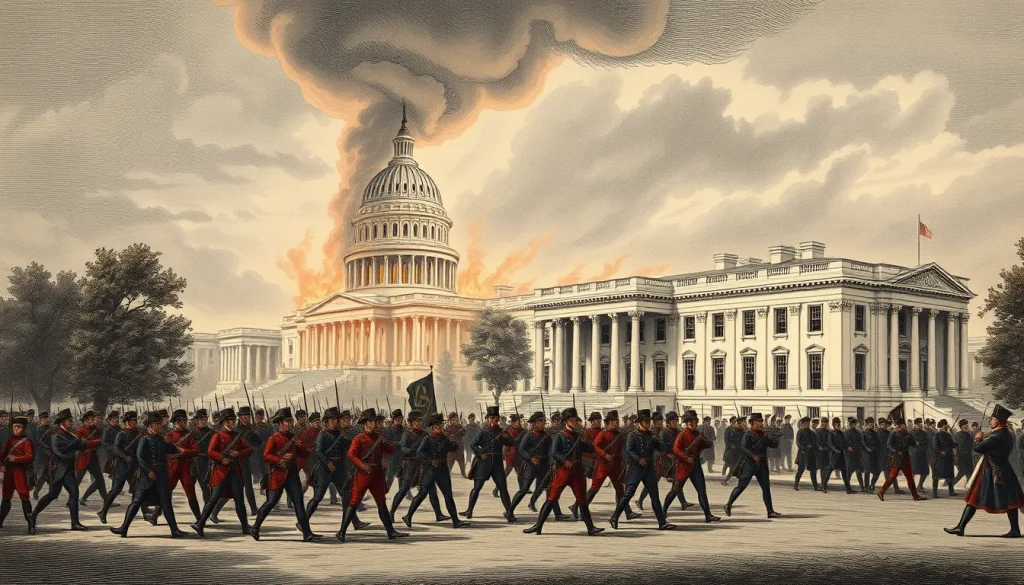
Washington, D.C., the capital of the United States, was captured and its principal public buildings burned by British forces on August 24–25, 1814, during the War of 1812. The attack followed a humiliating American defeat at the Battle of Bladensburg and exposed the young republic’s military weakness. The burning of the federal city was a psychological blow, yet it did not break American resistance and ultimately inspired a renewed determination to defend the nation.
Historical Context
When the United States declared war on Britain in June 1812, Washington was a nascent federal city of roughly 8,000 residents, lacking both fortifications and a substantial garrison. The war had initially focused on the U.S.–Canadian border, where American invasions of Upper Canada failed. By 1814, with the defeat of Napoleon in Europe, Britain was able to transfer seasoned troops to North America. The British high command launched a Chesapeake campaign aimed at distracting American forces from the Canadian frontier and striking at the seat of government. Secretary of War John Armstrong dismissed the threat to Washington, believing the British would target Baltimore, but Secretary of State James Monroe, after personally scouting, warned President Madison that the enemy was advancing.
What Happened
British forces under Major General Robert Ross and Rear Admiral George Cockburn landed at Benedict, Maryland, on August 19–20, 1814, with about 4,500 troops. They marched northward toward Washington, meeting an American force of militia and regulars at Bladensburg on August 24. The Battle of Bladensburg resulted in a swift American defeat—so rapid that the engagement was mockingly called the “Bladensburg Races.” That evening, the British entered Washington unopposed. They burned the United States Capitol (which then housed the Library of Congress), the President’s Mansion, the Treasury, and the Washington Navy Yard (which had been set aflame by retreating Americans to prevent capture). Private homes were generally spared, but public buildings were systematically set alight. President Madison had already fled the city; First Lady Dolley Madison remained long enough to secure the Gilbert Stuart portrait of George Washington, federal papers, and other valuables before escaping. The British occupation lasted barely a day; they left on the morning of August 25, partly owing to a violent thunderstorm that produced a tornado, which caused further damage and hastened their departure.
Why It Matters
The burning of Washington was an unprecedented humiliation for the United States. Although the city was not strategically vital, its capture and the destruction of government buildings struck at American prestige. The event galvanized public opinion, and subsequent American victories at Baltimore and New Orleans helped restore national pride. The Treaty of Ghent, signed December 24, 1814, ended the war with no territorial changes, but the successful defense of Baltimore (including Fort McHenry) and later battles gave Americans a sense of vindication. The damage to Washington also spurred a later program of rebuilding and improvement; the white paint applied to the scorched President’s Mansion gave it the name “White House.” Historians see the incident as a demonstration of both the vulnerability of the young republic and its resilience under adversity.
Historical Map Context
Washington was a planned city designed by Pierre L’Enfant, laid out along the Potomac River with broad avenues radiating from the Capitol and the President’s Mansion. In 1814 many streets remained unpaved, and the city was surrounded by farmland and forests. The British approach exploited the poorly defended Patuxent River route, landing at Benedict and marching overland through Bladensburg to reach the capital from the east. Andrew Ellicott’s 1794 plan shows the nascent city’s layout, with the Capitol and Executive Mansion prominent.
Modern Location
Washington, D.C., today is the capital of the United States, located on the Potomac River between Maryland and Virginia. The historical sites of the 1814 burning—the U.S. Capitol, the White House, the Treasury Building, and the Washington Navy Yard—remain in active use or have been reconstructed. The vicinity of Bladensburg, Maryland, now a suburban area, preserves some memory of the battle with historical markers.
Events at the Site
The key events of the 1814 attack centered on public buildings. The Capitol was set alight, destroying the Library of Congress and many early congressional records. The President’s Mansion (now White House) was burned, leaving only walls. The Treasury and other departmental buildings were also fired. At the Washington Navy Yard, Americans burned ships and stores to keep them from British hands. The Patent Office was spared, reportedly thanks to William Thornton’s appeal that its contents represented inventions valuable to humanity. British troops entered the city along Maryland Avenue and Pennsylvania Avenue, and the occupation lasted from nightfall on August 24 until the following morning.
Associated People
Key participants included British Major General Robert Ross and Rear Admiral George Cockburn, who led the attack; American President James Madison, who fled; First Lady Dolley Madison, who orchestrated the removal of valuables; and American commanders at Bladensburg, including Brigadier General William H. Winder. Secretary of State James Monroe also played a crucial role in warning of the British advance.
Surviving Monuments and Site
After the fire, the rebuilt White House was painted white, giving it its lasting nickname. The Capitol was restored and expanded. The Washington Navy Yard remains an active military installation. Today, the National Park Service’s Star-Spangled Banner National Historical Trail traces the route of the British invasion, and several markers and monuments in Washington and Bladensburg commemorate the events of August 24–25, 1814.
Primary Sources
Important contemporaneous accounts include:
- James Monroe’s urgent note to President Madison on August 22, 1814, stating “The enemy are in full march for Washington” and advising “You had better remove the records.”
- Dolley Madison’s letter to her sister, written as the British approached, describing her preparations to salvage items from the White House.
- George Robert Gleig, a British officer, who later published a memoir recounting the burning of the city, including claims of American treachery that justified the destruction.
- Official U.S. reports and letters documenting the loss of archives and the state of the city after the British departure.
These sources must be read with awareness of their biases: American accounts often emphasize the trauma and heroism, while British accounts justify the destruction as retaliation for American raids in Canada.
Further Reading
- Walter Lord, The Dawn’s Early Light (1973).
- Anthony Pitch, The Burning of Washington: The British Invasion of 1814 (1998).
- Steve Vogel, Through the Perilous Fight: Six Weeks That Saved the Nation (2013).
- Jessie Kratz, “P.S.: You Had Better Remove the Records,” Prologue (National Archives, 2014).
- National Park Service, “1814 Chesapeake Campaign” (Star-Spangled Banner National Historic Trail).
References
- National Park Service, “1814 Chesapeake Campaign,” Star-Spangled Banner National Historic Trail, https://nps.gov/stsp/learn/historyculture/1814-chesapeake-campaign.htm.
- Jessie Kratz, “P.S.: You Had Better Remove the Records: Early Federal Archives and the Burning of Washington during the War of 1812,” Prologue, National Archives, 2014, https://www.archives.gov/files/publications/prologue/2014/summer/1812.pdf.
- William T. Weber, “Strategic Surprise: The British Capture of Washington, DC, 1814,” CIA Studies in Intelligence, https://www.cia.gov/resources/csi/static/British-Capture-Washington-DC.pdf.
- American Battlefield Trust, “The Capture and Burning of Washington, D.C.,” https://www.battlefields.org/learn/articles/burning-washington-dc.
- James M. Lindsay, “The 1814 British Sack of Washington,” Council on Foreign Relations, August 24, 2026, https://www.cfr.org/articles/the-1814-british-sack-of-washington.
FAQ
Why did the British burn Washington, D.C.?
The British aimed to strike a psychological blow against the American government and avenge American destruction of public buildings in Canada, such as York (Toronto) in 1813.
Did the British destroy private homes?
No. British officers ordered that private property be spared, and the destruction was limited to public buildings such as the Capitol, White House, Treasury, and Navy Yard.
What happened to President Madison?
James Madison fled the city before the British arrived. He and Dolley Madison were reunited in Virginia on August 25, 1814.



Leave a Reply