
Short Answer
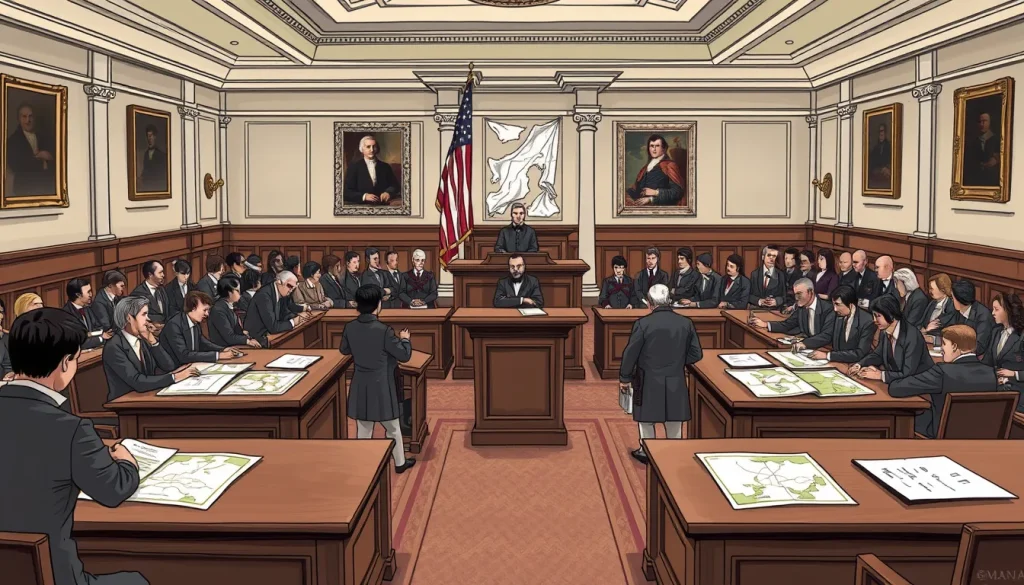
How Congress voted on the War of 1812 refers to the narrow, partisan legislative decisions in June 1812 that authorized the first declaration of war in U.S. history. After President James Madison sent his war message on June 1, the House passed the declaration on June 4 by 79–49, and the Senate followed on June 17 by 19–13, with Madison signing the law on June 18. The votes, which remain the closest in any U.S. declaration of war, reflected deep political and regional disagreements over British maritime practices and western frontier grievances.
Historical Context
By 1812, the United States had endured more than a decade of friction with Great Britain, which was locked in a global war with Napoleonic France. The Royal Navy’s impressment of American sailors, enforcement of the Orders in Council that restricted neutral trade, and British support for Indigenous resistance on the western frontier all fueled American anger. President Thomas Jefferson’s and Madison’s economic sanctions—the Embargo Act of 1807 and subsequent non-intercourse measures—had failed to force British concessions. Within Congress, a group of young Republicans known as the War Hawks, led by Speaker Henry Clay and John C. Calhoun, argued for a military response to defend national honor and stop alleged British incitement of Indian attacks. At the same time, Federalists, especially in New England, opposed war because of its threat to trade and what they saw as Republican political motives.
What Happened
On June 1, 1812, President Madison sent a special message to Congress reciting American grievances against Britain, including impressment, the Orders in Council, and British encouragement of Indian warfare. Madison stopped short of formally recommending war, leaving the decision to Congress as the Constitution requires. The House of Representatives took up the matter quickly; after a brief but intense debate, it voted on June 4, 1812, to pass a declaration of war by 79 to 49. The Senate debated for nearly two weeks, at one point briefly considering a limited naval war against Britain—a motion that failed on a tie vote when a supporter switched sides. On June 17, the Senate approved the House resolution by 19 to 13. President Madison signed the declaration on June 18, 1812, officially beginning hostilities. The voting exhibited a stark partisan pattern: all ninety-eight congressmen who voted in favor across both chambers were Republicans, while all thirty-nine Federalists in Congress voted against. However, about one-quarter of House Republicans either voted no or abstained, indicating that even the majority party was split.
Why It Matters
The congressional vote was the first exercise of the Constitution’s declaration-of-war power and remains the closest in U.S. history. It set the stage for a conflict for which the United States was woefully unprepared—the Army had only about 6,700 men and the Navy a few dozen ships—and it intensified partisan hostility. Federalists and some Republicans condemned the decision as “Mr. Madison’s War,” and the war itself proved costly and divisive, culminating in the burning of Washington in 1814. The narrowness of the vote signaled that the conflict would be fought amid domestic dissent, shaping how the Madison administration pursued the war and how historians later interpreted its origins and legacy.
Definition
This topic refers specifically to the roll-call votes in the U.S. House of Representatives and Senate on the declaration of war against Great Britain in June 1812. It encompasses the legislative process, the political alignments, and the immediate circumstances that produced the closest war vote in American history.
Background
The constitutional framework assigns Congress the sole power to declare war, and no Congress had exercised that power since the Constitution’s ratification. By 1812, diplomatic efforts to secure British recognition of American neutral rights had failed. The Twelfth Congress, which convened in November 1811, included a vocal War Hawk faction eager to use military force. President Madison’s war message of June 1, 1812, enumerated long-standing grievances, but he left the decision to Congress, framing it as a “solemn question” for the legislative branch. The House debated the resolution for only a few days, while the Senate’s deliberations were longer and more contentious.
How It Worked
The declaration of war was a joint resolution, introduced as H.R. 184 in the House. After a brief debate, the House passed it 79–49 on June 4, 1812. The Senate then considered the House resolution; after making minor changes, it approved it 19–13 on June 17. The resolution authorized the president to use “the whole land and naval force of the United States” to execute the war. President Madison signed the bill into law the following day, June 18, 1812. The roll-call votes were recorded in the Annals of Congress and are preserved in the official records of the U.S. Congress.
Competing Viewpoints
Proponents of war argued that British impressment, the Orders in Council, and incitement of Indigenous attacks violated American sovereignty and required a forceful response. War Hawks also hoped that a successful invasion of Canada would end British influence and open land for American settlement. Opponents, chiefly Federalists, argued that the United States was unprepared and that a war would devastate commerce, particularly in New England. Some Republicans, notably from the maritime states, worried about the costs and the lack of a navy. The Senate’s near-passage of a limited naval war demonstrated that even among Republicans, support for a full conflict was tentative.
Role in the War of 1812
The declaration authorized President Madison to use the army and navy. It immediately led to a planned invasion of Canada, which failed disastrously in the early campaigns of 1812–13. The absence of overwhelming congressional support—and the vocal opposition of Federalists—hampered recruitment, funding, and coordination. The vote also established a precedent for how the United States would decide on future wars, and it made the war a partisan issue from the outset.
Consequences and Historical Interpretation
Historians generally view the congressional vote as a reflection of both sincere grievances and partisan political calculation. The narrow margin and the complete opposition of the Federalist Party demonstrate that the decision to go to war was far from a national consensus. The war itself ended in a stalemate with the Treaty of Ghent in 1814, but the vote’s closeness became an enduring symbol of early American political division. Some scholars argue that the Republican Party used the war to unify its own ranks and weaken Federalists, while others emphasize the genuine diplomatic and economic provocations. In any case, the vote’s outcome profoundly shaped the war’s conduct and its contested memory in American history.
Primary Sources
Key primary sources include President James Madison’s war message of June 1, 1812, which outlined the stated reasons for war. The official declaration itself, signed on June 18, 1812, is held by the National Archives and Records Administration. The roll-call votes are recorded in the Annals of Congress (12th Congress, 1st Session). Also valuable are contemporary newspaper accounts, such as those from the National Intelligencer, and anti-war pamphlets like John Lowell’s Mr. Madison’s War. These documents reveal both the arguments for war and the intensity of opposition.
Further Reading
- Hickey, Donald R. The War of 1812: A Forgotten Conflict. University of Illinois Press, 2012.
- Stagg, J.C.A. Mr. Madison’s War: Politics, Diplomacy, and Warfare in the Early American Republic, 1783–1830. Princeton University Press, 1983.
- Watts, Steven. The Republic Reborn: War and the Making of Liberal America, 1790–1820. Johns Hopkins University Press, 1987.
- National Park Service, “Summer 1812: Congress stages fiery debates over whether to declare war on Britain.” Link
- Council on Foreign Relations, “The United States Declares War on Britain in 1812.” Link
References
- National Park Service, “Summer 1812: Congress stages fiery debates over whether to declare war on Britain,” https://www.nps.gov/articles/mr-madison-s-war.htm
- U.S. Capitol Visitor Center, “Senate Changes to the House Declaration of War, June 17, 1812,” https://www.visitthecapitol.gov/artifact/senate-changes-house-declaration-war-june-17-1812
- Council on Foreign Relations, “The United States Declares War on Britain in 1812,” https://www.cfr.org/articles/the-united-states-declares-war-on-britain-in-1812
- GovTrack.us, “TO REJECT H.R. 184 (JUNE 18, 1812) TO DECLARE WAR WITH GREAT BRITAIN,” https://www.govtrack.us/congress/votes/12-1/h208
- GovTrack.us, “TO PASS H.R. 184,” https://www.govtrack.us/congress/votes/12-1/h214
FAQ
Why was the vote on the War of 1812 so close?
The vote reflected deep regional and partisan divisions. Federalists, concentrated in New England, opposed war because it threatened trade and they distrusted Republican motives. Even some Republicans harbored doubts about the nation's military readiness and the wisdom of a full conflict, leading to a narrow margin in both chambers.
Who voted against the declaration of war?
All Federalists in Congress voted against the declaration. Additionally, about one-quarter of House Republicans voted against or abstained, including John Randolph and other anti-war Republicans. The opposition was strongest in New England and parts of the Mid-Atlantic.
What did the declaration of war authorize?
The joint resolution, H.R. 184, gave President Madison the authority to use the entire land and naval force of the United States to carry out the war against Great Britain. It did not specify military objectives, leaving strategy to the executive.


Leave a Reply