
Short Answer
On June 4, 1812, the United States House of Representatives voted 79 to 49 to declare war on Great Britain, a margin that seems narrow for such a consequential decision. The vote revealed deep national divisions over the causes of conflict, the readiness of the republic to fight, and the likely consequences of war. Understanding why the vote was so close requires examining the competing interests—sectional, economic, and political—that shaped the early republic’s entry into the War of 1812.
Historical Context
By 1812, the United States had endured a decade of escalating grievances against Great Britain. British impressment of American sailors, seizure of neutral ships under the Orders in Council, and interference with American trade in Europe fueled widespread resentment. At the same time, white settlers on the frontier demanded action against British support for Indigenous resistance in the Northwest Territory. These issues divided the nation: the South and West, led by the “War Hawks” in Congress, advocated military coercion, while Federalist New England, dependent on maritime commerce, feared economic ruin from war. The election of 1810 had swept many young, pro-war Republicans into Congress, but the legislative branch remained deeply split over how to respond.
What Happened
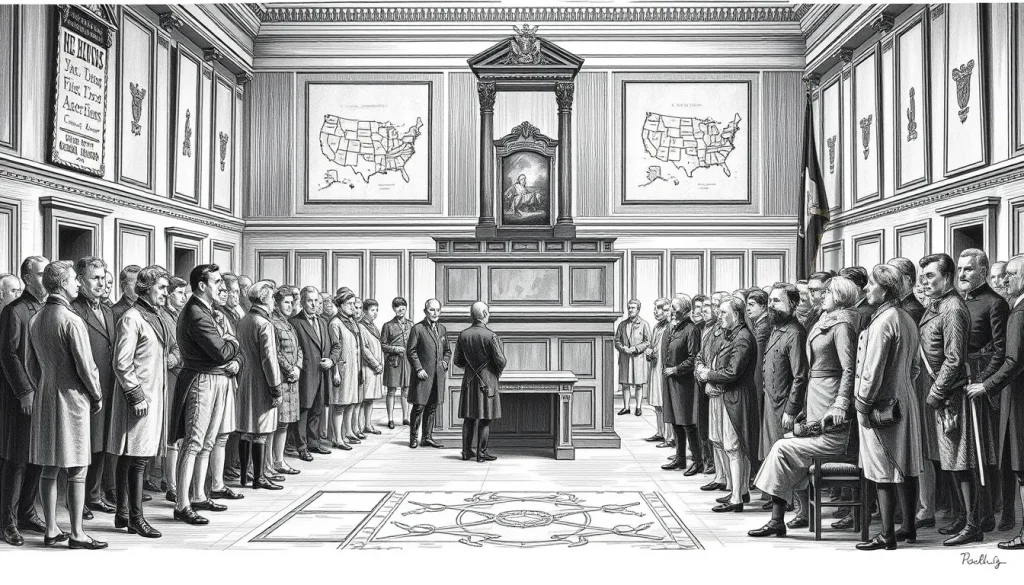
The House debate over war began in earnest in May 1812, after President James Madison sent a secret message to Congress reviewing British provocations. On June 4, the House voted on a war resolution introduced by the Committee on Foreign Relations. The tally was 79 in favor and 49 against—a decisive but far from unanimous majority. The vote broke largely along regional and party lines. Southern and western members, including Henry Clay of Kentucky and John C. Calhoun of South Carolina, provided the core of the war vote, arguing that national honor and western security required action. New England Federalists, led by Josiah Quincy of Massachusetts, opposed the measure as ruinous to commerce and unconstitutional in its ends, while some northern Republicans, representing urban mercantile districts, also voted no. The resolution then passed to the Senate, where it narrowly succeeded on June 17 by 19 to 13, and Madison signed the declaration on June 18.
Why It Matters
The 79-49 vote mattered both practically and symbolically. It revealed that the United States was not united for the conflict, casting doubt on the ability of the government to wage war effectively. The close vote reflected a nation deeply uncertain about its military strength and its place in the Atlantic world. It also set the stage for wartime dissent, as Federalist merchants and state governments continued to criticize and sometimes obstruct the war effort. Historians have seen the vote as a key indicator of early American political sectionalism, foreshadowing the fractures that would later lead to the Nullification Crisis and Civil War. The margin also shaped how the Madison administration prosecuted the war, lacking a broad base of support to raise armies and finance campaigns.
Definition
The 79-49 House vote refers to the roll-call vote on June 4, 1812, in the U.S. House of Representatives, which approved a declaration of war against Great Britain. The tally was the closest such vote in America’s early history, with nearly four in ten representatives opposing the measure.
Background
The vote arose from President James Madison’s request to Congress after years of diplomatic tension with Britain. The key issues were impressment, the Orders in Council, and alleged British influence over Indigenous peoples on the frontier. The Twelfth Congress, which convened in November 1811, included a group of “War Hawks”—younger Republicans from the West and South—who believed that economic coercion via the Embargo Act had failed and that military force was necessary to secure American rights. The Federalists, strongest in New England, argued that war would devastate trade and that the United States was unprepared. The vote emerged after three months of intensive debate, including secret sessions and reports from the Foreign Relations Committee.
How It Worked
The declaration process began when the House referred Madison’s message to the Committee on Foreign Relations, chaired by John C. Calhoun. The committee reported a resolution on June 3, stating that the United States would wage war against Great Britain. The next day, after a brief debate, the House voted. The resolution did not specify a formal declaration but authorized the president to use the military and navy to carry out the war. The vote was recorded by state and individual, revealing a clear geographic split. In the House, 79 yeas came overwhelmingly from the South and West, while 49 nays came largely from New England, New York, and other coastal districts. The Speaker, Henry Clay, voted for war, as did John Randolph famously opposed, calling it an act of “war without a cause.”
Competing Viewpoints
Supporters of war held that British impressment violated American sovereignty and that the Orders in Council directly attacked neutral rights. They argued that only a resumption of war would force Britain to respect American shipping and end its support for Indigenous resistance in the Old Northwest. Many also saw the war as a means to expand the republic by annexing Canada, which they believed would be easily captured. Opponents countered that the United States was militarily and financially unprepared, that the war would destroy the merchant marine and agricultural exports, and that the real interest in Canada was land speculation, not national honor. Federalists warned that the war would ally the United States with Napoleonic France, which they considered an enemy to civilized order. The split was also personal: John Randolph of Virginia, a Republican, called the war a “war of conquest” and a “sheep-stealing conflict,” while Henry Clay insisted that America’s “reputation and honor” were at stake.
Role in the War of 1812
The close vote shaped the war’s execution. President Madison and his officials knew that substantial congressional opposition meant limited manpower and funding. The government resorted to a small regular army, militia calls, and privateers rather than a broad national mobilization. The New England states, which had voted overwhelmingly against war, were reluctant to supply troops and sometimes refused to send their militia across state lines. The peace negotiations at Ghent in 1814 were conducted partly with the knowledge that American public opinion was fragile. The vote also emboldened critics: the Federalist press attacked the war as “Madison’s war” and called for a convention in Hartford. The war effort suffered from the lack of a unified political base, and the close vote is often seen as a reason the United States was unable to achieve a decisive victory.
Consequences and Historical Interpretation
Historians have interpreted the 79-49 vote as evidence of widespread ambivalence about the war. Some, like Donald Hickey, argue that the close margin showed that the war was a risky gamble rather than a national project. Others, such as J.C.A. Stagg, suggest that the vote reflected a narrow but sufficient coalition, and that the war was intended to consolidate Republican control over the West and South. The vote also prompted later debates about the constitutional power to declare war; Federalists argued that the resolution was too broad and violated the separation of powers by effectively authorizing an offensive war. In the long run, the close vote contributed to the perception that the war was an unpopular conflict, even though it produced a sense of national pride after the Battle of New Orleans. The vote remains a key illustration of how foreign policy decisions can divide a young republic.
Primary Sources
The most direct primary source is the Annals of Congress, which records the debate and the roll-call vote for June 4, 1812. This source provides the names of representatives and their positions. Another valuable document is President Madison’s war message to Congress, delivered on June 1, 1812, in which he detailed British aggressions. Madison’s message is reprinted in the American State Papers and other collections. Additionally, the letters of John Randolph and Henry Clay offer personal views on the debate. The Annals is a contemporary compilation, but it was not a verbatim transcript; it was reconstructed from newspaper reports, so some speeches may be paraphrased. Still, the vote numbers are reliable.
Further Reading
- Hickey, Donald R. The War of 1812: A Forgotten Conflict. University of Illinois Press, 1989.
- Stagg, J.C.A. Mr. Madison’s War: Politics, Diplomacy, and Warfare in the Early American Republic, 1783-1830. Princeton University Press, 1983.
- Mahant, Edelgard, and Graeme Mount. An Introduction to Their Impact on Canadian-American Relations. University of Toronto Press, 1989.
- The Library of Congress, “The Declaration of War of 1812,” includes digital copies of the document and related records.
References
- Annals of Congress, 12th Congress, 1st Session, pp. 1627-1631 (June 4, 1812).
- Madison, James. “War Message to Congress,” June 1, 1812, American State Papers, Foreign Relations, vol. 3.
- Hickey, Donald R. The War of 1812: A Forgotten Conflict. University of Illinois Press, 1989.
- Stagg, J.C.A. Mr. Madison’s War. Princeton University Press, 1983.
- “The Declaration of War of 1812,” Library of Congress, digital files.
FAQ
Why was the vote on the declaration of war in 1812 so close?
The vote was close because the nation was deeply divided over whether war would protect or damage American interests. Federalists and many northern Republicans feared the economic consequences and doubted military readiness, while southern and western War Hawks insisted on action to defend national honor and secure the frontier.
Which states voted against war in 1812?
Most congressmen from New England states (Massachusetts, Connecticut, Rhode Island, and New Hampshire) voted against the declaration. Many representatives from New York and other coastal districts also opposed it.
What did President Madison's war message of June 1812 emphasize?
Madison's message catalogued British abuses, including impressment, the illegal blockade of American ports, and the incitement of Indigenous warfare on the frontier. He contended that negotiation had failed and that the United States must assert its rights.


Leave a Reply