
Short Answer
The Battle of North Point, fought on September 12, 1814, was a land engagement between Maryland militia and British regulars during the War of 1812. It formed the opening phase of the larger Battle of Baltimore, as British forces under Major General Robert Ross advanced overland from North Point toward the city. Though driven from the field, the Americans inflicted heavy casualties, including the mortal wounding of Ross, and delayed the British advance long enough to strengthen Baltimore’s defenses, contributing to the overall American victory.
Historical Context
By 1814, the War of 1812 had reached a stalemate, but Britain, having defeated Napoleonic France, redirected veterans to North America. In August 1814, a British force under Major General Robert Ross and Rear Admiral George Cockburn entered the Chesapeake Bay, defeated American militia at Bladensburg, and burned Washington, D.C. Baltimore, the third largest U.S. city and a major commercial and privateering hub, became the next target. The city’s capture would disrupt American trade and potentially end the war. Its defense depended on cooperation between the U.S. Navy at Fort McHenry and a ring of land fortifications, including the entrenched line on Hampstead Hill. The British planned a coordinated attack: the army would land at North Point and march overland, while the navy bombarded Fort McHenry to silence its guns and open the harbor.
What Happened
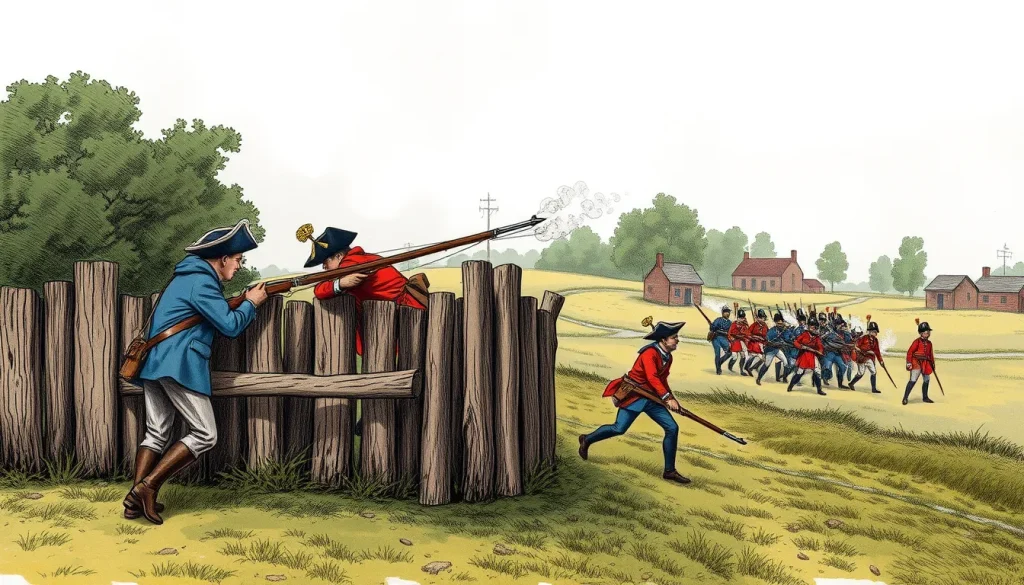
On September 12, 1814, a British fleet of more than 30 warships and transports landed roughly 4,700 troops at North Point, the peninsula between the Patapsco and Back Rivers. Major General Ross and Rear Admiral Cockburn disembarked with the advanced guard, while Colonel Arthur Brooke of the 44th Foot supervised the rest of the landing. The British army marched westward toward Baltimore. In response, American Major General Samuel Smith dispatched Brigadier General John Stricker’s 3rd Brigade of Maryland militia—about 3,000 men—to meet the invaders on the Patapsco Neck. Stricker chose a defensive line near Godly Wood, where Bear Creek and Bread and Cheese Creek narrowed the peninsula, and placed his troops behind a long wooden fence.
Around midday, a skirmish erupted when American riflemen, under Captain William Dyer, advanced to probe the British. Ross, hearing the fire, rode forward with his staff. When Ross approached a bend in the road, American sharpshooters from Captain Benjamin Chew’s Mechanical Volunteers fired. A bullet struck the general in the chest, mortally wounding him. He was carried to the rear and died while being conveyed back to the fleet. Daniel Wells and Henry McComas, two teenage militiamen, were later credited with the shot, though both were killed in the exchange. Ross’s death demoralized the British; Colonel Arthur Brooke assumed command.
Brooke reformed the army and by 3:00 p.m. launched a deliberate attack on Stricker’s line. The British used Congreve rockets to disturb the Americans, but the 5th Maryland Regiment, which had experienced rockets at Bladensburg, reportedly calmed their comrades, and the attack on the American left made progress. The 51st and 39th Maryland regiments became entangled while attempting to maneuver, and part of the line broke. Nevertheless, Stricker ordered a disciplined withdrawal, with the 5th Maryland covering the retreat. The British did not pursue. American casualties were 24 killed, 139 wounded, and 50 captured; British casualties were about 46 killed and 295 wounded. The British occupied the battlefield but had delayed their march, allowing Stricker to fall back to the main defensive line at Hampstead Hill.
Why It Matters
The Battle of North Point, though a British tactical victory, proved strategically decisive. The death of Major General Ross deprived the British of an experienced commander, and the stiff resistance of American militia—many of whom had fled at Bladensburg—boosted American morale and convinced Brooke to pause. That evening and the next day, British reconnaissance revealed the impressive earthworks of Hampstead Hill defended by thousands of troops, and the Royal Navy’s failure to reduce Fort McHenry on September 13–14 made a land assault untenable. Brooke therefore ordered a withdrawal, ending the British Chesapeake Campaign. The successful defense of Baltimore saved a vital seaport and privateer base, ensured the continuation of the war, and gave Francis Scott Key the inspiration for “The Star-Spangled Banner.” Later historians have emphasized the battle’s role in shaping American national identity, while recognizing that the British could have advanced more aggressively had Ross survived.
Prelude
After the burning of Washington, the British fleet moved up the Chesapeake Bay, re-embarking troops at the Patuxent River. Ross and Cockburn sailed to the northern end of the bay, and on September 11, 1814, they anchored off North Point. American scouts observed the fleet, and Major General Samuel Smith ordered Brigadier General John Stricker to move his 3rd Brigade out of Baltimore to oppose a likely landing. Stricker’s men marched to Godly Wood, about seven miles from the city, on the night of September 11–12. He posted his line between Bear Creek and Bread and Cheese Creek, anchoring it against the waterways and thick woods.
Forces and Commanders
American: Brigadier General John Stricker commanded about 3,000 Maryland militia, including the 5th, 6th, 27th, 39th, and 51st regiments, a battalion of volunteer riflemen, a cavalry troop, and six 4-pounder field guns. Many lacked combat experience, but the 5th Maryland had seen action at Bladensburg.
British: Major General Robert Ross led about 4,700 soldiers, sailors, and Royal Marines, including veterans of the Duke of Wellington’s Peninsular War. The force included the 4th (King’s Own), 21st Fusiliers, 44th, and 63rd regiments, plus a battalion of Royal Marines and a detachment of the Corps of Colonial Marines—freed enslaved men who had joined the British cause. Colonel Arthur Brooke of the 44th Foot took command after Ross was killed.
Battlefield and Map Context
The engagement took place on the Patapsco Neck peninsula, bounded by the Patapsco River to the south and Back River to the north. At the American defensive line, Bear Creek and Bread and Cheese Creek narrowed the land to about a mile. The main road from North Point to Baltimore ran through the center, and a wooden fence provided cover. The thick woods and marshy creeks limited flanking movements. Today, the battlefield is a suburban area but retains a small park and monument.
Battle Chronology
September 12, early morning: British troops begin landing at North Point; Ross and Cockburn land with the initial wave. Mid-morning: Ross and Cockburn reconnoiter, stopping at a farm for breakfast and interrogating prisoners. Noon: American riflemen under Captain Dyer engage British pickets near the Gorsuch farm. Ross rides forward and is shot, dying shortly thereafter. 3:00 p.m.: Colonel Brooke orders an artillery and rocket bombardment, then an infantry assault. The British attack forces the American left flank to break, but the 5th Maryland covers an orderly retreat. Late afternoon: The British occupy the field but do not pursue. Stricker withdraws to Cook’s Tavern, then to Baltimore under cover of darkness.
Casualties and Losses
American losses were accurately reported as 24 killed, 139 wounded, and 50 captured. British casualties were heavier, with estimates ranging from 39 to 46 killed and 251 to 295 wounded. The most significant British loss was Major General Robert Ross, killed by rifle fire during the opening skirmish. Contemporary reports indicate that both sides considered the battle a hard-fought encounter.
Result
The British were tactically victorious, holding the field and forcing the Americans to retreat. However, the loss of General Ross and the unexpected resistance disrupted the British timetable. Colonel Brooke, concerned about the strong defenses at Hampstead Hill and the status of the naval bombardment, decided not to press the attack further without support. The British withdrew the army the next day after the naval attack on Fort McHenry failed.
Strategic Consequences
The delay and casualties inflicted at North Point contributed directly to the failure of the British land assault on Baltimore. The British withdrew on the night of September 13–14, ending the Chesapeake campaign. The defense of Baltimore preserved one of America’s principal ports and privateer havens, boosting national morale and enabling the continued war effort. The death of Ross, who had gained a reputation in Europe, was a blow to British prestige. The battle also demonstrated that American militia could stand against British regulars under favorable conditions.
Primary Accounts
Several primary accounts survive. American reports include Brigadier General John Stricker’s official despatch to Major General Samuel Smith, dated September 13, 1814, describing the battle and casualty lists. The British perspective is recorded in the diary of Lieutenant John A. Macdonald of the 44th Foot, and in the official report of Colonel Arthur Brooke to Major General Sir Edward Pakenham, dated September 17, 1814. The Baltimore newspapers, such as the Federal Gazette and American, published accounts of the battle and eulogies for Ross. A map of the battlefield was drawn by an American engineer and printed in 1814.
Battlefield Today
The battlefield site is located in modern-day Dundalk, Maryland, within the Patapsco Valley State Park? Actually, it is preserved as the Battle of North Point State Park (also known as the North Point Battlefield). The park, established in the early 20th century, contains a battle monument, interpretive trails, and a visitor center. It is part of the Star-Spangled Banner National Historic Trail. The battlefield landscape has been partially preserved, though much is urbanized. The monument, erected in 1815, is one of the oldest War of 1812 memorials.
Primary Sources
Key primary sources include:
- Stricker’s Official Report (September 13, 1814): A detailed American account of the battle, including orders, troop dispositions, casualties, and the conduct of the militia.
- Brooke’s Official Report (September 17, 1814): The British commander’s account, which lists casualties and describes the tactical outcome, blaming the lack of naval support for the withdrawal.
- Diary of Lieutenant John A. Macdonald: A firsthand British narrative noting the shock of Ross’s death and the stubbornness of American resistance.
- Baltimore Newspapers (September 13–20, 1814): Contemporary articles, including the first published accounts of the battle and the death of Ross, often with patriotic rhetoric.
- Map of the Battle of North Point (1814): An engraved map based on surveys, showing troop positions and the landscape.
Further Reading
- Bush, Bernard. Baltimore and the Attack on Fort McHenry. Baltimore Historical Society, 1986.
- Hickey, Donald R. The War of 1812: A Forgotten Conflict. University of Illinois Press, 1989.
- Pitch, Anthony. The Burning of Washington: The British Invasion of 1814. Naval Institute Press, 2000.
- Steele, Ian K. The Chesapeake Campaign: A History. University Press of Kentucky, 2002.
- National Park Service, Star-Spangled Banner National Historic Trail. “Battle of North Point.” Accessed date.
References
- National Park Service, “Battle of North Point,” Star-Spangled Banner National Historic Trail, accessed 2025, https://www.nps.gov/stsp/learn/historyculture/battle-of-north-point.htm.
- National Park Service, “The Battle of North Point Part 1,” Fort McHenry National Monument and Historic Shrine, accessed 2025, https://www.nps.gov/fomc/learn/historyculture/north-point-pt-1.htm.
- National Park Service, “The Battle of North Point Part 2,” Fort McHenry National Monument and Historic Shrine, accessed 2025, https://www.nps.gov/fomc/learn/historyculture/north-point-pt-2.htm.
- “Battle of North Point,” Wikipedia, accessed 2025, https://en.wikipedia.org/wiki/Battle_of_North_Point.
FAQ
Why is the Battle of North Point important?
It was a critical part of the larger Battle of Baltimore. The American resistance delayed the British advance, killed Major General Robert Ross, and gave the defenders time to prepare, contributing to the American victory that saved Baltimore and inspired the national anthem.
Who killed Robert Ross at North Point?
Tradition credits Daniel Wells and Henry McComas, two teenage members of the 5th Maryland Militia, with firing the fatal shot. They were killed later in the battle, and their claim was celebrated in Baltimore memorials, though specific evidence is circumstantial.
What was the outcome of the Battle of North Point?
The British drove the Americans from the field, but suffered heavy casualties, including their commander. Colonel Arthur Brooke then chose not to pursue, and the delay allowed Baltimore's defenses to be fully manned. The British later withdrew after the failure at Fort McHenry.



Leave a Reply