
Short Answer
The Battle of Sackets Harbor, fought on 29 May 1813 at Sackets Harbor, New York, was a British and Canadian amphibious raid on the principal United States naval base and shipyard on Lake Ontario during the War of 1812. Sometimes called the Second Battle of Sackets Harbor to distinguish it from a naval exchange off the harbor on 19 July 1812, it ended with the raiders withdrawing after several hours of fighting, leaving the shipyard intact although the defenders themselves had burned much of its naval stores. It was tactically an American victory, but the raid disrupted the American squadron’s timetable on the lake and contributed to a wider British recovery in Upper Canada during the spring of 1813.
Historical Context
Control of Lake Ontario was central to the land war along the Niagara River and the St. Lawrence valley. Troops, ordnance, food, and shipbuilding materials moved most efficiently by water, and both Britain and the United States invested heavily in squadrons based at the lake’s opposite ends: the Royal Navy at Kingston, in Upper Canada, and the United States Navy at Sackets Harbor, in Jefferson County, New York. Sackets Harbor was more than a harbor. It became the headquarters for American military activity in the upper St. Lawrence valley and on Lakes Ontario and Erie, with ample local timber supporting a navy yard, barracks for thousands of soldiers, and earthwork fortifications, blockhouses, and batteries including Fort Madison.
Throughout 1812 and early 1813 the two squadrons were closely matched, and neither commander was willing to risk a decisive fleet action. The result was a pattern of raiding, transport escort, and small engagements. In the spring of 1813 the Americans tried to break the stalemate: Commodore Isaac Chauncey’s squadron carried a force under Major General Henry Dearborn across the lake to attack York (present-day Toronto), the capital of Upper Canada, on 27 April 1813. The Americans took the town, but the operation produced limited strategic gain and cost the British the capture of stores and the death of Major General Sir Isaac Brock’s successor, Brigadier General Zebulon Pike, in the magazine explosion.
That raid gave the British both a motive and an opening. Learning that Chauncey’s squadron had moved to the western end of Lake Ontario to support the American attack on Fort George, and that Sackets Harbor was consequently stripped of much of its naval and military strength, the British at Kingston decided on a counter-stroke against the American shipyard. A warship under construction there, the corvette General Pike, threatened to tip the balance on the lake.
What Happened
The expedition sailed from Kingston at about midnight on 27 May 1813. It comprised roughly 800 troops drawn largely from the light companies of eight regiments in the Kingston garrison, about 40 First Nations warriors, and a naval flotilla of five warships and some 33 bateaux under Commodore Sir James Lucas Yeo, newly arrived from the Royal Navy. Lieutenant General Sir George Prevost, governor general of Canada and temporarily commanding in Upper Canada, accompanied the expedition and retained overall authority, while Colonel Edward Baynes commanded the landing force.
Winds died soon after departure, slowing the passage, and an American schooner sighted the force and carried a warning to Sackets Harbor, so surprise was lost. On 28 May the expedition was still well short of its objective. Baynes considered abandoning the attempt but continued after capturing a body of American reinforcements — reported variously as about 115 to 150 men — travelling by boat to Sackets Harbor.
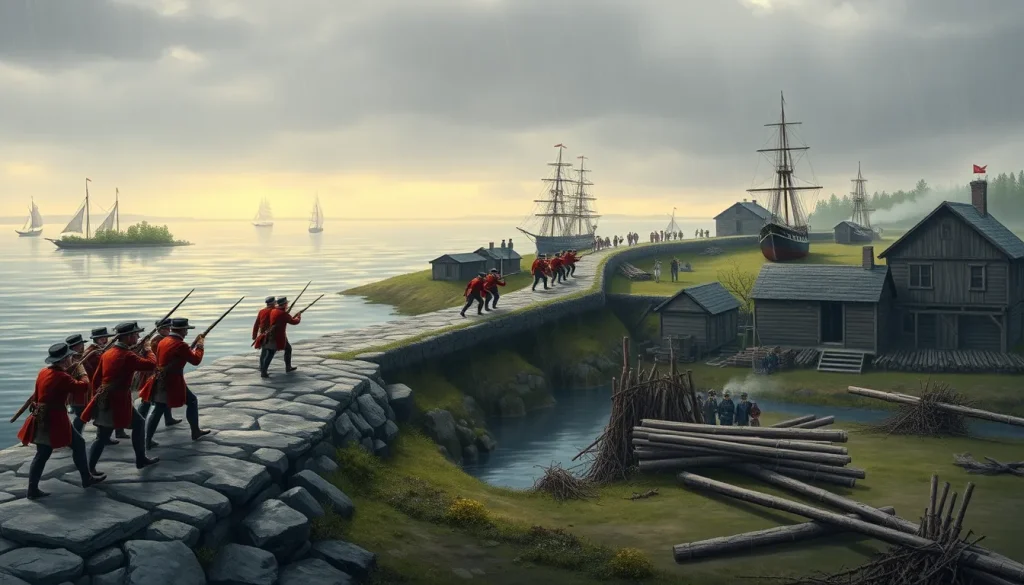
The landing began in the early morning of 29 May on and near Horse Island, roughly a mile west of the village. New York militia and volunteers posted near the shore fired on the approaching boats and inflicted some loss, but could not stop the landing, and the British regulars, once formed, pushed them back across the low causeway linking Horse Island to the mainland. The militia fell back in disorder; Brigadier General Jacob Brown, the senior American officer present, rallied them and the fighting continued against entrenched positions centred on three barracks buildings, supported by artillery and defended by United States regulars.
The British advance stalled. Contrary winds prevented most of Yeo’s squadron from closing to bombard the American works, leaving naval support to one schooner and two gunboats, and the attackers found themselves too few to carry the position. After roughly three hours of fighting, with casualties mounting and key officers down, Baynes asked Prevost for orders, and Prevost, unwilling to risk his force being cut off or caught between the shore defences and Chauncey’s returning squadron, ordered a withdrawal to the boats and back across Horse Island.
Before the attack ended, panicked Americans in the navy yard set fire to storehouses and to the General Pike on the stocks. The fires were extinguished and the ship was saved, but the destruction of naval stores was costly — a self-inflicted loss that gave the raiders part of what they had come for.
Why It Matters
The immediate effect was the preservation of the American shipyard and of the General Pike, launched later that summer. The ship briefly gave the Americans an advantage on Lake Ontario before the British answered with new construction, and the naval arms race continued on an escalating scale. In the short term, however, the raid altered the campaign. Chauncey resolved to remain at Sackets Harbor until his new ship was complete, which separated the American squadron from the army on the Niagara peninsula. Prevost was then able to send Yeo with reinforcements to Burlington Bay; the combined British force struck the Americans after the Battle of Stoney Creek and helped drive them back to Fort George.
Historians differ over how to weigh these outcomes. John R. Grodzinski argues that the raid was a tactical failure but an operational success, and that its effects, combined with Stoney Creek, were decisive in saving Upper Canada from what may have been the Americans’ best opportunity of the war. Writers emphasising the American side, including the American Battlefield Trust’s site study by Constance Barone, treat the engagement primarily as a successful defence of a strategic base and a major lost opportunity for the British. The two readings are not incompatible: the raiders failed to take the base, yet the disruption they caused changed the timing and momentum of the 1813 campaign.
The battle also mattered to individual reputations. Prevost’s decision to withdraw was criticised in Britain and contributed to doubts about his leadership that persisted until his death in 1816. Brown’s conduct enhanced his standing and helped earn him a commission as a brigadier general in the regular army. For Indigenous communities the engagement illustrated divided and locally determined allegiances: about 40 First Nations warriors served with the British force, and the American Battlefield Trust notes evidence of other Indigenous people volunteering with United States troops.
Prelude
The raid grew directly out of the American attack on York on 27 April 1813 and the subsequent American amphibious campaign against Fort George, which drew Chauncey’s squadron and the bulk of the American field force to the Niagara end of Lake Ontario. British reconnaissance confirmed the absence of the American squadron from Sackets Harbor, leaving the shipyard, its stores, and the nearly completed General Pike as targets.
Forces and Commanders
The British and Canadian force numbered roughly 800 to 870, drawn from light companies of the Kingston garrison, including the 1st Foot (Royal Scots), the 104th New Brunswick Regiment, companies of the 8th Foot, and the Glengarry Light Infantry, together with about 40 First Nations warriors. Yeo commanded the naval flotilla; Baynes commanded the landing force; Prevost accompanied and directed the expedition overall.
The American defenders numbered roughly 1,200 to 1,500, of whom perhaps two-thirds were New York state militia and volunteers, including men from Albany, with the remainder United States regulars. Brown of the New York militia was the senior officer present. Sources credit the defence with about 17 guns, supported by shore batteries and Fort Madison.
Battlefield and Map Context
Sackets Harbor sits on the eastern shore of Lake Ontario in Jefferson County, New York. Horse Island lies about a mile west of the village, joined to the mainland by a low, in places submerged, natural rocky causeway that the attackers used both to advance and to withdraw. American defences included an abatis of felled trees around the approaches, earthworks, blockhouses, and batteries covering the water approach and the naval yard.
Battle Chronology
- 27 April 1813: American forces attack York, prompting the British counter-stroke.
- About midnight, 27 May 1813: The British expedition sails from Kingston; light winds slow it and an American schooner carries a warning to Sackets Harbor.
- 28 May 1813: Still short of the objective, the expedition captures a party of American reinforcements, reported at about 115 to 150 men; Baynes decides to continue.
- Early morning, 29 May 1813: Troops land on and near Horse Island; militia fire on the boats, then fall back across the causeway.
- Mid-morning, 29 May 1813: British columns advance on entrenched American positions around the barracks; naval support is limited by contrary winds.
- Late morning, 29 May 1813: After about three hours of fighting, Prevost orders a withdrawal; the raiders re-cross Horse Island to their ships. American defenders burn naval stores and set fire to the General Pike, but the fires are extinguished.
Casualties and Losses
Casualty figures vary by source and should be treated as approximate. One widely reproduced tabulation gives British and Canadian losses as 47 killed, 195 wounded, and 16 missing — roughly a third of the attacking force, a striking proportion for a raid of a few hours. The same tabulation gives American losses as 21 killed, 85 wounded, and 154 missing; the large number of missing probably reflects militia and volunteers who dispersed during the fighting rather than men captured or killed. The American Battlefield Trust gives total estimated casualties of about 307 American and 265 British and Canadian. The destruction of naval stores at the navy yard was a material loss not captured by personnel casualty returns.
Result
The raid failed in its central purpose: the shipyard was not destroyed, the General Pike was saved and later launched, and the attacking force withdrew. It is therefore conventionally described as an American victory, and Sackets Harbor remained the American naval and military headquarters on Lake Ontario.
Strategic Consequences
The strategic ledger was more mixed than the tactical result suggests. The raid interrupted the American shipbuilding programme, consumed stores the Americans could not easily replace, and helped pin Chauncey’s squadron at Sackets Harbor at the very moment when the army on the Niagara frontier needed naval support. That separation allowed Prevost to reinforce the British position at Burlington Bay and contributed to the American retreat from the peninsula after Stoney Creek. Contemporary British critics nonetheless faulted Prevost for not pressing the attack; later historians have defended the decision as prudent given the force available, the failure of naval gunfire support, and the risk of being cut off.
Primary Accounts
Two eyewitness texts are frequently cited. Brigadier General Jacob Brown’s report on the approach of the enemy fleet describes seeing a large number of boats and concluding that the British intended to land and storm the American works. Balthaser Kramer, a volunteer in the militia, wrote a short account within days of the action describing the battle beginning about four o’clock in the morning, the small number of volunteers engaged, their retreat from the island, and the resumption of fighting on the mainland. Both are terse, partial, and shaped by the writer’s own role; neither is a complete narrative of the engagement.
Battlefield Today
The Sackets Harbor Battlefield State Historic Site preserves the navy yard, the 1850s commandant’s house, and battleground acreage, and offers exhibits, guided and self-guided tours, and living-history interpretation. Horse Island, where the 1813 landing began, was acquired by the American Battlefield Trust and transferred to New York State Parks in 2019; the island’s terrain remains comparatively undisturbed. In 2007 the National Park Service’s American Battlefield Protection Program identified Sackets Harbor as a Priority I principal site, citing both its historical significance and its vulnerability. A monument to the British and Canadian dead, dedicated two hundred years after the battle, was recognised by Queen Elizabeth II in 2013.
Primary Sources
The principal contemporary American documents are Brigadier General Jacob Brown’s report of the action and the associated correspondence of Commodore Isaac Chauncey and Major General Henry Dearborn, much of which is printed in the Naval Historical Center’s documentary series The Naval War of 1812: A Documentary History. Balthaser Kramer’s brief volunteer’s account, written a few days after the fighting, survives as a rare enlisted man’s description and is quoted in modern site studies. On the British side, the dispatches and reports of Lieutenant General Sir George Prevost, Colonel Edward Baynes, and Commodore Sir James Lucas Yeo, together with Prevost’s correspondence with the Colonial Office, are the core official record; many are printed in William Wood’s Select British Documents of the Canadian War of 1812.
These sources must be read with care. Brown’s report was written to justify his deployment and conduct, and it exaggerates neither his own losses nor the enemy’s strength consistently. Prevost’s dispatches were addressed to superiors who were already sceptical of him and were composed with an eye to explaining the withdrawal. Official returns count soldiers but not the destruction of stores, and militia returns are unreliable because many men dispersed. No verified full transcript of every relevant dispatch is reproduced here; readers seeking exact wording should consult the published documentary editions or the originating archives in London and Ottawa.
Further Reading
- Patrick A. Wilder, The Battle of Sackett’s Harbour: 1813 (Nautical & Aviation Publishing Company of America, 1994).
- John R. Grodzinski, Defender of Canada: Sir George Prevost and the War of 1812 (University of Oklahoma Press, 2013).
- Robert Malcomson, Lords of the Lake: The Naval War on Lake Ontario, 1812–1814 (Naval Institute Press, 1998).
- Donald R. Hickey, The War of 1812: A Forgotten Conflict (University of Illinois Press).
- J. C. A. Stagg, The War of 1812: Conflict for a Continent (Cambridge University Press, 2012).
- William S. Dudley, ed., The Naval War of 1812: A Documentary History, Naval Historical Center.
- William Wood, ed., Select British Documents of the Canadian War of 1812, Champlain Society.
- Sackets Harbor Battlefield State Historic Site, New York State Parks, Recreation and Historic Preservation.
- American Battlefield Trust, battle and site articles on Sackets Harbor.
- The Canadian Encyclopedia, “Battle of Sackets Harbor” by John R. Grodzinski.
References
- American Battlefield Trust, “Sackets Harbor Battle Facts and Summary,” battlefields.org.
- Constance Barone, “Controlling the Waterways at Sackets Harbor,” Hallowed Ground Magazine, American Battlefield Trust.
- John R. Grodzinski, “Battle of Sackets Harbor,” The Canadian Encyclopedia.
- New York State Parks, Recreation and Historic Preservation, “Sackets Harbor Battlefield State Historic Site.”
- “Battle of Sackets Harbor,” thewarof1812.org, battle entry citing Hickey, Lambert, and Latimer.
- Patrick A. Wilder, The Battle of Sackett’s Harbour: 1813 (1994).
- Robert Malcomson, Lords of the Lake: The Naval War on Lake Ontario, 1812–1814 (1998).
- William S. Dudley, ed., The Naval War of 1812: A Documentary History, Naval Historical Center.
FAQ
Who won the Battle of Sackets Harbor in 1813?
The engagement is conventionally counted as an American victory. The British and Canadian landing force under Colonel Edward Baynes withdrew after about three hours of fighting and failed to destroy the shipyard or the warship under construction. However, American defenders burned naval stores and set the ship on fire themselves before the fires were put out, so the raiders achieved part of their objective.
Why did the British attack Sackets Harbor?
Sackets Harbor was the main United States naval base and shipyard on Lake Ontario. After the American raid on York in April 1813, the British at Kingston learned that Commodore Isaac Chauncey's squadron had moved to the Niagara end of the lake, leaving the base weakly held. The British aimed to relieve pressure on their own forces and to destroy naval stores and the nearly completed corvette General Pike.
Is the Battle of Sackets Harbor the same as the 1812 action there?
No. A naval exchange took place off Sackets Harbor on 19 July 1812, sometimes called the First Battle of Sackets Harbor. The engagement of 29 May 1813, sometimes called the Second Battle of Sackets Harbor, was a larger combined land and naval raid on the base itself.



Leave a Reply