
Short Answer
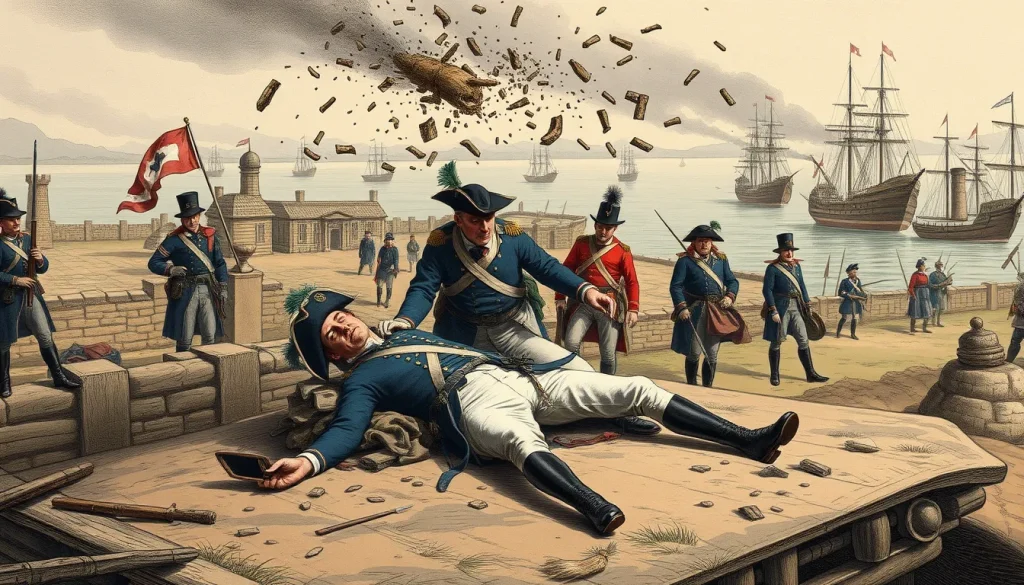
The death of Brigadier General Zebulon Pike at the Battle of York on 27 April 1813 came at the moment of an American tactical victory. Pike, the ranking U.S. land commander in the raid on York (present-day Toronto), was mortally wounded by debris from a massive magazine explosion. His death removed a senior officer from the northern theater, inflamed American troops, and contributed to the burning of Upper Canada’s public buildings, which British officials later cited to justify the burning of Washington in 1814. Its direct effect on the American war effort was therefore less a collapse of strategy than a sharp, consequential loss of leadership and an escalation of retaliation.
Historical Context
By early 1813, the United States had suffered a series of reverses in the northern theater. An attempted invasion of Canada had ended in the surrender of Detroit in August 1812; another American force was defeated at Queenston Heights in October; and the River Raisin disaster in January 1813 left hundreds of American prisoners dead. Control of Lake Ontario became essential to any successful American campaign against Upper Canada. President James Madison’s new secretary of war, John Armstrong Jr., worked with Major General Henry Dearborn and Commodore Isaac Chauncey to build a squadron at Sackets Harbor, New York. The original target was Kingston, the main British dockyard on the lake, but Dearborn and Chauncey concluded that Kingston was too strongly defended. They shifted their attention to York, the capital of Upper Canada, where the British were building the 24-gun corvette HMS Sir Isaac Brock. Capturing or destroying that ship and seizing military stores could restore American honor and improve the U.S. position on the lake. York was defended by Major General Roger Hale Sheaffe with a mixed force of British regulars, Canadian militia, and Ojibwe and Mississauga warriors. The Americans assembled about 1,700 regulars under Brigadier General Zebulon Pike, supported by Chauncey’s squadron.
What Happened
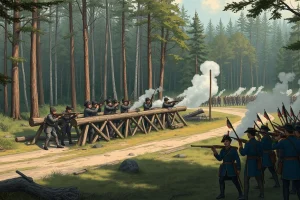
On the morning of 27 April 1813, American troops landed west of York under covering fire from Chauncey’s ships. Pike’s force advanced eastward against Sheaffe’s outnumbered defenders. The British regulars, militia, and Indigenous warriors fought a withdrawal through the woods and along the shoreline, but they could not stop the American advance. As the British position became untenable, Sheaffe ordered a retreat toward Kingston, leaving much of the militia and the civilian population to their fate. During the American approach to Fort York and the surrounding defenses, a massive explosion destroyed the main magazine. Whether the blast was deliberately set by the retreating British or occurred accidentally has never been conclusively established. Contemporary British accounts generally described it as an accident, while some American sources alleged deliberate sabotage. The explosion killed or wounded more than 200 Americans and mortally wounded Pike, who was struck by falling debris and died later that day after being taken to the American squadron. Commonly cited casualty figures place American losses at about 55 killed and 265 wounded, including Pike, while British and allied losses were about 82 killed, 112 wounded, and 274 captured. Command on the American side devolved to senior regimental officers, including Colonel Cromwell Pearce. In the days that followed, American troops occupied York, burned the parliament buildings and other public structures, and looted private property and the town library. The Americans withdrew after several days, having destroyed the unfinished HMS Sir Isaac Brock and captured some stores, though less than they had hoped.
Why It Matters
Pike’s death mattered immediately because it removed the ranking American land commander during a successful but chaotic operation. The explosion that killed him also caused the single heaviest concentration of American casualties at York, and the shock and anger among the troops contributed to the subsequent burning and looting of the town. In the longer term, the destruction of York’s public buildings became a central British justification for the burning of Washington in August 1814. British officers, including Major General Robert Ross and Rear Admiral George Cockburn, pointed to American conduct at York, along with the later destruction of Newark (Niagara-on-the-Lake), as reason for retaliation. Pike’s death thus became part of a cycle of escalation that shaped the war’s final year. At the same time, the American raid itself succeeded in its immediate military objectives. The loss of Pike did not prevent the capture of York or the destruction of the warship under construction. The question is therefore not whether his death caused an American defeat, but how far it altered command, discipline, strategy, and memory.
Definition
In this context, the death of Zebulon Pike at York refers to his mortal wounding on 27 April 1813 during the American raid on the capital of Upper Canada. The question asks how that specific event affected the broader American war effort, including military command, morale, discipline, recruitment, strategy on the Niagara and Lake Ontario frontiers, and the war’s escalating cycle of retaliation. It does not assume that Pike’s death alone determined the outcome of the campaign.
Background
Zebulon Pike was a career U.S. Army officer and explorer, known for expeditions to the upper Mississippi and the Southwest. By 1813 he had been promoted to brigadier general and given command of the land force for the York operation. He was 34 years old and eager for military distinction. The American northern command was already troubled by Dearborn’s poor health and indecision, so Pike represented one of the more energetic senior officers available. His death therefore removed a commander who might have played a larger role in the 1813 campaign along the Niagara frontier and Lake Ontario.
How It Worked
The magazine explosion killed Pike and many of his soldiers at the moment when American troops were pressing toward the British defenses. Because Pike was the senior land commander, his death created a sudden vacuum at the top of the American force. Subordinate regimental commanders, including Colonel Cromwell Pearce, had to restore order and complete the occupation. The explosion also produced intense anger. Whether or not the British deliberately detonated the magazine, many American soldiers believed they had been victims of treachery. That belief, combined with the shock of Pike’s death, helped produce the indiscipline that followed. The burning of the parliament buildings and the looting of York were not simply random acts; they occurred in an atmosphere inflamed by the explosion and the loss of the commanding general. The military effect was thus twofold: a temporary command crisis and a breakdown in restraint.
Competing Viewpoints
Historians differ on how much Pike’s death actually changed the American war effort. One interpretation emphasizes continuity: the raid achieved its objectives, the Americans withdrew as planned, and the loss of one brigadier general did not alter the broader strategic balance. From this view, the burning of York and the later burning of Washington were products of established retaliation policies and the nature of the war, not of Pike’s death alone. Another interpretation stresses the significance of Pike’s removal. It deprived the northern army of a capable and aggressive officer at a time when leadership was scarce. His death also inflamed American public opinion and contributed directly to the destruction at York, which British leaders later used to justify the burning of Washington. Some historians also argue that the indiscipline after his death damaged American claims to moral superiority and gave Britain a powerful propaganda weapon. The disagreement is partly about causation: was Pike’s death a decisive turning point or an emotional and symbolic event within a larger pattern?
Role in the War of 1812
Pike’s death occurred during one of the few clear American land victories of 1813. It did not stop the U.S. campaign on Lake Ontario, but it removed a general who might have led subsequent operations with more energy than Dearborn. The Niagara campaign later in 1813 produced mixed results, including American successes at Fort George but also setbacks at Stoney Creek and Beaver Dams. It is impossible to know how Pike would have performed, but his absence left a gap in the senior leadership. More concretely, the burning of York’s government buildings became part of the legal and rhetorical basis for British retaliation. When British forces entered Washington in August 1814, they explicitly cited the destruction of York and Newark. In that sense, Pike’s death indirectly affected the American war effort by helping to trigger a cycle of destruction that reached the U.S. capital.
Consequences and Historical Interpretation
The most immediate consequence of Pike’s death was the loss of a senior commander and the heavy casualties from the magazine explosion. The most enduring consequence was the escalation of retaliatory warfare. American troops burned Upper Canada’s parliament buildings after his death, and British forces later burned Washington. Pike himself became a martyr in American memory, his death used to illustrate both the cost of victory and alleged British treachery. Yet the strategic effect on the American war effort was limited. The United States did not lose the Battle of York, and the raid did not prevent later operations. Pike’s death did not change the outcome of the war. It did, however, weaken American leadership in the northern theater, contribute to a breakdown in discipline, and deepen the cycle of destruction that marked the conflict’s later years. Historians continue to debate how much weight to give his death compared with broader factors such as command failures, logistics, and British retaliation policy.
Primary Sources
Contemporary evidence for Pike’s death and its aftermath comes from several types of sources. Commodore Isaac Chauncey’s official report to the Secretary of the Navy, written in late April 1813, describes the naval support and the explosion, though it focuses on the fleet’s role. Major General Henry Dearborn’s correspondence with Secretary of War John Armstrong provides the American army perspective, including casualty reports and the decision to withdraw. British Major General Roger Hale Sheaffe’s report to Governor General Sir George Prevost defends his retreat and describes the explosion, generally treating it as an accident. American newspapers reprinted letters, casualty lists, and eyewitness accounts that emphasized Pike’s death and the alleged treachery of the British. These accounts must be used carefully: they were often written quickly, shaped by patriotism, and based on incomplete information. British and Canadian accounts sometimes minimize the destruction at York or justify it as retaliation for earlier American actions. No single source gives a complete or neutral picture, and the cause of the magazine explosion remains disputed.
Further Reading
- Donald R. Hickey, The War of 1812: A Forgotten Conflict.
- Andrew Lambert, The Challenge: Britain Against America in the Naval War of 1812.
- Jon Latimer, 1812: War with America.
- Alan Taylor, The Civil War of 1812.
- J.C.A. Stagg, The War of 1812: Conflict for a Continent.
- Pierre Berton, The Invasion of Canada, 1812-1813.
- Jeremy Black, The War of 1812 in the Age of Napoleon.
- David S. Heidler and Jeanne T. Heidler, eds., Encyclopedia of the War of 1812.
- Library and Archives Canada, War of 1812 records and British military correspondence.
- William L. Clements Library, University of Michigan, War of 1812 manuscript collections.
References
- The War of 1812, ‘Raid on York – War of 1812,’ https://thewarof1812.org/battles/raid-on-york/.
- World History Encyclopedia, ‘Battle of York,’ https://www.worldhistory.org/article/2582/battle-of-york/.
- Donald R. Hickey, The War of 1812: A Forgotten Conflict (Urbana: University of Illinois Press, 1989).
- Andrew Lambert, The Challenge: Britain Against America in the Naval War of 1812 (London: Faber and Faber, 2012).
- Jon Latimer, 1812: War with America (Cambridge, MA: Harvard University Press, 2007).
- Alan Taylor, The Civil War of 1812 (New York: Knopf, 2010).
- J.C.A. Stagg, The War of 1812: Conflict for a Continent (Cambridge: Cambridge University Press, 2012).
- Pierre Berton, The Invasion of Canada, 1812-1813 (Toronto: McClelland & Stewart, 1980).
- Jeremy Black, The War of 1812 in the Age of Napoleon (Norman: University of Oklahoma Press, 2009).
FAQ
Did Zebulon Pike's death cause the United States to lose the Battle of York?
No. The Americans won a tactical victory at York and achieved their main objectives, including destroying the unfinished HMS Sir Isaac Brock. Pike's death created a command crisis and contributed to indiscipline, but it did not reverse the outcome of the raid.
How did Pike's death affect American leadership in the War of 1812?
Pike was the ranking U.S. land commander at York and one of the more energetic senior officers in the northern theater. His death removed him from the 1813 campaign and left a gap in a command structure already hampered by Major General Henry Dearborn's poor health and indecision.
What was the connection between Pike's death and the burning of Washington in 1814?
After Pike was mortally wounded by the magazine explosion, American troops burned York's parliament buildings and other public structures. British commanders later cited the destruction of York and Newark as justification for burning Washington in August 1814. Pike's death thus contributed indirectly to the escalation of retaliatory warfare.


Leave a Reply