
Short Answer
The Battle of New Orleans, fought on January 8, 1815, was a major engagement of the War of 1812 that occurred after diplomats had signed the Treaty of Ghent on December 24, 1814, but before the treaty had been ratified by both governments. Because the treaty explicitly stated that hostilities would cease only after ratification, the war was still legally in progress. This article explores the diplomatic, logistical, and communication factors that made the battle possible despite a peace agreement existing on paper.
Historical Context
The War of 1812 had raged since June 1812, pitting the United States against Great Britain over issues such as impressment, trade restrictions, and British support for Indigenous resistance to American expansion. By 1814, Britain had defeated Napoleon in Europe and turned its full military attention to North America. British leaders saw an opportunity to strike a decisive blow against the United States, and they targeted New Orleans, the great port city at the mouth of the Mississippi River, as a strategic prize that would control the river trade and limit American westward expansion.
Peace negotiations had been underway at Ghent (modern-day Belgium) since August 1814. Both sides were weary, and the talks produced a treaty on December 24, 1814. The treaty called for the cessation of hostilities and the restoration of pre-war boundaries, but it specified that fighting would end only following ratification by both the United States and Great Britain. Great Britain ratified the treaty on December 27, 1814, but the document had to cross the Atlantic to reach Washington, D.C., for the U.S. Senate to approve. Transatlantic travel in that era took several weeks, and news of the peace did not reach the Gulf Coast in time to stop the military campaign.
What Happened
Late in 1814, British Vice-Admiral Sir Alexander Cochrane assembled an invasion force at Jamaica and sailed toward Louisiana. On December 14, 1814, British sailors defeated American gunboats on Lake Borgne, an estuary east of New Orleans. British troops then landed below the city and advanced toward it. Major General Andrew Jackson, commanding American forces, declared martial law in New Orleans and moved to block the British advance. On December 23, Jackson launched a surprise night attack on British troops camped at Villere Plantation, and after a fierce fight he withdrew to a stronger defensive line along the Rodriguez Canal near Chalmette Plantation.
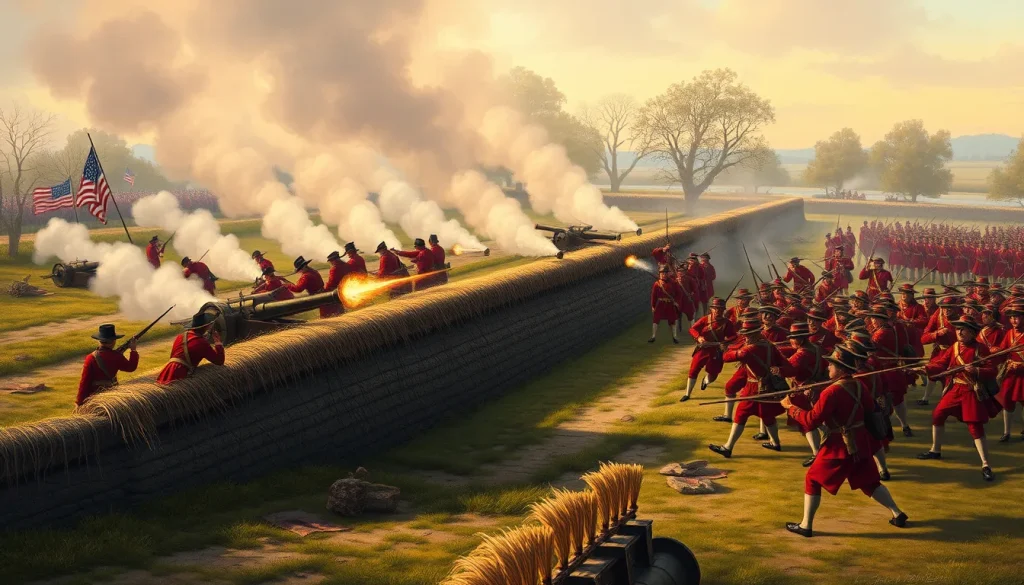
The British army, commanded by Lieutenant General Sir Edward Pakenham, arrived and attempted several approaches. After a skirmish on December 28 and an artillery duel on January 1, Pakenham ordered a full-scale assault on January 8, 1815. The British attacked Jackson’s fortifications, but the American defenders, firing from behind earthworks with artillery support, inflicted devastating casualties. Pakenham was killed and his force lost about 2,000 men in the space of twenty minutes. The British withdrew and left the area on January 18, abandoning the campaign. The battle was a decisive American victory.
Meanwhile, the Treaty of Ghent had been signed on December 24, but it was not ratified by the U.S. Senate until February 16, 1815, and peace was proclaimed on February 18. Therefore, the Battle of New Orleans was fought while the two nations were still technically at war. Even after the main battle, small actions continued, including a British attack on Fort Bowyer in Mobile Bay in February 1815, which occurred after the battle but before official peace.
Why It Matters
The Battle of New Orleans is significant because it gave Americans a major victory that boosted national pride and enhanced Andrew Jackson’s reputation, helping him win the presidency in 1828. However, in terms of the war’s outcome, it had no direct effect on the Treaty of Ghent, which largely restored the pre-war status quo. The battle has become a celebrated event in American memory, but it also reveals important aspects of early 19th-century warfare and diplomacy—especially the slow pace of communication and the legal complexities of concluding a war. The myth that the battle was fought after the war ended is widespread, but in fact the war was not over until the treaty was ratified. This distinction matters for understanding the legal definition of war and the challenges of enforcing peace agreements without instant communication.
Definition
The Battle of New Orleans occurred on January 8, 1815, after the signing of the Treaty of Ghent but before its ratification by both nations. Because the treaty stipulated that hostilities would cease only upon ratification, the battle took place while the war was still legally in progress.
Background
The Treaty of Ghent was signed on December 24, 1814, by American and British commissioners. The treaty’s terms included the restoration of territories captured during the war and the establishment of a commission to settle boundary disputes. Crucially, Article 1 stated that “all hostilities, both by sea and land, shall cease and terminate” only after the treaty’s ratification and the exchange of ratifications between the two governments. Therefore, the official end of the war did not occur until both nations had formally approved and exchanged the document.
Great Britain ratified the treaty on December 27, 1814, but the U.S. Senate did not approve it until February 16, 1815, after receiving the document on February 14. In the interval, the British military campaign against New Orleans continued, as did all other military operations.
How It Worked
The ratification process required the treaty to be delivered to Washington, D.C., from Ghent. The British copy arrived in late January, but the American copy was still in transit. The U.S. Senate received the treaty on February 14, debated it, and approved it unanimously on February 16. President James Madison signed the ratification, and the two nations exchanged the documents, completing the process. Until that exchange, neither the United States nor Britain was legally obligated to stop fighting. Communication across the Atlantic took several weeks, so commanders in the field, particularly those in the isolated Gulf Coast region, had no knowledge of the treaty or its status.
Competing Viewpoints
Historians generally agree that the Battle of New Orleans occurred because of the lag between the signing of the treaty and its ratification. However, there are differing interpretations about the battle’s broader significance. Some emphasize it as a heroic episode that proved American military capability, while others point out that it had no effect on the war’s outcome and was essentially a unnecessary bloodshed after peace had been negotiated. Another viewpoint stresses that British military leaders were aware of the peace negotiations but chose to continue the campaign, either to gain a bargaining advantage or because they received orders that arrived too late. Still, the official legal interpretation is clear: the war continued until ratification, and the battle was a lawful military engagement.
Role in the War of 1812
The Battle of New Orleans was the largest and bloodiest battle of the War of 1812. It secured control of the Mississippi River for the United States and ended British plans for a major invasion of the American South. In the broader context of the war, it was the last major engagement, though smaller actions continued until the peace proclamation. The battle also solidified Andrew Jackson’s reputation as a military leader and contributed to the American public’s perception that the nation had won the war, even though the treaty merely restored the status quo.
Consequences and Historical Interpretation
The immediate consequence of the battle was a decisive American victory, with heavy British casualties and relatively few American losses. The psychological impact was enormous: Americans celebrated the “Eighth of January” as a national holiday for decades. Jackson leveraged his fame into a political career, becoming president in 1828. Historians have since debunked several myths, such as the idea that the battle occurred after the war had officially ended (it had not), that Kentucky riflemen won the day (actually artillery and regular troops were decisive), and that Jean Lafitte was a battlefield hero (he was present but his exact role is exaggerated). The battle is now studied as an example of the importance of logistics, intelligence, and defensive warfare, as well as the challenges of ending hostilities in an era without instantaneous communication.
Primary Sources
Key primary sources include the Treaty of Ghent itself, which clearly states the condition of ratification. Andrew Jackson’s official report to the Secretary of War, dated January 9, 1815, describes the battle and his perspective on the American victory. Additionally, Edward Pakenham’s letters and British military orders provide the British viewpoint. These sources must be read with an understanding of the authors’ perspectives and the limitations of contemporaneous information. For example, Jackson’s report praises his troops but was also written to boost morale and justify his actions. The Treaty of Ghent is a formal legal document and the most authoritative source for determining the war’s end date.
Further Reading
- Hickey, Donald R. The War of 1812: A Forgotten Conflict. University of Illinois Press, 1989.
- Remini, Robert V. The Battle of New Orleans. Viking, 1999.
- Smith, Gene A. “The Battle of New Orleans and the Treaty of Ghent” in The Journal of Military History.
- U.S. Army Center of Military History. The Battle of New Orleans, 1815.
References
- Army historian corrects myths on Battle of New Orleans’ 200th anniversary, The United States Army, https://www.army.mil/article/140876/army_historian_corrects_myths_on_battle_of_new_orleans_200th_anniversary
- War of 1812 – Causes, Battles, Aftermath, Britannica, https://www.britannica.com/event/War-of-1812/Final-stages-of-the-war-and-the-aftermath
- Battle of New Orleans: The Last Battle of the War of 1812, American Battlefield Trust, https://www.battlefields.org/learn/articles/battle-new-orleans-last-battle-war-1812
- 6 Myths About the Battle of New Orleans, HISTORY, https://www.history.com/articles/6-myths-about-the-battle-of-new-orleans-3
- Battle of New Orleans: War of 1812 & Andrew Jackson, HISTORY, https://www.history.com/articles/battle-of-new-orleans
FAQ
Was the War of 1812 officially over when the Battle of New Orleans was fought?
No. The Treaty of Ghent had been signed on December 24, 1814, but it specified that hostilities would cease only after both nations ratified it. The U.S. Senate did not ratify until February 16, 1815, so the war was still legally in progress on January 8.
Why didn't the Treaty of Ghent stop the fighting immediately?
The treaty's terms required ratification by both the United States and Great Britain before a ceasefire took effect. Additionally, news of the signing and ratification took weeks to cross the Atlantic, so commanders in Louisiana had not received official notification.
Did the Battle of New Orleans affect the outcome of the war?
No. The Treaty of Ghent had already been negotiated, and its terms were not altered by the battle. The American victory, however, boosted national morale and made the war seem more successful to many Americans.



Leave a Reply