
Short Answer
The Battle of New Orleans, fought on January 8, 1815, near the Mississippi River, was the final major engagement of the War of 1812. Although a peace treaty had been signed in Ghent on December 24, 1814, it was not yet ratified, and the battle occurred before word of the treaty reached the combatants. The American victory under Major General Andrew Jackson over a British force commanded by Lieutenant General Edward Pakenham produced a dramatic disparity in national narratives: Americans celebrated it as a triumph of frontier militiamen over Wellington’s veterans, while British accounts emphasized blunders and the battle’s irrelevance to the war’s outcome. This article explains why these accounts differed so profoundly.
Historical Context
By late 1814, the War of 1812 had reached a stalemate. The British, having defeated Napoleon, redirected veteran troops to North America and launched a three-pronged offensive. One prong targeted New Orleans, a vital port controlling the Mississippi River trade. Andrew Jackson, fresh from his victory over the Creeks at Horseshoe Bend, commanded the American defenses in the Gulf region. British forces under Admiral Alexander Cochrane and General Edward Pakenham planned to seize the city, which would secure British control of the lower Mississippi and impede American expansion. The Treaty of Ghent, signed on Christmas Eve 1814, essentially restored pre-war boundaries, but news did not reach the armies. Both sides thus fought a battle with no bearing on the final peace terms.
What Happened
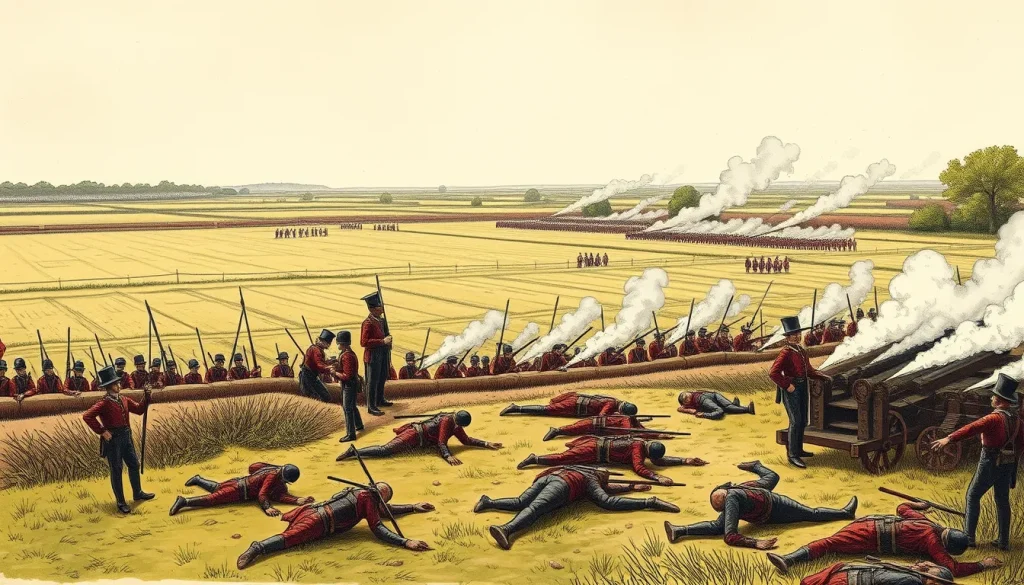
British forces first engaged American gunboats on Lake Borgne on December 14, 1814, securing a passage to the bayous. They landed troops on December 23, prompting Jackson to launch a night attack on the British camp. After several skirmishes and an artillery duel on January 1, 1815, Pakenham ordered a full-scale assault on January 8 against Jackson’s defensive line along the Rodriguez Canal, known as Line Jackson. The British columns advanced in the open against well-placed artillery and rifles, suffering catastrophic losses. The assault collapsed quickly, with Pakenham himself killed. British casualties numbered over 2,000, while American losses were fewer than 100. The British withdrew on January 18 and later captured Fort Bowyer, but news of the treaty arrived soon after, ending the war.
Why It Matters
The Battle of New Orleans had immense psychological and political consequences for the United States. It restored national pride after the humiliation of Washington’s burning and produced a new national hero in Andrew Jackson. The battle’s aftermath saw the rise of a powerful patriotic narrative that shaped American identity for decades, even as historians later deconstructed its myths. For Britain, the battle was a costly embarrassment, often downplayed or explained as an ill-conceived operation. The differing accounts reflect not only the outcomes but also the ways nations construct their histories.
Definition
British and American accounts of the Battle of New Orleans differ in emphasis, causation, and significance. American versions typically portray it as an underdog victory achieved by raw militia and frontier marksmen over elite British regulars, while British versions often attribute the defeat to faulty planning, poor coordination, and the strength of American fortifications. The divergence also stems from the battle’s timing relative to the Treaty of Ghent, which made it strategically irrelevant but symbolically potent.
Background
The divergence arose from multiple factors: national propaganda needs, the actual composition of forces, and the political ambitions of Andrew Jackson. American newspapers and songs, such as “The Hunters of Kentucky,” exaggerated the role of riflemen, ignoring the decisive contributions of artillery and regulars. The British, conversely, had no need to glorify a lost battle and often framed it as an anomaly, citing the inexperience of some regiments or the failure of diversionary attacks. Moreover, the treaty’s signing meant the battle was already strategically moot, leading British accounts to dismiss its importance.
How It Worked
Both sides constructed narratives that served their interests. The American narrative emphasized the nation’s martial vigor and justified the war’s outcome, making Jackson a national symbol. This narrative was propagated through official reports, newspapers, and popular culture. British narratives, in contrast, often appeared in official dispatches and later histories, which stressed the difficult terrain, the strong fortifications, and the failure of the naval support. The American emphasis on the battle as a decisive victory overshadowed the fact that the treaty had already ended the conflict.
Competing Viewpoints
Modern historians have largely debunked the myth of unschooled frontiersmen defeating Peninsular War veterans. The American line was strongly fortified, protected by artillery, and anchored by natural obstacles. The British assault was poorly executed; the scaling ladders were mislaid, and the diversionary attack on the west bank failed to materialize in time. Some British regiments had not served under Wellington. Furthermore, the American regulars and artillery, not the Kentucky militia, did most of the damage. Yet the patriotic myth persisted, partly because Jackson himself encouraged it and later used it for political gain.
Role in the War of 1812
Strategically, the battle had no impact on the war’s outcome, as the Treaty of Ghent had already been signed. However, it shaped the American perception of the war as a victory, masking the fact that the conflict was essentially a draw. The battle also reinforced British reluctance to continue the war and contributed to the establishment of relatively peaceful U.S.-British relations in the following decades. The differing accounts influenced diplomatic posturing and national narratives on both sides of the Atlantic.
Consequences and Historical Interpretation
The differing accounts of the battle have had lasting effects on historical memory. In the United States, the battle became a symbol of exceptionalism and military prowess, fueling westward expansion and national pride. In Britain, it was a minor episode in a larger global conflict, often omitted from histories. Historians now recognize the battle as a tactical masterpiece by Jackson but also acknowledge that the American victory was facilitated by British bungling and the strength of defensive works. The persistence of myths, such as the Kentucky riflemen and the pirate Jean Lafitte, underscores the power of national narratives to shape historical understanding.
Primary Sources
Key American primary sources include Andrew Jackson’s official report to the Secretary of War dated January 9, 1815, which praised his troops but omitted the flight of some militia; he later criticized the Kentucky militia, contradicting his earlier praise. British sources include the court-martial of Colonel Thomas Mullins for failing to bring ladders and fascines, and the dispatch of Admiral Cochrane, which attributed the defeat to unexpected defenses. Contemporary newspaper accounts from both nations offer partisan views. The memoirs of Major A. Lacarriere Latour, an American engineer, provide a detailed account, albeit with patriotic bias.
Further Reading
- Robert V. Remini, The Battle of New Orleans (New York: Viking, 1999).
- Donald R. Hickey, The War of 1812: A Forgotten Conflict (Urbana: University of Illinois Press, 1989).
- Andrew Jackson, Official Report, January 9, 1815, in The Papers of Andrew Jackson, vol. 4.
- Jean Lafitte National Historical Park and Preserve, National Park Service – resources on the battle.
References
- Douglas Brown, “Battle of New Orleans, 1815,” warof1812.ca. Retrieved from https://www.warof1812.ca/battle-of-new-orleans-1815.htm
- Christopher Klein, “6 Myths About the Battle of New Orleans,” HISTORY.com, 2015. Retrieved from https://www.history.com/articles/6-myths-about-the-battle-of-new-orleans-3
- David Vergun, “Army historian corrects myths on Battle of New Orleans’ 200th anniversary,” U.S. Army, 2015. Retrieved from https://www.army.mil/article/140876/army_historian_corrects_myths_on_battle_of_new_orleans_200th_anniversary
- “Battle of New Orleans,” HISTORY.com Editors, 2009. Retrieved from https://www.history.com/articles/battle-of-new-orleans
FAQ
Was the Battle of New Orleans fought after the war ended?
The Treaty of Ghent was signed on December 24, 1814, but not ratified until February 16, 1815. The battle occurred on January 8, 1815, so legally the war was still ongoing despite the treaty's signing.
Why did American accounts exaggerate the role of Kentucky riflemen?
Popular songs and political propaganda, such as 'The Hunters of Kentucky,' elevated the militia's contribution to support Andrew Jackson's political career and national pride, though actual damage was largely from artillery and regulars.
Why did British accounts downplay the defeat?
The British saw the battle as strategically irrelevant since peace had been agreed, and they attributed the loss to tactical errors and strong defenses rather than inferiority of their troops.



Leave a Reply