
Short Answer
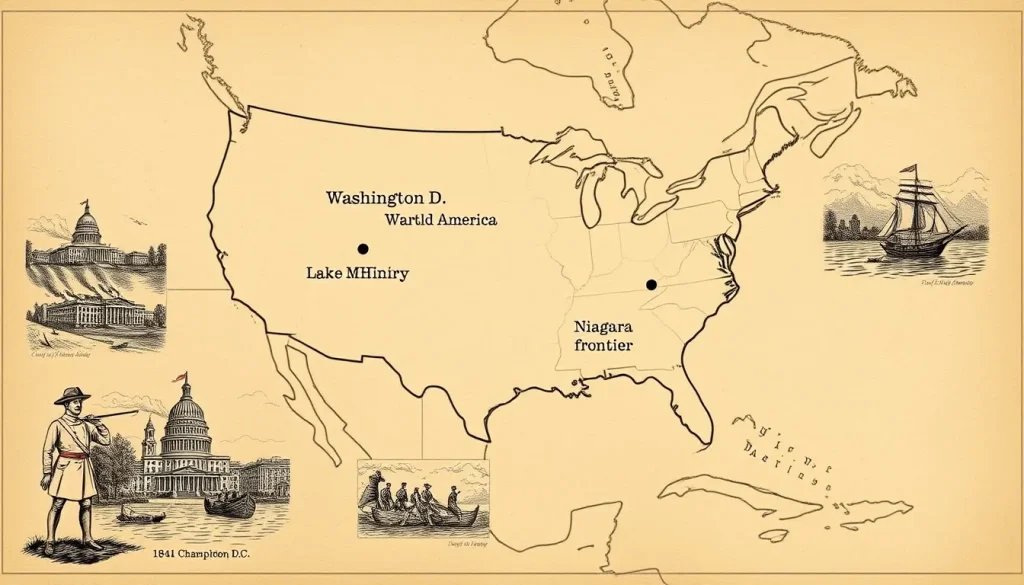
The War of 1812, though named for its first year, reached several of its most decisive points in 1814. This year saw the culmination of the conflict’s military operations, including the British capture and burning of Washington, D.C., the fierce Niagara campaign, the naval battle on Lake Champlain, and the eventual negotiation of the Treaty of Ghent that ended the war. The events of 1814 shaped the conflict’s outcome and its lasting memory in the United States, Britain, and Canada.
Historical Context
By 1814, the War of 1812 had reached a critical juncture. The United States had declared war on Britain in 1812, partly due to impressment and trade restrictions, and had made unsuccessful attempts to invade Canada. The British, preoccupied with the Napoleonic Wars, had largely fought a defensive war, but the spring of 1814 saw Napoleon’s first abdication, allowing Britain to transfer veteran troops and naval resources to North America. The American military had gained experience, but also suffered from internal discord and financial strain. The British enforced a tightening blockade of the American coast, and both sides sought to gain advantage before peace negotiations began in Ghent.
What Happened
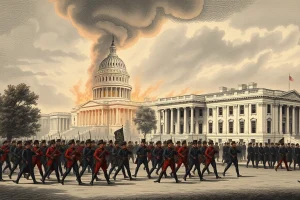
The year’s major events unfolded on multiple fronts. In the spring and early summer, American forces launched renewed campaigns on the Niagara frontier. Under Major General Jacob Brown, with brigadiers Winfield Scott and others, they captured Fort Erie on July 3 and defeated the British under Phineas Riall at the Battle of Chippawa on July 5. A subsequent engagement at Lundy’s Lane on July 25 was a bloody and inconclusive battle, but the Americans withdrew to Fort Erie and eventually retreated across the Niagara River in November. Meanwhile, British forces, now bolstered by veterans from Europe, conducted a campaign in the Chesapeake Bay region. In August, a British army under Robert Ross and Admiral George Cockburn landed in Maryland and defeated American militia at the Battle of Bladensburg on August 24. The British then entered Washington, D.C., and burned numerous public buildings, including the Capitol, the White House, and the Library of Congress. They subsequently attacked Baltimore, but the bombardment of Fort McHenry on September 13–14 failed, and the British withdrew. On the northern front, American naval forces under Thomas Macdonough defeated a British squadron at the Battle of Lake Champlain on September 11, forcing the British army advancing from Canada to retreat. In the far north, British forces occupied parts of Maine, and in the south, Andrew Jackson conducted campaigns against the Creek and later captured Pensacola. Ultimately, peace negotiations concluded with the signing of the Treaty of Ghent on December 24, which restored pre-war boundaries.
Throughout the year, the naval blockade tightened, affecting American trade and daily life. British raids along the coast, including the attack on Alexandria, Virginia, and the occupation of eastern Maine, highlighted British dominance at sea. At the same time, the American privateer and naval efforts, though limited, contributed to the strategic standoff. The spring had also seen raids and counter-raids, such as the American destruction of Port Dover and the British attack on Fort Oswego. The decisive campaigns, however, centered on the Niagara, Chesapeake, and Champlain regions.
Why It Matters
The events of 1814 were decisive in ending the war. The successful American defense at Baltimore and the naval victory on Lake Champlain strengthened the American negotiating position at Ghent, while the burning of Washington served as a humiliating setback and a rallying point for American nationalism. The Treaty of Ghent, signed in December 1814, effectively ended the war with no territorial changes, but it resolved none of the original grievances; instead, the end of the Napoleonic Wars removed many of those issues. The war’s conclusion, and the subsequent Battle of New Orleans (January 1815, after the treaty was signed but before it was ratified), created a sense of American triumph. Historians have interpreted 1814 as the turning point that forced both sides to seek peace, and the year’s events continue to shape national narratives in the United States, Canada, and Britain.
Definition
The War of 1812 in 1814 refers to the military and diplomatic events of that year, which comprised the final major campaigns of the conflict. A “year in review” approach focuses on the chronological progression of these events and their interconnections, examining how the campaigns on multiple fronts influenced each other and the peace negotiations.
Background
The war had seen three consecutive years of American attempts to invade Canada and British counter-offensives. By 1814, the American army had gained experienced officers like Jacob Brown and Winfield Scott, while the British, having defeated Napoleon, could deploy veteran regiments. The Royal Navy tightened its blockade, affecting the American economy. Both sides were also wearied by the cost of war, and peace talks had begun in Ghent in August 1814. The background to the 1814 campaigns includes the American strategy of attacking points in Canada to create bargaining chips, and the British desire to punish the United States and protect Canada.
How It Worked
The military operations of 1814 illustrate the interplay of land and naval power. The Niagara campaign demonstrated improved American discipline and tactics, as seen at Chippawa, but also the difficulty of maintaining supply lines and controlling territory. The Chesapeake campaign exploited British naval supremacy to land troops wherever coastal defenses were weak, and combined bombardment and maneuver to capture Washington. Conversely, the Battle of Lake Champlain showed how a decisive naval victory could stop a land invasion, as Macdonough’s victory forced the British army under Sir George Prevost to retreat. Diplomatically, the Treaty of Ghent emerged from a stalemate: neither side could achieve a decisive military advantage, and the negotiators agreed to a return to pre-war boundaries without settling the maritime issues.
Competing Viewpoints
Contemporary and modern interpretations differ sharply on the significance of 1814. American memory often celebrates the defense of Baltimore and the Battle of New Orleans, which restored national honor after the burning of Washington. British accounts tend to emphasize the destruction of Washington as a punitive retribution for American raids against Canadian towns, and often argue that the Royal Navy’s blockade crippled the American economy. Canadian historiography highlights the role of colonial militia and Indigenous allies in repelling invasions, particularly at Beaver Dams and elsewhere, and views the war as a precursor to Canadian nationhood. Historians also debate the relative importance of the Battle of Lake Champlain versus the Treaty of Ghent in ending the conflict, with some arguing that the American naval victory undermined British territorial ambitions and facilitated a status quo ante bellum.
Role in the War of 1812
The events of 1814 determined the war’s end. The British campaign against Washington and Baltimore strained the Royal Navy and army, while the failure at Lake Champlain and the costly stalemate on the Niagara frontier reduced British leverage. Meanwhile, American domestic sentiment, Federalist opposition (symbolized by the Hartford Convention), and fiscal strain pushed the Madison administration toward a negotiated peace. The Treaty of Ghent, signed on December 24, essentially ended the war with no territorial changes, and its ratification in 1815 brought a durable peace between the United States and Britain. Without the 1814 campaigns, neither side would have been willing to compromise, so the year’s events were pivotal in shaping the final outcome.
Consequences and Historical Interpretation
The long-term consequences of 1814 include the emergence of the United States as a respected military power, the development (in Canada and the United States) of national symbols and heroes such as Isaac Brock and Andrew Jackson, and the end of British support for Indigenous nations in the Old Northwest, which opened the door to westward expansion. Historians have reinterpreted the war in the context of a broader Atlantic conflict, noting that the British saw it as a sideshow to the Napoleonic Wars. The burning of Washington and the Star-Spangled Banner (written during the bombardment of Fort McHenry) have become enduring cultural touchstones. Modern scholarship emphasizes the role of Indigenous peoples and the war’s effects on their lands and sovereignty, as well as the internal American politics that made the war controversial. The 200th anniversary commemorations have revived interest, with new studies revisiting old assumptions about the war’s causes and results.
Primary Sources
Key primary sources for studying the War of 1812 in 1814 include the Treaty of Ghent itself, which is held in the National Archives of the United States and the British National Archives. Official dispatches from commanders such as Major General Jacob Brown, Lieutenant General Gordon Drummond, Commodore Thomas Macdonough, and Admiral George Cockburn provide detailed accounts of battles and strategies. Dolley Madison’s letters, including her famous correspondence about the rescue of George Washington’s portrait during the burning of the White House, offer a personal perspective. The diary of British officer James Scott, who served under Admiral Cockburn, describes the burning of Washington and the Baltimore attack. American newspapers of the time, such as the Niles’ Weekly Register, reported on events and public reactions. These sources must be read critically, as they reflect contemporary biases and propaganda.
Further Reading
- Donald R. Hickey, The War of 1812: A Forgotten Conflict (University of Illinois Press, 2012).
- Peter Snow, When Britain Burned the White House: The 1814 Invasion of Washington (John Murray, 2014).
- J.C.A. Stagg, The War of 1812: Conflict for a Continent (Cambridge University Press, 2012).
- The War of 1812 Bicentennial website (warof1812-bicentennial.info) offers a detailed chronology and primary documents.
- The Smithsonian Magazine article by Peter Snow, “Your Guide to the Three Weeks of 1814 That We Today Call the War of 1812,” provides a readable overview.
References
- Britannica, The Editors of Encyclopaedia. “War of 1812 – US-Britain, Causes, Outcome.” Britannica, accessed 2025. https://www.britannica.com/event/War-of-1812/War.
- Snow, Peter. “Your Guide to the Three Weeks of 1814 That We Today Call the War of 1812.” Smithsonian Magazine, August 21, 2014. https://www.smithsonianmag.com/history/your-guide-three-weeks-1814-we-today-call-war-1812-180952425/.
- “History: 1814 (and a little bit of 1815).” War of 1812 Bicentennial, accessed 2025. https://warof1812-bicentennial.info/history/1814.php.
- “1814 in the United States.” Wikipedia, accessed 2025. https://en.wikipedia.org/wiki/1814_in_the_United_States.
- History in the Margins. “1814: The Year in Review.” December 23, 2014. https://www.historyinthemargins.com/2014/12/23/1814-the-year-in-review/.
FAQ
What were the most significant events of the War of 1812 in 1814?
The most significant events included the Battle of Chippawa (July 5), the Battle of Lundy's Lane (July 25), the British burning of Washington, D.C. (August 24), the Battle of Lake Champlain (September 11), the failed British attack on Baltimore (September 13-14), and the signing of the Treaty of Ghent (December 24).
How did the burning of Washington affect the outcome of the war?
The burning of Washington was a military humiliation for the United States, but it also galvanized American resistance. It did not decisively change the strategic balance; both sides continued to fight until the Treaty of Ghent, which restored the status quo ante bellum.
Why was the Battle of Lake Champlain important in 1814?
The American naval victory at the Battle of Lake Champlain on September 11, 1814, prevented a British invasion from Canada and forced the British army to retreat. This victory strengthened the American negotiating position at the Ghent peace talks and helped ensure a return to pre-war boundaries.


Leave a Reply