
Short Answer
The Treaty of Ghent, signed on December 24, 1814, formally ended the War of 1812, but the war’s final armed clashes occurred after that date due to the slow transmission of news across the Atlantic and beyond. The most famous was the Battle of New Orleans on January 8, 1815, and the last naval action was the USS Peacock’s capture of the East India cruiser Nautilus on June 30, 1815. This article explains why these battles took place, how the treaty addressed the problem of communication delays, and why they remain significant in understanding the war’s conclusion.
Historical Context
By late 1814, both the United States and Great Britain were exhausted by years of conflict. The Napoleonic Wars in Europe were ending, freeing British resources, while the American economy suffered from blockade and trade disruption. Negotiations began at Ghent (in present-day Belgium) in August 1814. The American delegation—John Quincy Adams, Albert Gallatin, Henry Clay, Jonathan Russell, and James A. Bayard—faced British demands for a Native buffer state, territorial concessions, and acknowledgment of maritime rights. However, American victories at Plattsburgh and Baltimore in September 1814 strengthened the U.S. position, and British demands gradually softened. The treaty, signed on December 24, restored the status quo antebellum, with no mention of impressment or neutral rights, and established commissions for boundary disputes. Ratification processes took time: Britain ratified on December 27, 1814, and the U.S. Senate approved on February 16, 1815, with formal exchange on February 17. Crucial maritime regions were subject to specific time limits for the cessation of hostilities, as detailed in Article II of the treaty.
What Happened
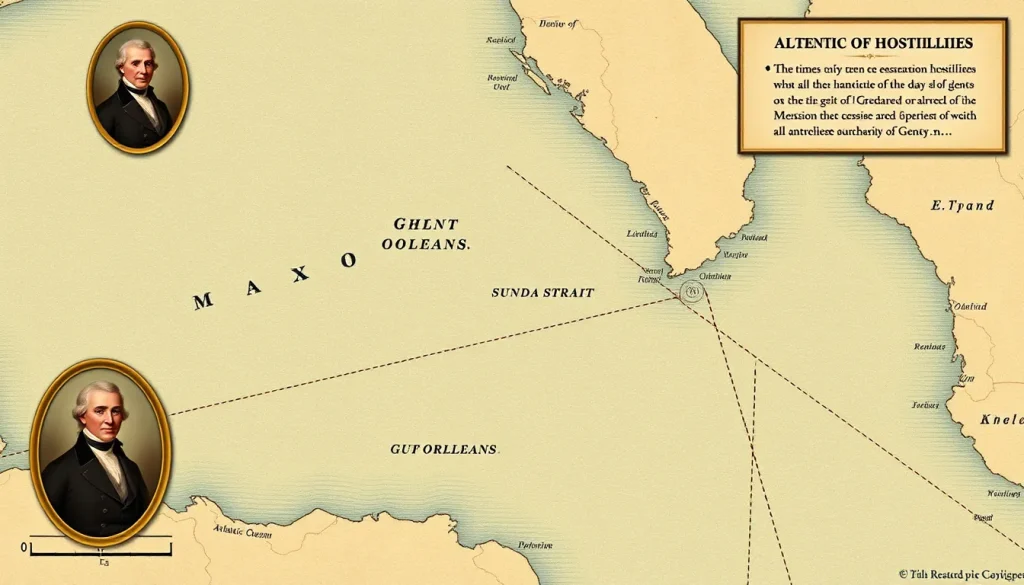
After the Treaty of Ghent was signed but before it was ratified by the United States, two significant military actions occurred. The Battle of New Orleans (January 8, 1815) saw Major General Andrew Jackson’s American forces decisively defeat a British army under Major General Edward Pakenham, who was killed. This engagement took place about two weeks after the treaty was signed, but news had not reached either side. A smaller action was the second Battle of Fort Bowyer in Alabama, fought February 8–12, 1815, where British forces captured the fort before the treaty took effect. After ratification on February 17, 1815, the USS Constitution captured the British frigates HMS Cyane and HMS Levant off Madeira on February 20, as the crews were unaware of the peace. The final naval action of the war occurred on June 30, 1815, when the USS Peacock, under Captain Lewis Warrington, encountered the East India Company brig Nautilus in the Sunda Strait. The British commander, Lieutenant Charles Boyce, informed Warrington of the treaty and its ratification, but Warrington suspected a ruse and attacked. After several casualties, Boyce produced documents confirming the peace, and Warrington released the surviving crew. This incident happened well beyond the 120-day grace period for the region, underscoring the limitations of wartime communication.
Why It Matters
These post-treaty battles shaped the war’s legacy. The Battle of New Orleans, though strategically unnecessary, became a symbol of American victory and propelled Andrew Jackson to national prominence. It also influenced the perception that the United States had won the war, despite the treaty’s restoration of the prewar status quo. The Peacock–Nautilus action highlighted the practical difficulties of implementing peace across vast distances, and the treaty’s Article II represented a diplomatic effort to mitigate those delays. Historians note that these actions had no effect on the treaty’s provisions or on the final territorial settlement, but they did affect public memory and the political careers of participants.
Definition
In the context of the War of 1812, “after the Treaty of Ghent” can mean either after its signing on December 24, 1814, or after its ratification and exchange on February 17, 1815. The treaty itself distinguished between these: it required both parties to send orders to cease hostilities immediately after ratification, and it set time limits—ranging from 12 to 120 days—for different maritime regions to allow for notification. Therefore, any military action that occurred after the signing but before the ratification, such as New Orleans, is technically “after the treaty” in a chronological sense, though the treaty was not yet in force. Actions after ratification, such as the Peacock–Nautilus fight, violated the spirit and letter of the agreement if they occurred after the grace period, as this one did.
Background
The Treaty of Ghent was negotiated against a backdrop of shifting military fortunes. After the American victories in September 1814, the British government, weary of war and facing domestic discontent, accepted the status quo antebellum. The treaty’s Article II was designed to prevent disputes over prizes taken after hostilities ended. It specified exact dates for different regions, reflecting the known travel times for orders and news. However, the effectiveness of these provisions depended on commanders receiving and heeding the information, which was not always the case, as the Peacock–Nautilus incident demonstrates.
How It Worked
Article II of the Treaty of Ghent stipulated that “all vessels and effects which may be taken after the space of twelve days from the said Ratifications upon all parts of the Coast of North America” should be restored, with longer periods for other areas—thirty days for the Atlantic north of the equator, forty for the West Indies, sixty for the Atlantic south of the equator, ninety for the Indian Ocean and other southern regions, and one hundred twenty days for all other parts of the world. These intervals were meant to allow news of the ratification to reach distant ships. In practice, the system relied on the assumption that commanders would learn of the peace within those windows. In the case of the Peacock and Nautilus, the battle occurred on June 30, 1815, more than 120 days after the ratification, so both should have known; the American captain’s skepticism led to an unnecessary loss of life.
Competing Viewpoints
Historians and commentators have offered different interpretations of these post-treaty actions. Some argue that the Battle of New Orleans, while fought after the treaty was signed, was a legitimate operation because the treaty had not yet been ratified and thus was not in effect; others contend that it was a pointless slaughter because the outcome was already determined. For the Peacock–Nautilus action, some defend Captain Warrington’s caution, given the possibility of a British trick, while others criticize his decision to open fire against a clearly outmatched vessel after being informed of the peace. The U.S. Navy court of inquiry later exonerated Warrington, but contemporary British accounts expressed outrage.
Role in the War of 1812
These final actions underscore the chaotic end of the War of 1812. The Battle of New Orleans was the largest land battle of the war and, despite its irrelevance to the treaty, it had a profound effect on American national identity. The Peacock–Nautilus engagement was the last armed conflict between the United States and Great Britain in the war, marking the conclusion of the naval conflict. The treaty’s provisions for staggered cessation were an initial attempt to manage such delays, but they could not account for human decision-making in remote theaters.
Consequences and Historical Interpretation
The post-treaty battles contributed to the divergent memories of the war in the United States and Britain. In America, Jackson’s victory at New Orleans led many to consider the war a win, obscuring the treaty’s failure to address the original causes. In Britain, the war was largely forgotten amid the greater struggle with Napoleon. Over time, historians have emphasized that these engagements did not alter the territorial settlement, but they did shape the political careers of figures like Jackson. The Peacock–Nautilus incident has been cited as an example of the challenges of pre-communications-era warfare, and it is often the final event listed in chronologies of the war.
Primary Sources
The Treaty of Ghent itself is the most critical primary source; its full text is available from the National Archives and online via OurDocuments.gov. For the Battle of New Orleans, Major General Andrew Jackson’s official report to Secretary of War James Monroe (dated January 9, 1815) provides an American account of the engagement; British perspectives come from the report of Major General Pakenham’s successor, Major General John Lambert. For the Peacock–Nautilus action, Captain Lewis Warrington’s letter of July 14, 1815, to the Secretary of the Navy describes the engagement and his justification, while Lieutenant Charles Boyce’s testimony to the British East India Company offers the British side. Each source carries the biases of its author and nation, and must be weighed against each other.
Further Reading
- Hickey, Donald R. The War of 1812: A Forgotten Conflict. University of Illinois Press, 1989.
- Stagg, J.C.A. The War of 1812: Conflict for a Continent. Cambridge University Press, 2012.
- Heidler, David S., and Jeanne T. Heidler, eds. Encyclopedia of the War of 1812. ABC-CLIO, 1997.
- NPS.gov – “Summer 1814: Americans and British open peace negotiations at Ghent.” U.S. National Park Service article.
- American Battlefield Trust – “The Treaty of Ghent: Ending the War of 1812.”
References
- Britannica, “War of 1812 – Final stages of the war and the aftermath,” https://www.britannica.com/event/War-of-1812/Final-stages-of-the-war-and-the-aftermath
- National Park Service, “Summer 1814: Americans and British open peace negotiations at Ghent,” http://nps.gov/articles/treaty-of-ghent-1.htm
- American Battlefield Trust, “The Treaty of Ghent: Ending the War of 1812,” https://www.battlefields.org/learn/articles/treaty-ghent-ending-war-1812
- National Park Service, “War’s End – Star-Spangled Banner National Historic Trail,” https://www.nps.gov/stsp/learn/historyculture/war-s-end.htm
- History Stack Exchange, “Why was the last battle of the War of 1812 fought fully half a year after the official end of the war?” https://history.stackexchange.com/questions/34706/
FAQ
Did the Battle of New Orleans occur after the Treaty of Ghent was signed?
Yes. It was fought on January 8, 1815, about two weeks after the treaty was signed on December 24, 1814, but before the U.S. Senate ratified it on February 16, 1815.
Why did the USS Peacock attack the Nautilus after the war was officially over?
Captain Lewis Warrington did not have reliable confirmation of the treaty's ratification and suspected a British ruse. He attacked after being told of the peace, then released the prisoners when shown documentary proof.
What did the Treaty of Ghent say about ending hostilities?
Article II required both parties to stop fighting immediately after ratification, but it provided extra time for news to reach distant naval forces, ranging from 12 to 120 days depending on the region.


Leave a Reply