
Short Answer
Why did Britain, a global power that had once governed the Thirteen Colonies, never attempt to reconquer the United States after 1783? The question is central to understanding the War of 1812 and the consolidation of American independence. This article examines the strategic, political, and economic reasons why Britain did not pursue reconquest, focusing on the War of 1812 as the final window of opportunity.
Historical Context
The American Revolution ended with the Treaty of Paris in 1783, but British resentment and hopes of reversing the loss lingered. In the decades that followed, Britain faced revolutionary and Napoleonic France, which consumed its military and financial resources. Meanwhile, the new United States struggled under the Articles of Confederation before adopting a stronger federal Constitution in 1789. British leaders, steeped in monarchical assumptions, widely believed that the American republic would fail and eventually seek a return to monarchy, making reconquest unnecessary. Moreover, after 1783 Britain found that trading with the independent United States was highly profitable without the administrative and military costs of colonial rule.
What Happened
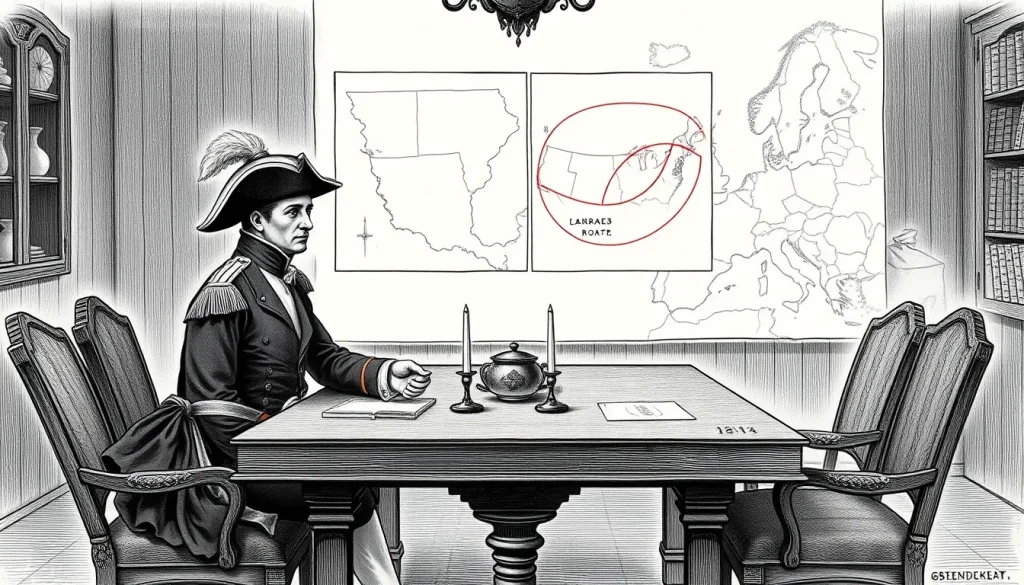
The War of 1812 (1812–1815) was the last time Britain could have realistically reconquered parts of the United States. The conflict arose from maritime grievances, impressment, and trade restrictions, as well as American frontier expansion. Britain, preoccupied with Napoleon, initially fought a defensive war in North America, but after Napoleon’s abdication in April 1814, it sent reinforcements to Canada and launched raids along the American coast, including the burning of Washington in August 1814. Yet the British war aim was never reconquest. Prime Minister Lord Liverpool sought only limited territorial gains, such as annexing parts of Maine (proposed as the colony of “New Ireland”) to secure better borders for Canada. At the peace negotiations in Ghent, Britain made no territorial demands, largely because redrawing Europe’s map after the Napoleonic Wars took priority. The Treaty of Ghent, signed December 24, 1814, restored the status quo ante bellum. The Battle of New Orleans, fought in January 1815 after the treaty was signed but before ratification, was a British attempt to strengthen their negotiating position, not a step toward reconquest.
Why It Matters
Britain’s refusal to attempt reconquest cemented American independence and allowed the United States to emerge as a continental power. It also shaped British strategic thinking: after 1815, London turned its attention to India, Africa, and the balance of power in Europe, treating North America as a secondary concern. The War of 1812 is sometimes called America’s “Second War of Independence” because it confirmed that Britain would not seek a return to colonial rule. Historians debate whether Britain ever seriously considered reconquest, but the consensus is that practical obstacles—the size of the territory, its hostile population, and the cost of occupation—made it impossible, even at the peak of British military strength in 1814.
Definition
In this context, reconquest refers to a British military campaign to re-establish sovereignty over the former Thirteen Colonies, either by force or through political collapse of the United States. This article uses the term to encompass any British plan, after 1783, to annex part or all of the United States.
Background
Britain’s initial post-Revolution stance was to wait for the American experiment to fail. The prevailing belief in Parliament, as noted by historian the narrator of a 2024 animated documentary, was that “monarchy was the most natural form of government and that as such, the new American Republic was doomed to failure.” This expectation was rooted in Britain’s own experience with republicanism in the 17th century. Additionally, Britain maintained lucrative trade with the US after independence, profiting from exports and imports without the costs of administration. When the French Revolutionary Wars began in 1793, Britain’s attention shifted to Europe, and any thought of reconquest faded into secondary importance.
How It Worked
Three strategic factors made reconquest impractical. First, geography: the United States was vast, and an occupying army would face immense supply and control problems. Second, population: the American people had demonstrated a capacity for resistance during the Revolution, and conquering a hostile, armed population would require a massive, expensive occupation. Third, global commitments: Britain’s empire and European interests demanded its fleet and army elsewhere. Even after Napoleon’s defeat, Britain’s army was demobilizing, and its leaders were focused on the Congress of Vienna and preserving the European settlement. These constraints meant that a full reconquest was never a realistic option; Britain lacked the resources and political will.
Competing Viewpoints
Historians disagree on the extent to which Britain ever considered reconquest. Some argue that Britain never took the idea seriously, viewing the United States as too big and too difficult to govern, and that the War of 1812 was merely a punitive expedition. Others point to Lord Liverpool’s proposal to annex Maine as evidence of limited territorial ambition, but not full reconquest. A third view holds that Britain’s belief in the republic’s inevitable collapse was genuine, so reconquest was deemed unnecessary. These interpretations are not mutually exclusive, and the evidence suggests that British policy evolved from hope of collapse to pragmatic acceptance of US independence.
Role in the War of 1812
The War of 1812 was the last realistic chance for Britain to gain US territory. British forces achieved notable victories, including the capture of Washington, D.C., and the successful defense of Canada. However, Britain’s war aims were limited: to protect Canada, gain better borders, and address maritime rights. Lord Liverpool, the prime minister, did not aim to conquer the United States but to expand British holdings at US expense, such as annexing Maine. At the peace negotiations, Britain did not even press for these gains, reflecting a desire to return to pre-war conditions in order to secure European stability. The war ended with the Treaty of Ghent, which restored all pre-war borders, and Britain never again contemplated reconquest.
Consequences and Historical Interpretation
The immediate consequence was that the United States retained its independence and territorial integrity. In the long term, Britain shifted its imperial focus to India, Africa, and Asia, while the US grew in population and economic power. By the mid-19th century, as the US expanded westward and industrialized, any British attempt at reconquest would have been strategically unwise, risking war with a powerful nation that could threaten Canada. Historians interpret Britain’s restraint as a pragmatic recognition of US strength and British priorities. Some see the War of 1812 as a missed opportunity for Britain, but most accept that reconquest was never a realistic policy. The 1849 Annexation Crisis in British North America showed that the US had its own expansionist ambitions, but Britain chose diplomacy over force, confirming that reconquest was a closed chapter.
Primary Sources
The Treaty of Ghent (December 24, 1814) is the primary document that ended the War of 1812 and restored the status quo ante bellum. Its provisions explicitly returned all conquered territories, showing that Britain did not seek permanent gains. The correspondence and cabinet papers of Lord Liverpool, now held at the British Library, reveal his limited war aims and his focus on European affairs. American sources include President James Madison’s war message to Congress (June 1, 1812) and the papers of the American commissioners at Ghent. These documents demonstrate that neither side envisioned British reconquest, and they illustrate the diplomatic context that led to peace.
Further Reading
- Hickey, Donald R. The War of 1812: A Forgotten Conflict. University of Illinois Press, 2012.
- Stagg, J.C.A. The War of 1812: Conflict for a Continent. Cambridge University Press, 2012.
- Lattimer, Jon. 1812: War with America. Harvard University Press, 2007.
- Bickham, Troy. The Weight of Vengeance: The United States, the British Empire, and the War of 1812. Oxford University Press, 2012.
- “Why didn’t Britain ever try to retake the United States?” History Matters, YouTube, 2024.
References
- History Matters, “Why didn’t Britain ever try to retake the United States? (Short Animated Documentary),” July 5, 2024, https://rosetta.to/u/historymatters/why-didn-t-britain-ever-try-to-retake-the-united-states-short-animated-documenta.
- “Why didn’t the British try to reconquer the US after 1812?” History Forum, 2018, https://historum.com/t/why-didnt-the-british-try-to-reconquer-the-us-after-1812.172331/.
- Ingham, John Bernard. “The role of British North America in Anglo-American relations, 1848-1854.” Durham University e-Theses, 1990, http://etheses.dur.ac.uk/6196.
- Hickey, Donald R. The War of 1812: A Forgotten Conflict. University of Illinois Press, 2012.
FAQ
Did Britain ever attempt to reconquer the United States after 1783?
No. Britain never mounted a full-scale invasion or campaign aimed at restoring colonial rule. The closest it came was during the War of 1812, when it sought limited territorial gains such as annexing parts of Maine, but it did not intend to reconquer the entire country.
Why didn't Britain press for territorial gains after Napoleon's defeat in 1814?
Britain's primary concern was the redrawing of Europe's map at the Congress of Vienna to ensure stability. It also feared that pressing for American territory would provoke further conflict, so it agreed to the status quo ante bellum in the Treaty of Ghent.
Could Britain have conquered the United States if it had tried?
Most historians agree it was impractical. The United States' size, population, and hostile citizenry would have required a massive occupation force and enormous expense, while Britain's global commitments limited its available resources. The War of 1812 demonstrated that even a powerful expeditionary force could not subdue the country.
Leave a Reply