
Short Answer
The Aroostook War (1838–1839) was a confrontation between the state of Maine and the British colonial province of New Brunswick over a disputed northeastern boundary, a legacy of the Treaty of Paris (1783) that the Treaty of Ghent (1814) had failed to resolve. Though it produced no pitched battles, the crisis brought Washington and London to the brink of a third Anglo-American war at a time when the memory of 1812 still shaped national attitudes. Its peaceful outcome and the subsequent Webster–Ashburton Treaty (1842) helped transform a volatile territorial question into a model for diplomatic resolution, marking a pivotal step in the maturation of U.S.–British relations after 1815.
Historical Context
The controversy traced to Article II of the Treaty of Paris, which defined the boundary between the United States and British North America using ambiguous phrases such as “highlands” that “divide rivers flowing into the St. Lawrence from those falling into the Atlantic.” Maps of the era were inaccurate, and both sides interpreted the geographical landmarks differently. The United States claimed territory as far north as the St. Lawrence valley; Britain extended its claim southward into the Aroostook River valley. After the War of 1812, the Treaty of Ghent established commissions to settle several boundary issues, but the northeastern boundary remained unresolved. Meanwhile, the Napoleonic Wars had made timber a strategic commodity, and New Brunswick’s white pine forests became vital to the Royal Navy. By the 1820s, American and British loggers, many of them trespassers, competed for timber in the disputed territory, which the Maliseet, Mi’kmaq, and other Indigenous peoples had long inhabited.
What Happened
Maine achieved statehood in 1820 and became increasingly assertive over its claimed northern lands. In 1827, Washington and London submitted the boundary question to King William I of the Netherlands, who in 1831 proposed a compromise line along the St. John River. Britain accepted, but the U.S. Senate, pressured by Maine’s delegation, rejected the plan. Maine then began to enforce its claim through land agents and census-taking. In February 1839, Maine Governor John Fairfield sent a posse led by Rufus McIntire to arrest suspected British subjects cutting timber illegally. After a short pursuit, New Brunswick lumberman Punderson Beardsley captured McIntire, reportedly brandishing a pistol and declaring, “This is my authority.” Maine responded by mobilizing militia forces, and New Brunswick’s Lieutenant-Governor Sir John Harvey dispatched British regulars, leading to the construction of blockhouses on both sides. Fearful escalation prompted President Martin Van Buren to send General Winfield Scott, a War of 1812 hero with a reputation for firmness and diplomacy, to the region. Scott arrived in early March, negotiated a truce with Harvey, and persuaded Maine to recall its militia, defusing the crisis by March 23, 1839.
Why It Matters
The Aroostook War, often ridiculed as the “Pork and Beans War,” was a serious test of Anglo-American diplomacy. It demonstrated that unresolved grievances could still spark armed conflict, but it also showcased how personal diplomacy and national interest could avert war. The crisis pushed both governments to pursue a permanent settlement, culminating in the 1842 Webster–Ashburton Treaty, which divided the disputed territory along a line roughly following the St. John River, securing Maine’s present northern boundary and New Brunswick’s western border. The treaty also resolved other boundary questions and improved British–American relations. Later historians have seen the episode as a significant example of states’ rights versus federal authority, partisan politics, and the role of individual agents like Winfield Scott. Its legacy also includes the creation of Aroostook County, Maine, in 1839, and the preservation of the Fort Kent blockhouse as a historic site.
Definition
The Aroostook War (1838–1839) was a non-lethal confrontation between U.S. state forces from Maine and British colonial authorities in New Brunswick over control of timber-rich lands along the border. Despite the name, it involved no major military engagement—only arrests, militia mobilizations, and diplomatic standoff.
Background
The immediate cause of the Aroostook War was the conflicting interpretations of the 1783 Treaty of Paris boundary combined with the economic lure of timber. Maine’s 1820 statehood gave it an institutional voice to press claims, while British officials in New Brunswick sought to protect their timber industry and maintain the Grand Communication Route, a military supply line between Halifax and Quebec. Attempts at arbitration, including the Dutch king’s 1831 proposal, failed due to Maine’s refusal to compromise, which was rooted in a states’-rights stance that the federal government could not relinquish state territory without consent.
How It Worked
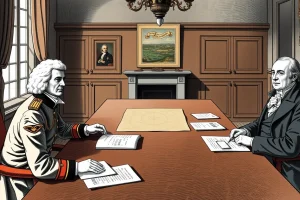
The conflict operated on two tracks: local confrontation and federal diplomacy. On the ground, Maine land agents and New Brunswick lumbermen clashed, leading to arrests and a militia standoff. Nationally, President Van Buren faced pressure from Maine’s congressional delegation and political rivals, while Britain sought to avoid war but could not appear weak. Winfield Scott’s mission used his authority as a national figure to persuade Maine’s governor—a Democrat—to trust a Whig general. Scott’s open communication with Sir John Harvey, built on mutual respect from their War of 1812 encounters, allowed a negotiated truce without formal concessions, effectively freezing the status quo while diplomats negotiated a final treaty.
Competing Viewpoints
Maine’s leadership and citizens viewed the territory as rightfully theirs, citing the Treaty of Paris language and colonial-era charters. New Brunswick and British officials argued that the boundary should follow the Mars Hills line, placing the Aroostook valley within British territory. Contemporary commentators also differed about whether the conflict was trivial or dangerous: some mocked the “Pork and Beans War” as an absurd overspending on provisioning troops, while others saw it as a genuine trial of the young republic’s durability. Scholars later emphasized the role of party politics—Democrats and Whigs manipulating border rhetoric for electoral gain—and the tension between state authority and federal power, which the U.S. Constitution left ambiguous and which was a central issue before the Civil War.
Role in the War of 1812
The Aroostook War directly connected to the War of 1812 through the Treaty of Ghent, which had created commissions to settle land and water boundary disputes between the United States and British North America. Article V of that treaty specifically provided for a commission to determine the northeast boundary, but the commissioners failed to agree, leaving the issue open. The Aroostook War thus represented a failure of the 1815 peace settlement to definitively resolve one of its core issues. It also recalled the military dynamics of 1812–15: many participants, including Winfield Scott and Sir John Harvey, had served in the earlier conflict, and their shared experience of leadership and respect played a role in avoiding escalation. The crisis revealed that the lessons of 1812, particularly the dangers of unresolved territorial claims and the importance of naval and military preparedness, still influenced policy.
Consequences and Historical Interpretation
The Aroostook War accelerated the diplomatic process that produced the Webster–Ashburton Treaty, which settled the boundary line and improved overall Anglo-American relations. It also reinforced the principle of peaceful arbitration, foreshadowing later treaties. Maine’s creation of Aroostook County strengthened its administrative hold on the region, while the fortifications built during the crisis became enduring symbols. Historians have interpreted the war as a product of local boosterism, timber economics, and partisan politics. Some argue that the crisis was intentionally inflated by Maine politicians to pressure Washington, while others emphasize the genuine danger of escalation. The absence of combat led to it being caricatured, but as John A. Soares notes, it “allows us to examine how both partisan politics and the growing debate over national and state authority dominated political and diplomatic affairs in the antebellum period.”
Primary Sources
Key primary sources include: Maine Governor John Fairfield’s order to Rufus McIntire (February 1839), which authorized the arrest of suspected trespassers; General Winfield Scott’s correspondence with Lieutenant-Governor Sir John Harvey (March 1839), documenting the truce negotiations; The report of the Maine Land Agent (1839) on timber depredations; The Webster–Ashburton Treaty (1842), which formalized the boundary; and contemporary newspaper accounts from Maine and New Brunswick that reflect public opinion. These sources provide insight into the motivations and fears of participants, though they often carry state or national biases. For example, Maine’s reports emphasize British aggression, while British colonial records stress Maine’s encroachments. The full text of the treaty is available through U.S. National Archives and the Foreign Office records at the UK National Archives.
Further Reading
- Carroll, Francis M. A Good and Wise Measure: The Search for the Canadian-American Boundary, 1783–1842. University of Toronto Press, 2001.
- Le Duc, Thomas. “The Maine Frontier and the Northeastern Boundary Controversy.” The American Historical Review, 1947.
- Jones, Howard. “Anglophobia and the Aroostook War.” The New England Quarterly, 1975.
- Soares, John A., Jr. “‘The Lion of the Day’: Diplomacy, States’ Rights, and Party Politics in the Aroostook War.” Maine History 42:4 (2006).
- Campbell, Gary. The Aroostook War: A Maine Historical Society Special Publication. Maine Historical Society, 2012? (Verify)
References
- Nguyễn Văn Sáng, Luu Trang, and Phuong Nguyen, “Aroostook War in the British-American Diplomacy in the First Half of the Nineteenth Century,” Jimbun gakuhō 7(1) (2021), doi:10.12691/wjssh-7-1-3.
- John A. Soares, Jr., “‘The Lion of the Day’: Diplomacy, States’ Rights, and Party Politics in the Aroostook War,” Maine History 42:4 (July 2006).
- Canadian Encyclopedia, “Aroostook War,” https://thecanadianencyclopedia.ca/en/article/aroostook-war.
- Maine Atlas Project, “Aroostook War,” Maine.gov, https://www.maine.gov/sos/maineatlas/explore-the-atlas/aroostook-war.
- CBC News, “‘This is my authority’: The war that got New Brunswick a border 180 years ago,” February 11, 2019, https://www.cbc.ca/news/canada/new-brunswick/180-years-aroostook-war-anniversary-1.5009200.
FAQ
Did the Aroostook War involve military combat?
No. It was a bloodless confrontation; the only reported casualties were a horse injured by a stray shot and one civilian accidentally killed by a ricocheting bullet during a peace celebration.
How did the Aroostook War connect to the War of 1812?
The Treaty of Ghent, ending the War of 1812, provided for commissions to settle the northeast boundary, but failure to do so left the issue unresolved, contributing directly to the 1838–39 crisis.
What was the outcome of the Aroostook War?
The crisis ended with a truce negotiated by Winfield Scott, and the final settlement came in the 1842 Webster–Ashburton Treaty, which established the current Maine–New Brunswick border.

Leave a Reply