
Short Answer
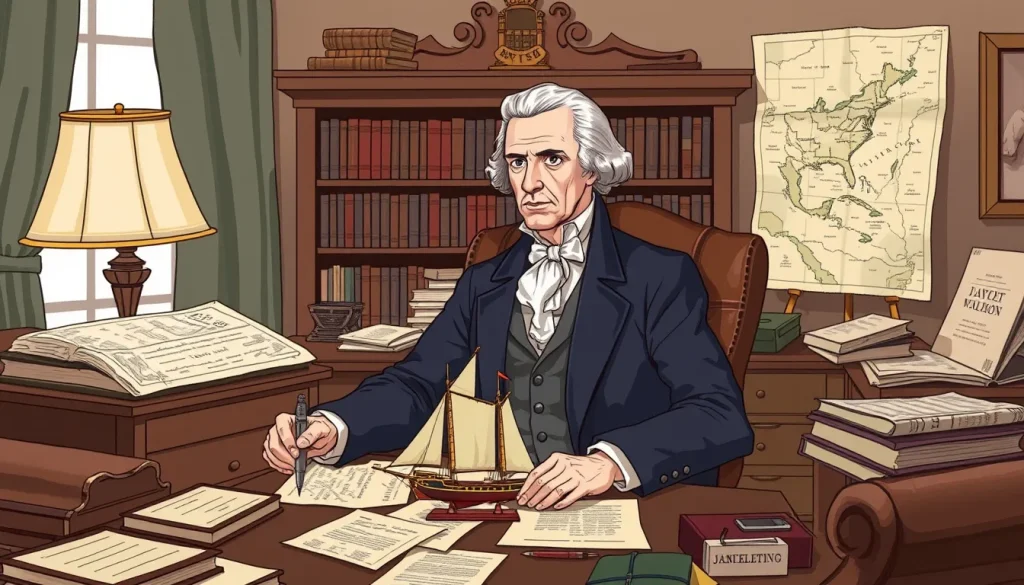
James Madison, the fourth President of the United States, served as commander-in-chief during the War of 1812 from 1812 to 1815. His presidency during this conflict tested the young republic’s endurance and his own leadership abilities. Madison navigated early military failures, naval successes, the burning of Washington, and diplomatic negotiations that culminated in the Treaty of Ghent, leaving a transformative mark on American nationalism and governance.
Historical Context
The War of 1812 arose from unresolved conflict between the United States and Great Britain, rooted in British maritime practices during the Napoleonic Wars. Britain impressed American sailors, imposed blockades via Orders in Council, and supported Indigenous resistance on the western frontier. The Democratic-Republican Party, led by Madison, had long sought to avoid entangling alliances and maintain neutrality, but escalating pressures pushed the nation toward war. Federalists, concentrated in New England, opposed the conflict, while southern and western politicians, known as “War Hawks,” demanded military action to uphold national honor and expand territory. Britain, preoccupied with France, viewed the American declaration of war as an inconvenience, but for the United States it became a test of republican governance under fire.
What Happened
Madison delivered his war message to Congress on June 1, 1812, enumerating British grievances, and Congress declared war on June 18, 1812—the first formal declaration under the Constitution. The American invasion of Canada early in the war turned into a series of disasters, including the surrender of Detroit by General William Hull and defeats at Queenston Heights and Frenchtown. However, the United States Navy won remarkable single-ship duels, such as the USS Constitution’s victory over HMS Guerriere, which boosted national morale. In 1813, American forces under Oliver Hazard Perry secured control of Lake Erie, leading to the Battle of the Thames, where Tecumseh was killed. In 1814, British forces, freed from European commitments, launched attacks on the Chesapeake, capturing Washington, D.C., and burning the Capitol and the White House. Madison, who witnessed the destruction, fled the capital with his wife Dolley, who famously saved the Gilbert Stuart portrait of George Washington. British attacks on Baltimore and Plattsburgh failed, and American negotiations at Ghent led to the Treaty of Ghent on December 24, 1814, which restored pre-war boundaries without addressing impressment or maritime rights. The Battle of New Orleans, fought on January 8, 1815, before word of the treaty reached the United States, was a crushing American victory under Andrew Jackson. The war concluded with no clear victor, but it solidified American independence and sovereignty.
Why It Matters
The War of 1812 confirmed the United States’ ability to defend itself against a global power, even though the treaty did not resolve the maritime issues that triggered the war. Madison’s presidency saw a pragmatic expansion of federal power: he approved an enlarged navy, supported establishment of the Second Bank of the United States, and accepted a higher national debt—policies that had previously been Federalist priorities. The conflict also fueled American nationalism, giving rise to symbols like the “Star-Spangled Banner.” Historians debate Madison’s effectiveness as a war leader. Some, like Gordon S. Wood, describe it as a “weird war” fought for questionable aims, while others, such as Andrew Burstein and Nancy Isenberg, argue that Madison responded with pragmatic realism, ultimately preserving American honor. His role in the war shaped his presidential legacy, demonstrating that a republic could conduct a war without succumbing to military despotism.
Early Life
James Madison was born on March 16, 1751, in Orange County, Virginia, to a wealthy planter family. He attended the College of New Jersey (now Princeton University), where he excelled in classical studies and law. As a young man, he suffered from ill health, which precluded military service during the Revolutionary War. Instead, he entered politics, serving in the Virginia House of Delegates and later in the Continental Congress. His most notable early achievement was his role as “Father of the Constitution,” as he drafted the Virginia Plan and kept detailed notes at the Constitutional Convention in 1787. His political philosophy emphasized a strong but balanced federal government, and he later co-authored The Federalist Papers with Alexander Hamilton and John Jay.
Role Before the War
Madison served as Thomas Jefferson’s Secretary of State from 1801 to 1809, during which he dealt with the escalating maritime crisis with Britain. He supported the Embargo Act of 1807, which prohibited American trade with foreign nations, but it proved economically disastrous. After succeeding Jefferson as president in 1809, Madison continued diplomatic efforts, including the Macon’s Bill Number 2, which attempted to pressure both Britain and France by reopening trade. By 1811, Madison became convinced that Britain would not repeal the Orders in Council or stop impressment. He began preparing the nation for war, strengthening defenses and communicating with congressional War Hawks. His decision to declare war in 1812 was a culmination of these frustrations and a commitment to protect American sovereignty.
Role During the War
As commander-in-chief, Madison oversaw all military and naval operations, though he lacked direct military experience. He relied on seasoned officers and cabinet members, frequently dismissing ineffective appointments. He supported the construction of warships, including the famous frigates, and championed naval expansion. He also directed campaigns against Canada, though these were poorly coordinated and met with failure. When British forces attacked Washington in August 1814, Madison personally visited the battle lines at Bladensburg and was forced to flee the capital. He returned after the British departed, determined to restore the government. He maintained communication with American negotiators in Ghent, ultimately accepting the treaty that ended the war. His leadership during the crisis helped preserve the union, despite considerable internal opposition.
Major Actions
War Message and Declaration: Madison delivered a detailed war message on June 1, 1812, outlining British abuses, including impressment, illegal blockades, and violations of American neutrality. Congress declared war on June 18.
Naval Buildup: He authorized the construction of battleships on Lake Erie and Lake Ontario, and supported the deployment of frigates, leading to key victories like that of the USS Constitution.
Response to Burning of Washington: After the British sacked Washington in 1814, Madison issued orders to reestablish the government and rebuild the capital, demonstrating resilience.
Diplomatic Oversight: He guided peace negotiations, instructing American envoys to secure peace without sacrificing national honor, resulting in the Treaty of Ghent.
Post-War Address: After the Battle of New Orleans, Madison delivered a message to Congress framing the war as a successful assertion of American independence.
Contemporary Accounts
Contemporary opinions of Madison as a war leader varied. An opposition newspaper in Alexandria, Virginia, published doggerel mocking his perceived indecisiveness: “Who will be the next President causes great doubt, / As all parties agree whiffling Jemmy goes out.” Secretary of State James Monroe called General Hull “weak, indecisive, and pusillanimous” after the surrender of Detroit, reflecting the administration’s frustration. Senator Robert Wright of Pennsylvania, who spent time with Madison in 1814, said the president remained “cheerful” and maintained composure “that ever became a great man.” After the war, a Rhode Island newspaper proclaimed, “The republic is safe,” crediting Madison’s leadership. These contrasting views show the divided sentiment of the time.
Later Life
After leaving office in March 1817, Madison retired to Montpelier, Virginia. He remained active in public life, serving as rector of the University of Virginia and promoting agricultural reforms. He also worked to organize and publish his Federalist papers and constitutional notes, but he grew increasingly concerned about the expansion of slavery. He remained a respected elder statesman until his death on June 28, 1836, the last surviving signer of the Constitution.
Historical Legacy
Madison’s legacy is heavily shaped by his presidency during the War of 1812. Historians have reassessed his leadership, with some criticizing his initial military unpreparedness and others praising his adaptability. Gordon S. Wood, in review, notes the war was “a small war within a larger one” and questioned its strategic necessity. Andrew Burstein and Nancy Isenberg view Madison as a “quintessentially practical man” who enlisted seasoned advisors and saved face. The war’s outcome, often perceived as a draw, nevertheless solidified American union and paved the way for the Era of Good Feelings. Madison’s willingness to adopt Federalist policies, such as a national bank and larger navy, marked a distinct departure from his early Republican principles, but it secured the nation’s financial and military stability. His legacy is further complicated by his association with slavery, but his role as a war president remains an essential part of his story.
Primary Sources
The most important primary source for understanding Madison’s justification for war is his Special Message to Congress on the foreign policy crisis, delivered on June 1, 1812, commonly known as the War Message. In it, Madison laid out the grievances of impressment, illegal blockades, and British actions against American sovereignty. The message is available in the U.S. National Archives and numerous documentary editions. Other primary sources include Madison’s letters to Thomas Jefferson, his cabinet members, and his instructions to peace commissioners at Ghent. These documents reveal his evolving strategy and priorities. The Treaty of Ghent itself is a crucial primary source, as it outlines the articles of peace. Each source carries bias: Madison’s war message was political rhetoric aimed at persuading Congress, while his private letters offer more candid assessments. The limitations include partial documentation and the absence of British and Indigenous perspectives.
Further Reading
- Brookhiser, Richard. James Madison. Basic Books, 2011.
- Broadwater, Jeff. James Madison: Son of Virginia and a Founder of the Nation. University of North Carolina Press, 2012.
- Daughan, George C. 1812: The Navy’s War. Basic Books, 2011.
- Burstein, Andrew, and Nancy Isenberg. “Fit for war? Guiding the nation through political and military battles.” U.S. National Park Service, 2015.
- Burstein, Andrew, and Nancy Isenberg. “Defining a national system: Madison, party politics and the road to war.” U.S. National Park Service, 2015.
References
- Madison, James. “War Message to Congress.” June 1, 1812. American Battlefield Trust. https://www.battlefields.org/learn/primary-sources/james-madison-war-message-congress.
- “Special Message to Congress on the Foreign Policy Crisis (War Message).” June 1, 1812. San Diego State University. https://loveman.sdsu.edu/docs/1812SpecialMessagetoCongresswarmessage.pdf.
- Burstein, Andrew, and Nancy Isenberg. “Fit for war? Guiding the nation through political and military battles.” National Park Service, March 6, 2015. https://www.nps.gov/articles/fit-for-war.htm.
- Burstein, Andrew, and Nancy Isenberg. “Defining a national system: Madison, party politics and the road to war.” National Park Service, March 6, 2015. https://www.nps.gov/articles/defining-a-national-system.htm.
- Wood, Gordon S. “Mr. Madison’s Weird War.” The New York Review of Books, June 21, 2012. https://www.nybooks.com/articles/2012/06/21/mr-madisons-weird-war/.
FAQ
What were Madison's main reasons for declaring war in 1812?
Madison cited impressment of American sailors, illegal maritime blockades, and British violations of neutral rights as key causes. He also alluded to British support for Indigenous resistance on the frontier.
How did Madison react to the burning of Washington in 1814?
Madison, who had been surveying the battlefield, fled the capital but later returned to rebuild the government. He condemned the British act as barbaric and used it to rally American nationalism.
What was Madison's historical legacy as a war president?
Historians view Madison as a pragmatic leader who adapted to the exigencies of war, accepted necessary federal expansions like a national bank, and secured a peace that affirmed American independence, despite early military failures.
Leave a Reply