Short Answer
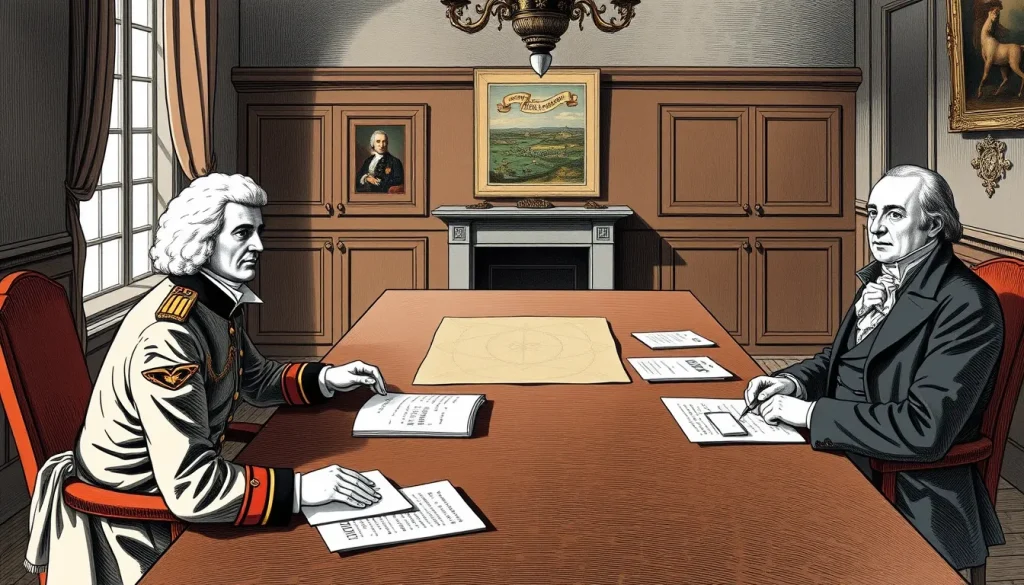
The British negotiators at Ghent were the three plenipotentiaries appointed by His Britannic Majesty to negotiate an end to the War of 1812: Admiral James Lord Gambier, Henry Goulburn, and William Adams. Meeting with American commissioners in the Belgian city of Ghent from August to December 1814, they concluded the Treaty of Ghent on December 24, 1814, which restored peace between Great Britain and the United States.
Historical Context
The War of 1812, fought between the United States and Great Britain, was rooted in maritime disputes, territorial expansion, and British support for Indigenous resistance to American settlement. By 1814, after two years of inconclusive conflict, both sides faced financial and military exhaustion. The British government, preoccupied with the Napoleonic Wars, saw the North American theater as a secondary front. The defeat of Napoleon in April 1814 allowed Britain to turn more attention to America, but also removed the immediate naval pressures that had fueled American grievances. Peace negotiations were proposed through Russian mediation in 1813, but direct talks were eventually arranged, with Ghent chosen as the venue due to its neutrality and accessibility from London and Washington.
What Happened
The British delegation arrived in Ghent in early August 1814. They presented a set of demands based on instructions from the Foreign Office, including the creation of an independent Indigenous buffer state in the Northwest Territory, British control of the Great Lakes, and adjustments to the U.S.-Canadian boundary. The Americans, led by John Quincy Adams, Albert Gallatin, Henry Clay, James A. Bayard, and Jonathan Russell, rejected these terms as unacceptable. Over the following months, the negotiators exchanged notes and proposals, with the British gradually moderating their demands under pressure from London, which was increasingly concerned about the costs of the war and diplomatic isolation. Key sticking points included the Indigenous territory question, the fisheries, and the navigation of the Mississippi River. The American victory at Plattsburgh and the military stalemate in Canada, along with British political considerations, led the British government to soften its stance. By December, both sides agreed to a status quo ante bellum treaty, restoring all territory captured during the war and setting up commissions to resolve boundary disputes. The treaty was signed on December 24, 1814, and ratified in February 1815.
Why It Matters
The Treaty of Ghent ended the War of 1812 without any territorial changes or clear resolution of the issues that had caused the conflict. British negotiators, bound by instructions from London, helped shape a treaty that preserved the pre-war status quo and allowed Britain to focus on European affairs. The treaty also laid groundwork for future negotiations on boundaries and disarmament. Historically, the outcome is interpreted as a diplomatic standoff: the Americans celebrated a victory that they were not forced to cede territory, while the British saw peace as a relief from a costly sideshow. The British negotiators’ roles, particularly Goulburn’s detailed documentation, provided a record of the negotiations that has shaped scholarly understanding.
Early Life
James Gambier (1756–1833) was a career naval officer, rising to admiral. Henry Goulburn (1784–1856) was a politician and civil servant, educated at Trinity College, Cambridge. William Adams (1778-1842) was a lawyer and civil law doctor, serving as an admiralty court judge.
Role Before the War
Gambier had served in the Royal Navy during the American Revolutionary War and the French Revolutionary Wars, commanding fleets in the Napoleonic Wars. Goulburn was a Member of Parliament and had been Under-Secretary for War and the Colonies since 1810. Adams was a prominent lawyer specializing in maritime law and had been a judge of the Admiralty Court.
Role During the War
On July 28, 1814, the British appointed Gambier, Goulburn, and Adams as plenipotentiaries to negotiate peace with the United States. They received instructions from Lord Castlereagh, the Foreign Secretary, and communicated regularly with the Prime Minister and Secretary of War Earl Bathurst. Their role was to present British demands, conduct negotiations, and report back to London for approval on substantive points. They met with the American commissioners at Ghent, exchanged notes, and drafted treaty articles. They faced internal pressure to adhere to London’s instructions but also had to adapt as circumstances changed.
Major Actions
The trio presented British peace terms in August 1814, including the demand for an Indigenous buffer state. They maintained a hard line through September, but after British defeats at Plattsburgh and Baltimore, London authorized them to adjust. They negotiated the article on the restoration of territories and the status of Indigenous nations, ultimately agreeing to a clause that simply restored them to their pre-war status. They also resolved the fisheries and Mississippi navigation issues by abandoning the proposed article under American insistence. On December 24, 1814, they signed the treaty with the American commissioners.
Contemporary Accounts
John Quincy Adams’s diary provides a detailed account of the negotiations, including exchanges with the British negotiators. Henry Goulburn’s papers, held at the University of Michigan, contain the official correspondence between the British commissioners and the Foreign Office, as well as draft treaty texts and letters between the delegations. These documents show the British negotiators’ adherence to instructions and their engagement with the Americans. James Gallatin, son of American delegate Albert Gallatin, wrote in his diary about the British delegates, particularly noting Lord Gambier’s demeanor and Goulburn’s tenacity.
Later Life
Gambier continued his naval career, becoming a full admiral in 1830. Goulburn served in various political posts, including Chancellor of the Exchequer in the 1820s, and later as Home Secretary in 1835. Adams became a judge of the Admiralty Court and was knighted.
Historical Legacy
The British negotiators at Ghent are remembered for securing a peace that ended the war without territorial loss. Their papers provide crucial insight into British wartime diplomacy. Historians note that their effectiveness was constrained by slow communications and rigid instructions, yet they successfully concluded a treaty that both sides found acceptable.
Primary Sources
The principal primary sources for the British negotiators are the Goulburn papers at the William L. Clements Library, which include official and private correspondence, treaty drafts, and one of the six original copies of the Treaty of Ghent. The Treaty of Ghent transcript is available from the U.S. Senate. John Quincy Adams’s diary, published as Memoirs of John Quincy Adams, offers an American perspective. The report by Adams, reproduced in Original Sources, shows exchanges among the commissioners. The National Park Service article provides a summary of the negotiations.
Further Reading
- Donald E. Graves, The Peacemakers: The Ghent Negotiations and the Treaty of 1814 (Toronto: Robin Brass Studio, 1994).
- Henry Goulburn Papers, William L. Clements Library, University of Michigan.
- U.S. Senate, “Transcript: Treaty of Ghent.” https://www.senate.gov/about/powers-procedures/treaties/treaty-of-ghent/transcript-treaty-of-ghent.htm.
- National Park Service, “Summer 1814: Americans and British open peace negotiations at Ghent.” https://www.nps.gov/articles/treaty-of-ghent-1.htm.
- John Quincy Adams, Memoirs of John Quincy Adams, ed. Charles Francis Adams (Philadelphia: Lippincott, 1874-1877).
References
- Henry Goulburn papers, 1813-1826, William L. Clements Library, University of Michigan.
- U.S. Senate, “Transcript: Treaty of Ghent.” https://www.senate.gov/about/powers-procedures/treaties/treaty-of-ghent/transcript-treaty-of-ghent.htm.
- National Park Service, “Summer 1814: Americans and British open peace negotiations at Ghent.” https://www.nps.gov/articles/treaty-of-ghent-1.htm.
- John Quincy Adams, “Discussing the Terms of Peace,” in Original Sources, https://www.originalsources.com/Document.aspx?DocID=1CQRYEK1ILXQKTL.
- Institute of Historical Research, “‘Everlasting bickering and matters delayed’: the American delegation and the 1814 Ghent peace negotiations.” https://blog.history.ac.uk/2014/12/everlasting-bickering-and-matters-delayed-the-american-delegation-and-the-1814-ghent-peace-negotiations/.
FAQ
Why were the British negotiators at Ghent chosen?
They were chosen for their expertise: Gambier as a naval officer, Goulburn for colonial and war affairs, and Adams as a legal authority on maritime law.
What were the main British demands at Ghent?
The British demanded an Indigenous buffer state, control of the Great Lakes, boundary adjustments, and restoration of territories.
How did the British negotiators' role affect the final treaty?
They followed strict instructions from London, but adapted as military setbacks and political pressures led to more conciliatory terms, ultimately agreeing to a status quo ante bellum.

Leave a Reply