
Short Answer
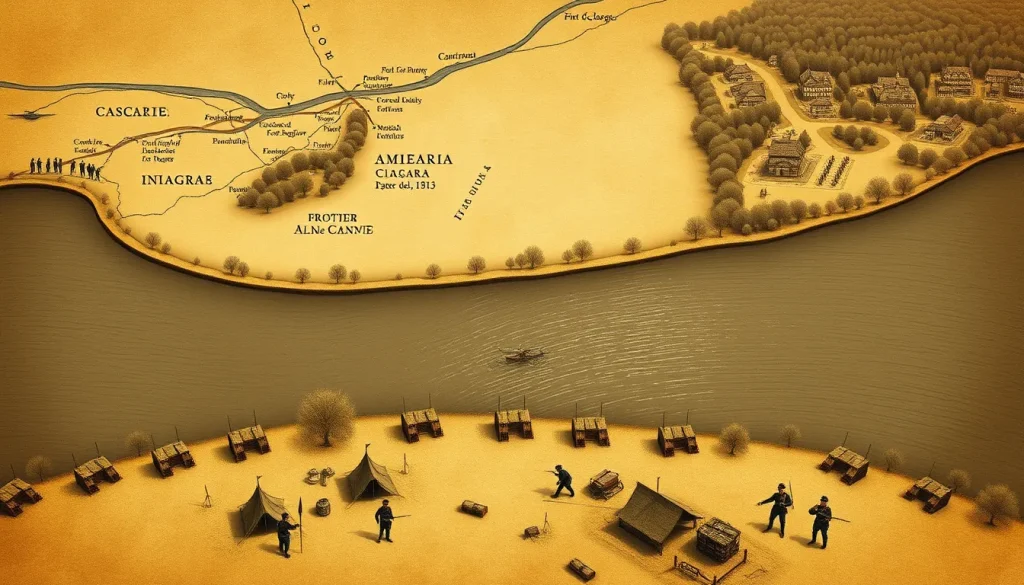
The American occupation of Upper Canada in 1813 was a military campaign during the War of 1812 in which United States forces seized and held parts of the Niagara Peninsula, including Fort George and the village of Niagara, from May to December 1813. The occupation marked a rare American success in the first two years of the war, but it was ultimately reversed by British and Canadian counterattacks. The episode is historically significant for its role in escalating the conflict on the Niagara frontier and for the controversial burning of Newark, which led to a cycle of retaliation.
Historical Context
After the American declaration of war in June 1812, the United States sought to conquer Upper Canada as a strategic objective. The initial invasion attempts in 1812 failed at Detroit and Queenston Heights, leaving the northern frontier largely in British hands. In early 1813, the U.S. government and military leaders planned a renewed campaign, focusing on the Niagara River corridor, where control of the Great Lakes and the St. Lawrence River route was vital. The British, meanwhile, were stretched by the ongoing Napoleonic Wars in Europe, but they maintained a regular army and militia forces in Upper Canada supported by Indigenous allies. In February 1813, President James Madison appointed John Armstrong as Secretary of War, who favoured an aggressive strategy against Upper Canada. The American command prepared a joint army-navy operation to seize Kingston or the Niagara frontier, ultimately deciding on the latter under the command of Major General Henry Dearborn.
What Happened
In April 1813, a large American force under Dearborn crossed Lake Ontario and landed near Fort George, the principal British post on the Niagara River. From 27 May, American troops, supported by naval gunfire, attacked the fort. The British commander, Brigadier General John Vincent, evacuated Fort George and retreated westward to Burlington Heights. The Americans occupied Fort George and the adjacent village of Niagara (now Niagara-on-the-Lake), establishing a foothold in Upper Canada. Dearborn’s forces pursued Vincent but were repulsed at the Battle of Stoney Creek on 6 June, a nighttime attack that forced the Americans to retreat to Fort George. The American occupation then became a defensive stalemate. British and Canadian troops, reinforced by Indigenous warriors, began a blockade of the American garrison at Fort George. Throughout the summer, American forays into the surrounding countryside met limited success, and the occupation gradually drained men and supplies.
As winter approached, the American position deteriorated. Desertion, disease, and a shortage of provisions weakened the garrison. In late November 1813, Brigadier General George McClure, commanding the American forces after Dearborn’s recall, received orders from Secretary Armstrong to abandon Fort George and retreat to U.S. soil. On 10 December, McClure ordered the burning of the village of Niagara to deny shelter to British pursuers. This action was immediately condemned by both American and British officials, but it inflamed the British command. On 18–19 December, a British and Canadian force under Lieutenant General Gordon Drummond crossed the Niagara River and captured Fort Niagara in a surprise night assault, taking over 300 prisoners. The British then launched a campaign of retaliation, burning American towns along the frontier, including Lewiston and Buffalo. By the end of December 1813, the American occupation of Upper Canada had completely ended, and the British had regained control of the entire Niagara frontier.
Why It Matters
The American occupation of Upper Canada in 1813 had immediate and lasting consequences. In the short term, it temporarily shifted the balance of power on the Niagara frontier and demonstrated that American forces could sustain a foothold in Canadian territory. However, the occupation failed to achieve its strategic goal of securing a decisive victory that would force Britain to negotiate. The burning of Newark caused an international controversy and led to a brutal scorched-earth response by the British, which in turn fueled American resentment and calls for revenge. The British recapture of Fort Niagara and the subsequent destruction of American frontier settlements in late 1813 and early 1814 highlighted the vulnerability of the U.S. border and the cost of the war. For the inhabitants of Upper Canada, the occupation represented the reality of war, with many families displaced and homes destroyed. Later historians have interpreted the occupation as a turning point in the war, as it prompted a more aggressive British strategy and contributed to the hardening of attitudes on both sides. The episode also illustrates the limitations of American military preparedness in the early years of the war, a theme central to the broader narrative of the War of 1812.
Definition
The term “American occupation of Upper Canada in 1813” refers to the period when United States military forces seized and controlled British territory in the Niagara Peninsula of Upper Canada, specifically around Fort George and the village of Niagara, from May to December 1813. It was not a formal annexation but a military occupation maintained by armed forces.
Background
The occupation was rooted in the American war plan of 1812–1813, which assumed that capturing Canada would force Britain to cease impressment and other maritime violations. After failing to invade at Detroit and Queenston in 1812, the U.S. Army and Navy focused on the Niagara River as a more accessible route. The build-up of naval forces on Lake Ontario and the appointment of a more aggressive Secretary of War in early 1813 set the stage for a renewed attempt.
How It Worked
The occupation functioned as a military garrison. American troops occupied Fort George and the village of Niagara, establishing batteries and fortifications. They attempted to control the surrounding countryside through patrols and foraging expeditions, but faced constant harassment from British and Indigenous forces. The American commander, initially Dearborn and later McClure, issued proclamations to the local population, but the occupation was never popular among the Canadian settlers. The American hold was precarious, and the inability to extend control beyond the immediate fort area made the occupation untenable.
Competing Viewpoints
American leaders justified the occupation as a legitimate military measure to protect their northern frontier and compel Britain to meet American demands. They viewed the burning of Newark as a necessary act of war, though official U.S. policy later disavowed it. British and Canadian contemporaries condemned the occupation as an invasion of sovereign territory and the burning of Newark as an atrocity. Indigenous allies of the British, who had their own grievances against American expansion, saw the occupation as another invasion of their lands. Historians have traditionally emphasized the failures of American leadership and logistics, while more recent scholarship highlights the experiences of civilians and the impact of the occupation on the local population.
Role in the War of 1812
The occupation was a major event in the War of 1812’s second year. It gave the Americans control of the strategic Niagara crossing, but it did not lead to the hoped-for capture of York or the severing of British supply lines. The British counter-offensive that ended the occupation shifted the war’s focus to the American frontier, setting the stage for the devastating campaigns of 1814. The occupation also cemented the importance of the Great Lakes and inland waterways in the conflict, as both sides raced to build naval superiority.
Consequences and Historical Interpretation
The immediate consequence was the destruction and displacement of civilians on both sides. The occupation and its aftermath left the Niagara frontier in ruins and deepened Anglo-American animosity. Strategically, the failure of the occupation discredited the American administration and contributed to the eventual abandonment of the conquest of Canada as a war aim. Later historians have debated whether the occupation could have succeeded with better leadership and more troops, or whether it was doomed from the start. The episode is often cited as an example of the inadequacy of the U.S. Army’s regular forces and the challenges of waging war in a sparsely populated, heavily wooded region. In Canadian historical memory, the occupation and the subsequent reprisals are seen as key moments in the defense of Upper Canada, reinforcing a narrative of resilience against American invasions.
Primary Sources
Key primary sources include official correspondence from Secretary of War John Armstrong to Brigadier General George McClure, particularly the order to destroy the village of Niagara, which is documented in the American War Department records. McClure’s proclamations and his subsequent reports to the U.S. government provide an American perspective. British accounts include Lieutenant General Gordon Drummond’s dispatches describing the capture of Fort Niagara and his letters condemning the burning of Newark. The diary or letters of Canadian civilians who experienced the occupation, such as those of Thomas Dickson, offer local insights. These sources, while valuable, are biased by military and civilian perspectives, so they must be interpreted with caution.
Further Reading
- Richard V. Barbuto, The Canadian Theater 1813 (Washington, D.C.: U.S. Army Center of Military History, 2013).
- Richard Feltoe, The Flames of War: The Fight for Upper Canada, July–December 1813 (Toronto: Dundurn Press, 2013).
- The Canadian Encyclopedia, “Capture of Fort Niagara,” available online at thecanadianencyclopedia.ca.
- Donald E. Graves, Where Right and Glory Lead! The Battle of Lundy’s Lane, 1814 (Robin Brass Studio, 1997) for broader campaign context.
References
- Richard V. Barbuto, The Canadian Theater 1813 (U.S. Army Center of Military History, 2013), accessed from govinfo.gov.
- The Canadian Encyclopedia, “Capture of Fort Niagara,” https://thecanadianencyclopedia.ca/en/article/capture-of-fort-niagara.
- Richard Feltoe, The Flames of War: The Fight for Upper Canada, July–December 1813 (Dundurn Press, 2013).
FAQ
Why did the Americans burn the village of Niagara in 1813?
American Brigadier General George McClure ordered the burning on December 10, 1813, to deny shelter to pursuing British forces as he withdrew across the Niagara River. The order followed Secretary of War John Armstrong’s directions to destroy the village if necessary.
How did the British respond to the occupation?
British and Canadian forces, reinforced by Indigenous allies, launched counterattacks. After the village burning, Lieutenant General Gordon Drummond captured Fort Niagara in a night assault on December 18–19, 1813, and subsequently burned American towns in retaliation.
What was the strategic significance of the American occupation?
It gave the Americans a temporary foothold on Canadian soil and demonstrated the difficulty of conquering Upper Canada. The failure of the occupation contributed to the American decision to abandon the invasion of Canada as a primary war aim and led to a cycle of reprisals along the frontier.


Leave a Reply