
Short Answer
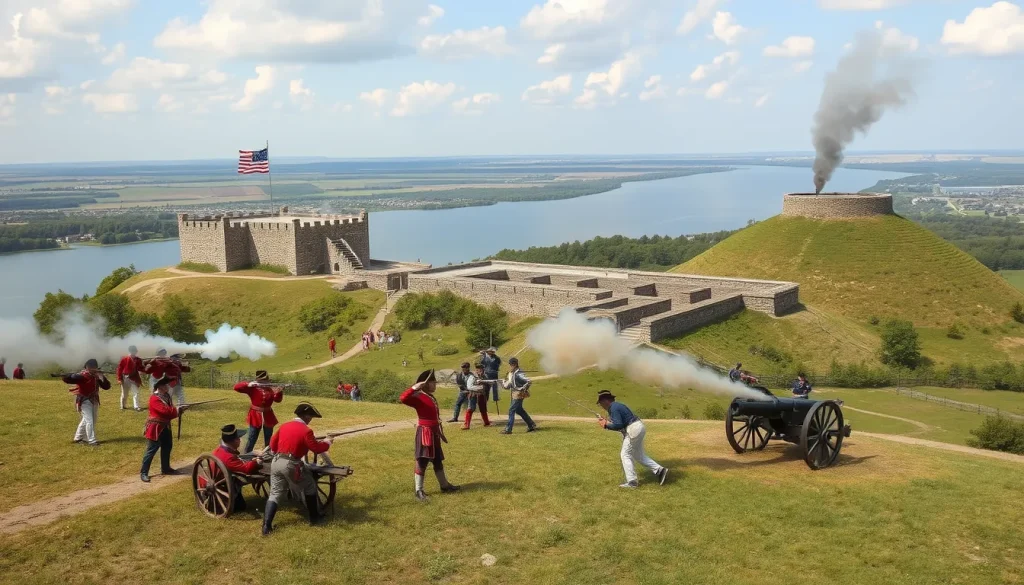
Fort Erie was a British military post at the entrance of the Niagara River on Lake Erie, located in present-day Ontario. During the War of 1812, it was the site of a dramatic campaign in 1814: American forces captured the fort, used it as a base after the Battle of Lundy’s Lane, survived a British siege, and finally evacuated and destroyed it. The fighting at Fort Erie marked the end of the last major American invasion of Upper Canada and left a lasting impact on the Niagara frontier.
Historical Context
Before the War of 1812, the Niagara River had long been a strategic corridor between Lake Ontario and Lake Erie, and the British had maintained a military presence at its mouth since 1764. The third Fort Erie, built between 1805 and 1808, was located on high ground overlooking the river and was intended to defend the portage route and communications along the frontier. During the early years of the war, both sides launched raids and counter-raids along the Niagara, but Fort Erie itself saw limited action until 1814. That year, the American government planned a major invasion of Upper Canada (present-day Ontario) from the Niagara frontier, aiming to break British control and secure a peace on favourable terms. The capture and defence of Fort Erie would become central to that campaign.
What Happened
On 3 July 1814, an American force of roughly 4,000 men under Major General Jacob Brown crossed the Niagara River from Buffalo and surrounded Fort Erie, which was defended by a garrison of about 170 men. The British commander, Major Thomas Buck, surrendered the fort that afternoon, and the Americans occupied it. The invasion force immediately moved northward, winning a skirmish at Chippawa on 5 July and fighting the bloody Battle of Lundy’s Lane on 25 July. Although tactically inconclusive, Lundy’s Lane severely mauled both armies, and the Americans withdrew south to Fort Erie, where they began to strengthen the fortifications.
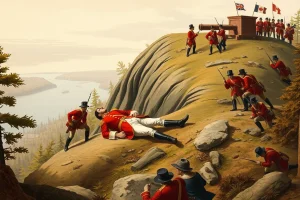
The British commander, Lieutenant-General Gordon Drummond, followed cautiously. By early August, he had established a blockade and decided to assault the American position. The British launched raids on American supply depots at Black Rock and Buffalo on 4 August, but these failed to dislodge the Americans. Drummond then emplaced siege batteries and began a bombardment on 13 August. On the night of 15 August, he ordered a three-column assault. The main attack against Snake Hill, a fortified sand mound south of the fort, was repulsed with heavy casualties—American defenders, forewarned by deserters, had prepared effective fields of fire. The attacks on the fort’s northeastern bastion and northern entrenchments also failed, though a British force temporarily captured the bastion before a massive explosion in an ammunition magazine killed many attackers and ended the assault. The British suffered about 900 casualties, including several senior officers, while American losses were only about 62.
Drummond, though shaken, continued the siege. The Americans, under the command of Brigadier General Edmund P. Gaines and later Major General Brown (who had recovered enough to return), carried out a successful sortie on 17 September, capturing several British batteries and spiking their guns. With his forces depleted by casualties and sickness, Drummond withdrew on 21 September, taking up a position behind Chippawa Creek (Welland River). The American army remained at Fort Erie through the autumn, but further advance was impossible. On 5 November 1814, American soldiers evacuated the fort, crossed the Niagara River to Buffalo, and detonated a powder magazine that destroyed the fortifications. The fort was never rebuilt as a military installation.
Why It Matters
The events at Fort Erie in 1814 brought the war on the Niagara frontier to a decisive conclusion. The American retreat across the river ended the last major American invasion attempt of Upper Canada, and the British, despite failing to recapture the fort, successfully prevented further penetration of Canadian territory. The siege and its associated actions cost more than 2,000 casualties on both sides, making the Niagara campaign one of the bloodiest of the war. The fort’s destruction ensured it would not be used in future conflicts, and its ruins became a symbol of the war’s devastation. For Canadians, the defence of the fort and the eventual British pressure that led to the American withdrawal are remembered as a successful repulse of an invasion. For Americans, the fort represents the high-water mark of their campaign, which ended in retreat but also demonstrated the fighting capability of their regular army. The site was later restored and is now a national historic site commemorating the sacrifices of all who fought there.
Historical Map Context
The original Fort Erie stood on high ground at the eastern end of the Niagara Peninsula, where the Niagara River meets Lake Erie. This location controlled the portage around the falls and the water route from Lake Erie to Lake Ontario. The fort’s position commanded the narrow crossing to Buffalo, New York, and protected British supply lines along the river. The American fortifications built during the siege—a series of earthworks and redoubts extending from the fort to Snake Hill—covered about 30 acres and took advantage of the terrain to create a formidable defensive perimeter. Maps of the period show the fort, the surrounding trenches, and the British siege lines about a mile to the north and west.
Modern Location
The Fort Erie National Historic Site is located at 350 Lakeshore Road in the town of Fort Erie, Ontario, directly opposite Buffalo, New York. The original stone walls, partially restored, stand on the same ground as the 1814 fort. The site is now a heritage park, administered by the Niagara Parks Commission, with an interpretive centre, a visitor route through the fort’s buildings, and views across the Niagara River to the Buffalo skyline. The town of Fort Erie, which grew around the former military post, occupies the surrounding area.
Events at the Site
Key events at the site during the War of 1812 include the American capture on 3 July 1814, the expansion of defences in early August, the British siege and bombardment from 4 August to 21 September, the failed assault on 15 August, and the American sortie on 17 September. The fort was finally evacuated and blown up on 5 November. Later, in 1866, the ruins served as a campsite for a Fenian invasion from the United States, and the property was transferred to the Niagara Parks Commission in 1901. A memorial was erected in 1905, and the fort was reconstructed between 1937 and 1939 based on its 1814 configuration.
Associated People
Major General Jacob Brown led the American army that captured the fort and later returned during the siege after being wounded at Lundy’s Lane. Brigadier General Edmund P. Gaines commanded the defence from late July to mid-September. Brigadier General Eleazer W. Ripley, who held the senior field command briefly, played a key role in organising the initial fortifications. Captain Nathan Towson, who commanded the battery on Snake Hill, became famous for his artillery fire during the assault. On the British side, Lieutenant-General Gordon Drummond directed the siege, and Lieutenant-Colonel Victor Fischer led the failed attack on Snake Hill, while Lieutenant-Colonel William Drummond (a distant relative) was killed in the attack on the northeast bastion. Colonel Hercules Scott also died in the assault. The fort’s first American captor was Major Thomas Buck, the British officer who surrendered.
Surviving Monuments and Site
The fort was rebuilt by the Niagara Parks Commission between 1937 and 1939 using the original stone foundations and some surviving walls. Today, the site includes the restored walls, barracks, a powder magazine, and a visitor centre. A 9-metre-high granite memorial, erected in 1905, honours those who died during the war. The fort is operated as a museum with costumed interpreters, and since 1986 a re-enactment of the Siege of Fort Erie has been held annually. The surrounding park covers about 17.5 acres and retains the viewscapes described in its national historic site designation.
Primary Sources
Contemporary accounts of the Fort Erie campaign include official reports and letters from the commanders. Major General Jacob Brown’s reports to the U.S. Secretary of War and Lieutenant-General Gordon Drummond’s dispatches to the British commander in chief in Canada provide detailed narratives of the siege. The American side also produced orderly books and soldiers’ diaries, such as that of Lieutenant David B. Douglass, who helped design the fortifications. British officers’ letters, including those describing the 15 August assault, survive in regimental archives. Published collections of War of 1812 documents, such as the papers of James Madison and the correspondence of the British commanders, are accessible at national archives. The Parks Canada plaque at the site offers a concise official description of the fort’s history, though it should be read as a commemorative text.
Further Reading
- Sherman Zavitz, “Siege of Fort Erie, War of 1812,” The Canadian Encyclopedia, online edition.
- Sherman Zavitz, “Fort Erie National Historic Site of Canada,” The Canadian Encyclopedia, online edition.
- American Battlefield Trust, “Siege of Fort Erie Battle Facts and Summary,” web article.
- Joseph W. A. Whitehorne, “Fort Erie, 1814—Battles Fought and Refought,” Journal of the War of 1812 and the Era 1800 to 1840, Vol. I, No. 3 (Spring 1996).
- Parks Canada, “Fort Erie National Historic Site of Canada,” heritage designation records.
References
- Parks Canada, “Fort Erie National Historic Site of Canada,” https://www.pc.gc.ca/apps/dfhd/page_nhs_eng.aspx?i=89724&id=371.
- Sherman Zavitz, “Siege of Fort Erie, War of 1812,” The Canadian Encyclopedia, https://thecanadianencyclopedia.ca/en/article/siege-of-fort-erie-war-of-1812.
- Sherman Zavitz, “Fort Erie National Historic Site of Canada,” The Canadian Encyclopedia, https://thecanadianencyclopedia.ca/en/article/fort-erie-national-historic-site-of-canada.
- American Battlefield Trust, “Siege of Fort Erie Battle Facts and Summary,” https://www.battlefields.org/learn/war-1812/battles/siege-fort-erie.
- Joseph W. A. Whitehorne, “Fort Erie, 1814—Battles Fought and Refought,” Journal of the War of 1812 and the Era 1800 to 1840, Vol. I, No. 3 (Spring 1996). URL: https://archives.ubalt.edu/swe/pdf/8A-2-39.pdf.
FAQ
Why did the Americans capture Fort Erie in 1814?
The capture was part of a planned American invasion of Upper Canada. Major General Jacob Brown's army crossed the Niagara River from Buffalo on 3 July 1814 and took the fort, which was defended by only a small guard, to establish a base for advancing against British forces.
What was the outcome of the British assault on Fort Erie on 15 August 1814?
The British assault failed with heavy losses. Three columns attacked the American position, but they were repulsed with about 900 British casualties, while the Americans lost only about 62. The explosion of an ammunition magazine during the fight killed many of the attackers.
Did the Americans successfully use Fort Erie as a base?
They did, but only defensively. After the battle of Lundy's Lane, the army retreated to Fort Erie and held it during a six-week British siege. Although American sorties damaged British batteries, the army was unable to launch further offensives and finally evacuated the fort in November 1814.


Leave a Reply