

Short Answer
Fort George was a British military post on the west bank of the Niagara River at the northern end of the Niagara Peninsula, in present-day Niagara-on-the-Lake, Ontario. During the War of 1812 it served as the headquarters of the British Centre Division and became the target of a major American amphibious assault on 27 May 1813. The fort’s location at the gateway between Lake Ontario and the Niagara River made it a vital strategic point in the struggle for the Niagara frontier, and its capture gave the United States its first significant foothold on the Canadian side of the river.
Historical Context
Fort George was built by the British army between 1796 and 1799 after the evacuation of Fort Niagara on the American side of the river, which was required under the terms of Jay’s Treaty (1794). The fort guarded the entrance to the Niagara River and protected the portage route between Lake Ontario and Lake Erie, the main line of communication between Upper Canada and the Atlantic. By 1802 the post had become the headquarters of the British army in Upper Canada, the local militia, and the British Indian Department.
When war broke out in June 1812, Fort George was the centre of British military power on the Niagara frontier. Major General Isaac Brock used it as his base for operations in 1812, including the movement that led to the capture of Detroit in August and the defence of Queenston Heights in October, where Brock was killed. After Brock’s death, command of the Centre Division passed to Brigadier General John Vincent.
The American campaign plan for 1813, approved by military leaders in Washington, identified Fort George as one of the principal objectives, along with Kingston, York (Toronto), and Fort Erie. The plan, as outlined by Major General Henry Dearborn, was to ‘take York; from there proceed to Niagara and attack Fort George by land and water.’ The attack on York succeeded on 27 April 1813, and the troops used there were transported to Fort Niagara on the American side of the river, opposite Fort George, by 8 May.
What Happened
The American attack on Fort George began on 25 May 1813 with a heavy naval and artillery bombardment. Commodore Isaac Chauncey’s squadron on Lake Ontario and American guns at Fort Niagara opened fire on the fort, setting fire to the log buildings inside the earthworks. Only the stone powder magazine survived the bombardment, which largely destroyed the wooden interior of the fort.
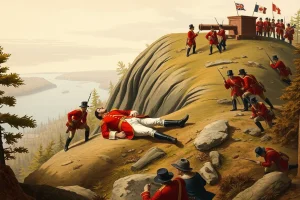
The amphibious assault took place early on the morning of 27 May. Colonel Winfield Scott, serving as adjutant general under the ailing Dearborn, led the landing force of between 4,000 and 5,000 American troops on the lakeshore about two miles west of the fort. The defenders—about 1,000 British regulars of the 8th and 49th Regiments of Foot, the Royal Newfoundland Fencibles, and the Glengarry Light Infantry, supported by roughly 300 militia—attempted to contest the landing but were driven back by the concentrated fire of the naval guns. As Vincent reported to Governor General Sir George Prevost, the British ‘were obliged to fall back, and the fire from the Shipping so completely enfiladed and scoured the plains that it became impossible to approach the beach.’
British casualties were about 52 killed and 306 wounded or missing. Vincent, recognizing that he was outnumbered, spiked his guns, destroyed ammunition, and withdrew his force along the Niagara River toward Queenston, then west to Burlington Heights at the head of Lake Ontario. The American capture of Fort George cost about 40 killed and 120 wounded.
The Americans occupied and refortified the ruined fort. They used it as a base for attempts to destroy Vincent’s army, but those efforts failed at the Battle of Stoney Creek on 6 June and the Battle of Beaver Dams on 24 June 1813, where American detachments were defeated or captured. After those reverses, the Americans at Fort George were effectively blockaded by British forces and Indigenous allies. On 10 December 1813, the Americans evacuated the fort and burned the town of Niagara on their departure. British forces reoccupied the fort on the same day and, on 19 December, crossed the river and captured Fort Niagara, which they held for the rest of the war.
Why It Matters
The capture of Fort George on 27 May 1813 was the first American victory on the Niagara front, but it did not produce the decisive strategic results Washington had hoped for. Vincent’s successful withdrawal preserved the British field army and allowed the British and their Indigenous allies to regain the initiative at Stoney Creek and Beaver Dams. The American occupation of the fort tied down thousands of troops but failed to open a path deep into Upper Canada.
In the longer term, the fort’s vulnerability shaped British military planning. The war demonstrated that Fort George did not fully command the mouth of the Niagara River and was exposed to fire from Fort Niagara and naval bombardment from Lake Ontario. After the war, the British shifted their defences to Fort Mississauga and Butler’s Barracks, leaving Fort George to decay. The fort’s role in the war, however, gave it lasting historical significance in Canadian memory, and it was designated a National Historic Site in 1921.
Historical Map Context
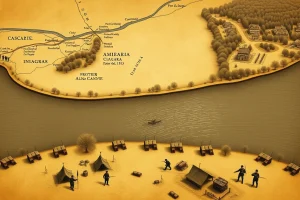
Fort George stood on the west bank of the Niagara River, at the point where the river enters Lake Ontario. It faced Fort Niagara on the American side of the river, about 700 metres away. The fort was connected to the town of Niagara (now Niagara-on-the-Lake) by an open common of nearly a mile. The surrounding country was a mix of cleared farmland, orchards, and woods, with a low plain extending along the lake shore where the American landing occurred. The fort’s position protected the strategic Niagara Portage route, which linked Lake Ontario and Lake Erie and was a main artery for trade and military movement.
Modern Location
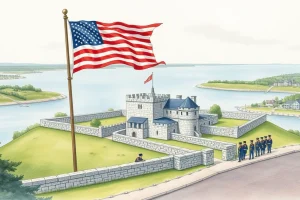
The site of Fort George is in the town of Niagara-on-the-Lake, Ontario, Canada, approximately 25 kilometres north of Niagara Falls. It is administered by Parks Canada as Fort George National Historic Site. The modern property includes a reconstruction of the fort as it appeared during the War of 1812, along with the original stone powder magazine. The battlefield of Fort George, where the landing occurred, is located about 3 kilometres northwest of the fort near Lake Ontario and is commemorated by a cairn.
Events at the Site
In addition to the May 1813 battle and the subsequent seven-month American occupation, Fort George was the site of several other significant wartime events. It was the headquarters from which Isaac Brock launched his successful operation against Detroit in 1812. After his death at Queenston Heights, Brock was initially buried in one of the fort’s earthen bastions before his remains were moved to Brock’s Monument. The fort also witnessed the December 1813 American retreat and the burning of the neighboring town. The spring of 1814 saw reconstruction efforts as the British prepared for further campaigning, although Fort George was never attacked again after the Americans returned to the Niagara front that summer.
Associated People
Key military figures connected with Fort George include Major General Isaac Brock, who commanded British forces in Upper Canada and used the fort as his base; Brigadier General John Vincent, who commanded the Centre Division at the time of the battle and led the withdrawal to Burlington Heights; Major General Henry Dearborn, the American commander who planned the 1813 offensive; and Colonel Winfield Scott, who led the American assault landing. Commodore Isaac Chauncey, commander of the American naval squadron on Lake Ontario, directed the bombardment on 25 May. Sir George Prevost, as governor general and commander of British forces in Canada, received Vincent’s reports and oversaw the broader conduct of the war. Indigenous warriors from the local First Nations communities, who served as allies of the British, took part in the fighting and in the subsequent skirmishes around the fort.
Surviving Monuments and Site
Fort George National Historic Site, declared a National Historic Site in 1921, preserves the fort’s earthworks and several rebuilt structures. Reconstruction work, guided by original Royal Engineers’ plans, took place from 1937 to 1941 and transformed the fort into a living history museum. Parks Canada has managed the site since 1969, with staff dressed in period costume and offering interpretive programs. The original stone powder magazine, completed around 1799, survived the 1813 bombardment and remains the only intact original building. A cairn with a plaque added in 1923 marks the northeast corner of the Battle of Fort George site, near Lake Ontario, about 3 kilometres from the fort; the battlefield itself is not open to the public.
Primary Sources
A valuable early account of the battle is Ernest Cruikshank’s Battle of Fort George, read before the Niagara Historical Society on 14 March 1896 and published the same year. Cruikshank, a Canadian military historian, drew on British and American official reports and compiled a detailed narrative of the events of 25–27 May 1813, including Vincent’s report to Prevost and American correspondence. The report by Major General John Vincent to Sir George Prevost, dated after the battle, is a key primary document that describes the British withdrawal and the impact of American naval gunfire. American official reports from Dearborn and Scott, along with correspondence preserved in the National Archives of the United States, provide the American view. One important limitation of these sources is that they were written by participants with personal and national stakes in the outcome; casualty figures and descriptions of tactics therefore vary. The original documents are held by institutions such as the Library and Archives of Canada and the U.S. National Archives.
Further Reading
- Ernest Cruikshank, Battle of Fort George (Niagara Historical Society, 1896; available via Project Gutenberg).
- J. Mackay Hitsman, The Incredible War of 1812, revised by Donald E. Graves (Toronto: Robin Brass Studio, 1999).
- Yvon Desloges, Structural History of Fort George, History and Archaeology 3 (Parks Canada, 1980).
- Ronald J. Dale, ‘Fort George National Historic Site of Canada,’ The Canadian Encyclopedia (2011).
- James H. Marsh, ‘Battle of Fort George,’ The Canadian Encyclopedia (2011).
References
- James H. Marsh, ‘Battle of Fort George,’ The Canadian Encyclopedia, https://thecanadianencyclopedia.ca/en/article/battle-of-fort-george.
- Ronald J. Dale, ‘Fort George National Historic Site of Canada,’ The Canadian Encyclopedia, https://thecanadianencyclopedia.ca/en/article/fort-george-national-historic-site-of-canada.
- Ernest Cruikshank, Battle of Fort George (Niagara, 1896), Project Gutenberg, https://gutenberg.org/files/33621/33621-h/33621-h.htm.
- Yvon Desloges, Structural History of Fort George, History and Archaeology 3 (Parks Canada, 1980), http://parkscanadahistory.com/series/ha/3.pdf.
- ‘Battle of Fort George, 25-27 May 1813,’ HistoryOfWar.org, https://www.historyofwar.org/articles/battles_fort_george.html.
FAQ
When was Fort George built?
The British army constructed Fort George between 1796 and 1799 after evacuating Fort Niagara under Jay's Treaty. It became the headquarters of British forces in Upper Canada by 1802.
Why did the Americans attack Fort George in 1813?
Fort George was a key objective in the American 1813 campaign, part of a plan to capture York and Fort George before moving against Kingston. Capturing the fort was intended to secure American control of the Niagara frontier and open a route into Upper Canada.
What happened after the Americans captured Fort George in May 1813?
The Americans occupied the fort for seven months, but failed to destroy Vincent's army, which regrouped at Burlington Heights. American defeats at Stoney Creek and Beaver Dams in June 1813 left the fort isolated. The Americans evacuated Fort George on 10 December 1813, burning the nearby town as they left.


Leave a Reply