
Short Answer
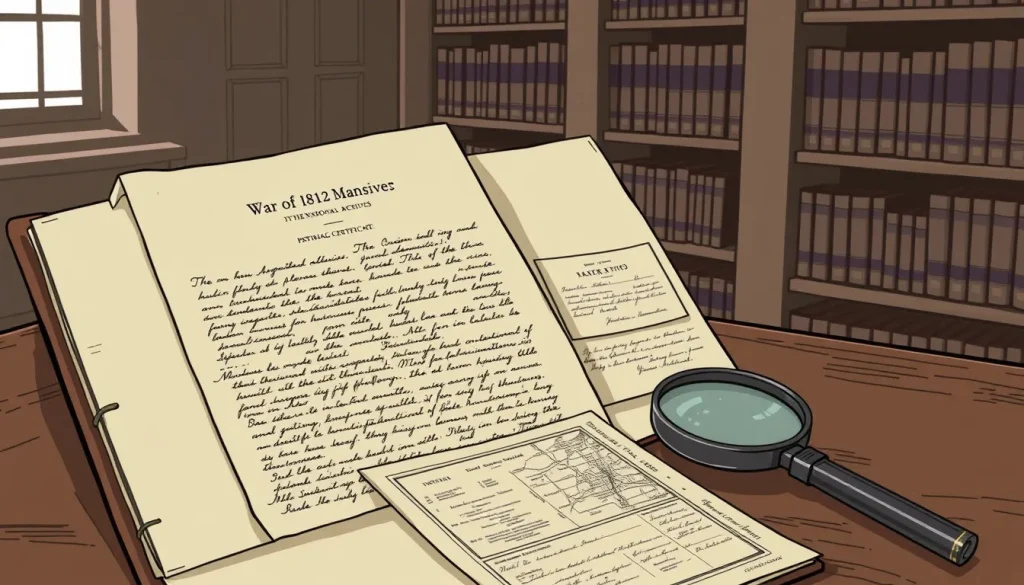
War of 1812 pension records are surviving federal application files created when veterans, widows, and heirs sought pensions under acts passed in the late nineteenth century. These files often contain service details, family relationships, and personal documents that make them a cornerstone of genealogical and historical research. The records span the period of the war (1812–1815) and its aftermath, documenting the soldiers, sailors, and families connected to the conflict.
Historical Context
The War of 1812 (1812–1815) was fought between the United States and Great Britain, with Indigenous nations playing significant roles. After the war, the U.S. government gradually developed a system of military pensions and bounty land grants. Early pension laws, from 1813 onward, provided benefits only for service-connected disability or death. The General Pension Act of 1871 and the act of 1878 extended pensions to veterans and widows based on service alone, opening the door for nearly 100,000 applications. Bounty land warrants, authorized by acts from 1811 to 1855, rewarded service with land. The pension and bounty land application files, preserved in Record Group 15 at the National Archives, are the result of these programs.
What Happened
Between 1812 and 1815, the U.S. raised volunteer militia and regular army regiments. Pension acts of 1813, 1816, and later years initially provided disability pensions. The pivotal change came with the act of February 14, 1871 (16 Stat. 411), which granted pensions to any surviving honorably discharged veteran who had served at least 60 days, and to widows of such veterans if the marriage predated the Treaty of Ghent ratification (February 17, 1815). The act of March 9, 1878 (20 Stat. 27) reduced the service requirement to 14 days or any engagement and removed the marriage date restriction. Under these acts, more than 100,000 applications were filed. The National Archives and Records Administration (NARA) created an index to these files (Microfilm M313) and, beginning in 2015, partnered with genealogical organizations to digitize the files. As of 2024, about 86% of the records have been digitized.
Why It Matters
These records are invaluable because they preserve the only detailed evidence of service for many soldiers, since regular military records were often incomplete or lost. Applications required stringent proof: affidavits from fellow soldiers, family Bibles, marriage certificates, and death records. Widows had to prove their marriages and the veteran’s death. As a result, the files provide names of children, maiden names of wives, family relationships, residences, physical descriptions, and service histories. They are essential for genealogists and historians studying military participation, family dynamics, and the postwar lives of veterans.
Definition
War of 1812 pension records are application files submitted by veterans, their widows, and sometimes heirs to obtain federal military pensions or bounty land warrants based on service during the War of 1812. They include the application forms, supporting documents, and government correspondence, and are part of the Records of the Veterans Administration (Record Group 15) at the National Archives.
Background
The U.S. established pensions for Revolutionary War veterans in 1818, and similar provisions were extended to War of 1812 veterans through acts of 1813 and 1816. However, these early pensions applied only to disability or death in service. Bounty land warrants were authorized by acts of 1811, 1812, and later, rewarding service with land. The first service-based pension for the War of 1812 came with the act of 1871, and the act of 1878 expanded eligibility. These late-nineteenth-century acts generated the bulk of the pension files, as veterans and widows were then elderly or deceased.
How It Worked
Applicants submitted a claim to the Pension Office, providing proof of service (such as dates, unit, rank) and, for widows, proof of marriage. The Adjutant General and auditors verified service against muster rolls and compiled service records. The file was then marked as approved or rejected. Application files were consolidated per veteran, so a widow’s claim might be combined with the veteran’s. Files include affidavits from comrades, family records, and sometimes photographs. The index to these files (M313) is arranged alphabetically by veteran’s name, with cross-references for alternate spellings and substitutes. The files are available on microfilm and, increasingly, online through Fold3, FamilySearch, Ancestry, and the National Archives Catalog.
Competing Viewpoints
Scholars and genealogists debate the reliability of pension records. Some argue that because they were created decades after the war, memories could be faulty, and applicants might exaggerate service. Others note that the government verification process served as a check, and the supporting documentation often provides primary evidence. There is also discussion about the completeness of the records: not all veterans applied, and some applications were denied. Thus the files represent a subset of all participants, with a bias toward those who survived to old age or whose widows pursued benefits.
Role in the War of 1812
Pension records are not contemporary to the war itself but are retrospective records that document its participants. They capture the names of hundreds of thousands of regular soldiers, militia volunteers, and naval personnel, often including African American and Indigenous individuals who served. They also provide evidence of civilian contributions, such as witnesses’ affidavits. These records are essential for reconstructing the social and demographic history of the war, as well as for commemorating individual service.
Consequences and Historical Interpretation
Pension records have shaped historical understanding by allowing researchers to trace soldiers’ lives after the conflict, their migrations (often westward), and family structures. They have been used to study the demographics of the army, pension policy, and the long-term fiscal impact of the war. The records also highlight the changing nature of veterans’ benefits over the nineteenth century. Their digitization has made them widely accessible, spurring new genealogical and historical research.
Primary Sources
The most important primary sources are the War of 1812 pension and bounty land warrant application files at the National Archives, indexed in M313, Index to War of 1812 Pension Application Files. Other related sources include compiled military service records (M602), the General Land Office bounty land patents, and the “Old Wars” application files. The National Archives has published a guide, and the files themselves contain affidavits, certificates, and family documents. Researchers must distinguish between the summaries on file envelopes and the more detailed contents within.
Further Reading
- FamilySearch Blog: “How to Use War of 1812 Pension Files” (2018).
- National Archives guide: “Pre-World War I U.S. Army Pension and Bounty Land Applications.”
- Claire Kluskens, “War of 1812 Military Service, Bounty Land, and Pension Records” (2020).
- Fold3 Blog: “What Can You Learn From the War of 1812 Pension Files” (2024).
References
- FamilySearch. “How to Use War of 1812 Pension Files.” June 13, 2018. https://www.familysearch.org/en/blog/how-to-use-war-of-1812-pension-files.
- National Archives and Records Administration. “Pre-World War I U.S. Army Pension and Bounty Land Applications.” https://www.archives.gov/research/military/army/pensions.
- National Archives and Records Administration. “Publication Number: M-313, Index to War of 1812 Pension Application Files.” https://www.archives.gov/files/research/military/army/dc/m313.pdf.
- Ashcraft, Jenny. “What Can You Learn From the War of 1812 Pension Files.” Fold3 HQ, April 15, 2024. https://www.fold3.com/blog/what-can-you-learn-from-the-war-of-1812-pension-files/.
- Kluskens, Claire. “War of 1812 Military Service, Bounty Land, and Pension Records.” National Archives, 2020. https://twelvekey.com/wp-content/uploads/2020/05/war_of_1812_basic_guide_2020_05_19.pdf.
FAQ
Who can apply for a War of 1812 pension?
Veterans who served at least 60 days under the 1871 act, or at least 14 days under the 1878 act, and widows of such veterans under certain conditions.
What kind of information is in a pension file?
Pension files typically contain the veteran's service details, age, residence, and often family information including marriage dates, children's names, and supporting affidavits.
How can I access War of 1812 pension records?
The files are available at the National Archives in Washington, D.C., and many have been digitized and are accessible online through Fold3, FamilySearch, and Ancestry.


Leave a Reply