Short Answer
Contemporary accounts of the burning of Washington in August 1814 comprise the letters, newspaper reports, military reports, and later memoirs written by individuals who witnessed or participated in the British attack on the American capital. These sources are essential for reconstructing the events and for understanding how contemporaries on both sides explained and justified the destruction. They reveal deep divergences in perspective, shaped by nationalism, military discipline, and personal experience, and they remain the basis for all later historical narratives.
Historical Context
In the summer of 1814, with the Napoleonic War ending in Europe, Britain turned its full military attention to the War of 1812. Admiral Alexander Cochrane commanded the North American station, and Major General Robert Ross led a veteran army recently released from Wellington’s Peninsular campaign. The Chesapeake Bay offered a vulnerable artery for attacking the United States’ young capital. The American government, caught between political division and military unpreparedness, had only scattered militia and a small regular force under Brigadier General William Winder to oppose an invasion aimed at reducing American morale. The British objective was not merely to seize territory but to punish the United States for its declaration of war and to force favorable peace terms.
What Happened
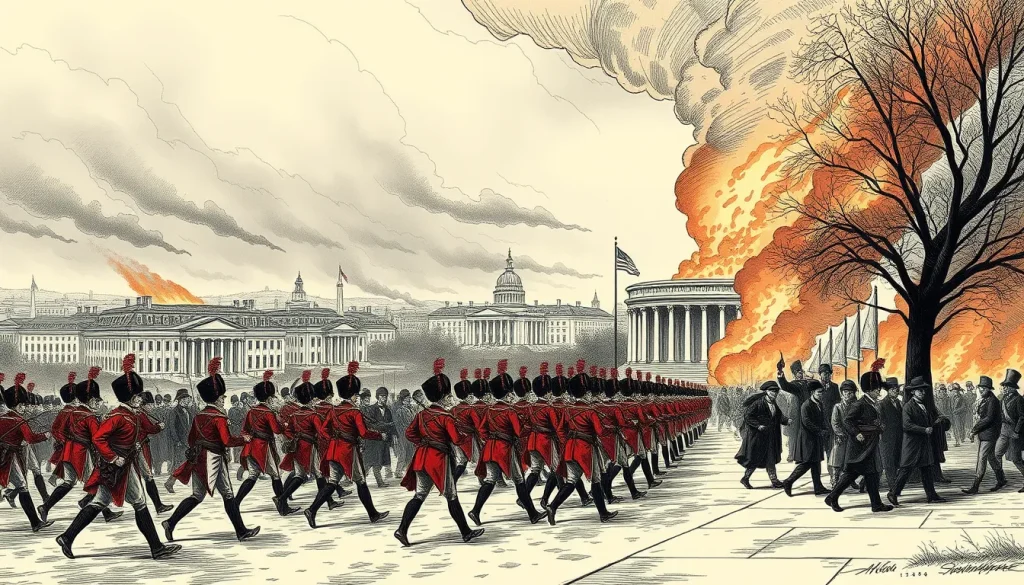
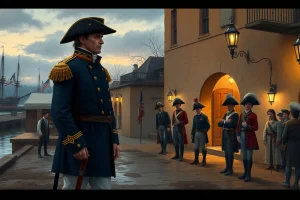
On August 19, 1814, a British force of about 4,500 soldiers and sailors landed at Benedict, Maryland, on the Patuxent River. They marched toward Washington, skirmishing with American militia along the way. On August 24, a hastily assembled American army, numbering around 7,000, was driven from its position at Bladensburg, Maryland, after a brief but decisive engagement. President James Madison, his cabinet, and most of the military fled. The British entered Washington that evening and set fire to the Capitol, the President’s House, the Treasury, and other public buildings. The American military burned the Washington Navy Yard to prevent its capture. A severe thunderstorm that night extinguished some fires but also compounded the chaos. The British occupation lasted roughly 24 hours before they withdrew, fearing an American counterattack and recognizing that their strategic objective—the destruction of government property—had been achieved.
Why It Matters
The burning of Washington shocked Americans and was seen as a national humiliation. It had immediate political consequences, including the resignation of Secretary of War John Armstrong. Strategically, it demonstrated Britain’s ability to strike at the heart of the United States and contributed to the subsequent British attack on Baltimore, which proved more costly. Over the long term, the event became a symbol of the war’s unpredictability and of American resilience. Contemporary accounts matter because they capture the raw emotions, the confusion, and the competing narratives that shaped public memory. They also provide the evidential substrate for historians to evaluate responsibility, conduct, and the nature of the conflict.
Definition
In historical usage, “contemporary accounts” refer to documents created during or shortly after an event by people who experienced it or had access to immediate information. For the burning of Washington, these include military orders and reports, private letters, newspaper articles, diary entries, and later autobiographies written by participants. They are distinct from retrospective histories written decades afterwards.
Background
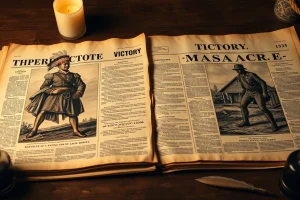
Because the War of 1812 was a limited conflict, many participants, especially officers, were literate and expected to report to superiors or to the public. The British army maintained a tradition of after-action reports; the American government likewise required official returns. Newspaper editors, hungry for war news, published letters from soldiers and civilians, often without rigorous verification. The political atmosphere of 1814—Federalists denouncing the war, Republicans defending it—infused many accounts with polemical energy.
How It Worked
Contemporary accounts were produced through several channels. Military officers submitted written reports to their commands; these might be published or leaked. Soldiers and sailors wrote home, and letters were frequently printed in local newspapers with editorial commentary. Civilians in Washington and nearby Alexandria recorded the terror and confusion in letters to relatives and friends. British officers like Captain George R. Gleig later reworked their wartime journals into memoirs, sometimes decades after the events. The speed of the campaign meant that many American reports were hasty and incomplete, while British accounts benefited from a victor’s confidence.
Competing Viewpoints
British accounts, exemplified by Gleig’s memoir, emphasize the professional execution of the attack, the discipline of the troops, and the provocation caused by American resistance (including alleged firing on a flag of truce). They downplay or justify the destruction of public buildings as legitimate military retaliation. American accounts, such as the anonymous soldier’s letter printed in newspapers, emphasize the confusion and poor leadership of their own army, the bravery of some units, and the perceived humiliation. They often assign blame to President Madison and Secretary Armstrong. Civilians’ letters, like the one from Alexandria, convey fear and desperation, and sometimes criticize both belligerents. These differing perspectives make it difficult to reconstruct a single, neutral narrative, but they also reveal the contested meanings of the event.
Role in the War of 1812
Contemporary accounts of the burning of Washington served immediate propaganda purposes. British accounts framed the raid as a punitive response to American aggression, while American accounts rallied public opinion against the enemy and fueled demands for revenge. The “Bladensburg Races” became a shorthand for American military incompetence, used by Federalists to attack the administration. The destruction also influenced peace negotiations, as both sides used the event to justify demands or to press for a return to the status quo ante bellum. In England, the news was celebrated as a triumph; in the United States, it intensified the anti-war movement but also encouraged some to continue fighting.
Consequences and Historical Interpretation
Historians have long relied on these contemporary accounts, but they have also interrogated their biases. Later generations used them to evaluate leadership, to assess the morality of the British action (whether it was a war crime or a legitimate act), and to understand the war’s impact on American nationalism. The discrepancies between British and American versions have led modern scholars to weigh the reliability of each. For instance, Gleig’s account of the burning is detailed but written years later and colored by hindsight; the anonymous American soldier’s letter is immediate but partisan. The Raleigh newspaper letter provides a civilian perspective but reflects a Southern regional viewpoint. By comparing multiple accounts, historians can reconstruct the main outlines of the event while acknowledging the gaps and contradictions.
Primary Sources
The most relevant contemporary documents include:
- Captain George R. Gleig’s memoir (first published 1821): a British officer’s detailed narrative of the Chesapeake Campaign, including the Battle of Bladensburg and the burning of Washington. Available at American Battlefield Trust and Library of America. Bias: British, officer, retrospective.
- Extract of a letter dated Alexandria, August 26, 1814, printed in The Star (Raleigh, NC) on September 2, 1814: provides a civilian American view of the aftermath, including the burning of the navy yard and the occupation. Bias: civilian, panic, regional newspaper.
- Anonymous American soldier’s letter dated Washington, August 29, 1814, published in multiple newspapers (e.g., United States Gazette): offers a critical view of American leadership and a description of the retreat and destruction. Bias: soldier on the losing side, possibly censored by editor.
- Dolley Madison’s letter to her sister, August 23, 1814 (not included in the provided sources but a well-known primary source): a first-hand account of the flight from the President’s House, available at the Library of Congress. Bias: personal, dramatic.
Further Reading
- Pitch, Anthony. The Burning of Washington: The British Invasion of 1814. Naval Institute Press, 2000.
- Hickey, Donald R. The War of 1812: A Forgotten Conflict. University of Illinois Press, 1989.
- Library of America. The War of 1812: Writings from America’s Second War of Independence. Edited by Donald R. Hickey. 2013.
- Vogel, Steve. “Five myths about the burning of Washington,” The Washington Post, August 22, 2014.
- American Battlefield Trust. “War of 1812: ‘To the Inhabitants of Washington…A Night of Terror and Dismay’” and “War of 1812: ‘The city was left a prey to the invaders’.”
References
- American Battlefield Trust. “War of 1812: ‘To the Inhabitants of Washington…A Night of Terror and Dismay’.” https://www.battlefields.org/learn/primary-sources/war-1812-inhabitants-washington-night-terror-and-dismay
- American Battlefield Trust. “War of 1812: ‘The city was left a prey to the invaders’.” https://www.battlefields.org/learn/primary-sources/war-1812-city-was-left-prey-invaders
- History Central. “The Burning Of Washington [1814] By Richard Hildreth.” https://historycentral.com/documents/BurningWash.html
- ANCHOR. “Primary Source: The Burning of Washington.” https://www.ncanchor.org/anchor/primary-source-burning
- Library of America. “Story of the Week: Storming the Capital.” https://storyoftheweek.loa.org/2014/08/storming-capital.html
FAQ
What are the most important contemporary accounts of the burning of Washington?
Key accounts include Captain George R. Gleig's memoir (a British officer), an anonymous American soldier's letter published in newspapers, and a civilian letter from Alexandria printed in the Raleigh Star. These provide British, American military, and civilian perspectives.
How reliable are contemporary accounts of the burning of Washington?
Each account has biases based on nationality, rank, and timing. Official reports may be sanitized, letters emotional, and memoirs retrospective. Historians compare multiple sources to reach a balanced view.
Why did the British burn Washington, according to contemporaries?
British officers stated it was retaliation for American destruction and resistance, and a demonstration of power. American accounts often emphasized wanton destruction and British cruelty. Both sides used the event for propaganda.
Leave a Reply